
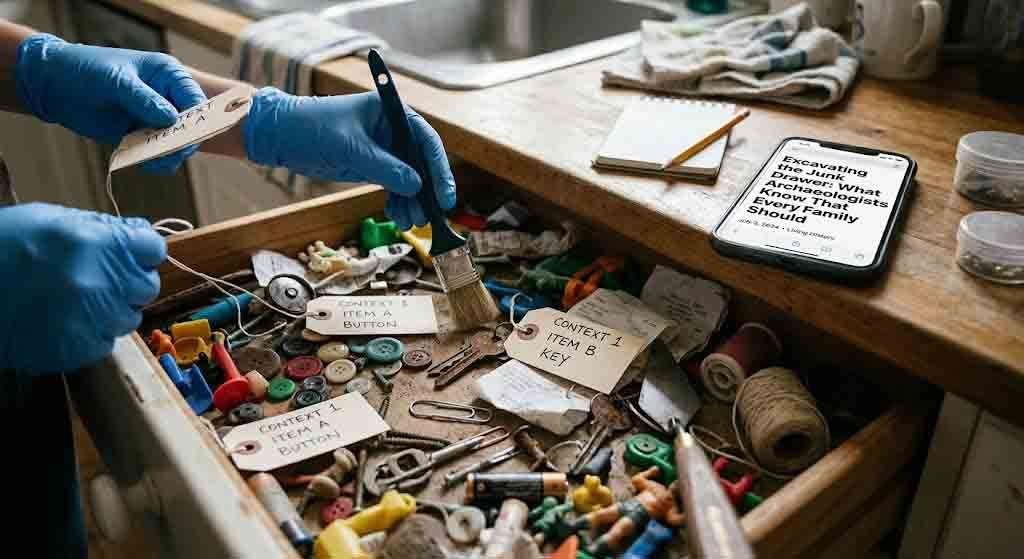
Pull open that drawer — the one in the kitchen, or next to the front door, or tucked into the sideboard nobody quite has a name for. You know the one. The scissors with one broken handle. A flattened takeout menu from a restaurant that closed three years ago. A birthday candle, half-used. A key with no known lock. A child’s drawing folded so many times the crayon lines have started to crack.
Professional archaeologists have a word for what lies in there: an assemblage — a collection of objects from a single context, recovered and studied together to reconstruct the life of a people in a particular place and time. They would approach it with a grid, a field notebook, and a systematic hand — recording not just the objects themselves but their provenience, which in archaeological practice means the three-dimensional position of each find within the site. Where it was. What it was touching. What layer it came from.
Most families never treat their own material culture this way. They should.
The habits of the discipline — documentation, context, careful handling, systematic inquiry — are not arcane professional tools. They are portable frameworks for teaching children how the world actually works: that objects carry stories, that things without records eventually lose their meaning, and that the act of asking where did this come from? is among the most powerful questions a curious mind can form.
What Archaeologists Actually Do (And Why It Looks Like Your Attic)
The discipline of archaeology is, at its core, the science of what people leave behind. From Pompeii’s frozen kitchens to the indigenous middens of coastal Long Island, the record of human life is embedded in objects — their material, their condition, their position relative to everything else in the ground.
Professional excavations begin not with shovels but with documentation. Before a single artifact is lifted, the site is divided into a grid and every surface feature is photographed, drawn, and described. As the dig proceeds, the team records not only what is found but exactly where — down to the centimeter, in three dimensions. Each object is bagged, tagged with its provenience, and catalogued in a field notebook before it ever reaches a lab.
The reason for this apparent obsession with paperwork is simple: excavation is a destructive process. Once you disturb the ground, the original context is gone forever. An artifact without its context is interesting. An artifact with its context is evidence. The difference is the difference between a pretty old coin and a window into a civilization’s trade routes.
What this means for the family junk drawer — or the attic box, or the closet shelf where three generations of miscellany have accumulated — is that the same principle applies in miniature. A hand-painted Christmas ornament found loose in a shoebox is touching. That same ornament, documented with a note in a child’s handwriting that reads “Great-grandma Eleni brought this from Salonika, 1951”, is something else entirely. It is evidence. It is provenance. It is alive.
The Concept of Provenance and Why It Belongs at the Kitchen Table
In museum practice, provenance refers to the documented history of an object — past owners, places, and the chain of custody from creation to the present. The Brooklyn Museum defines it as “the history of a work following its creation, including past owners or caretakers and how it changed hands over time and from place to place.” Provenance research can determine a work’s authenticity, its cultural significance, and whether it should be returned to its original community.
In the home, provenance is almost never formally recorded — and so it evaporates. The grandmother who knew the story dies. The grandchildren inherit a drawer full of objects whose silence grows deeper with every passing year. The meaning that was once vivid and communal becomes opaque and private, and finally disappears entirely.
Children are the natural fixers of this problem, if given the right framework. Research consistently shows that hands-on engagement with objects awakens historical curiosity in young people in ways that textbooks rarely do. A 2022 study published in Teacher Learning found that when children were allowed to physically handle objects from the past, “the objects were genuinely doing things to the pupils” — awakening “historical curiosity and imaginative sense of the past.” The gap in information — who owned this? where did it come from? — didn’t discourage children; it prompted hypotheses, speculation, and narrative construction. The mystery, in other words, was the lesson.
When a family treats its own objects with the same investigative attitude that archaeologists bring to an ancient site, children learn that history is not something that happened to other people in distant centuries. History is the drawer in the kitchen. History is the object your great-uncle brought back from somewhere he never quite explained. History is here, and it is waiting to be recorded before it becomes unknowable.
The Active Site: Treating Your Home as an Excavation
Applying archaeological methodology to domestic collections doesn’t require a trowel or a research permit. It requires documentation tools most households already have — a phone camera, a notebook, some index cards or a simple digital spreadsheet — and a willingness to slow down and ask questions.
The core practices translate directly from field archaeology to home archaeology:
Survey before you disturb. Before sorting, cleaning, or discarding anything, photograph the collection as you find it. The original arrangement — even a chaotic one — is itself data. Archaeologists call this in situ documentation: recording the object in its undisturbed position before it is moved. A photograph of the drawer as it exists today is a document. Years from now, it will be evidence of how your family actually lived.
Record provenance for every object you can. This is the most important habit, and the one most families skip. For each item with a known story, write it down: who owned it, where it came from, when it entered the household, and what it was used for. The Library of Congress’s Family History preservation resources recommend labeling materials with “as much information as possible including dates, events, people, locations” — noting that even objects with writing on them should have their inscriptions documented separately, in case the inscription becomes illegible over time.
Catalogue systematically. Archaeologists assign each recovered artifact an accession number and enter it into a database along with its physical description, material, condition, and provenience. At home, this doesn’t need to be formal — a shared Google Sheet, a physical index card box, or even a dedicated notes app on a phone will do. The discipline of the practice matters more than the sophistication of the system. What you’re building is a record that can be read by someone who wasn’t there.
Invite children into the process as active investigators, not passive observers. The Historical Association in the UK recommends giving children specific inquiry questions to anchor their engagement with objects — What is this made of? Who might have used it? What does it tell us about where we came from? The goal is not to transfer information but to model a habit of mind: that objects are not mute, that they reward attention, and that the act of asking why is the beginning of understanding.
The Stratigraphy of Memory
In archaeological excavation, stratigraphy refers to the layering of soil deposits over time — the deeper you go, the further back you travel. Each layer represents a distinct period of human activity, and the boundaries between layers mark transitions: a flood, a fire, the abandonment of a settlement, the arrival of a new people.
Domestic collections have their own stratigraphy. The bottom of the junk drawer is often older than the top. Attic boxes tend to preserve deeper layers of family history than kitchen shelves. A child who learns to read this layering — to notice that the photographs in the bottom of a shoebox are more faded, the handwriting more formal, the clothing in the images more distant from anything they recognize — is learning to think temporally. They are learning that the present is a layer too, accumulating on top of everything that came before, and that one day it will be the past for someone else.
This is not a lesson that can be taught abstractly. It has to be felt, through the handling of actual objects that carry actual time in their wear patterns, their material degradation, and the stories attached to them.
Philosopher and psychologist William James described curiosity as “the impulse towards better cognition” — the desire to understand what one knows one does not yet know. Research published in Neuron (Gruber, Gelman & Ranganath, 2014) has since demonstrated that curiosity states activated by gaps in knowledge enhance hippocampus-dependent learning through the dopaminergic circuit — meaning that the not-knowing itself, properly channeled, makes the eventual learning deeper and more durable. The unanswered question about the key with no known lock, held in a child’s hand, is a more powerful learning instrument than any worksheet.
Building the Family Archive: Tools and Practices That Last
A family archive is not a museum. It does not need climate-controlled storage or acid-free archival sleeves, though the Canadian Conservation Institute notes that controlling temperature and humidity significantly extends the life of organic materials like leather, paper, and textiles. What a family archive needs, above all else, is intention — the decision to treat family material culture as something worth recording.
San Diego State University’s library guidance on family history archiving suggests organizing materials in ways that “contribute to the meaning of the archive” — by type, date, event, or family line — and discussing succession plans explicitly: who will care for the collection, what will be donated, what should be preserved above all else.
For families beginning this process with children, a few practical approaches build both the archive and the habit of historical thinking simultaneously:
The Object Interview. Assign each child an object from the family collection. Their task is to interview every living family member who might know something about it, recording what they learn. The object becomes a thread pulled through the generations, and the child becomes the archivist.
The Provenance Card. Create a simple index card for each significant object: name, estimated date, material, condition, known history, and the name of the family member who provided the information. File these with the objects or digitize them. When the object eventually passes to the next generation, the card travels with it.
The In Situ Photograph. Before any major sort or reorganization of a collection, document it as found. This takes ten minutes and creates an irreplaceable record.
The Accession Log. When a new object enters the family collection — an inheritance, a gift, a flea market find — it gets logged immediately. Who brought it in. Where it came from. What is known. What is not.
These practices are simple enough for a child to execute, rigorous enough to produce a genuine archive, and meaningful enough to be worth doing. The Northeast Document Conservation Center, through the Library of Congress, offers free preservation guidance for private family collections at https://www.nedcc.org — a resource designed precisely for non-professionals who want to take family material culture seriously.
The Ethics of What Gets Kept
Every archaeologist confronts the ethics of selection: not everything can be preserved, not everything should be, and the choices made in the field determine what survives for future scholarship. Professional practice now requires explicit justification for what is documented and what is deliberately omitted — and why.
Families face the same question every time they sort through an attic. The impulse to discard is not wrong; it is part of a necessary curation. But the act of discarding without documentation is the permanent loss of context. The responsible approach — taught to children not as a burden but as a skill — is to photograph and briefly note an object before it leaves the collection, even if it is being donated or thrown away. The record of what a family chose to let go is itself historical data.
A 2018 research paper in the Journal of Contemporary Archaeology formalized this thinking in what the author called “The Junk Drawer Project” — applying professional archaeological field photography to contemporary American home assemblages to examine how domestic objects carry meaning that is invisible until it is systematically examined. The methodology confirmed what most families sense intuitively: that the mundane objects of everyday life carry encoded information about who people were, what they valued, and how they understood the world around them.
The junk drawer is an active site. The attic is a stratified deposit. The family is the excavation team, and the children, given proper tools and the right questions, are among the most capable investigators in the house.
Sources
- Brooklyn Museum. Provenance. https://www.brooklynmuseum.org/research/provenance
- Canadian Conservation Institute. Caring for Archaeological Collections. Government of Canada. https://www.canada.ca/en/conservation-institute/services/preventive-conservation/guidelines-collections/archaeological-collections.html
- Gruber, M., Gelman, B., & Ranganath, C. (2014). “States of Curiosity Modulate Hippocampus-Dependent Learning via the Dopaminergic Circuit.” Neuron, 84(2), 486–496. https://doi.org/10.1016/j.neuron.2014.08.060
- Library of Congress. Preserving Family Documents, Artifacts and More. https://guides.loc.gov/family-history-for-kids/preservation
- National Park Service. Archeological Documentation Guidelines. https://www.nps.gov/articles/sec-standards-archeo-doc-guidelines.htm
- San Diego State University Library. Family History Archiving. https://libguides.sdsu.edu/c.php?g=1166513
- Stevens, M., et al. (2003). Cited in: We Are What We Keep: The “Family Archive”, Identity and Public/Private Heritage. Journal of Contemporary Archaeology. https://www.tandfonline.com/doi/full/10.1080/2159032X.2018.1554405
- Teacher Learning. “Interacting with Objects and History.” (2022). https://teacherlearning.org/interacting-with-objects-and-history/
- The Junk Drawer Project. Journal of Contemporary Archaeology. Equinox Publishing. https://journal.equinoxpub.com/JCA/article/view/9818
- Northeast Document Conservation Center (NEDCC). Caring for Private and Family Collections. https://www.nedcc.org
