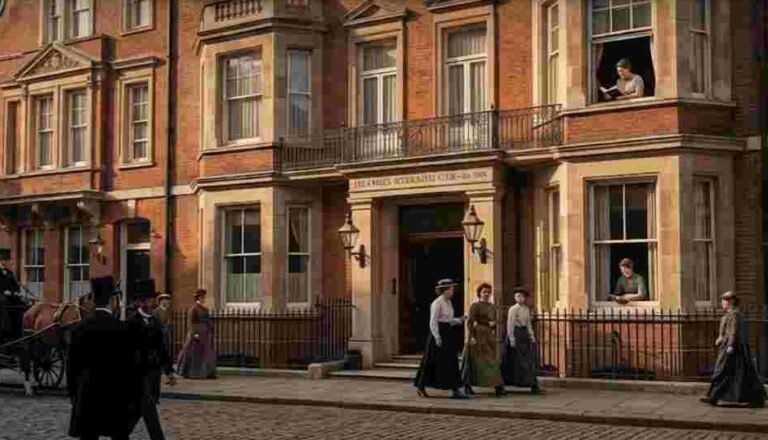
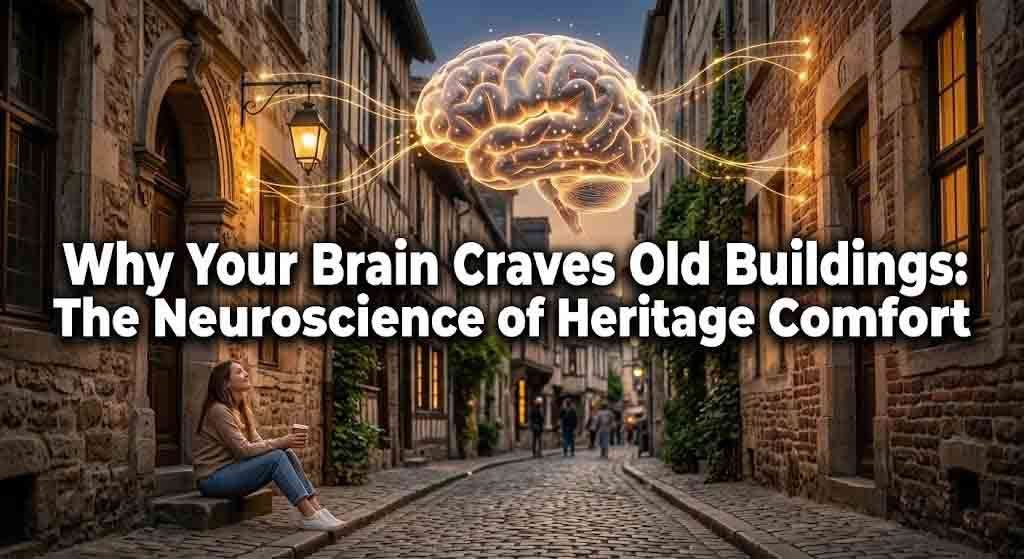
Walk into a room lined with aged oak, lime plaster, and worn stone — and something happens before you even take a seat. Your shoulders drop. Your breathing slows. The background noise of the day fades. You didn’t decide to feel this way. Your nervous system did it for you.
This is not nostalgia, and it is not sentiment. It is neuroscience. A growing body of research is confirming what architects, innkeepers, and philosophers have long suspected: the human brain responds measurably, physiologically, and positively to environments built with heritage materials, historical texture, and the kind of imperfect warmth that modern design has spent decades trying to sand away. Researchers now call this phenomenon neuro-comfort — and its implications for how we build, live, and gather are profound.
The Sterile Trap: What “Cleanical” Design Does to the Brain
The past two decades gave rise to what design critics have begun calling “cleanical” spaces — environments that prioritize frictionless surfaces, cold minimalism, and material uniformity. Glass, poured concrete, brushed steel, and stark white walls became the signature vocabulary of modernity, from open-plan offices to upscale restaurants to hospital waiting rooms. The aesthetic communicated progress, hygiene, and efficiency.
What it did not communicate to the human nervous system was safety.
Neuroarchitecture — the discipline that integrates neuroscience, environmental psychology, and spatial design — has documented how the built environment directly modulates brain activity. Research published in Frontiers in Medicine (2025) describes how architectural features influence specific brain structures: the amygdala (the brain’s threat-detection center), the prefrontal cortex (governing rational thought and executive function), and the hypothalamic-pituitary-adrenal (HPA) axis — the body’s primary stress-response system. Sterile, featureless environments tend to keep these systems alert. The brain, trained by millions of years of evolution to interpret visual and tactile complexity as richness — as resources, shelter, community — finds emptiness ambiguous. Ambiguity triggers vigilance. Vigilance raises cortisol.
The contrast with heritage environments is not stylistic. It is biological.
Stone, Wood, and the Nervous System: Why Old Materials Calm the Brain
The human brain did not evolve in drywall-and-fluorescent settings. It evolved outdoors, in forests, in caves, beside rivers, and eventually in structures built from earth, timber, clay, and stone — materials that were warm, varied, and alive with texture. The biophilia hypothesis, first proposed by biologist E.O. Wilson in 1984, argues that humans carry an innate affinity for natural forms and materials. Decades of research have since transformed this from a compelling theory into clinical evidence.
A 2025 study published in Frontiers of the Built Environment reviewed biophilic hospital design data spanning 2010 to 2023 and found that environments incorporating natural materials and heritage textures consistently reduced patient stress, shortened hospitalization time, and lowered mortality rates. These are not soft metrics. These are clinical outcomes. Natural materials — aged wood, stone, brick, plaster — activate what researchers call the brain’s “restorative response,” measurably lowering salivary cortisol levels, reducing anxiety markers, and improving mood (Global Wellness Institute, 2025).
The mechanism is tied to what psychologists call Attention Restoration Theory, developed by Rachel and Stephen Kaplan at the University of Michigan. The theory holds that environments rich in what the Kaplans call “soft fascination” — irregular patterns, varied textures, organic complexity — allow the prefrontal cortex to recover from the directed-attention fatigue caused by modern life. Heritage textures provide exactly this kind of restorative stimulus. A rough-hewn beam, a lime-washed wall, an aged brick facade — these are not uniform. They require no concentration, yet they engage. They restore rather than deplete.
In a study measuring visitors’ cortisol levels before and after visiting historic sites, researchers recorded a 40% increase in subjective wellbeing alongside a 60% decrease in stress markers — results attributed specifically to the aesthetic experience of being in heritage spaces (Grossi et al., 2019, cited by Historic England).
Heritage Sites and the Measurable Happiness Effect
The connection between historic environments and community wellbeing is now well-documented enough to carry an economic price tag.
A landmark report by Historic England estimated that the wellbeing value of heritage visits across England amounts to £29 billion annually — not in revenue, but in the measurable improvement to life satisfaction and mental health among citizens who visit, live near, or engage with heritage sites (World Cities Culture Forum, 2024). The same research found that a visit to a local monument, historic park, or listed building can boost happiness and subjective wellbeing by 93% — comparable in effect to visiting one of the Seven Wonders of the World.
A large-scale regression study using data collected between 2010 and 2013 by England’s Taking Part survey found that people who visited heritage sites at least once per year reported happiness scores 1.6% higher than those who did not — a statistically significant margin across a population sample (Historic England). Studies conducted on urban cultural heritage sites using psychophysiological measures confirm that these spaces reduce anxiety, increase pleasant emotional states, and deliver what researchers describe as a “mental break from the city” — even when the city is the context in which the heritage site sits (Lauwers et al., 2021).
What Bhutan recognized long ago and encoded into its Gross National Happiness Index — that culture, heritage, and psychological wellbeing are inextricably linked — Western public health researchers are now beginning to formalize in their own frameworks. California’s public health consortium has included cultural engagement as one of its 20 community health indicators (Landmarks Illinois, 2023). Heritage is no longer a soft public good. It is a measurable determinant of community health.
The Brain Finds Meaning in Aging: Place Attachment and Identity
Beyond cortisol and attention restoration, there is a deeper neurological dynamic at work in heritage environments: the architecture of memory itself.
Heritage spaces carry what psychologists call place attachment — the emotional bonds that form between people and particular environments. Research published in PMC (2024) explains that place attachment is not merely affective; it is identity-forming. Buildings that preserve common memories become symbols of cultural identity for residents, and engagement with those symbols triggers the brain’s reward pathways, producing feelings of belonging, continuity, and security. These are among the most potent buffers against anxiety and depression that human psychology has access to.
A qualitative study using walking interviews to explore how urban spaces affect mental wellbeing found that historical architectural elements specifically contributed to feelings of fascination and relaxation — two states that do not coexist easily but that heritage environments seem uniquely capable of generating together (Lauwers et al., 2021, cited in Historic England). The brain recognizes patina — the wear of time on stone, the darkening of oak, the crazing of old tile — not as decay, but as evidence of continuity. Something that has endured tells the nervous system that this is a place worth trusting.
This is what the research literature describes as ontological security: the deep, pre-cognitive sense that existence is stable, ordered, and meaningful. A 2022 study examining how people used heritage sites during the first UK COVID-19 lockdown found that these places provided exactly this — offering “relaxing, stress-reducing, and hedonic effects” alongside what researchers called “ontological security and life purpose effects” (Gallou et al., 2022, cited in Historic England). At the height of civilizational disruption, people sought out old buildings to feel grounded.
Neuro-Comfort as a Design Philosophy: The Industry Responds
The design world is catching up to what the neuroscience has been documenting. A 2026 trend report from Wimberly Interiors — one of the most influential voices in global hospitality design — identified a formal shift away from visual spectacle toward what they call “emotional resonance and resilience.” The defining characteristics of this movement are telling: a preference for materials that patina and age gracefully, including honed stone, cork, and leather; hyper-localization through vernacular architecture and regional materials; and holistic wellness integration built into the architectural fabric, not cordoned off in spa annexes (Wimberly Interiors/WATG, 2026).
This is neuro-comfort design formalized into industry practice. It is the recognition that luxury, properly understood, is not the absence of imperfection but the embrace of it. Aged brass over polished chrome. Linen over polyester. Reclaimed timber over engineered wood composite. Not because these materials are merely beautiful — but because the human brain, at a neurological level, finds them safe.
The restaurant industry is feeling this shift acutely. Hospitality design trends for 2025 from Shaw Contract and Hotel Designs note that spaces are “moving beyond flat surfaces in favor of layered textures, sculptural forms, and bold material contrasts” — driven not by aesthetics alone but by the demand for environments that “foster a sense of retreat and restoration” (Shaw Contract, 2025). Texture has returned to fine dining not because the design world ran out of minimalist ideas, but because guests are increasingly requiring something from their environments that bare concrete cannot provide: warmth.
The Paradox of Modern Comfort: Why the “New” Often Feels Empty
Herein lies the central paradox of contemporary interior culture. The environments marketed most aggressively as premium — the gleaming hotel lobby, the spotless open-plan office, the glass-and-steel restaurant — are frequently the environments that the human nervous system finds most fatiguing. They eliminate irregularity. They suppress patina. They mistake uniformity for elegance and restraint for care.
But care, as the neuroscience demonstrates, shows up in texture. In accumulated time. In the slight unevenness of a hand-laid stone floor or the darkened corner of an old bar. These are not flaws the human brain looks past — they are signals it actively reads. They communicate that the environment has been inhabited, that it has history, that it belongs to a community rather than to an aesthetic brief. The brain reads these signals as welcome.
The Harvard neuroscientist Eve Marder has described the nervous system as a pattern-recognition engine perpetually searching for predictive context. Old materials, in their irreducible variety, offer the kind of high-information texture that satisfies this search without triggering alertness. The brain finds them interesting without finding them threatening. This is the physiological definition of comfort.
Sterile modern environments, by contrast, offer too little information. The brain, encountering a surface that is perfectly uniform and unchanging, has nothing to predict. It remains slightly on edge — waiting for a context that never arrives.
What This Means for How We Build, Eat, and Live
The implications of neuro-comfort research reach well beyond interior design theory. They touch every decision about where and how we choose to spend our time — and increasingly, where we choose to invest.
For restaurateurs, the evidence argues for the irreplaceable value of the worn booth, the brick wall, the reclaimed wood table that bears the marks of its previous life. Not as rustic affectation, but as genuine hospitality design rooted in how the human brain actually experiences space. A guest who leaves your restaurant relaxed, grounded, and somehow lighter than when they arrived has not simply been well fed. They have been well-housed. The environment did work on their nervous system that no amount of innovative cuisine can replicate on its own.
For real estate, the research provides a neurological foundation for what buyers often describe in purely emotional terms: the feeling of solidity that older homes carry. Properties near heritage sites, in historic neighborhoods, or built with traditional materials consistently command premium value — and the research now explains why the demand is not irrational. It is neurological. People are drawn to these environments because their brains are wired to trust them.
For community planning, the evidence aligns with a growing public health consensus: the conservation of heritage architecture is not a luxury amenity for the aesthetically inclined. It is a public health infrastructure. Historic England’s valuation of heritage wellbeing at £29 billion annually quantifies what many communities already know intuitively — that the old church on the corner, the limestone town hall, the century-old diner at the end of Main Street are not merely picturesque. They are anchor points for psychological security, communal identity, and collective happiness.
The Lasting Argument for Imperfection
The most durable lesson from neuro-comfort research may be the simplest: the brain does not want perfection. It wants evidence of care. And care, over time, produces the one quality that cannot be manufactured, simulated, or fast-tracked — patina.
Patina is what happens when material meets lived experience and both are changed by it. It is the darkening of copper, the softening of stone, the warm sheen of old leather, the smoky character of aged timber. It is the visual record of a place that has been used, loved, and maintained. And it is, according to the neuroscience, among the most calming signals the human brain can receive.
We spend enormous resources pursuing the pristine and the new. But the most restorative environments humans have ever built — the cathedral, the old inn, the colonial tavern, the family diner that has not changed its ceiling in forty years — were not designed to look new. They were designed to endure. And in their endurance, they became not just beautiful, but biologically useful.
The brain craves old buildings because old buildings speak a language evolution wired into us long before we could read. They say: this place has stood. This place is known. You are safe here. Sit down.
Sources:
- Historic England. Improving Mental Health Through Heritage. Heritage Counts. https://historicengland.org.uk/research/heritage-counts/heritage-and-society/mental-health/
- World Cities Culture Forum. Building Bliss: Living Near Heritage Sites Improves Citizens’ Wellbeing. May 2024. https://worldcitiescultureforum.com/2024/05/30/building-bliss-living-near-heritage-sites-improves-citizens-wellbeing/
- Frontiers in Medicine. Biophilic Design, Neuroarchitecture and Therapeutic Home Environments. 2025. https://www.frontiersin.org/journals/medicine/articles/10.3389/fmed.2025.1610259/full
- Global Wellness Institute. Biophilic Design Evidence Summary. 2025. https://globalwellnessinstitute.org/wellnessevidence/biophilic-design/
- PMC / National Library of Medicine. Promoting Health and Wellbeing Through Heritage. 2023. https://pmc.ncbi.nlm.nih.gov/articles/PMC10479254/
- PMC. Urban Cultural Heritage is Mentally Restorative. 2023. https://pmc.ncbi.nlm.nih.gov/articles/PMC10231237/
- PMC. Legacy of Cultural Heritage Building Revitalization: Place Attachment and Cultural Identity. 2024. https://pmc.ncbi.nlm.nih.gov/articles/PMC10851752/
- What Works Centre for Wellbeing. Heritage and Wellbeing Scoping Review. https://whatworkswellbeing.org/resources/heritage-and-wellbeing-2/
- Landmarks Illinois. How Historic Preservation Can Improve Health. 2023. https://www.landmarks.org/resources/preservation-news/preservation-as-a-matter-of-health/
- WATG / Wimberly Interiors. Interior Design Trends 2026: Authenticity, Resonance, and Resilience. https://www.watg.com/interior-design-trends-2026-authenticity-resonance-and-resilience/
- Shaw Contract. 2025 Macro Trends in Hospitality Spaces. https://www.shawcontract.com/en-us/details/blog/hospitality-design-trends
- Singapore National Heritage Board / Roots.gov.sg. Heritage, Health and Happiness: How Heritage Works for Wellbeing. https://www.roots.gov.sg/MUSE/articles/Heritage-Health-and-Happiness-How-Heritage-Works-for-Wellbeing
- Frontiers in Psychology. Urban Nature Experiences Reduce Stress Based on Salivary Biomarkers. 2019. https://www.frontiersin.org/journals/psychology/articles/10.3389/fpsyg.2019.00722/full