Philosophers have been arguing about personal identity for a long time. Locke said you are your memories. Hume looked inward and couldn’t find a self at all — just a river of sensations he couldn’t stop. Parfit decided we were loose collections of psychological continuity, less like solid objects and more like nations that slowly change every person without ever announcing a revolution. They were all working from the top down — from mind, from language, from experience.
Gerald Callahan works from the bottom up. He starts with lymphocytes.
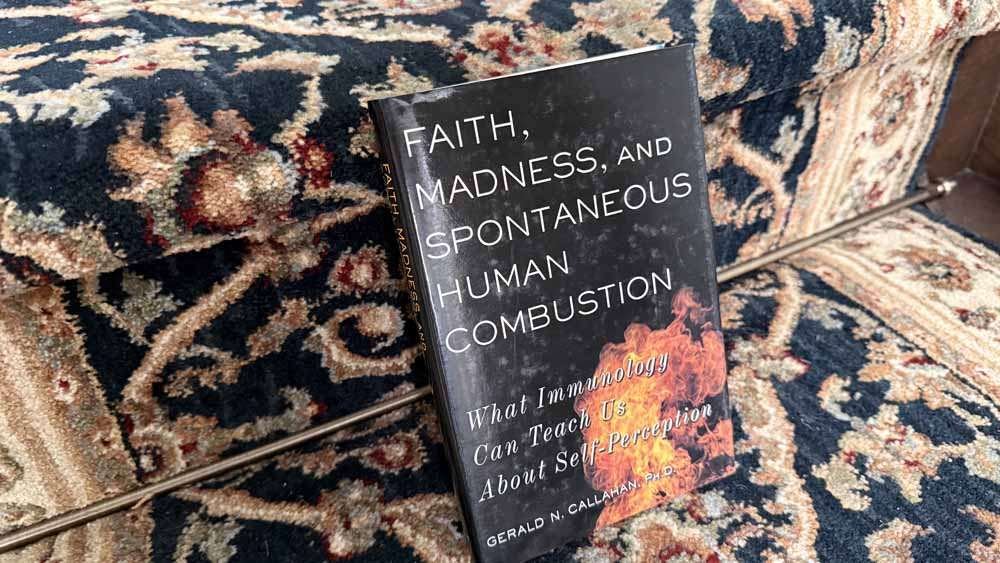
Faith, Madness, and Spontaneous Human Combustion is a book of twelve essays by an immunologist and poet — a combination that shouldn’t work and does, mostly. Callahan’s core argument is both scientifically precise and philosophically jarring: you are an individual because you have an immune system. Not because you have a soul, not because you have a name, not because someone raised you in a particular house on a particular street. Your singularity is a biological achievement, fought for and maintained at the cellular level every second of every day. “We are individuals,” Callahan writes, “because we have immune systems.” Pull that thread and the whole sweater of identity begins to unravel in directions none of the philosophers above predicted.
The Self as a Defended Border
The immune system’s primary job is distinction. It looks at every molecule that enters the body and asks a binary question: self or not-self? That question sounds simple. It is not. The answer involves a machinery of almost incomprehensible complexity — T cells, B cells, the thymus, MHC proteins, immunological memory stretching back through every infection you’ve ever survived. Get the answer wrong in one direction and you’re defenseless against a pathogen. Get it wrong in the other and your immune system attacks your own tissue, which is autoimmune disease, which is the body failing to recognize itself.
What Callahan does that most immunology texts don’t is treat this distinction as a philosophical problem dressed in biological clothes. The question of self versus not-self is the oldest question in metaphysics wearing a lab coat. And the biology complicates the philosophy in ways that are genuinely unsettling.
Consider chimeras — human beings who, through twin absorption during fetal development, carry two genetically distinct populations of cells in their bodies. Their immune systems have learned to tolerate both. Two selves, one body. Or consider the microbiome, which Callahan anticipates in ways that feel prescient for a book published in 2002: the bacteria in your gut are not you by any standard genetic measure, yet remove them and you stop functioning. Where does the border of the self actually run? The immune system draws it. And it draws it differently in every person. That’s where individuality lives, according to Callahan — not in the face you see in the mirror, not in the name your parents gave you, but in the exact, unrepeatable way your immune system has mapped the interior of your body and decided what belongs.
What Happens When the Border Fails
Callahan is at his best in the essays where immune failure becomes a lens on identity. His treatment of AIDS is not primarily about the virus — it’s about what happens when the machinery of self-recognition collapses. When the immune system fails, Callahan argues, “people disappear, and in their places arise communities of living things.” The body, no longer defended, becomes colonized. Opportunistic infections move in. What remains is no longer quite the self that was there before, because the self — in Callahan’s framework — is not static. It requires constant maintenance. It must be defended every day or it begins to dissolve.
There is something in this that resonates beyond the clinical. Most of us understand identity as something given — you were born a particular person and you remain that person as long as you’re alive. Callahan insists otherwise. Identity is a process. A verb dressed as a noun. And processes can slow. They can fail. They can be overwhelmed.
The Fire in the Body
The essay that gives the book its strangest third is “The Flame Within,” Callahan’s account of Mary Reeser, a sixty-seven-year-old woman in St. Petersburg, Florida, who in 1951 was found reduced — almost entirely — to ash in her apartment. No fire damage beyond a small circle around her chair. No explanation that fully satisfied investigators, physicians, or the FBI agents who were eventually called in. Spontaneous human combustion.
Callahan does not try to debunk this or sensationalize it. What he does is use it as a frame for the combustion that happens inside every body all the time. We are, metabolically speaking, continuously burning. The process of turning food into energy is oxidation — controlled fire, running constantly at the cellular level. We generate heat. We have internal temperatures that, if allowed to deviate too far in either direction, kill us. The immune response itself produces fever — a deliberate increase in internal heat designed to create an environment hostile to pathogens but survivable for the host.
Callahan writes about this in a way that makes you feel differently about sitting in a chair. The body is not a passive container. It is an ongoing chemical event. The question of what makes it cohere — what keeps the fire controlled, what keeps the self intact — is not just biological. It is, in his telling, closer to the question of what a person is than anything you’ll find in a philosophy of mind textbook.
Where the Book Has Edges
Publishers Weekly noted at the time of publication that Callahan is “being marketed as a successor to Oliver Sacks” but “lacks Sacks’s gift for engaging narrative.” That’s fair in places. Callahan is a poet and it shows — his prose has a lyrical quality that occasionally floats free of the argument and drifts into impressionism when you want precision. Sacks always brought you back to a specific patient, a specific case, a face you couldn’t forget. Callahan’s cases are sometimes vivid and sometimes blurred, and the blur can feel like evasion.
Booklist was more generous, calling the collection a work where Callahan “conveys both science and sympathy” and concluding that “it is hard to think of a type of reader who wouldn’t be intrigued by this fascinating book.” That feels right too. This is not a comfortable book to file anywhere. It isn’t really a science book and it isn’t really a philosophy book, which is either its greatest strength or its central weakness depending on what you came for.
The structural looseness that bothers some readers is the same looseness that lets Callahan make connections nobody else is making. He has one degree in protein chemistry, another in pathology, and a third, essentially, in poetry. The book is what happens when those three things try to occupy the same mind at the same time and refuse to take turns. The result is sometimes disorienting. It is never boring.
What Callahan Actually Gives You
The deepest thing this book does is shift where you look when you ask the question “what am I?” The answer, after reading Callahan, stops being primarily about memory or consciousness or social role and starts being about maintenance. You are the ongoing project of biological self-distinction. You are a boundary that must be constantly redrawn. You are, in a very precise sense, the sum of everything your immune system has decided is you versus everything it has decided is not.
That sounds reductive. It doesn’t read that way. It reads as something closer to a rescue — a way of returning the question of identity to something physical and real, at a moment when philosophy has sometimes treated selfhood as so constructed and so contingent that there’s nothing left to stand on. Your immune system is not confused about who you are. It has known since before you did.
Dawkins showed us that the gene is the unit of selection, and evolution makes more sense once you accept that. Callahan shows us that the immune system is the unit of individuation, and the self makes more sense — or at least becomes stranger in the right ways — once you accept that.
Faith, Madness, and Spontaneous Human Combustion is not for everyone. It is for people who don’t mind their categories getting scrambled, who pick up a book about the immune system and find themselves three essays in wondering what they actually are. It is, in that sense, exactly the kind of book that deserves to be read slowly, argued with, and returned to. The Albuquerque Journal called Callahan “a Carl Sagan, an Isaac Asimov of our times.” That overstates it a little. But the impulse behind the comparison is right — this is science writing that understands science is not separate from the rest of human life. It runs underneath all of it.
You can find Faith, Madness, and Spontaneous Human Combustion on Amazon and at Barnes & Noble.
You Might Also Like:
– The Selfish Gene by Richard Dawkins — The Book That Unlocked Darwin for Me
– The Lives of a Cell: Notes of a Biology Watcher by Lewis Thomas — A Review
– The Extended Phenotype: How Your Genes Build Structures Beyond Your Body
Sources:
– Callahan, Gerald N. Faith, Madness, and Spontaneous Human Combustion: What Immunology Can Teach Us About Self-Perception. Thomas Dunne Books / St. Martin’s Press, 2002. https://www.amazon.com/Faith-Madness-Spontaneous-Human-Combustion/dp/0425188523
– Penguin Random House listing: https://www.penguinrandomhouse.com/books/287015/faith-madness-and-spontaneous-human-combustion-by-gerald-n-callahan/
– Booklist review, quoted via Barnes & Noble: https://www.barnesandnoble.com/w/faith-madness-and-spontaneous-human-combustion-gerald-n-callahan/1103214945
– Publishers Weekly review, quoted via AbeBooks: https://www.abebooks.com/9780425188521/Faith-Madness-Spontaneous-Human-Combustion-0425188523/plp
– Albuquerque Journal quote via Penguin Random House