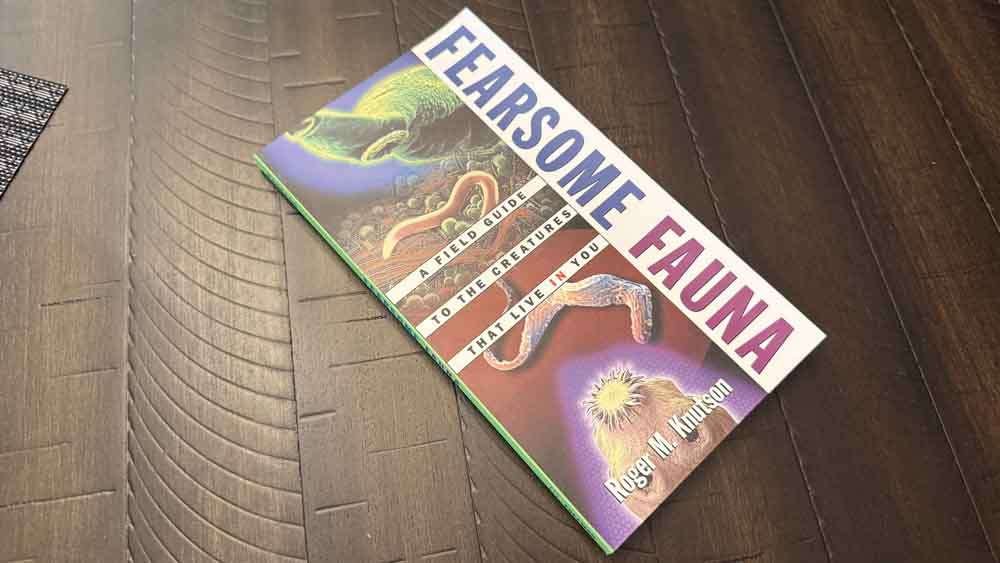
Pick this book up and the cover alone does something to you. Illustrated parasites curl and bristle against an acid-green background — lurid, almost carnival-like — and the subtitle delivers the quiet punch: A Field Guide to the Creatures That Live in You. Not near you. Not around you. In you.
That distinction is everything.
Roger Knutson is a botanist by training, and he brings to this slim, unsettling volume the calm, observational register of a man who has spent his life watching things grow and die without much sentimentality about either. Fearsome Fauna, first published in 1999 by W.H. Freeman, profiles roughly two dozen organisms — mites, worms, flukes, bacteria, fungi — that have made the human body their permanent address. He writes about them the way a naturalist writes about birds: with field-guide precision, without melodrama, and with a dry affection for the subject that somehow makes everything worse.
The Intimacy Nobody Talks About
The book opens with a number that stops you cold. Knutson estimates that the human body hosts somewhere between ten and one hundred trillion microbial organisms at any given moment — a figure so large it ceases to feel numerical and starts to feel existential. By cell count, you are more them than you. The body you have spent your whole life thinking of as yours is, in a very real biological sense, a shared arrangement.
What Knutson does well — better than most popular science writers — is refuse to make this disgusting. He’s not interested in your reaction. He’s interested in the organisms. He describes the Demodex follicle mite, which lives inside the hair follicles of virtually every adult human face, not as a horror but as an evolutionary success story. It has no anus. It lives its entire life inside a single follicle, feeding on sebum, reproduces, and dies there. It has been with us so long it may have co-evolved with our skin microbiome. Knutson writes about it with something close to admiration.
That admiration is the book’s most unsettling quality — and its most honest one.
Science as Quiet Terror
The field-guide format is the engine of Fearsome Fauna’s particular dread. Each organism gets its own section: common name, Latin name, where it lives in the body, what it eats, how it reproduces, how long it stays. It reads like a travel guide to territories you already occupy. Knutson doesn’t sensationalize the roundworm Ascaris lumbricoides — he simply tells you it can reach fourteen inches in length, prefers the small intestine, and that perhaps one billion people carry it worldwide, most without symptoms. He moves on. No pause for effect. The effect lands anyway.
This is the book’s rhetorical genius: Knutson understands that understatement is more disturbing than emphasis. He describes the bot fly larva’s brief excursion beneath human skin and then notes, almost as an aside, that removal must be done carefully to avoid bursting the creature and causing serious infection. The careful prose is more effective than anything dramatic would be.
There is also real science here. Knutson explains the evolutionary logic of parasitism with genuine clarity — the cost-benefit calculus of a parasite that is too virulent, which kills its host and therefore itself, versus one that has found the sweet spot of mild exploitation. He introduces the concept of host manipulation: certain parasites alter the behavior of their host to improve their own transmission. The hairworm, Spinochordodes tellinii, induces its cricket host to seek water and drown, at which point the worm exits and continues its aquatic life cycle. Knutson doesn’t editorialize. He just describes it, and lets the reader sit with the implications.
What It Means to Share a Body
The philosophical weight of this book is modest and mostly implicit, but it is there. Knutson is writing, underneath everything, about the illusion of bodily autonomy. We tend to think of the body as a sovereign territory — something we own, control, and inhabit alone. Fearsome Fauna dismantles that quietly and without apology. The skin, the gut, the hair follicle, the mucous membrane — all of them are contested real estate, negotiated over geological time by organisms that have no interest in your comfort or your self-image.
I’ve spent enough time reading Dawkins to know that the gene’s-eye view of evolution doesn’t have much room for human exceptionalism. Fearsome Fauna arrives at the same conclusion from the parasite’s-eye view. You are not the protagonist of your own biology. You’re the environment.
That’s hard to accept. It’s also, once you sit with it, kind of liberating. The organisms in this book are not invaders. Most of them are residents, some of them ancient partners, a few of them genuinely helpful. The gut bacteria Knutson describes are essential to digestion, to immune regulation, to the synthesis of vitamins you cannot produce on your own. The relationship is not predator and prey — it is something stranger and more mutual than that.
Knutson’s Voice and the Book’s Limits
Knutson writes with the compressed humor of a man who finds the world funny without needing anyone else to laugh. His chapter introductions tend toward the wry, and he occasionally allows himself a line that is almost playful — almost. He is never sentimental and never alarmist, which makes him easy to trust. When he says something is dangerous, you believe him because he doesn’t say it often.
The book’s limitations are those of its brevity. At under two hundred pages, Fearsome Fauna is a tasting menu, not a full meal. Several fascinating organisms get only a few paragraphs when they could sustain entire chapters. The section on toxoplasmosis — the brain parasite carried by cats that may influence human behavior and risk tolerance — is over almost before it begins, which feels like a missed opportunity given what subsequent research has revealed. Knutson was writing in the late nineties, and some of the science has been updated and expanded in the two decades since publication, but the foundational framework he provides holds.
The writing can occasionally feel clipped to the point of flatness, the field-guide format working slightly against narrative momentum. But this is a minor complaint. For a popular science book, Fearsome Fauna is admirably rigorous, and Knutson never condescends.
Who This Book Is For
Read it if you have any genuine curiosity about biology and are not in the habit of demanding that science make you feel safe. Read it if you’ve ever found yourself interested in evolution from the organism’s point of view rather than the textbook’s. Read it if you appreciate the kind of prose that trusts the reader to handle a disturbing idea without being cushioned from its implications.
Don’t read it if you’re looking for reassurance. Knutson doesn’t traffic in that.
Fearsome Fauna sits on a shelf in my house between Dawkins and Lewis Thomas, which is exactly where it belongs — in the company of writers who understand that the most interesting science is the kind that revises your understanding of what you are. This book does that. It does it efficiently, without fuss, in under two hundred pages, and it sticks around long after you’ve put it down.
Just like its subjects.
Sources
- Knutson, Roger M. Fearsome Fauna: A Field Guide to the Creatures That Live in You. New York: W.H. Freeman, 1999.
- Zimmer, Carl. Parasite Rex: Inside the Bizarre World of Nature’s Most Dangerous Creatures. New York: Free Press, 2000. https://www.simonandschuster.com/books/Parasite-Rex/Carl-Zimmer/9780743203142
- Dawkins, Richard. The Selfish Gene. Oxford: Oxford University Press, 1976. https://global.oup.com/academic/product/the-selfish-gene-9780198788607
- Thomas, Lewis. The Lives of a Cell: Notes of a Biology Watcher. New York: Viking Press, 1974. https://www.penguinrandomhouse.com/books/86616/the-lives-of-a-cell-by-lewis-thomas/