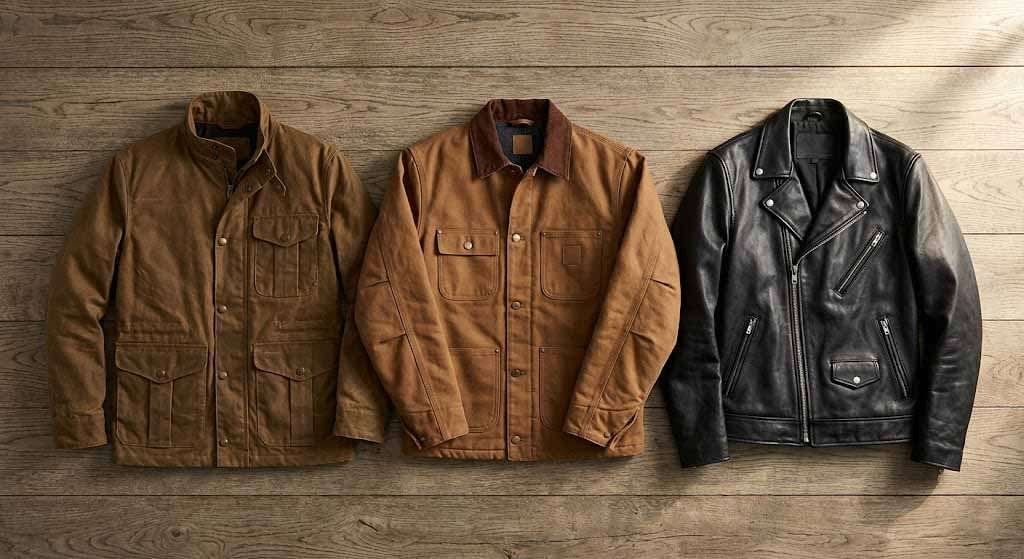
Three brands built by men who needed gear that worked. A century later, they’re still here — but which one belongs in your closet depends on what you’re actually doing with your hands.
That question sounds simple. It isn’t. The internet has spent the last decade turning workwear into aesthetics, photographing Filson jackets in Scandinavian coffee shops and Carhartt beanies in fashion week street style galleries, and in doing so has managed to completely confuse the signal. The gear still works the way it worked in 1897 or 1928 or 1913. The people talking about it often don’t know why.
So let’s go back to what these jackets were built for. The man, the job, the climate. Start there and everything else falls into place.
Filson: The Craftsman’s Jacket
C.C. Filson founded his company in Seattle in 1897, which is the year the Klondike Gold Rush began pushing thousands of men into the Alaskan and Yukon wilderness. These were not weekend campers. They were prospectors, guides, and woodsmen who needed clothing that could take a saturated Pacific Northwest winter and not quit. Filson built for them. He didn’t build for people who were going to be photographed.
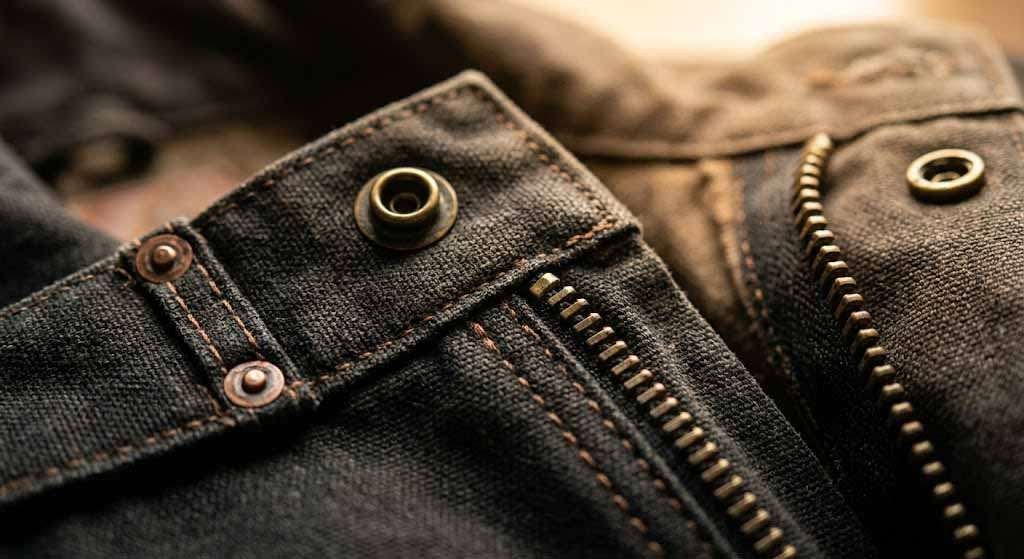
The signature material is tin cloth — a dense, dry wax-impregnated cotton that Filson calls Tin Cloth. It does not breathe particularly well. It smells like wax and oil. It is stiff when cold and softens as it warms to your body. When it gets wet, it repels the water rather than absorbing it, but it will dampen in sustained rain. The correct response is not to complain but to re-proof it with Filson’s own wax compound, which takes ten minutes and adds another decade to the jacket’s life.
The Filson Tin Cloth Short Cruiser Jacket is the centerpiece of their line and has been for over a hundred years. Double-layered on the shoulders and chest. Game pocket in the back that can hold a surprising amount. The cut is cut for movement — arms forward, body bent, doing work. Not standing at a bar. Not walking into a meeting. Working.
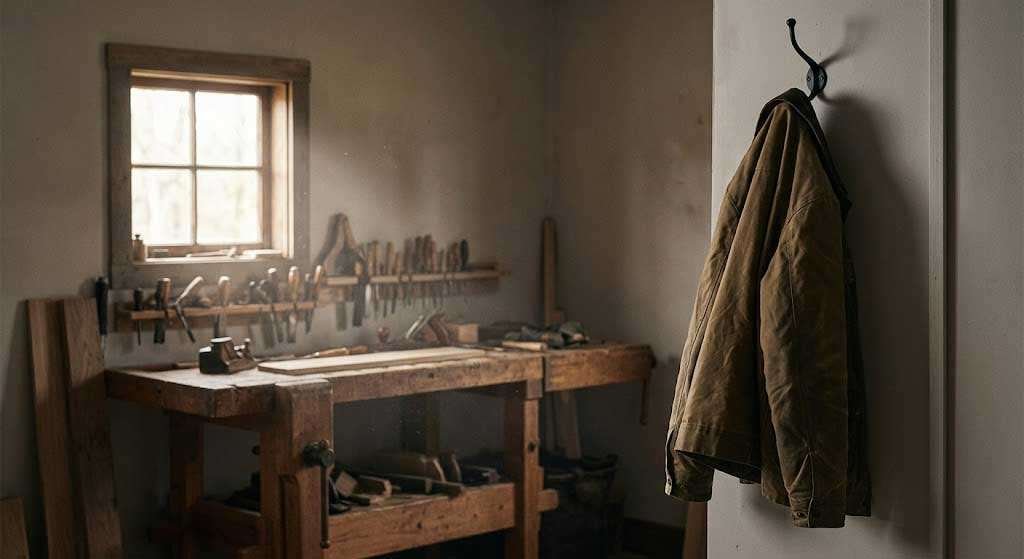
This is the jacket for the craftsman. For the guy with the workshop in the garage, the guy running a fishing charter, the guy who logs enough outdoor hours that a jacket needs to survive real punishment. The tin cloth doesn’t look new for long. It gets marked up, it develops character, the wax finish picks up the history of wherever you’ve taken it. That is not a bug. That is what it’s for.
I spend enough time at a bench — cutting leather, stitching, handling hardware — to understand the value of gear that doesn’t pretend to be something it isn’t. The Filson jacket is the clothing equivalent of a tool that earns its place on the wall. Nothing flashy. Everything functional. The kind of thing you stop thinking about because it just works, and that’s the highest compliment you can give a piece of equipment.
The price is significant — expect $325 to $450 depending on the style — but the math changes when you understand that this jacket may outlive the person who bought it. Filson repairs their products. They stand behind them. The upfront cost is not the actual cost.
Carhartt: The Worker’s Jacket
Hamilton Carhartt started his company in Detroit in 1889 with a single sewing machine and a clear mission: make work clothes for the people who actually work. His target customer was the railroad worker, the farmer, the factory man. Not an aspirational demographic. The people who built the infrastructure of this country and wore through everything they owned because they used it every day.
The Carhartt Detroit Jacket has been in continuous production since 1932. Canvas shell, blanket lining, rib-knit cuffs, triple-stitched seams. The sizing runs big in the American workwear tradition because it’s designed to fit over layers — over a hoodie, over a flannel, over whatever you need to add to get through the temperature. The cut is boxy and nobody is pretending otherwise.
What the Detroit Jacket does better than almost anything at its price point — around $100 to $150 — is handle the kind of work that ruins jackets. Construction. Roofing. Landscaping. The tasks that involve kneeling, reaching, crawling through tight spaces, dragging things, carrying things, getting your sleeves into situations they were not designed to handle. The canvas shell is abrasion-resistant. The lining is warm without being bulky. The fit is forgiving enough that you can move in it without restriction.
Carhartt also makes the Loose Fit Firm Duck Chore Coat, which extends the formula into a longer silhouette with more pocket real estate. For the person whose workday involves needing things in their pockets — pencils, tape measures, phone, keys, receipts — the Chore Coat solves the problem without requiring a separate bag.
The honest caveat about Carhartt is that their main line and their “Work In Progress” fashion sub-line coexist in the market, and the fashion line is made overseas at a significantly lower construction standard. Check the label. If it says “Carhartt WIP” or if it has a slim or tapered cut, that is the fashion product. If it says Carhartt and it looks like it was designed for someone who actually works, it probably was.
Schott NYC: The Rider’s Jacket
Irving Schott made the first motorcycle jacket ever sold in America in 1928. He named it the Perfecto, after his favorite cigar. He sold it through Harley-Davidson dealerships for $5.50. When Marlon Brando wore it in The Wild One in 1953, the moral panic came so fast and fierce that certain school districts banned the jacket outright. That was the moment the Perfecto became permanently attached to a cultural meaning that has nothing to do with riding and everything to do with refusal.
But let’s be clear about what it was before it became a symbol: it was a tool. The asymmetric zipper runs at an angle because when you’re leaning into the wind on a motorcycle, an asymmetric closure aligns properly with your body position. The snap-down lapels keep wind from catching and pulling the jacket open at speed. The snap cuffs seal against the wrist. The belt cinches the waist so the jacket doesn’t ride up when your arms are extended on the handlebars. Every single design detail on the Schott 618 Perfecto existed to solve a specific problem that riders had in 1928.
The leather is cowhide on most models, lamb on others. The cowhide versions are stiffer out of the box and require a break-in period — sometimes an uncomfortable one. The lamb is softer immediately but less abrasion-resistant. For actual riding, cowhide. For everyday wear, the lamb is more comfortable from day one.
Schott is still made in the same factory in Union, New Jersey. The construction has not changed. The Perfecto starts around $500 for cowhide and climbs from there. A properly cared-for Schott jacket is measured in decades.
The cultural weight is real, but it’s also optional. The Perfecto does not require you to be a rebel. It doesn’t require you to own a motorcycle. What it requires is that you understand you’re buying a piece of equipment designed with precision, built to last, and carrying enough cultural history that you will occasionally have to explain it to people. That’s a fair trade.
The Honest Comparison
Here is the thing these three jackets share: all of them were designed by people who respected the end user enough to build something that actually worked. None of them came from a marketing department. All of them have survived for a century because the people who needed them bought them, used them, and came back.
Where they diverge is in use case, and use case is everything. The Filson is for the person who works outdoors, needs weather protection above all else, and can accept a jacket that will look worse every year it does its job properly. The Carhartt is for the person who works with their hands, needs to move freely, and needs gear that can be replaced without ceremony when it finally gives out. The Schott is for the person who rides, or who wants a leather jacket built to a standard that makes most leather jackets look like theater props by comparison.
The mistake people make is buying these jackets for the image and then being surprised when the reality of the materials doesn’t match what they expected. Tin cloth is not a fashion fabric. Carhartt canvas is not a luxury material. Schott cowhide is not a soft European dress leather. These things are built for use. If you’re going to use them, they’re the best things available at their respective purposes. If you’re going to wear them to look like you use them, there are cheaper ways to tell that particular story.
My ongoing work on American leather goods — from the history of New York’s tannery towns to the best American-made leather wallets and bags — keeps coming back to this same principle: the things worth owning are the things built for a purpose, and the purpose is visible in every stitch. That’s true whether you’re talking about English bridle leather or Midwestern duck canvas or New Jersey cowhide.
The tool earns its keep. Everything else is decoration.
Sources
- Filson Heritage Page. filson.com/heritage
- Carhartt Brand History. carhartt.com
- Schott NYC Brand History. schottnyc.com
- Williams, Mark. “How the Perfecto Became the Most Iconic Jacket in America.” Gear Patrol, 2022. gearpatrol.com