Few stories from the American Revolution carry the compressed drama of a single November night on Long Island — a young spymaster rowing across a black and churning Sound with eighty men in eight open whaleboats, landing in the dark on a shore that would one day become Mount Sinai, New York. What followed over the next thirty-six hours was one of the most surgically executed raids of the entire war: the burning of Fort St. George on the South Shore, the capture of dozens of British soldiers, and — critically — the destruction of three hundred tons of hay stockpiled in a small hamlet called Coram. The British Empire, stretched thin across two continents and preparing for a brutal winter, felt that fire all the way to Manhattan. George Washington, when he heard the news, sat down and wrote a personal letter of congratulations. The man responsible for all of it was Major Benjamin Tallmadge of Setauket — a Yale-educated preacher’s son who had quietly become America’s most effective intelligence officer — and his story belongs to this stretch of the North Shore as much as the Sound itself does.
As we enter 2026 and the nation’s Semiquincentennial — the 250th anniversary of the signing of the Declaration of Independence — Long Island has its own war story to reclaim. A story that didn’t happen in Philadelphia or Boston or Concord, but right here: on the roads between Setauket and Coram, on the waters between Mount Sinai and Fairfield, Connecticut, and on the grounds of a South Shore manor that the British had fortified and that Tallmadge’s men tore apart before dawn. The Long Island 250 Bi-County Commission, formed by Suffolk and Nassau County Executives to coordinate this year’s commemorations, has confirmed that the Tallmadge raid will be a centerpiece of the region’s Revolutionary War programming — and rightly so. (Source: Long Island 250 Bi-County Commission / New York State Museum, 2023)
The Spy Who Came in from the Sound
Benjamin Tallmadge was born in 1754 at the Presbyterian parsonage in Setauket, Long Island, the son of a clergyman who would eventually officiate at his own son’s wedding to Mary Floyd, daughter of a signer of the Declaration of Independence. He graduated from Yale in 1773 — classmates with Nathan Hale, whose hanging in September 1776 may have steeled something permanent in Tallmadge’s resolve — and was commissioned as a lieutenant in 1776 before being promoted to Major of the 2nd Continental Light Dragoons.
By 1778, operating under the code name “John Bolton,” Tallmadge had established a small group of trustworthy men and women from his hometown of Setauket — a network that would become known as the Culper Spy Ring and is now regarded as the most effective intelligence-gathering operation on either side of the Revolutionary War. HISTORY The ring’s dispatches moved through a chain that began with merchant Robert Townsend in British-occupied New York City, traveled overland through couriers to Setauket, then across the Sound by whaleboat — operated by the indomitable Caleb Brewster — and finally into Tallmadge’s hands in Connecticut, where they were passed to Washington. About 50 miles of Route 25A has since been officially designated by New York State as the Washington Spy Trail — the historic path of the Culper ring — stretching from Great Neck to Port Jefferson along the North Shore. Ustoursamerica If you have driven that road on a clear autumn morning, watching the Sound glitter through the tree breaks, you have traveled the same corridor these men used to hold the Revolution together.
Washington’s Primary Target: The Hay at Coram
In late October 1780, in the aftermath of Benedict Arnold’s betrayal — a wound still raw throughout the Continental Army — Tallmadge slipped onto Long Island himself to conduct a personal reconnaissance of a nearly-finished British fortification on the South Shore called Fort St. George. On his way back north toward the Sound, he discovered something that arguably mattered even more to Washington than the fort itself: the British had recently stockpiled three hundred tons of hay in the small town of Coram, a few miles from the fort, purchased from local Long Island farmers to support their large garrison in New York City. Journal of the American Revolution
This detail is crucial and often overlooked in popular retellings that focus on the fort’s dramatic nighttime assault. When Tallmadge wrote to Washington on November 7, 1780, appealing for permission to launch the raid, Washington’s consent came with a condition: he gave permission for the raid on the fort, providing it did not prevent the destruction of the hay in Coram, which was the primary target. Sccbsa Three hundred tons of winter forage for British cavalry horses was not a footnote — it was a strategic lifeline. Destroy it, and you degrade the enemy’s mobility across the entire theater as temperatures fell.
Eighty Men, Eight Whaleboats, and a November Storm
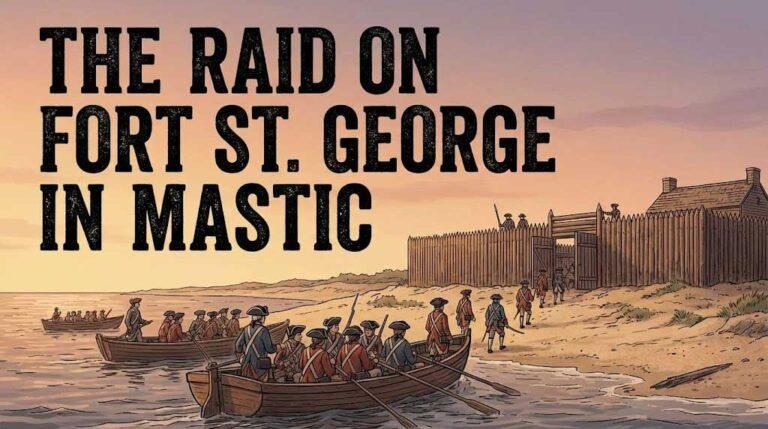
On Tuesday, November 21, 1780, Tallmadge’s force of eighty men left Fairfield, Connecticut in eight open whaleboats and rowed across Long Island Sound, landing at Old Man’s Harbor — now known as Mount Sinai. Sccbsa A heavy rain pinned them near the shore through the following day. Then, in the early hours of November 23rd, the dragoons moved out across the island in darkness.
At approximately 4 a.m., crying “Washington and glory!” three detachments of raiders attacked the sleepy garrison at Fort St. George. New York Almanack While the main body of the fort fell quickly, British soldiers held two of the manor houses, firing volleys from the windows before Tallmadge’s men charged the doors with axes. By 8 a.m., the fort was taken, its supplies demolished, a ship destroyed, and a haul of prisoners — including a lieutenant colonel, a captain, a lieutenant, and a surgeon — were being marched north toward the center of the island.
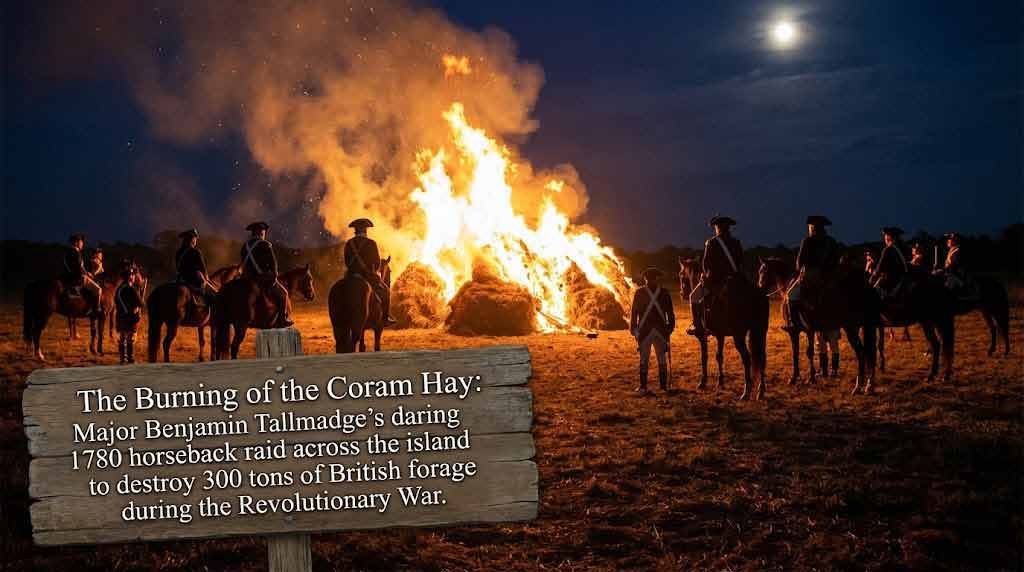
Then Tallmadge divided his force. He took approximately twelve men, mounted on horses seized from the fort, and rode for Coram. His squadron defeated the soldiers guarding the hay and burned all of it. Tallmadge and his riders rejoined the main column within two hours. Journal of the American Revolution By four o’clock in the afternoon, the entire party — raiders, prisoners, and spoils — was back at Old Man’s Harbor. They pushed off into the Sound and arrived in Connecticut around midnight. During this daring mission, Tallmadge’s men had traveled 20 miles by water and 40 miles on land. The American forces suffered no casualties. Sccbsa
Washington’s letter to Tallmadge, upon learning the outcome, was not the restrained correspondence of a careful general. It was personal. “I have received with much pleasure the report of your successful enterprise upon Fort St. George,” he wrote, “and was pleased with the destruction of the hay at Coram, which must be severely felt by the enemy at this time. I beg you to accept my thanks for your spirited execution of this business.” (Source: George Washington Papers, Series 4, General Correspondence, Library of Congress, November 1780)
The First Purple Heart Was Earned on Long Island Soil
There is a dimension to the Fort St. George raid that most Long Islanders have never been told — one that connects this ground directly to one of the most recognized symbols in American military history. Sergeant Elijah Churchill, a 26-year-old member of the 4th Troop, Second Continental Dragoons, was part of Tallmadge’s force that attacked Fort St. George on November 21, 1780. Churchill led the advance attack party, storming the stockade under the cry of “Washington and Glory” and quickly taking the fort. Military.com He would go on to lead another daring raid against Fort Slongo on the North Shore in 1781, during which he was wounded. For these two actions, Sergeant Churchill was presented with the Badge of Military Merit — the predecessor to the Purple Heart — by General George Washington on May 3, 1783. Since the award’s creation in 1782, it is estimated that the Purple Heart has been awarded over 1.9 million times. Veterans Affairs
The first one was earned right here. On the same ground where Tallmadge’s men launched their raid. On the same island you are driving across this morning on your way to work. Local historians and the Tri-Hamlet 250 Committee have noted that few people realize the Purple Heart’s first recipient earned it right here in this community South Shore Press — a fact that should be on a sign at every entryway to Suffolk County.
The North Shore as a Theater of Occupation
It is easy, from the comfortable vantage point of 2026, to romanticize the Revolutionary War as a series of gallant moments. The full picture on Long Island was considerably grimmer. In the years between the Battle of Long Island in August 1776 and the liberation of New York in November 1783, military occupation led to the loss and destruction of property, the separation of families, and an unprecedented level of suffering across this area. British forces used Long Island as a source of fuel and nourishment for their larger war effort — devastating churches, orchards, livestock, and woodlands. Longislandmuseum
Long Island was the only region of the colonies to remain under continuous British occupation for the entire duration of the war. Almost 30 percent of Long Islanders identified as Loyalists during the Revolution. Discover Long Island These were not abstract political affiliations — they were community fractures, neighbor against neighbor, family against family. The hay stockpiled in Coram had been purchased from local Long Island farmers, some of whom were almost certainly Loyalists supplying the crown. When Tallmadge’s dragoons rode into that field and lit it, they were burning the produce of their own island, in service of a country still being invented.
Abraham Woodhull, Benjamin Tallmadge, and Caleb Brewster were friends turned patriot spies from the North Shore of Long Island, whose lives under British occupation were dramatized in the AMC television series Turn, which aired from 2014 to 2017. Washingtonspytrail The show brought national attention to a story that had been largely confined to regional history buffs and academic journals. But the story it told — of ordinary men and women from Setauket, Mount Sinai, and Coram living double lives under enemy occupation — is a story that belongs to this community in a way that no television production can fully capture.
Route 25A, Living History, and 2026
Route 25A — also known as the Long Island Heritage Trail and formerly called The King’s Highway — rims picturesque Long Island Sound along the North Shore. President George Washington traveled this same route in 1790, in a horse-drawn carriage, on a mission to personally thank his Long Island Revolutionary War supporters and the Culper Spy Ring for their help in winning the war. Discover Long Island The road you take to pick up coffee in the morning, the one that winds past the harbors and the old farmhouses and the stone walls — Washington rode that road. Tallmadge’s men moved along its predecessors in the dark.
In 2026, the Long Island Museum in Stony Brook — a proud partner in Suffolk County’s year-long 250 celebration Longislandmuseum — is hosting exhibitions that include Tallmadge’s portrait miniature from 1783, on loan from the Litchfield Historical Society. The Long Island 250 Passport — a free commemorative guide available at suffolk250.org and through the Suffolk250 App — maps the Revolutionary War sites across the North Shore, inviting residents and visitors to experience the terrain as it was: a living theater of espionage, occupation, and resistance.
The Tallmadge Trail, as it is now informally recognized, retraces the route from Mount Sinai southward toward Mastic and back. Walking or driving that route today, you pass through some of the most quietly beautiful landscape on the East Coast — the kind of countryside that makes it difficult to imagine eighty freezing men in whaleboats moving toward it in November darkness. But that difficulty is worth sitting with. The ordinariness of the landscape is precisely what makes the courage required to act upon it so legible.
A Community That Has Always Known How to Hold the Line
There is a certain kind of place that survives not because it is loud about its own importance but because it understands, at a cellular level, what it is. The North Shore of Long Island is that kind of place. From the colonial farms along 25A to the fishing harbors that Caleb Brewster used to row dispatches across the Sound, this has always been a community that held its ground under pressure — economically, culturally, and in November 1780, literally.
Tallmadge’s raid is not merely a military footnote. It is the compressed story of what this place is made of: local men who knew the roads and the coves, intelligence passed through the community in invisible ink and coded letters, a willingness to risk everything for something larger than individual comfort. The three hundred tons of hay that burned in Coram did not end the war. But they kept the British cavalry grounded through a critical winter. They denied the enemy the kind of material confidence that sustains occupation. And they were gathered and destroyed by men who had grown up on this island, who understood its geometry, and who came back to it across dark water to do what needed doing.
In 2026, as the nation marks 250 years of independence, Long Island has an opportunity to do something more than commemorate. It has an opportunity to remember, clearly and in full, that the Revolution was fought here — in the fields off Middle Country Road, in the coves at Mount Sinai, in the dark between Setauket and the Sound. That the first Badge of Military Merit — the ancestor of the Purple Heart awarded to 1.9 million American service members since — was earned in these raids, on this soil. And that the name Benjamin Tallmadge should be as familiar to every person driving Route 25A as the road itself.
Explore More:
- Long Island 250 events and the Revolutionary Passport: suffolk250.org
- The Washington Spy Trail, North Shore: washingtonspytrail.com
- The Long Island Museum, Stony Brook (Tallmadge exhibition): longislandmuseum.org
- Journal of the American Revolution — full account of the Fort St. George raid: allthingsliberty.com
- George Washington Papers, Library of Congress (primary source correspondence): loc.gov