
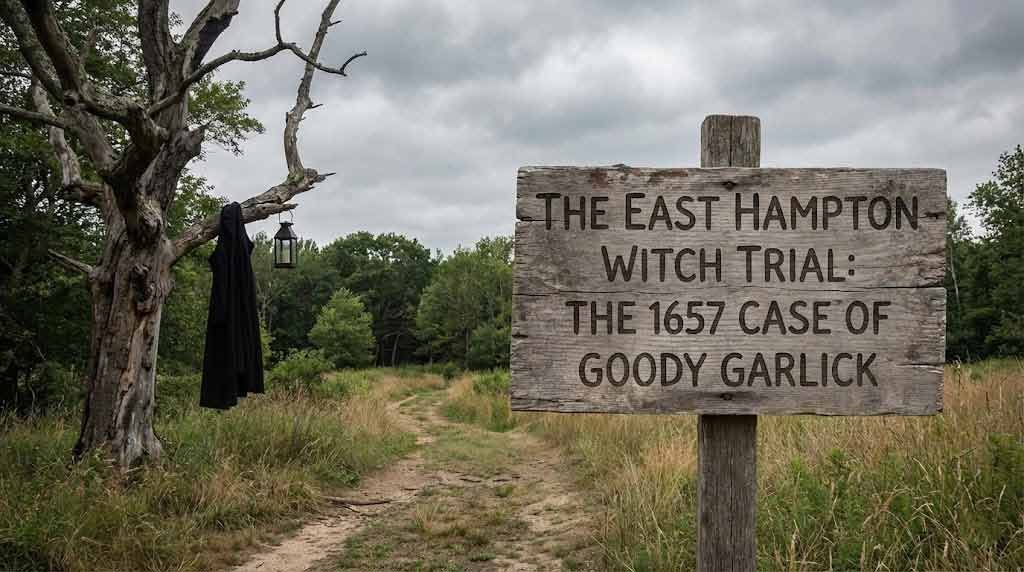
Thirty-five years before the hysteria of Salem burned its way into American mythology, a woman stood accused of witchcraft on the eastern end of Long Island — and the way that accusation was handled tells us something essential about who we are out here, and who we have always been.
The year was 1657. The place was East Hampton, a wind-scoured Puritan settlement clinging to the Atlantic edge of what is now Suffolk County. The accused was Elizabeth Garlick — known to her neighbors, in the custom of the day, as “Goody” Garlick. And her story, largely unknown to most Long Islanders today, is not merely a footnote in colonial history. It is the first X-ray of the Long Island character: the suspicion of the outsider, the power of rumor in a closed community, and — crucially — the willingness of the right men, in the right moment, to step forward and say enough.
The Landscape That Made the Accusation Possible
To understand what happened to Goody Garlick, you have to first understand what East Hampton was in 1657. It was not the Hamptons. There were no galleries, no hedge funds, no weekend estates with French doors opening onto the dunes. It was a dirt-road settlement of roughly 150 English Puritan colonists, geographically and psychologically isolated from the larger colonial world, operating under a provisional legal framework and governed largely by fear — of harsh winters, failing crops, illness, and the theological certainty that the Devil was an active and present force in the lives of ordinary people.
At this time, Suffolk County, Long Island, was a member of the Connecticut colony, a jurisdictional arrangement that would prove decisive in how the Garlick case ultimately unfolded. The settlers had carved their village out of land that bore the Montaukett name Paumanock — “land of tribute” — and they lived with the constant anxieties of people who understood themselves to be building something permanent in a place that had not yet decided to be permanent.
Into this community had arrived Joshua Garlick and his wife Elizabeth, formerly servants on the estate of Lion Gardiner, the commanding colonial patriarch whose island holding in Gardiner’s Bay was the only real estate intact in the United States that is still part of an original royal grant from the English Crown. The Garlicks were working-class people in a community that valued hierarchy, conformity, and the appearance of godliness. According to Long Island historians Kerri Ann Flanagan-Brosky and Loretta Orion, Garlick may have been of French ethnicity or have been considered a strong-willed woman and troublemaker. Orion has suggested Goody Garlick may have been a herbalist and healer, and possibly French, which contributed to her East Hampton Village reputation.
In Puritan New England, all of those qualities were dangerous.
A Death, a Dying Woman’s Words, and the Match That Lit the Fire
In February of 1657, Elizabeth Howell — the teenage daughter of Lion Gardiner himself, newly married and having recently given birth — fell gravely ill with what appears, through the historical record, to have been puerperal fever or some form of postpartum crisis. As her condition deteriorated and delirium set in, she began naming her tormentor.
During the illness, Elizabeth reportedly suffered from nightmares and claimed she saw “a black thing at the bed’s feet” and that Garlick stood by her bed at night “ready to pull me in pieces.” As friends ministered to her, she was reported to have shrieked in hysteria: “A witch! A witch! Now you are come to torture me because I spoke two or three words against you!”
She died within days. And in the grief and terror that followed, the village of East Hampton turned its eyes toward Goody Garlick.
Goody Garlick was, by all accounts, a mean, nasty gossip who got through her day talking about people behind their back. She had also publicly snubbed the young Elizabeth Howell after her marriage. In a community as small as East Hampton, those social strikes were remembered. And now Elizabeth Howell was dead, and her delirious dying words had pointed to one woman.
Goody Davis accused Garlick of witchcraft, saying Garlick had killed her infant with the “evil eye,” only moments after paying the baby a compliment. More accusations followed, each one building on the last. A sick child here. A pig that died strangely in labor. An ox with a broken leg. The architecture of a witch trial was being assembled from the raw materials of gossip, grief, and an old grudge between two women who had once both worked on Gardiner’s island.
Thirteen depositions were filed in which members of the East Hampton community relayed rumors they had heard from their fellow town member, Goody Davis. Most of the accusations flowed through Davis like a river through a single channel. And yet, in what would become one of the quietly remarkable legal observations of the case, the judges noticed that one person in particular was a witness mentioned in a majority of the complaints — a woman named Davis. Although she did not testify against Garlick, through the testimony of others Davis claimed that Garlick was a witch. Davis never filed a sworn statement of her own.
The Decision That Changed Everything: Sending It Up
East Hampton’s local magistrates found themselves at a crossroads. They had eleven witnesses. They had the dying declaration of Lion Gardiner’s own daughter. They had the weight of public opinion pressing hard toward condemnation. And they stopped.
The local judicial panel sent the Garlick case to the Particular Court of Connecticut in Hartford. East Hampton magistrates felt they did not have the legal knowledge and expertise to try Garlick for witchcraft, so they forwarded the case to Connecticut. The parent colony had a stronger legal system in place to deal with capital offenses. But there was more to it than jurisdictional modesty. Both Winthrop and Gardiner realized from the inception of Garlick’s case that her Puritanical and provincial East Hampton contemporaries would not give Goody Garlick a fair trial. So the case was relocated to mainland Connecticut, where much more unbiased minds existed.
That decision — to recognize the limits of local justice and seek a more impartial venue — is one of the overlooked acts of integrity in Long Island’s early history. It is not glamorous. It does not have the drama of a courtroom confrontation. But it was the hinge on which Elizabeth Garlick’s life turned.
The case went to Hartford in the spring of 1658. And there, it met the most intellectually formidable figure in colonial New England.
John Winthrop Jr.: The Alchemist Who Saved Her Life
John Winthrop the Younger was, by any measure, an extraordinary man operating in an extraordinary moment. A Renaissance man of many talents, the younger Winthrop was well-versed in alchemy, natural magic, medicine, and early modern industrial technology, and quickly acquired a talent for political maneuvering as well. He was elected governor of Connecticut in 1657 — the same year Goody Garlick was accused — and he brought to the bench not the fear-soaked superstition of the mob, but the cool analytical skepticism of a man who had actually studied the forces the accusers were invoking.
After Winthrop became governor of Connecticut in 1657, he presided over witch trials at Hartford. Up until that point, the court had a 100% conviction rate for witchcraft cases; 7 out of 7 accused witches had been condemned since 1647. That number is worth sitting with. Seven for seven. The court that received Goody Garlick’s case had never once found a defendant innocent of witchcraft.
And then Winthrop arrived. Winthrop’s dismissal of witchcraft accusations was rooted in being a learned occultist rather than a rationalist skeptic. He would have seen magical and alchemical practice as a complex system of forces that would be too much for the average person to be capable of doing without the right education. So oddly enough, it was his somewhat elitist attitude perhaps that ended up saving the lives of the women who were accused during his tenure as governor.
The logic was counterintuitive and brilliant: Winthrop did not argue that magic was impossible. He argued that it was difficult — too technically demanding for an uneducated village woman to have mastered. He turned the accusers’ own premise against them. If you believe in witchcraft, he was essentially saying, then you must also believe that it requires considerable skill. And Goody Garlick does not have that skill.
After hearing testimony, the jury reached a verdict of not guilty, and the court duly released her from custody. The indictment had threatened death. The verdict was freedom.
The Aftermath: Justice Partial, Community Fractured
The acquittal was not a clean ending. Her husband, however, had to enter a bond of thirty pounds to ensure that he and his wife would “carry good behavior to all the members of this jurisdiction” and appear before the next court held at East Hampton. Goody Garlick returned to the community that had tried to destroy her, under conditions not entirely unlike what we might today call supervised release. The stigma would not vanish with a verdict.
But Joshua Garlick, her husband, was not done. Following the preliminary inquest against Garlick at East Hampton, her husband Joshua Garlick filed a libel lawsuit against Goody Davis. It was an act of remarkable legal courage for a working-class man in a community where the Gardiners and the Howells held the weight. Davis, facing the suit, publicly declared (though not under oath) that Goody Garlick had been kind to her over the years. She died of unknown causes shortly after. Goody Davis’s chief accuser had recanted, and then vanished from history.
As for Elizabeth Garlick herself, the new sheriff, John Winthrop Jr., told the townspeople of East Hampton to act neighborly towards one another. She was offered work on the Gardiner estate and, according to some historians, lived to be 100. She is buried at the South End Burying Ground in East Hampton — the same town that had tried to see her hanged.
What This Story Says About Long Island
This is not simply a curiosity of colonial history. The Garlick case is the founding document of a Long Island disposition that still runs through the North Shore and the East End today: the instinct, imperfect and slow-moving as it always is, toward fairness over fury.
It matters that Lion Gardiner — whose own daughter had been killed, according to the community — intervened. In contrast to many of his peers, Gardiner did not clutter his mind with superstition, as proven by his reaction to an accusation of witchcraft. He was a man of property, power, and grief. He had every social incentive to let the mob have what it wanted. He chose differently.
It matters that the East Hampton magistrates, sitting in a community that had already decided Garlick was guilty, recognized the insufficiency of their own legal authority and referred the case upward rather than proceeding on the momentum of popular belief.
It matters that a Connecticut governor with a 7-0 conviction rate looked at the evidence before him, applied a form of reasoning that defied the emotional consensus of an entire colony, and returned a verdict of not guilty.
Long Island had a witch trial of its own — thirty-five years before the infamous Salem witch trials of 1692, and it ended differently. Salem resulted in twenty deaths. East Hampton produced an acquittal, a defamation suit, and an instruction to be better neighbors. The contrast is not accidental. It reflects something durable in the character of this place — a skepticism toward collective hysteria, a preference for procedural caution over passionate certainty.
Long Island has never been simple. It was built by people carrying the psychological freight of a very old world into a very new one. The Garlick case captures that collision in miniature: fear, power, gossip, and grief on one side; institutional restraint and intellectual courage on the other. The latter won. Just barely. But it won.
Next time you drive through East Hampton — past the galleries and the hedgerows and the old cemetery on the edge of town — know that somewhere beneath that manicured surface is the ground where a woman stood accused of an impossible crime and walked free. That ground has memory. Long Island always has.
Sources:
- Wikipedia: Elizabeth Garlick
- New York Almanack: Witchcraft Claims in East Hampton, Long Island
- New York Almanack: Witch, Be Gone! A Witch Trial Set in Long Island
- Dan’s Papers: Goody Garlick: The True Story
- Long Island Press: Witch Trials: Hexing in the Hamptons
- East Hampton Library: East Hampton’s Legendary Witch
- East Hampton Star: The First Gardiner Was Our Founding Father
- Robert D.L. Gardiner Foundation: Gardiner’s Island History
- Faith on View: John Winthrop Jr. and the Connecticut Witch Trials
- The Para-Historian: America’s Alchemist — John Winthrop the Younger
- Today in CT History: Connecticut Founder, Alchemist, and Witch Protector John Winthrop Jr.
- Walter W. Woodward: Prospero’s America: John Winthrop Jr., Alchemy, and the Creation of New England Culture, 1606–1676 (University of North Carolina Press, 2010)
- John Putnam Demos: Entertaining Satan: Witchcraft and the Culture of Early New England (Oxford University Press, 2004)