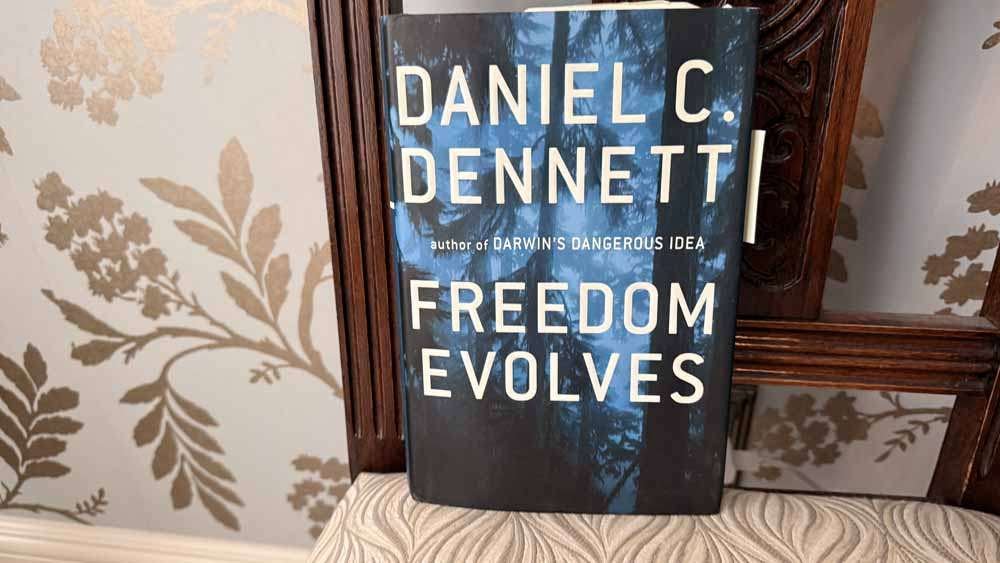
Most people hear “determinism” and think the game is over. Every neuron firing on schedule, every decision already locked into the chain of causes stretching back before you were born — what’s left to argue about? Dennett’s answer, developed across 334 pages of Freedom Evolves, is that you’re asking the wrong question. And if you’ve been waiting for someone to make that case without flinching, without sneaking God in through a side door, and without pretending that quantum randomness saves you — this is your book.
I’ve read Dennett since graduate school. Consciousness Explained, Darwin’s Dangerous Idea, Elbow Room — the man builds a cathedral over a career. Freedom Evolves is where he turns to face the thing most people are too afraid to look at straight: if natural selection built the brain, if the brain is matter, and if matter follows physical law, then what exactly are you doing when you “decide” something? The ghost-in-the-machine answer — that some immaterial soul is pulling the levers — is finished. Dennett buried it in Consciousness Explained and I finished burying my own version of it somewhere around the age of twenty-five, sitting with Dawkins on one knee and Nietzsche on the other. What Dennett does in Freedom Evolves is something harder and more interesting: he builds freedom back up from the rubble.
What Dennett Actually Argues
The book is not a polemic against free will. That’s the first thing critics get wrong. Dennett is not Sam Harris — he is not here to tell you that your choices are illusions and that you should sit still and accept your neurological fate. He’s a compatibilist. His argument is that the word “determinism” carries a specific and mostly unexamined assumption — that determined equals controlled, manipulated, robbed. He dismantles that assumption piece by piece.
Here is the sentence that stopped me cold the first time I read it: “In fact, if you are faced with the prospect of running across an open field in which lightning bolts are going to be a problem, you are much better off if their timing and location are determined by something, since then they may be predictable by you, and hence avoidable. Determinism is the friend, not the foe, of those who dislike inevitability.”
That’s the move. Dennett doesn’t argue that the future is open in some spooky metaphysical sense. He argues that the future is subjectively open — that we are, by biological design, built to treat it that way. He calls this “evitability,” the opposite of inevitability: the capacity of an agent to anticipate consequences and steer away from the bad ones. And here’s the thing about evitability — it doesn’t require magic. It requires exactly what evolution gave us: foresight, memory, the ability to model outcomes before they happen. That’s the whole ballgame.
The Evolutionary Argument
Dennett’s core move in this book is to show that freedom is not something that exists despite natural selection but because of it. Every living thing is what it is because of an unbroken line of ancestors that survived long enough to reproduce. As Dennett puts it: “You spring from an unbroken line of winners going back millions of generations, and those winners were, in every generation, the luckiest of the lucky, one out of a thousand or even a million.” That lineage didn’t produce a soul separate from biology. It produced increasingly sophisticated mechanisms for reading the environment, modeling futures, and choosing paths. The complexity that emerges from those mechanisms — the thing we call deliberation, intention, moral reasoning — is real. It just isn’t magic.
This is where Dennett’s argument connects directly to what Dawkins showed in The Selfish Gene — that the units of selection are genes, not organisms, and certainly not souls — and to what Darwin himself laid out in On the Origin of Species: that complexity, including the complexity of mind, has a history. Dennett is completing the circuit. He is saying: if you accept what Darwin found, and if you accept what neuroscience has found, the ghost in the machine was always a story we told ourselves to avoid the more frightening and more wonderful truth — that the machine can haunt itself.
Evitability, Moral Responsibility, and Why the Stakes Are High
The reason this isn’t just a philosophy seminar topic is that the free will debate has always been a proxy war for something more immediate: who is responsible for what. I have thought about this my whole adult life — through my own streets, through the things I watched happen to people who never had the choices they were supposed to have. Dennett addresses this head-on. He writes that our early ancestors “mindlessly created human culture, and then how culture gave us our minds, our visions, our moral problems — in a nutshell, our freedom.” Freedom is cultural inheritance. It is institutional. It is something that can be expanded or contracted by the conditions a society builds around its people.
The hard incompatibilists — those who say determinism and moral responsibility simply cannot coexist — are stuck in a binary. Either you have some mystic, causally unconstrained will, or you’re a leaf in the wind. Dennett rejects both. His category of “evitability” gives you a third option grounded not in theology but in biology: you are the kind of agent evolution built to foresee, weigh, and steer. That capacity is real. It is more than enough to ground moral responsibility — not the brutal, guilt-soaked, punitive version of moral responsibility, but the practical version that asks whether you were the sort of system that could have done otherwise given a different set of representations.
Sam Harris, a friend and admirer of Dennett’s, still concluded that Dennett changes the subject — trading the subjective experience of agency for a “conceptual understanding of ourselves as persons.” I understand the objection. When you are in the thick of a decision that feels like it genuinely could go either way, Dennett’s framework doesn’t quite map onto the inside of that experience. I’ll grant Harris that. But I think Dennett is doing something more important than describing the phenomenology of choice. He is building the framework in which moral and political reasoning can proceed without fantasy. That matters more.
The Prose and the Method
Dennett writes like a man who enjoys a fight. The reviewer at Metapsychology noted that he is “an intellectual force to be both reckoned with and enjoyed” and that his chapter headings — “Dumbo’s Magic Feather and the Perils of Paulina,” “Austin’s Putt” — read like a writer inventing ways to hold your attention through genuinely difficult terrain. He does. He uses analogies the way a good carpenter uses a sharp plane — quickly, cleanly, taking only what needs to come off. He was already doing this in his thinking about mind and mechanism, and in Freedom Evolves the analogical machinery is running at full speed.
Is the book occasionally maddening? Yes. Dennett can be arrogant in the way that a man who has been right a lot tends to become arrogant. He spends a sizable portion of the book fighting off misreadings from previous books, which can feel like watching someone settle old scores. And some critics — including philosophers far sharper than me — have said they couldn’t nail down his position even after two readings. I don’t share that experience, but the complaint isn’t unfair. The book rewards patience. It doesn’t reward skim-reading.
Where This Sits in the Dennett Canon
I have read almost everything Dennett wrote — and have written about several of those books here. The arc is a coherent one. Consciousness Explained dismantled the Cartesian theater. Darwin’s Dangerous Idea showed what selection really means as a universal acid. Elbow Room was his first pass at free will, smaller and sharper in some ways. Freedom Evolves is the full synthesis: consciousness is real but not magical, freedom is real but not magical, and the evolutionary story that produced both is more extraordinary than any alternative. His late work, From Bacteria to Bach and Back, extends this into cultural and linguistic evolution, and if you want the full arc, that’s where it ends. But Freedom Evolves is the moral center of the project. It is where he makes his stand on what kind of creatures we actually are and what we owe each other as a result.
What It Means to Read This Book Honestly
Reading Dennett requires something specific: the willingness to let a word you think you understand get taken apart and rebuilt in front of you. “Freedom” is not the word you came in with by the time you leave. Neither is “inevitable.” Neither, for that matter, is “you.” What remains when the rebuilding is done is not a smaller thing. It is a more honest one — a picture of human agency that starts with the real world and doesn’t require the furniture of the supernatural to get where it needs to go.
That’s always been what I love about Dennett. He doesn’t offer comfort. He offers something better: a framework you can actually stand on.
Sources
- Dennett, Daniel C. Freedom Evolves. Viking Press, 2003. Amazon
- Graham, George. “Freedom Evolves.” Metapsychology Online Reviews, Vol. 7, No. 25. Link
- Fischer, John Martin. “Freedom Evolves.” Journal of Philosophy 100, no. 12 (2003): 632–637. PhilPapers
- Goodreads reader quotes from Freedom Evolves. Link
- Wikipedia. “Freedom Evolves.” Link