Walt Whitman wrote about Brooklyn the way a man writes about a place he understands in his bones. Born in West Hills, Long Island in 1819, he spent his formative years in Brooklyn, typesetting and pressing for small newspapers through the 1830s before taking the editor’s chair at the Brooklyn Daily Eagle in 1846. He kept that chair until 1848, when a dispute over abolition ended the arrangement — Whitman was against slavery; the Eagle’s owners were not. He went on. The paper went on. But the site where he did that work, on Old Fulton Street at the foot of the Brooklyn Heights bluff, kept accumulating stories.
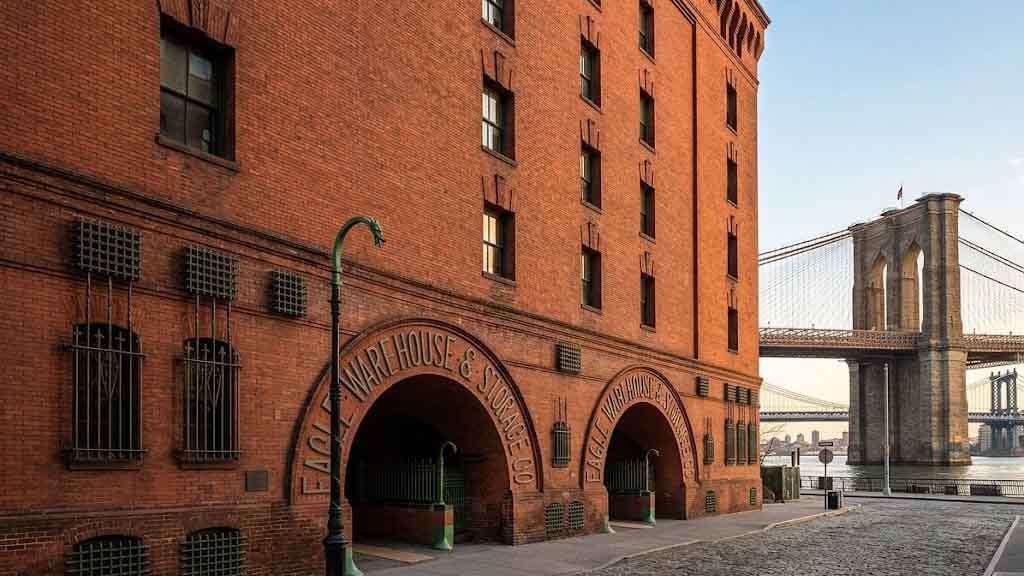
Today, 28 Old Fulton Street is one of DUMBO’s most recognizable buildings — and one of the most admired pieces of architecture in all of Brooklyn. What Frank Freeman built here in 1893 is described by historians as a masterpiece. The late New York Times architectural critic Christopher Gray called it a “medieval brick fortress” that recalls the Palazzo Vecchio in Florence. It has been a newspaper site, a warehouse, a law school, and since 1980, a cooperative apartment building with sweeping views of the Brooklyn Bridge. The mortar holds all of it.
The Brooklyn Eagle and the Site It Left Behind
For 114 years the Brooklyn Eagle was the borough’s paper of record. During Whitman’s brief tenure it was one of the most widely read papers in the country — he edited it, wrote for it, pushed its politics until the politics pushed back. The antislavery position cost him the job. He went on to New Orleans, then back to Long Island, then to the work that mattered most: Leaves of Grass, first published in 1855. “Crossing Brooklyn Ferry” — one of the great American poems — came from a man who knew this waterfront by foot and ferry before any bridge crossed the river.
When the Eagle eventually moved its offices north toward the Post Office (a building later demolished for Cadman Plaza), the original site on Old Fulton Street was cleared. The Eagle Warehouse and Storage Company purchased the land, named themselves — probably — for the newspaper that had occupied it. They commissioned Frank Freeman to design a building that would hold other people’s valuables: a warehouse, fireproof, massive, visible from the water.
Freeman was, by most accounts, Brooklyn’s greatest architect. He left relatively few buildings. What survive are disproportionately significant: his work is dense with ornament and detail at a scale that makes it impossible to walk past. The Eagle Warehouse, completed in 1894, is the most accessible and most celebrated of what remains.
What Frank Freeman Built
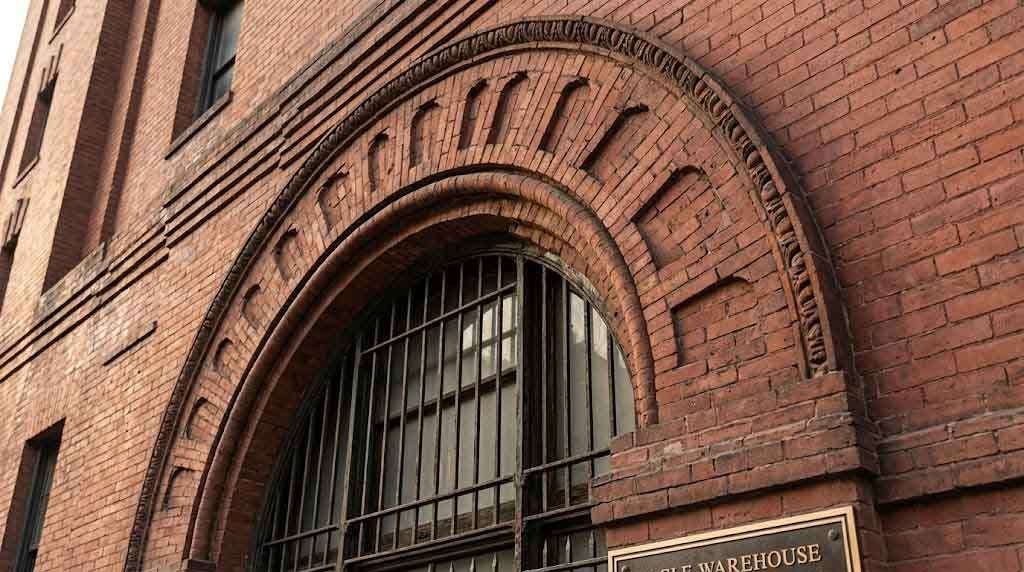
The building Freeman designed for the corner of Old Fulton and Elizabeth Streets is Romanesque Revival — the style pioneered by H.H. Richardson that combines massive masonry, round arches, and a surface richness that makes the walls feel alive. Freeman’s version leans toward the fortress. The ground floor is dominated by a wide Roman arch bearing the company name in large bronze lettering, leading into a barrel-vaulted passage. On either side, small windows are fitted with “handsome iron grilles,” as the landmarks report noted. A simple belt course separates the ground floor from the four stories above, which are slightly recessed and divided into rows of rectangular windows with crowned arches.
What makes the building extraordinary is not any single element — it is the accumulation of them. The patinated fencing. The dragon-headed gas light pole at the entrance, described by one observer as the building wearing “jewelry.” The machicolated cornice at the top, purely decorative, borrowed from medieval fortification architecture. None of this was functionally necessary for a warehouse. Freeman built it anyway, because the difference between a good architect and a great one, as one longtime observer put it, is in the detail — in making people keep looking.
Freeman also made a specific decision that speaks to a kind of architectural humility: he wrapped the new warehouse around the original three-story pressroom that the Brooklyn Eagle had left behind, preserving it at the corner of Doughty Street and Elizabeth Place. That pressroom, built in 1882, is still detectable today if you know where to look for its roofline. It may well be the room where Whitman himself worked. Freeman didn’t demolish it. He built around it, folded it in, kept it as part of the mass of the new building. The old structure is inside the new one, the way an earlier story is inside every building that gets revised rather than replaced.
A moat of air even surrounds the foundation underground — an engineering feature designed to protect the structure from water seepage, a level of care that a purely utilitarian building would never justify.
The Warehouse Years and the Law School Interlude
After its opening, the Eagle Warehouse functioned as intended: heavy storage for the businesses and households of Brooklyn at the height of its industrial era. DUMBO — the neighborhood “Down Under the Manhattan Bridge Overpass,” though the acronym came much later — was then a working waterfront district, its cobblestoned streets embedded with the rails of the Jay Street Connecting Railroad, its buildings given over to manufacturing and storage. The warehouse sat in a neighborhood of warehouses. By the time the Brooklyn Bridge opened in 1883, the Fulton Ferry area was already past its heyday; the bridge had made the ferry redundant, and the character of the neighborhood was changing. A visible, highly ornamental warehouse on Old Fulton Street was well-positioned for a clientele that wanted both security and prestige.
Between 1904 and 1928, the building served a different function entirely: the Brooklyn Law School operated here, turning a storage warehouse into classrooms and offices for two and a half decades before relocating. The building then returned to storage and industrial use, cycling through tenants as the neighborhood around it declined through the mid-20th century.
What saved it was the Landmarks Preservation Commission. Because the Eagle Warehouse sits within what became the Fulton Ferry Historic District — listed on the National Register of Historic Places in 1974 and designated a New York City landmark in 1977 — its demolition was never a viable option. But landmark status alone does not produce a livable building. Residential use was not permitted in the Fulton Ferry district at all, and it required the Commission itself to apply to the City Planning Commission on behalf of the owner for a special permit allowing the conversion. Without that intervention, observers at the time noted, the building would likely have sat vacant indefinitely.
The 1980 Conversion
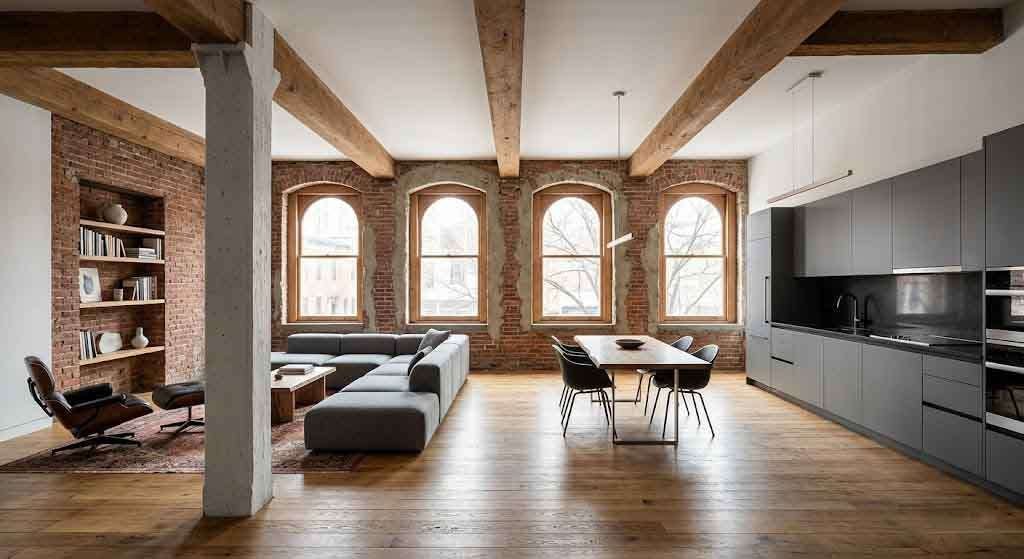
In 1980, Brooklyn architect Bernard Rothzeid renovated the Eagle Warehouse into cooperative apartments. The conversion by the firm Rothzeid Kaiserman & Thomson — now RKTB — was completed and accepted by the state attorney general’s office by 1984. The building became 84 residential units, a cooperative rather than a condominium, with ceiling heights running to 12 feet in some units, original exposed beams, concrete columns, and the deep-set fortress windows that one observer noted “aren’t everyone’s cup of tea” — the same windows that gave the building its impregnable character from the street made for dimmer interiors than standard residential construction would produce.
What buyers got was extraordinary proportions, a connection to one of the most storied sites in Brooklyn literary and civic history, and the particular satisfaction of inhabiting a building that was never designed for habitation — whose ceilings were built to hold other people’s possessions, whose arches were built to impress other people’s clients, and whose walls were built to last.
The Whitman plaque near the building entrance on Old Fulton Street marks the literary history of the site. It is easy to walk past. People who live in the building presumably walk past it regularly — the way you walk past anything that has become ordinary through proximity.
DUMBO Now
The neighborhood the Eagle Warehouse stands in is not the DUMBO that existed when Freeman built here, or when Rothzeid converted the building, or even the early 2000s DUMBO that began attracting the first wave of tech companies and artists. The cobblestone streets are the same; the rails are still embedded. The buildings around the Eagle Warehouse are largely the same industrial brick structures, now converted to loft residences, boutique offices, and the kind of curated retail that arrives when a neighborhood’s rent curve steepens past a certain point.
The East River frontage that Whitman wrote about in “Crossing Brooklyn Ferry” — the ferry that ran its last crossing from the foot of Old Fulton Street in 1924 — is now a park. The DUMBO Archway hosts street fairs and film shoots under the Manhattan Bridge. Property values have made the Eagles of today significantly more expensive than anything the Whitman-era Brooklyn market ever contemplated.
Pawli at Maison Pawli Realty works with buyers across the New York metro market, and buildings like the Eagle Warehouse represent a specific category of real estate demand that transcends pure square-footage math. The buyer who chooses an 1,120-square-foot co-op in an 1893 warehouse over a 1,400-square-foot new-build two blocks away is buying something the numbers don’t capture. They are buying Freeman’s Roman arch. They are buying Whitman’s pressroom in the corner of the building. They are buying the moat of air that the architect put in the foundation because he was building something that needed to last.
What the Mortar Holds
Whitman wrote: “A man is not a whole and complete man unless he owns a house and the land it stands on.” He wrote that in 1856, in a real estate column, before the building on this site had even been commissioned. He wrote it as a Brooklyn man and a Long Island man — born in West Hills, raised on ferry crossings, shaped by the particular relationship this part of New York has always had with land and water and permanence.
The Eagle Warehouse is not the building Whitman worked in. His pressroom is inside it, incorporated into Freeman’s structure at the corner of Doughty and Elizabeth — a three-story relic from 1882 that Freeman chose to preserve rather than clear. But the site is continuous. The address is the same. The relationship of the building to the bridge, to the river, to the street below the bluff is unchanged. When you stand in one of those high-ceilinged co-op units with the Brooklyn Bridge filling the window, you are standing where Brooklyn’s oldest newspaper stood, where Whitman argued about abolition, where Freeman decided to build a warehouse as beautiful as a Florentine palace because a building worth building is worth building right.
The mortar holds the stories of all three.
- Heritage as a Climate Strategy: Why Old Buildings Are Greener than New Glass
- The Craftsman Home Revival on Long Island: Architecture, History, and Market Value
- The Ghost Station Capital: How the World’s Lost Railway Architecture Continues to Define the Cities That Erased It
- Wikipedia: Eagle Warehouse & Storage Company
- Brownstoner: Eagle Warehouse — The Dramatic Fireproof Fortress of Fulton Ferry
- Forgotten New York: Eagle Warehouse, DUMBO
- Curbed/Brownstoner: White Cube of a Co-op With Exposed Brick in Dumbo’s Eagle Warehouse
- HMDB: Eagle Warehouse Historical Marker
- StreetEasy: 28 Old Fulton Street