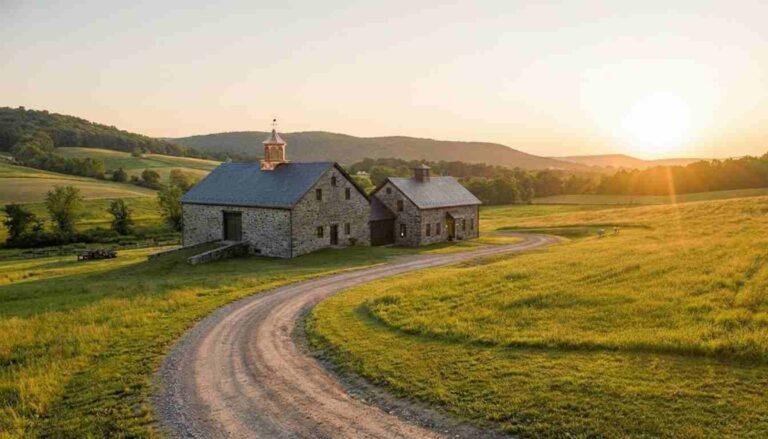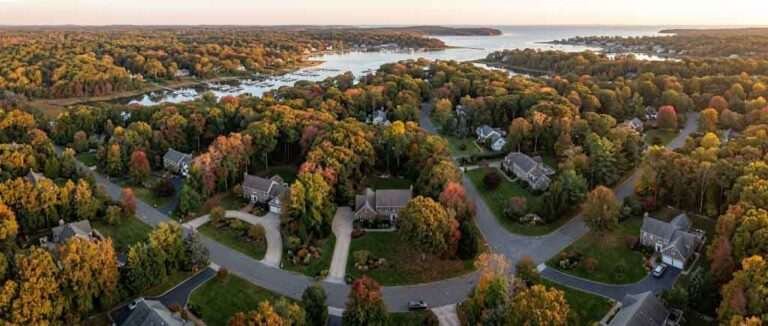
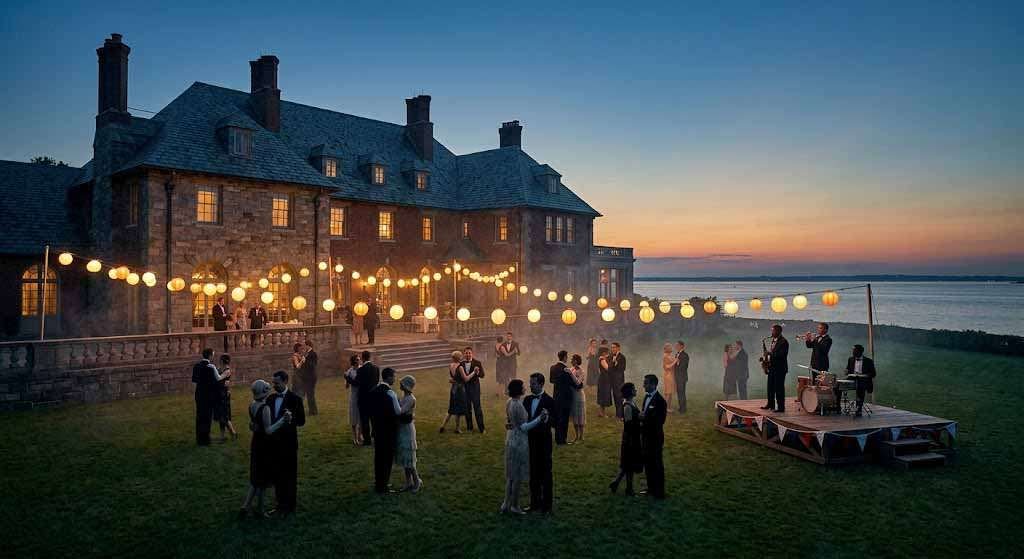
Walk the grounds of Oheka Castle in Huntington today and you’re moving through one of the most expensive pieces of real estate ever built in the United States — 127 rooms, 23 acres of formal gardens designed by the sons of the man who created Central Park, constructed at a cost that translates to roughly $110 million in modern dollars. Otto Hermann Kahn, investment banker and self-styled patron of the arts, built it in 1919 as a summer home. He employed 126 full-time servants. He threw parties that brought royalty, heads of state, and Hollywood stars to the North Shore’s back roads.
What the estate’s published histories don’t say much about is the music.
The Gold Coast of Long Island — that stretch of the North Shore from Great Neck to Centerport where the Vanderbilts, Guggenheims, Whitneys, Woolworths, Astors, and Pratts built their summer worlds between the Civil War and the Second World War — was the most concentrated display of private wealth in America during the Jazz Age. And the Jazz Age was not a metaphor. It was a specific cultural moment when the most important music being created in the country was being made by Black artists from the South and from Harlem, being hired to perform for white audiences who wanted the energy without the complexity of where it came from.
That arrangement — Black musicians, white money, no paper trail — is the essential story of the Gold Coast’s music scene. And it’s the story that almost nobody wrote down.
The Architecture of the Party
F. Scott Fitzgerald lived in Great Neck from 1922 to 1924, which is to say he watched the Gold Coast from the inside. He coined the term “the Jazz Age” himself. The parties he described in The Great Gatsby — the blue gardens, the champagne, the men and women moving like moths under lantern light — were based on real events at real estates up and down the North Shore. Old Westbury Gardens, the Phipps family estate, has been suggested as a partial model for Daisy Buchanan’s home. Oheka itself has been cited as a possible inspiration for Gatsby’s mansion. These weren’t literary inventions; they were observations dressed in fiction.
The estates were extraordinary. A revolving door of socialites, politicians, financiers, actors and artists — Fitzgerald included — rendezvoused in and around these properties. Among the Gold Coast residents were names synonymous with generational wealth and power: Vanderbilt, Morgan, Whitney, Roosevelt, Woolworth, Guggenheim, Pratt, Rockefeller, Belmont, Astor and Pulitzer. An estimated 1,200 estates were built on Long Island between the Civil War and World War II. At its peak, LIFE magazine called the North Shore “the most socially desirable residential area in the U.S.”
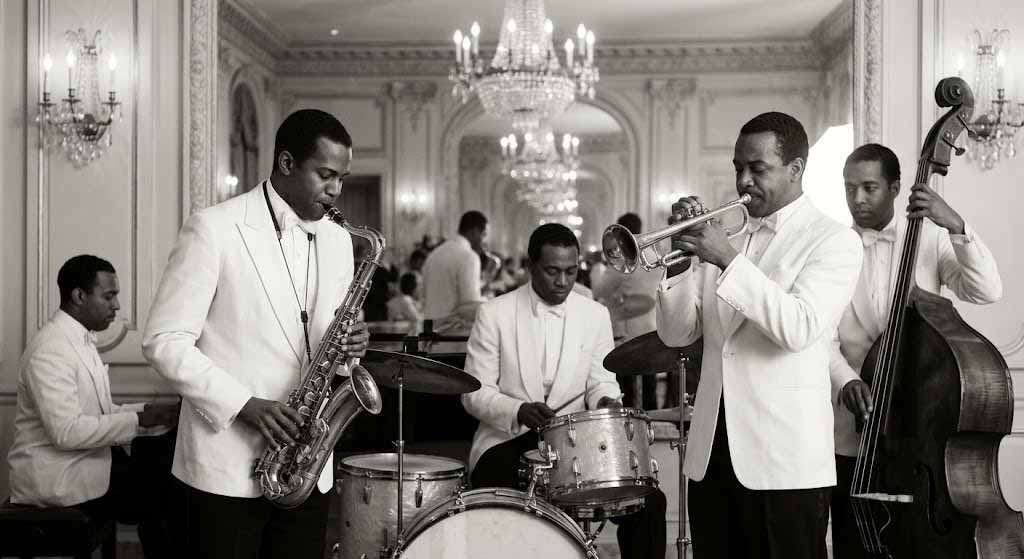
These gatherings required music. By the early 1920s, jazz had become the soundtrack of American aspiration and American transgression both. It had moved north from New Orleans, taken root in Chicago and Harlem, and was spreading across the country through radio broadcasts, records, and the appetite of a young generation for something that felt alive. If you wanted a party that felt like the moment you were living in, you needed jazz. And the people who played it best — the people inventing it, breathing it, building it into a new American art form — were Black.
The Cotton Club Equation
To understand what was happening on the Gold Coast, you have to understand the terms under which Black musicians worked in 1920s America. The Cotton Club in Harlem is the defining example. Black people initially could not patronize the Cotton Club, but the venue featured many of the most popular Black entertainers of the era — Ellington, Louis Armstrong, Cab Calloway, Ethel Waters, Bessie Smith, Fats Waller, Lena Horne. The audience was exclusively white. The club was run by Irish-English gangster Owney Madden, who had purchased it from retired boxer Jack Johnson in 1923. Duke Ellington’s orchestra was the house band from December 4, 1927, until June 30, 1931.
The Cotton Club was both glamorous and controversial. While it showcased the finest Black performers, it maintained a segregated audience of wealthy white patrons. Ellington himself was required to write what the management called “jungle music” — arrangements designed to evoke a primitivist fantasy for white New Yorkers who wanted to feel like they were experiencing something exotic without having to sit next to a Black audience member. Ellington’s residency at the Cotton Club from 1927 onward allowed him to experiment with bold arrangements and large orchestral compositions. He used the constraints as a workshop.
The Cotton Club’s radio broadcasts — first on WHN, then on the NBC Red Network — gave Ellington national exposure. By the late 1920s, he was the most famous bandleader in the country. He was also playing private events, society parties, and estate gatherings that generated far less documentation than his club residencies. The Cotton Club model — Black performers, white money, segregated access — wasn’t unique to that venue. It was the operating logic of the entire era. It applied everywhere, including on the North Shore.
What the Estates Hired
The parties at Oheka, at the Vanderbilt Eagle’s Nest estate in Centerport, at the Guggenheim estate at Sands Point, at the Woolworth mansion Winfield Hall in Glen Cove — these events required professional entertainment. The Gold Coast families were not hiring local talent. They were pulling from the same pool of musicians who played the Manhattan clubs, the Harlem ballrooms, the private affairs of the city’s monied class.
The economics worked in a specific direction. Black jazz musicians in the 1920s were simultaneously in high demand and subject to conditions no white musician would have accepted. They could be hired to play a ballroom on the North Shore for a fee, then barred from entering through the front door, required to eat separately from the guests, and prevented from staying overnight on the property. The performance was what was wanted. The person giving the performance was invisible off the bandstand.
This is why so little documentation exists. The estate accounts, when they survive at all, record expenditures for “entertainment” without specifying names or compositions. The Long Island newspapers of the era covered the social calendar of the Gold Coast families in elaborate detail — who attended, what they wore, which foreign dignitaries appeared — but almost never named the musicians who provided the sound for those evenings. The musicians themselves left few written records. They were professionals doing work, not guests creating memories worth preserving.
The Three Village Historical Society, working with the Jazz Loft in Stony Brook, has done some of the most careful local work on reconstructing this era’s music culture. Their annual Prohibition Night fundraiser draws from archival photographs and period accounts to recreate what those evenings actually sounded like. The historical record they’re working from is fragmentary. What survives is the shape of the thing, not the details.
The Erasure as History
Growing up in Brooklyn with Greek immigrant parents, I was aware early on that certain stories got told and others didn’t. The official version of any neighborhood, any era, any place was always a selection. The North Shore’s Gold Coast mythology — Gatsby, old money, sweeping lawns, Long Island Sound glittering at the edge of a great lawn — is a beautiful story. It is also a story told entirely from the perspective of the people who owned the estates. The musicians who played those lawns are not in the frame.
This is not unique to Long Island. It is the dominant pattern in American cultural history. The Black artists who created jazz — who built, from scratch, the defining American art form of the twentieth century — were systematically excluded from the historical record produced by the institutions that benefited from their work. The Cotton Club promoted Ellington’s music nationally while barring Black patrons from the room where he played. The Gold Coast estate parties hired the best jazz talent available and then refused to acknowledge, in any formal record, that the music had been made by people with names and histories and lives that extended beyond the bandstand.
Ellington remembered the competitive, fluid atmosphere of early New York performance life — answering requests, playing “anything and everything — pop songs, jazz songs, dirty songs, torch songs, Jewish songs.” He was performing for whoever would pay. Some of those people were the same Vanderbilts and Whitneys and Guggenheims whose estates line the North Shore to this day.
What Remains
The estates themselves are the most durable record. Oheka Castle operates today as a hotel and events venue. The Vanderbilt estate at Centerport is a museum. The Sands Point Preserve encompasses the Guggenheim estate grounds. Old Westbury Gardens holds concerts on its lawns in summer, and has for decades — the jazz coming back to the place where jazz once played, though now with a ticket price and a program listing the musicians’ names.
The Jazz Loft in Stony Brook, established by musician Tom Manuel, has made the recovery of Long Island’s jazz history a central part of its mission. Their work in partnership with the Three Village Historical Society represents some of the most serious local effort to reconstruct what actually happened in these communities during the Prohibition era. It is slow, archival, painstaking work — the kind of work that gets done when the official record was never kept in the first place.
The Rum Row and the Freeport Bootleggers piece I wrote earlier traces another side of this same era — the logistics of how the money that funded these parties moved in the first place, on boats off the South Shore in the dark. The two stories are connected. Prohibition didn’t stop the Gold Coast’s parties. It just changed who supplied the liquor and deepened the sense that the rules everyone else followed didn’t apply here.
The musicians who played those parties understood that arrangement without needing it explained. They had been navigating that equation their entire professional lives. They came, they played, they were paid, and they left. The lawns got written about. The music mostly didn’t.
You Might Also Like
- Rum Row and the Freeport Bootleggers: Long Island’s Clandestine War on the Water
- The Ride Down 25A: A Historic Motorcycle Journey Along Long Island’s North Shore
Sources
- Google Arts & Culture: “Gold Coast Mansions of Gatsby’s Long Island”
- Untapped New York: “10 Gold Coast Mansions of Long Island”
- Museum of the City of New York: “Duke Ellington’s New York Rise”
- Wikipedia: Cotton Club
- Big Apple Jazz: “Duke Ellington and the Harlem Soundscape”
- TBR News Media: “Booze, Bootlegging and Jazz — Three Village Historical Society and The Jazz Loft”
- Bowery Boys: “Gatsby and the Mansions of the Gold Coast”
- LIFE Magazine, July 22, 1946: “Living the Gatsby Life on Long Island’s Gold Coast”
- Fitzgerald, F. Scott. The Great Gatsby. Scribner, 1925.