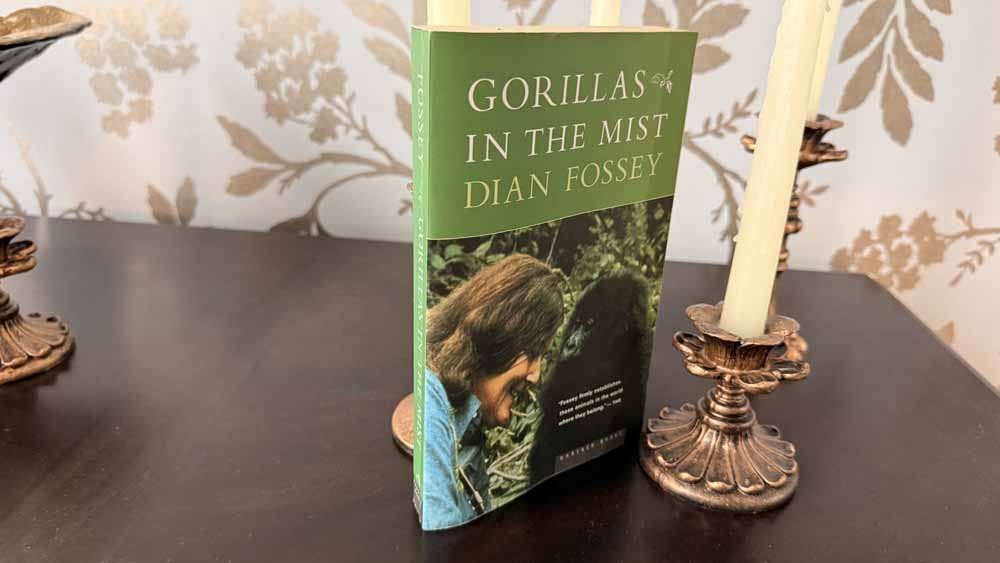
Dian Fossey didn’t go to Africa to become a symbol. She went because she couldn’t not go. She took out a bank loan to finance a seven-week safari in 1963 — a trip that made no practical sense, cost her money she didn’t have, and ended with her standing in the Virunga Mountains looking at mountain gorillas for the first time. She wrote later: “I left Kabara with reluctance but with never a doubt that I would, somehow, return to learn more about the gorillas of the misted mountains.” That sentence tells you everything about what kind of person you’re dealing with. Not a woman with a plan. A woman already claimed by something she hadn’t yet put a name to.
Gorillas in the Mist (1983) is the book that came out of eighteen years of field work at the Karisoke Research Centre, a camp Fossey built herself at 10,000 feet in the volcanic saddle between Rwanda and what was then Zaire. It is a work of science. It is also a record of a slow, irreversible surrender — of a woman giving more and more of herself to a world that could not reciprocate, until finally there was nothing left to give but the act of protection itself. Understanding that arc is the only way to understand the book.
The Science, and Why It Matters
Before the mythology swallows everything else, it’s worth saying plainly: Gorillas in the Mist is rigorous, serious field science. Fossey documents four gorilla family groups across fifteen years and three generations. She tracks social hierarchies, infant development, intergroup conflict, vocalizations, feeding behavior, and sexual dynamics with the patience of someone who understood that the data only accumulates if you show up every single day, regardless of whether the gorillas show up for you.
What she found dismantled the prevailing image of the mountain gorilla as a violent, dangerous beast — the King Kong mythology that had shaped Western perception of the species for decades. What she found instead was something closer to the structure of a large, quiet family. Silverback males governed their groups with more mediation than aggression. Females formed coalitions. Infants played. The dominant male she named Beethoven, nearly 350 pounds, was as attentive to his offspring as he was forceful in defending the group from outside males. The science here connects directly to the broader evolutionary conversation — if you’ve read the work of Richard Dawkins on The Selfish Gene, Fossey’s field data gives you the behavioral evidence that Dawkins gives you the genetic architecture for. Kin selection, reciprocal altruism, inclusive fitness — it all plays out in the Virungas, in the daily behavior of animals who had no idea they were being observed.
The process of habituation — getting the gorillas to accept a human presence — took years. On average, a year and a half passed before a gorilla would approach her. Fossey used everything available to her: knuckle-walking, chewing on the same vegetation they ate, mimicking their vocalizations, what she called the “belch vocalization” that signals contentment. She writes of the day a young male she named Peanuts moved tentatively toward her and touched her hand — a gesture so cautious, so deliberate, that it reads less like an animal becoming comfortable with a researcher and more like a negotiation between two forms of intelligence feeling out the terms of coexistence.
Digit
You cannot review this book without stopping on Digit.
Digit was a young male gorilla Fossey had known since he was a juvenile. He had an unusually formed finger — hence the name. He was curious, playful, tolerant of human presence in a way that made him the obvious subject for National Geographic photographers. Fossey writes of him: “There are times when one cannot accept facts for fear of shattering one’s being.” That sentence appears in the chapter describing what happened on December 31, 1977, when Digit was killed by six poachers and their dogs — stabbed multiple times while shielding the rest of his group, his head and hands removed afterward to be sold as trophies. He was ten years old.
The gorilla had spent years becoming familiar with her. He had allowed her close enough to observe, to document, to know him by name. And now he was dead because he had a face recognizable enough to be worth something to men who needed twenty dollars.
What Fossey did after Digit’s death is the hinge on which her entire story turns. She essentially abandoned academic research and redirected everything toward what she called “active conservation” — destroying poacher traps, burning camps, confronting and physically detaining poachers, establishing the Digit Fund to finance anti-poaching patrols. The scientific community began to distance itself from her. Conservation organizations tried to wrest control of Karisoke. The people she had made enemies of multiplied. She became known among locals as Nyiramacibiri — the woman who lives alone on the mountain. She named her own cabin the “mausoleum.” She knew what it looked like from the outside. She didn’t care.
What Obsession Costs
The book itself doesn’t fully grapple with the question of what all this cost Fossey — that accounting happens in the historical record around the book, in Harold Hayes’ The Dark Romance of Dian Fossey, in Farley Mowat’s Woman in the Mists, in the accounts of students who left Karisoke unable to cope with the conditions and her demands. By the end, she was described as isolated, volatile, alienating even people who wanted to help her. She had become the thing she was trying to protect — something rare, living in a remote place, hostile to intrusion, increasingly alone.
This is the paradox the book opens up without resolving, and it is the most honest thing about it. Fossey writes: “The more you learn about the dignity of the gorilla, the more you want to avoid people.” It reads as a joke. It isn’t. The gorillas didn’t lie to her, didn’t scheme for control of the research station, didn’t use her work to advance careers and tourism agendas. The politics of Karisoke — the institutional pressure from wildlife organizations, the Rwandan government’s competing interest in gorilla tourism, the colleagues who called her unstable — were all human inventions. The gorillas just lived. And that, after long enough, became the only world she trusted.
The Evolution of Primate Behavior by Alison Jolly gives useful scientific context for what Fossey was observing — but the emotional logic of Fossey’s trajectory requires a different framework. Call it vocation in the old sense: not a job, not a career, but a calling that reorganizes a life around a single purpose until the purpose and the life become indistinguishable. The question that hangs over Gorillas in the Mist, and over everything written about Fossey since, is whether that kind of total commitment is admirable or tragic. The honest answer is that it’s both, and that the distinction probably only matters to people who haven’t been called to anything in particular.
The Murder and What It Means
On December 27, 1985, two years after the book was published, Dian Fossey was found dead in her cabin at Karisoke, killed with a machete — the same kind of machete she had taken off poachers over the years. The case has never been officially solved. A research assistant was convicted in absentia by the Rwandan government and fled to the United States; many believe the killing was ordered by people with financial interests in the illegal animal trade, or by the poaching networks she had spent a decade hunting. The weapon was almost too symbolic to be accidental. She was buried in the gorilla graveyard behind her cabin, next to Digit.
Her tombstone reads: “No one loved gorillas more.” Whether you read that as tribute or epitaph depends on how you feel about love that consumes the person who carries it.
The final entry in her journal, written in the months before her death, was this: “When you realize the value of all life, you dwell less on past and concentrate more on the conservation of the future.” It is a sentence that earned its authority the hard way, by a woman who paid more than most are asked to pay to believe it.
What the Book Gives You
Gorillas in the Mist is not a comfortable read. It rewards patience — Fossey moves slowly, methodically, the way field science requires — and it delivers something that most books about animals cannot: the sustained sense of genuine encounter. You come to know Beethoven, Icarus, Uncle Bert, Old Goat, and Digit as individuals, not species representatives. That is a scientific and literary achievement at once.
It also asks a question it never explicitly states: how much is right to give? At what point does devotion become something that others — including the subjects of that devotion — cannot actually use? The gorilla population Fossey dedicated her life to has grown from fewer than 250 animals in the 1960s to over 800 today. The Dian Fossey Gorilla Fund, born from the Digit Fund she founded in grief, continues that work. Her methods remain controversial. Her results speak without controversy at all.
That tension — between how she did it and what it produced — is the book’s real subject, whether she intended it to be or not. Darwin spent a lifetime in meticulous, patient observation, building the case for natural selection from the ground up; his relationship to obsession was a different architecture entirely. Fossey’s version was louder, more combustible, and paid in full with everything she had. Both approaches changed what we know about living things. One cost its author twenty years in the Virunga mist, a machete in the dark, and a grave next to the gorilla she couldn’t save.
Read the book. Sit with the discomfort. That’s where it earns you.
You Might Also Like
- The Evolution of Primate Behavior by Alison Jolly — A Review
- The Selfish Gene by Richard Dawkins — The Book That Unlocked Darwin for Me
- Why Elephants Have Big Ears by Chris Lavers — When Nature’s Apparent Waste Turns Out to Be Genius
Sources
- Fossey, Dian. Gorillas in the Mist. Houghton Mifflin, 1983. — Amazon
- Dian Fossey Gorilla Fund International — Biography: gorillafund.org
- Wikipedia — Dian Fossey: en.wikipedia.org/wiki/Dian_Fossey
- HISTORY.com — “Primatologist Dian Fossey is Found Murdered in Rwanda”: history.com
- EBSCO Research Starters — “Gorillas in the Mist”: ebsco.com
- EBSCO Research Starters — “Fossey Is Murdered over Efforts to Protect Mountain Gorillas”: ebsco.com
- Dark Tourism — Dian Fossey grave at Karisoke: dark-tourism.com