Prairies don’t make good photographs. That’s part of the problem. You can’t frame a horizon the way you frame a mountain. There’s no peak to point at, no dramatic fall of rock. There’s just grass, wind, and a sky so wide it makes you feel small in a way that has nothing to do with awe and everything to do with exposure. Maybe that’s why we didn’t think twice before we plowed most of it under. What you can’t romanticize, you can’t protect.
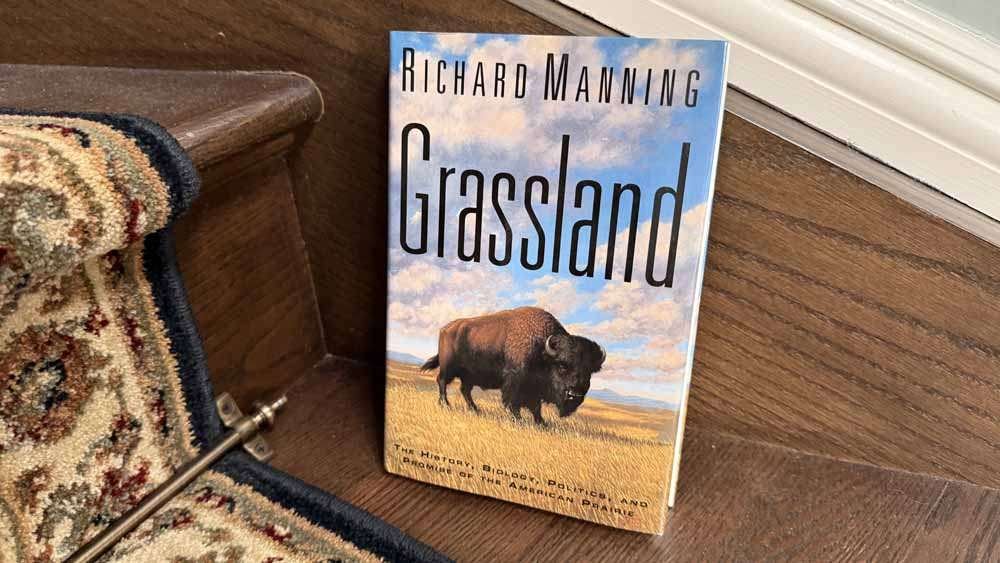
Richard Manning’s Grassland: The History, Biology, Politics, and Promise of the American Prairie is a book about what we lost before we understood what we had. Published in 1995, it arrived at a moment when the dominant conversation about American land preservation was still focused on forests — the spotted owl, the old growth, the Pacific Northwest. The prairie barely registered. Manning’s argument, made with the patience of someone who has spent serious time on the ground in the Northern Plains, is that the grassland ecosystem was not just ecologically significant but foundational — the biological engine underneath everything the American economy eventually called agriculture.
The Ground Beneath the Breadbasket
Manning opens not with crisis but with geology. The prairie is, at its root, a product of deep time — the collision of continental drift, rain shadow, and millennial cycles of fire and grazing that produced something with no real equivalent anywhere else on earth. The topsoil of the Great Plains, that famous black layer that built American wheat and corn production, was not a given. It was the accumulated output of ten thousand years of prairie biology. Grasses dying and composting. Bison moving through in patterns that broke soil and spread seed. Prairie dogs aerating the ground from below. Fire clearing the surface so the root systems — which can go fifteen feet down — could regenerate what the eye never saw.
That root system is the thing Manning keeps returning to. A prairie is not what you see above the ground. It’s what’s below it. The aboveground portion — the stems, seed heads, flowering forbs — is almost incidental. The real organism is underground, patient, and nearly indestructible under normal conditions. You can burn a prairie. You can graze it hard. You can even drought it for years. The roots survive. What the roots cannot survive is a steel plow.
One pass of a plow blade severs what ten thousand years built. That’s not hyperbole — that’s the arithmetic Manning lays out calmly, chapter by chapter, as he traces the conversion of the tallgrass and mixed-grass prairie from its pre-European state (an ecosystem spanning roughly 400 million acres across the center of North America) to its current condition: less than four percent of the original tallgrass prairie remains. The mixed-grass prairie is similarly diminished. What replaced it is not nature modified — it’s nature deleted and a machine installed in its place.
The Bison Problem
No account of the prairie makes sense without the bison, and Manning doesn’t try to avoid the weight of that history. At their peak, somewhere between 30 and 60 million bison moved across the plains in a pattern that was not random wandering but something closer to managed grazing — shaped over generations into routes that allowed grasslands to recover between passes. The bison and the grass had co-evolved. Each needed the other in a way that took biologists a long time to fully articulate, because the language of co-evolution requires you to think in timescales that don’t fit inside a human lifetime.
The destruction of the bison herds in the 1870s and 1880s was not incidental to western expansion — it was policy. Manning is clear about this. Military strategists and government officials understood that the Plains nations could not survive without the bison. The hunting campaigns were not the product of pure commercial greed, though that was present; they were also a deliberate ecological intervention aimed at social control. Destroy the food source, destroy the culture, open the land to the plow.
What followed the bison was cattle, and Manning has complicated things to say about cattle — not the simple condemnation you might expect, but a more nuanced account of how cattle ranching, at its best, can approximate some of what bison did, and how at its worst it finishes what the plow started. The distinction matters because Manning is not interested in nostalgia. He is interested in what is recoverable, what the land can still do if you let it.
Manning as Field Reporter
What keeps Grassland from becoming an extended ecological elegy is Manning’s reporting instincts. He goes places. He talks to ranchers, tribal members, biologists, federal land managers, and prairie restoration advocates, and he presents them with something rare in environmental writing — genuine curiosity rather than predetermined verdict. The rancher who has grazed the same family land for four generations and actually knows what he’s doing gets a fair hearing. So does the Lakota elder who understands the pre-contact prairie not as wilderness but as a managed landscape, tended across centuries through fire and movement.
This is Manning’s most significant contribution as a writer: he refuses the binary of pristine nature versus human destruction. The pre-European prairie was not untouched. It was managed — by indigenous peoples who had been doing so for thousands of years, who understood it the way a farmer understands a farm, with the same accumulated knowledge and the same generational stakes. What the 19th century erased was not just an ecosystem. It was a land management system sophisticated enough to sustain tens of millions of large ungulates and the human cultures that depended on them — simultaneously, indefinitely.
The Promise the Title Mentions
Manning’s subtitle includes the word “promise,” and he earns it, though not easily. The final sections of the book deal with restoration efforts — the Tallgrass Prairie National Preserve in Kansas, various Nature Conservancy holdings, the controversial Buffalo Commons proposal of Deborah and Frank Popper, which suggested returning a significant portion of the depopulating High Plains to managed bison range. These efforts were, in 1995, young and underfunded and met with deep skepticism from the agricultural communities whose livelihoods were implicitly questioned by their existence.
What Manning argues — quietly, without sloganeering — is that the prairie’s resilience is its own best argument. Those root systems did not die. They’re still there, under fields that have been cropped for a century, waiting. Restoration timelines are measured in decades rather than years, but they are real. Places where the plow was lifted and the grass was allowed to return have done so with a speed that surprised the scientists monitoring them. The soil rebuilds. The insects return. The birds follow the insects. The system remembers itself.
Whether that promise can compete with the economic logic of commodity agriculture — corn subsidies, soybean futures, the machinery of industrial monoculture — is a question Manning poses but does not pretend to answer. He is a journalist, not a prophet. The land knows what it wants to do. The question is whether the people living on it will let it.
Why This Book Still Lands
Grassland was written thirty years ago, but the core argument has not aged. If anything, the intervening decades have added urgency to it. The Ogallala Aquifer, which Manning mentions as a water source under serious depletion pressure, has continued to drop. Topsoil loss from the remaining croplands of the plains has continued at rates that conventional agriculture has no answer for. The commodity system Manning describes has grown larger and more concentrated, not less.
What Manning gave readers in 1995 was a frame: the prairie is not empty land waiting to be made useful. It was already useful — maximally useful, in ways that industrial agriculture cannot replicate. The ecosystem services it provided — water filtration, carbon sequestration, erosion control, biodiversity — were not understood or counted in any ledger when the plow went in. They are starting to be counted now, which is progress, though it may be the kind of progress that arrives after the damage is mostly done.
Reading Grassland now means reading it with that knowledge. The book holds up not because it predicted everything but because it looked clearly at what was already visible and named it with precision. The prairie was an American original — older than the republic, richer than most of what replaced it, and gone, mostly, before anyone thought to ask whether we should have done things differently.
Manning thought to ask. That’s what the book is.
Sources
- Manning, Richard. Grassland: The History, Biology, Politics, and Promise of the American Prairie. Viking, 1995.
- Samson, Fred B., and Fritz L. Knopf. “Prairie Conservation in North America.” BioScience 44, no. 6 (1994): 418–421. https://doi.org/10.2307/1312365
- Popper, Deborah Epstein, and Frank J. Popper. “The Great Plains: From Dust to Dust.” Planning, December 1987.
- U.S. Fish & Wildlife Service. “Tallgrass Prairie.” https://www.fws.gov/story/tallgrass-prairie
- The Nature Conservancy. “Tallgrass Prairie National Preserve.” https://www.nature.org/en-us/get-involved/how-to-help/places-we-protect/tallgrass-prairie-national-preserve/
- Lott, Dale F. American Bison: A Natural History. University of California Press, 2002.