
Archaeologists excavating the Roman frontier fort at Vindolanda, just south of Hadrian’s Wall, have been pulling wooden writing tablets from the anaerobic mud since 1973. The tablets — postcard-thin slivers of birch, alder, and oak — contain letters between soldiers, grocery lists, military reports, and the oldest known handwritten document by a woman in Britain: a birthday dinner invitation penned by Claudia Severa to her friend Sulpicia Lepidina sometime around 100 AD. More than 1,800 tablets have been recovered as of 2023. Many of them, particularly the stylus variety — where a pointed instrument pressed text into wax rather than ink onto wood — remain stubbornly, frustratingly illegible under normal examination. The impressions are shallow. The centuries are heavy.
Then a researcher moves a virtual light source across the surface of a digitized tablet on a computer screen, and the letters begin to surface like writing emerging from cold water. This is Reflectance Transformation Imaging — RTI — and it is doing something that should not technically be possible: it is recovering the language of the dead from surfaces that conventional photography cannot read.
What RTI Actually Is (And What It Is Not)
RTI is not a scanner in the way that word is commonly understood. It does not emit radiation or rely on X-ray penetration. It does not require the object to be touched, submerged, or treated with any chemical agent. At its core, it is a computational photography technique — a discipline that lives at the intersection of physics, mathematics, and digital imaging — and its elegance lies in how closely it mirrors the way humans have always tried to read worn surfaces: by tilting them in the light.
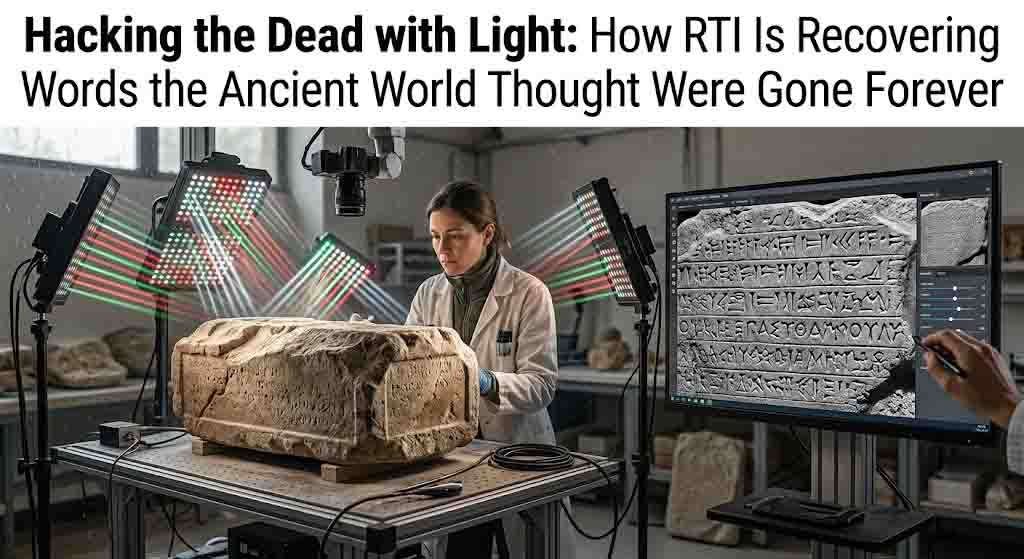
The process begins with a fixed camera positioned above a stationary artifact. A point light source — a single flash or portable lamp — is then moved systematically around the object along the perimeter of what researchers describe as a “virtual hemisphere,” striking the artifact’s surface from dozens of different angles and elevations. A typical capture sequence involves between 32 and 48 individual images, each lit from a distinct position. Alone, any one of those images is unremarkable. Combined through specialized software, they form something else entirely.
The software — developed primarily by the nonprofit Cultural Heritage Imaging (CHI) in San Francisco and built on foundational research originally conducted at HP Labs — calculates the precise mathematical relationship between light direction and surface response at every individual pixel in the frame. The output is a single interactive file called a texture map that encodes all of that light behavior. When a researcher opens the file in an RTI viewer, they do not see a static photograph. They see a two-dimensional surface they can relight in real time, dragging a virtual light source to any angle within the hemisphere and watching the object respond dynamically — highlights blooming, shadows migrating, shallow relief rising and falling as the illumination changes.
It is, as one scholar from the University of Southern California’s West Semitic Research Project put it, close to replicating the ancient experience itself: when a Mesopotamian scribe held a clay tablet to read it, he tilted it toward the sun to catch the right angle of light across its wedge-pressed surface. RTI gives us the digital equivalent of that gesture, available to researchers on any continent, at any hour, without ever handling the original object.
The HP Labs Origins and the Unlikely Genealogy of a Discovery Tool
The technology’s origin story has an unexpected protagonist. In 2001, Tom Malzbender, a researcher at Hewlett-Packard Labs, published a paper introducing a method he called Polynomial Texture Mapping (PTM) at the ACM SIGGRAPH conference — the premier annual gathering of computer graphics researchers. Malzbender’s original intent was not archaeological. He was exploring new ways to generate more photorealistic surface rendering for computer graphics applications. His co-author Daniel Gelb happened to be the grandson of I.J. Gelb, one of the great pioneers of Sumerian cuneiform studies — a coincidence that reads almost as providence in retrospect.
Cultural heritage institutions recognized the method’s potential almost immediately. Within a few years, CHI had adapted PTM into what became the broader RTI framework, releasing open-source capture and viewing tools and beginning to systematically train archaeologists, museum conservators, and classicists around the world. The technique found early purchase at institutions like the Smithsonian Institution’s Museum Conservation Institute, which applied it to paper “squeezes” — molds made of ancient Near Eastern inscriptions from sites that in some cases no longer exist — and at the Metropolitan Museum of Art, which co-hosted a major RTI symposium with CHI in 2017.
The Smithsonian’s Squeeze Project alone produced nearly 400 interactive RTI examples of Arabic script, Middle Persian, and Cuneiform inscriptions from archaeological sites across the ancient Near East, creating a permanent digital record of physical impressions whose originals are fragile beyond normal use. As the MCI noted in its documentation of the project, some of these squeezes represent primary intellectual resources from sites that have since been destroyed — making the RTI files not supplemental records, but the only surviving access point to that information.
Reading What Cannot Be Read: Cuneiform, Dead Sea Scrolls, and the Problem of Texture
The technology’s most arresting applications involve artifacts where texture, not ink, is the primary carrier of meaning. Cuneiform — the wedge-shaped writing system pressed into clay tablets across Mesopotamia for more than three millennia — is precisely this kind of surface. A photograph of a cuneiform tablet taken under diffuse or flat lighting is, in many cases, literally unreadable. The wedges are shallow, the surface aged, and the human eye requires the play of raking light to resolve their positions and shapes. As Todd Hanneken, writing for a Brill academic anthology on ancient digital culture, explained, a single angle of illumination can sometimes make an entire tablet readable — but often different sections of the same tablet require different lighting angles to resolve properly. RTI solves this by computing the texture of every pixel simultaneously across the full hemisphere of possible light positions, allowing researchers to hunt across the surface interactively.
The University of Southern California’s West Semitic Research Project (WSRP), led by biblical scholar and imaging expert Bruce Zuckerman, maintains InscriptiFact — an online library of more than 40,000 digital images of ancient inscriptions and manuscripts ranging from early cuneiform to the Dead Sea Scrolls. RTI images within InscriptiFact have allowed researchers to resolve details like the thickness of individual ink strokes on Dead Sea Scroll fragments, revealing not just letters but the physical practice of a scribe at work: the pressure variation in a single character, the width of a split-nib pen, the dried texture of animal skin beneath 2,000-year-old ink.
One documented example from the USC collection involves a 4,000-year-old administrative cuneiform tablet. Under normal photographic conditions, the seal impression endorsing the tablet — confirming its official status — was barely visible and its design completely indecipherable. Under RTI’s specular enhancement mode, the seal design resolved with dramatic clarity and the inscribed name of its owner became legible for the first time in four millennia. The object had not changed. Only the light had moved.
Herculaneum, Vindolanda, and the Graffiti That Survival Forgot
At Herculaneum — Pompeii’s smaller, arguably more affluent neighbor, buried by the same Vesuvian eruption in 79 CE — more than 8,000 pieces of ancient graffiti have been recorded across the walls of both cities. These are not monumental inscriptions. They are the casual, ephemeral voices of ordinary people: merchants, soldiers, women, enslaved individuals, all of them writing in the margins of public and private life. The wall plaster that preserves them is friable. Since excavation in the 18th through 20th centuries, exposure to the elements has been eroding the graffiti at a measurable and alarming rate.
The Herculaneum Graffiti Project has deployed RTI specifically to document and decipher these inscriptions before they disappear entirely. Researchers found that RTI was particularly effective at resolving individual letterforms — the critical unit of decipherment — especially where plaster damage had obscured or partially destroyed characters. The technique also enhanced surface color and texture simultaneously, allowing the wall plaster’s condition to be assessed alongside the inscription itself, integrating conservation documentation with epigraphic recovery in a single imaging session.
At Vindolanda, the challenge is different but the stakes are just as high. The Centre for the Study of Ancient Documents (CSAD) at Oxford, in conjunction with the British Museum, has applied RTI to hundreds of the Roman writing tablets. The stylus tablets — those where text was pressed into wax rather than written in ink — present a particular problem: the wax is long gone, leaving only faint ghost impressions in the underlying wood, far too shallow for standard photography to resolve reliably. RTI has enabled researchers to read tablets that were previously catalogued as blank or illegible. A 2023 collaboration between researchers from Western University, the University of Nottingham, and Oxford’s Roger Tomlin, examining previously unpublished stylus tablets using a combination of RTI and 3D laser scanning accurate to approximately 30 microns, recovered a fragmentary bill-of-sale for an enslaved person — a document type rare enough in Roman Britain to constitute a significant historical find, now deciphered from wood that survived buried for two thousand years.
Specular Enhancement, Normal Maps, and the Visual Vocabulary of RTI
Researchers working with RTI files do not simply drag a light source around. The software provides a set of computational enhancement modes that transform the raw interactive image into analytically specialized views, each designed to foreground different classes of surface information.
Specular enhancement, perhaps the most powerful mode for inscription work, mathematically amplifies the reflective response of the surface, making shallow relief details — the barely-there impression of a worn seal, the ghost of an erased letter — flash into visibility against the surrounding plane. The effect on certain surfaces can be startling: details invisible to extended naked-eye examination resolve almost instantaneously when specular enhancement is applied.
Normal visualization renders the surface as if it were uniformly matte and lit from directly above, using the mathematically derived normal vectors at each pixel to produce a shaded relief map of the surface’s three-dimensional topography. It removes color and stain information entirely, reducing the surface to its pure geometry — useful for artifacts where discoloration or patina is visually competing with incised marks, and for generating clean line drawings for publication.
Diffuse gain enhances the matte reflective component of the surface, useful for artifacts like textiles or paper where specular enhancement would be meaningless. A non-reflective surface can even be given a metallic rendering quality to increase the legibility of its fiber structure. As the Smithsonian’s MCI documentation notes, RTI can produce usable surrogates of objects ranging from smaller than a coin to larger than an easel painting, and its non-destructive, non-contact nature makes it suitable for objects whose fragility prohibits handling.
The Horizon: Spectral RTI, 3D Expansion, and Open Science
RTI’s current frontier lies in two directions. The first is spectral integration. Standard RTI captures surface topography and reflectance behavior, but does not differentiate between wavelengths of light. Spectral RTI — combining RTI’s multi-angle illumination with multi-spectral imaging’s wavelength discrimination — can distinguish ink traces from parchment corrosion at a chemical level, identifying the ghostly signature of letters that have been physically washed or scraped away. As Hanneken’s research documented, spectral RTI makes it possible to detect the corrosion of parchment where ink once sat — the molecular memory of a word — even when no visible trace remains. Manuscripts previously dismissed as thoroughly erased palimpsests become legible again.
The second direction is volumetric. Standard RTI is a 2.5D technique: it captures surface topography but renders it as a two-dimensional image. Researchers at institutions including the MDPI-published Virtual RTI (V-RTI) project have begun integrating RTI data with photogrammetry and structured-light 3D scanning to produce genuinely three-dimensional relightable models of objects too large or too architecturally embedded for standard dome capture — including carved wall sections at the Museo Egizio in Turin’s Chapel of Ellesiya, an entire inner wall of an ancient Egyptian rock-cut chapel that conventional RTI geometry made impossible to image.
All of this is being built, in significant part, on open-source tools. The RTIBuilder and RTIViewer software developed by CHI are freely available. The InscriptiFact database at USC is open to the public. The FSU Digital Repository hosts downloadable PTM files of cuneiform tablets. The democratization embedded in RTI’s technical architecture means that a researcher at a small institution with a DSLR camera, a portable flash, and a black reflective sphere can produce imaging data that would have required a laboratory of specialists twenty years ago.
When Light Becomes the Only Witness
What RTI ultimately represents is a renegotiation of what counts as lost. For most of recorded history, the standard of legibility has been the human eye under available light — and anything that fell below that threshold was categorically gone. Worn away. Erased. Gone. RTI insists that threshold was always artificial. The surface was never silent; it simply needed the right question, the right angle of light, and the mathematics to synthesize what no single viewing position could reveal.
The Vindolanda tablets, the Herculaneum graffiti, the cuneiform seals, the Dead Sea Scroll fragments — these objects survived the centuries. They waited in mud and ash and controlled museum environments for the instrument that could properly interrogate them. That instrument arrived from a computer graphics lab in Palo Alto in 2001, refined by a nonprofit in San Francisco, and is now being applied by researchers in Oxford, Los Angeles, Turin, and Hadrian’s Wall.
The light was always there. We finally learned how to move it.
Sources
- Cultural Heritage Imaging (CHI). “Reflectance Transformation Imaging (RTI).” https://culturalheritageimaging.org/Technologies/RTI/
- Smithsonian Institution, Museum Conservation Institute. “Reflectance Transformation Imaging.” https://mci.si.edu/reflectance-transformation-imaging
- Malzbender, T., Gelb, D., & Wolters, H. (2001). “Polynomial Texture Maps.” ACM SIGGRAPH 2001 Proceedings.
- Hanneken, T.R. (2016). “New Technology for Imaging Unreadable Manuscripts and Other Artifacts: Integrated Spectral Reflectance Transformation Imaging (Spectral RTI).” In Ancient Worlds in a Digital Culture, Brill. https://jubilees.stmarytx.edu/Hanneken(2016)NewTechnologyImaging.html
- Zuckerman, B. “New Eyeballs on Ancient Texts.” Biblical Archaeology Review, Biblical Archaeology Society. https://www.biblicalarchaeology.org/daily/archaeology-today/archaeological-views-new-eyeballs-on-ancient-texts/
- Benefiel, R. et al. “Application of Reflectance Transformation Imaging (RTI) to Ancient Graffiti from Herculaneum, Italy.” Journal of Archaeological Science: Reports, ScienceDirect, 2017. https://www.sciencedirect.com/science/article/abs/pii/S2352409X16308136
- Centre for the Study of Ancient Documents, University of Oxford. “Romano-British Writing Tablets 2023–2028.” https://www.csad.ox.ac.uk/rti
- Meyer, A., Mullen, A., Tomlin, R. “Illuminating the Vindolanda Tablets.” LatinNow Project Blog, 2021. https://latinnow.eu/2021/11/15/illuminating-the-vindolanda-tablets/
- Wikipedia. “Polynomial Texture Mapping.” https://en.wikipedia.org/wiki/Polynomial_texture_mapping
- Turco, G. et al. “The Use of Virtual Reflectance Transformation Imaging (V-RTI) in the Field of Cultural Heritage.” Applied Sciences, MDPI, 2024. https://www.mdpi.com/2076-3417/14/11/4768
- British Museum. “Making the Vindolanda Tablets.” https://www.britishmuseum.org/research/projects/making-vindolanda-tablets