Six hundred miles above the Mojave Desert, on May 22, 2023, a small device the size of a shoebox did something that would have seemed like pure science fiction a generation ago. It captured solar energy in the vacuum of low Earth orbit and beamed a detectable signal of that power back to the rooftop of an engineering building on the Caltech campus in Pasadena. No clouds. No atmospheric loss. No day-night cycle. Just clean, continuous photons harvested where the sun never sets, converted to electricity, and transmitted wirelessly back home.
That experiment — part of Caltech’s Space Solar Power Project and conducted aboard the SSPD-1 satellite launched January 2023 — marks what may be remembered as one of the quiet inflection points in energy history. Not the explosion of a bomb or the ignition of a reactor, but the lighting of two LEDs in orbit, powered by microwaves steered by silicon chips no thicker than a credit card. The implications, however, are anything but modest. What stands between that rooftop detection and a civilizational shift in how humanity powers itself is, fundamentally, a materials problem. And the race to solve it is one of the most technically demanding endeavors in modern science.
Why Space Solar Is Different From Everything Else We’ve Built
The appeal of space-based solar power (SBSP) begins with a simple physical fact: sunlight in geostationary orbit (GEO), approximately 22,000 miles above the equator, arrives at a constant flux of roughly 1,366 watts per square meter. Compare that to the Earth’s surface, where atmospheric interference, cloud cover, and the day-night cycle reduce practical yield to a fraction of that figure. Ground-based solar installations in the best locations on Earth average effective solar exposure of perhaps four to six hours per day. In GEO, a solar array receives uninterrupted sunlight for more than 99% of the year (Joule, 2025).
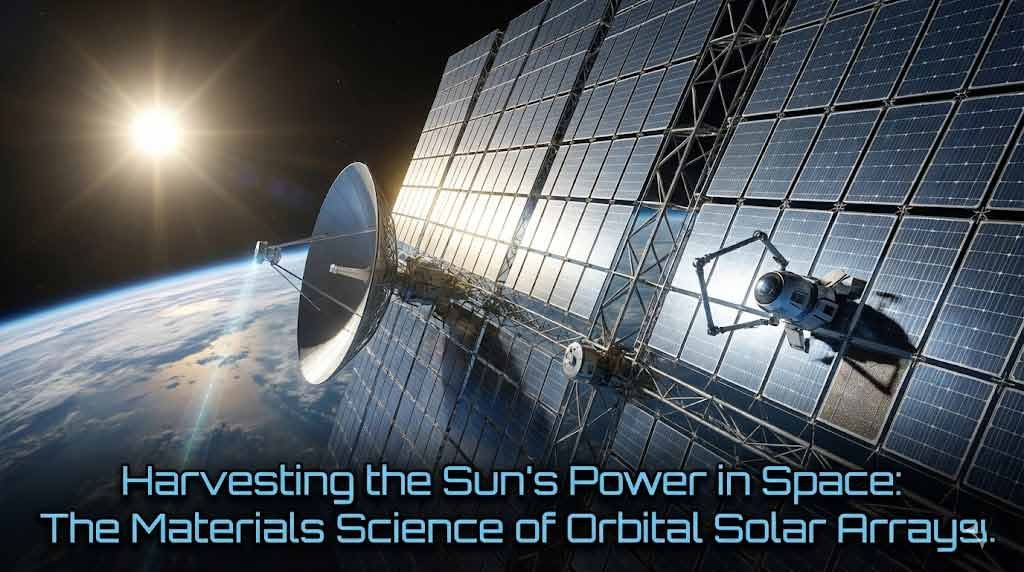
But capturing that abundance and returning it to Earth is not a matter of scaling up terrestrial photovoltaics and bolting them to a rocket. Every material, every junction, every structural element must survive an environment that punishes unprotected matter with a savagery that has no parallel on Earth’s surface. Proton bombardment from the Van Allen belts. Electron flux at doses that would degrade standard silicon cells within months. Thermal swings from +120°C in direct sunlight to -160°C in eclipse, cycling multiple times per orbit. Micrometeoroid impacts at velocities exceeding 10 kilometers per second. The materials that can survive all of that — and still convert sunlight to electricity with high efficiency — represent the bleeding edge of photovoltaic science.
The Gallium Arsenide Standard: Decades of Orbital Dominance
Silicon, the workhorse of terrestrial solar, is a reasonable photovoltaic material at sea level. In space, it is largely inadequate. Its radiation tolerance degrades rapidly under the electron and proton flux of orbital environments, and its efficiency at elevated temperatures falls off more sharply than alternatives. The space industry recognized this limitation decades ago.
The first known deployment of gallium arsenide (GaAs) solar cells in space traces back to the Soviet Venera 3 mission in 1965 (Wikipedia, Gallium Arsenide). By the 1990s, GaAs had displaced silicon as the dominant photovoltaic technology for satellite applications — including the Hubble Space Telescope’s arrays, upgraded during the 2002 Servicing Mission 3B with GaAs panels replacing earlier silicon units (PMC, Overview of GaAs-Based Solar Cells).
What makes GaAs remarkable is its combination of properties. Its direct bandgap of 1.42 eV sits close to the theoretical optimal for solar energy conversion. Its high optical absorption coefficient means effective conversion can occur in layers far thinner than silicon requires. And critically, its resistance to radiation damage — particularly from high-energy protons and electrons — is substantially superior to silicon’s, making it better suited to the sustained punishment of orbital service.
The real breakthrough, however, came not from single-junction GaAs alone, but from multi-junction architectures that stack multiple semiconductor materials atop one another, each tuned to capture a different slice of the solar spectrum. A triple-junction cell consisting of indium gallium phosphide (InGaP) on top, GaAs in the middle, and germanium (Ge) at the base can harvest photons across a broader wavelength range than any single material can manage. Under concentrated sunlight, multi-junction III-V cells have demonstrated efficiencies exceeding 40% in laboratory settings (Journal of Applied Physics, 2021). Commercial InGaP/GaAs/Ge cells achieve approximately 29-30% under AM0 conditions — the unfiltered solar spectrum of space — compared to 20-25% for terrestrial silicon panels.
In 2022, Rocket Lab unveiled a solar cell achieving 33.3% efficiency based on inverted metamorphic multi-junction (IMM) technology, where the growth sequence is reversed to permit better lattice matching and thus lower defect density — an architectural refinement that allows access to efficiency levels previously out of reach (Wikipedia, Gallium Arsenide).
The Weight Problem: Why Every Gram Is Negotiable
Efficiency is not the only criterion that matters. For a space-based solar power system, the cost of transportation to orbit dominates every economic calculation. At current launch prices — even in the SpaceX era where costs have fallen dramatically — lifting mass to geostationary orbit remains expensive enough that conventional, rigid GaAs panels backed on heavy substrates are prohibitively massive for the kilometer-scale arrays that SBSP ultimately requires.
A 2024 NASA Office of Technology, Policy, and Strategy report assessed the levelized cost of energy (LCOE) for representative SBSP designs and found that reducing mass — through lightweight materials, flexible substrates, and electric propulsion for orbital transfer — represents the single most powerful lever for cost reduction (NASA OTPS, 2024). The target is a specific power metric measured in watts per kilogram. Every kilogram that reaches GEO carries a launch cost attached to it; materials that can generate more watts per gram of structure directly translate to economic viability.
This is driving intense development of thin-film photovoltaics for space applications. NASA, working alongside X-Arc and Ascent Solar, has advanced ultralight solar arrays using thin-film materials — panels that are flexible enough to roll into a compact launch configuration and durable enough to survive deployment in the orbital environment (CFC Solutions, 2025). Copper indium gallium selenide (CIGS) thin-film cells have attracted particular interest because their radiation resistance is exceptional, partly due to a self-healing mechanism in which copper mobility within the material promotes defect relaxation after radiation damage — a phenomenon with no parallel in conventional semiconductor physics (ScienceDirect, Perovskite Radiation Studies, 2023).
The CIGS trade-off is efficiency: current best-in-class CIGS cells reached 23.64% power conversion efficiency in 2024 (ScienceDirect, Technical Challenges of SSPS, 2024), meaningfully below what multi-junction III-V cells can achieve. For applications where mass is the constraint, that trade-off may be acceptable. For maximum power density, it is not. This is why the field is not converging on a single material solution but exploring a portfolio of approaches calibrated to different mission requirements.
The Perovskite Challenger: Promise, Problems, and a Surprising Twist
Metal halide perovskites have become the fastest-improving class of photovoltaic materials in the history of the field. In laboratory settings, perovskite solar cells have exceeded 26% power conversion efficiency (ScienceDirect, Technical Challenges, 2024), and perovskite-silicon tandem architectures are pushing past 29% with a trajectory that suggests further headroom. For terrestrial applications, the challenge has been stability — perovskites can degrade rapidly in the presence of moisture and atmospheric oxygen, limiting their commercial viability despite impressive laboratory numbers.
In space, the calculus inverts in a way that surprised researchers. Caltech’s Space Solar Power Project ran an ALBA experiment aboard SSPD-1, deploying 32 different types of photovoltaic cells in orbit to measure real-world degradation under space conditions. Among the findings: while perovskites face radiation damage from high-energy particles, the absence of water vapor and atmospheric oxygen in space removes their dominant terrestrial failure mechanisms entirely. Harry Atwater, the Caltech professor who led the ALBA experiments, described perovskites as showing considerable promise for space applications precisely because the vacuum environment neutralizes their weakness while the absence of convective cooling makes their thermal management more manageable than on Earth (IEEE Spectrum, 2024).
Subsequent orbital testing has extended this finding. Research published in early 2025 showed perovskite solar cells operating for months in low Earth orbit and tolerating radiation doses equivalent to decades of service in the space environment — a result that positioned perovskites as a credible challenger to the GaAs standard for certain mission profiles (Nanowerk, 2025). The combination of potentially lower production cost, comparable radiation tolerance in certain conditions, and the ability to tune bandgap through composition changes makes perovskites a serious contender in the next generation of space photovoltaics.
Structural Materials and the Thermal Engineering Challenge
The photovoltaic cell is only one component of an orbital solar array. The structural framework that holds it in precise orientation, the flexible substrate it is bonded to, the interconnects that route current to a power conditioning system, and the thermal management architecture that prevents overheating — each of these represents a distinct materials engineering challenge.
Caltech’s DOLCE experiment (Deployable on-Orbit ultraLight Composite Experiment), flown on the same SSPD-1 mission, tested a novel ultra-lightweight composite structure designed to fold into a one-cubic-meter package and unfurl into a flat panel nearly 1.8 meters on a side. The successful deployment over the Canadian Arctic on September 29, 2023 validated an architecture based on TRAC (Triangular Rollable And Collapsible) longerons and battens — carbon fiber composite elements with a biomimetic folding geometry inspired by plant structures that can roll up without accumulating the stress fractures that plague conventional hinged deployables (Caltech SSPP, 2023).
Thermal management in orbit is a paradox of extremes. When facing the sun, arrays must dissipate excess heat without active cooling systems — there is no convective medium in the vacuum of space. When passing through eclipse, they must survive plunges to temperatures that would embrittle conventional polymers and crack conventional encapsulants. The solution lies in selective surface coatings: materials engineered with high solar absorptivity on the photovoltaic side and high thermal emissivity on the back side, allowing passive radiative cooling to maintain operating temperatures within acceptable bounds. Aluminum and its alloys remain foundational here for structural elements because of their well-characterized behavior over decades of orbital service, but advanced polymer composites — particularly carbon fiber reinforced polyimides — are displacing aluminum wherever mass reduction justifies the manufacturing complexity.
Wireless Transmission: The Materials Science at the Other End of the Chain
Generating power in orbit is only half the problem. Returning it to Earth requires converting electricity to microwave or laser radiation, beaming it across tens of thousands of kilometers of atmosphere, and reconverting it at a receiving station on the ground with minimal losses at each step.
Caltech’s MAPLE experiment demonstrated that flexible, lightweight microwave phased array transmitters built from silicon CMOS integrated circuits — low-cost commercial semiconductor technology — can operate in the orbital environment and steer energy beams without mechanical moving parts (Caltech SSPP, 2023). The transmitter arrays used constructive and destructive interference between individual antenna elements to focus energy directionally, a technique that scales from pocket-sized prototypes to eventually kilometer-scale apertures without changing the fundamental physics. Ali Hajimiri, who led the MAPLE development, noted that working at 10 GHz rather than the Wi-Fi band (2-6 GHz) reduces the size of both the space-based transmitter and the ground-based receiver by a factor of four — a direct consequence of diffraction physics that makes the choice of operating frequency a materials and systems co-optimization problem (IEEE Spectrum, 2024).
At the receiving end on Earth, large rectenna arrays convert microwave energy back to DC electricity. The efficiency of this conversion has been demonstrated above 85% in laboratory conditions, meaning that the wireless transmission link — while lossy by photovoltaic standards — is not the fundamental bottleneck in the energy chain. The bottleneck remains the cost and mass of the space segment: the photovoltaic cells, the structural framework, and the transmitter array that must collectively survive decades in orbit while justifying their launch cost through continuous energy generation.
A 2025 study published in Joule projected that a distributed 10 GHz space solar power system, given ten years of technology development and cost learning curves, could deliver electricity at approximately 9.4 cents per kilowatt-hour — approaching cost-competitiveness with the cheapest clean energy sources available (Joule, 2025). The optimistic assumptions in the NASA OTPS analysis suggest that with concurrent improvements in launch cost, solar cell efficiency, and manufacturing scale, LCOE could fall to 3 cents per kWh — a figure that would make space solar power not just viable but transformative (NASA OTPS, 2024).
The Geopolitical Dimension and What Comes Next
The competitive landscape surrounding orbital solar is not limited to academic laboratories. China, Japan, the United States, and the European Space Agency have all committed research resources to space-based solar power programs. The UK-based Space Solar initiative has tested modular arrays capable of 360-degree wireless power transmission. Aetherflux, an American startup, is pursuing solar-powered orbiting data centers with a planned launch in 2027. Star Catcher pilots, launched January 7, 2026, are scaling power transmission to LEO satellites and data centers (Aerospace & Defense News, 2026). The investment pace is accelerating, and the materials science enabling these programs is advancing in lockstep.
What Peter Glaser proposed in a 1968 paper — a massive orbiting structure beaming solar power to Earth — was not wrong in concept. It was simply premature by half a century. The materials did not exist. The launch economics were untenable. The semiconductor architectures had not been invented. Today, inverted metamorphic multi-junction cells push past 33% efficiency on flexible substrates. Perovskites demonstrate months of orbital service with radiation tolerance equivalent to decades. Carbon composite deployable structures unfurl from a cubic meter package to cover tens of square meters. Silicon CMOS chips steer microwave beams from orbit to a building rooftop in Pasadena.
The unseen details — the crystal perfection of an epitaxially grown GaInP layer, the copper mobility that heals radiation defects in a CIGS film, the precisely timed interference pattern that focuses a microwave beam without a single moving part — are where the real story of orbital solar is written. It is always the unseen details that determine whether something extraordinary becomes ordinary, or remains a footnote. The materials scientists working at this frontier are writing the next chapter of energy history one nanometer at a time.