Every discipline that demands mastery eventually produces its own pilgrimage. Chefs seek out Bocuse d’Or. Sommeliers travel to the Rhône for harvest. And leatherworkers — the ones who still hand-stitch, who still argue over the weight of a hide, who still believe that a properly made briefcase should outlast two generations — they travel to Sheridan, Wyoming. To Milan. To Salina, Kansas. To Baltimore. They go where the craft is taken seriously. Where a hand-carved panel is judged not for novelty but for the depth of its cut, the confidence of its line, the discipline it takes to repeat a pattern at midnight when you’ve already been at the bench for twelve hours.
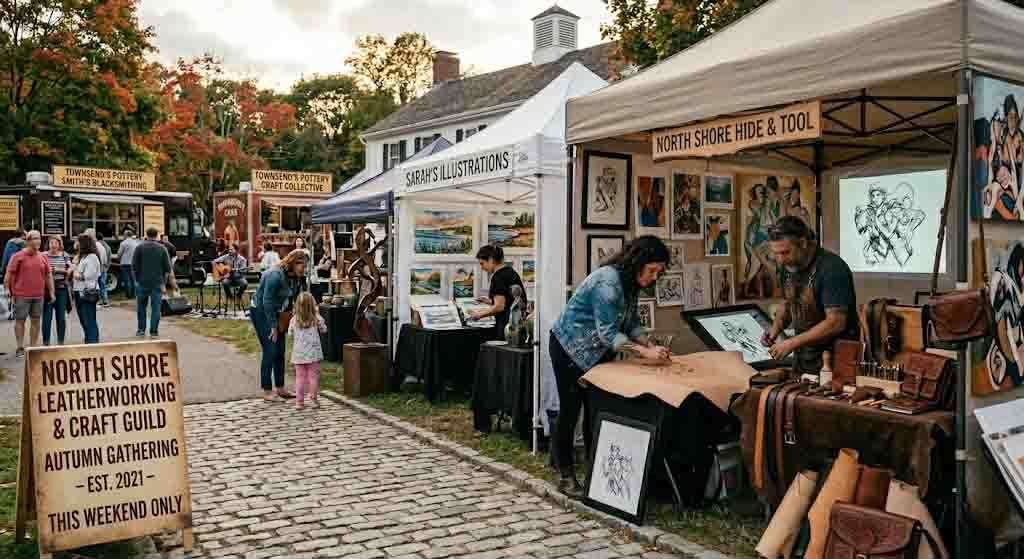
These are not hobbyist swap meets. The top leatherworking and master craft fairs in the world function more like academic conferences held in leather and candlelight — where knowledge is traded, standards are kept, and the next generation of makers is quietly being shaped. For collectors of hand-stitched goods, for buyers in search of a briefcase or handbag that will never be replicated, for craftspeople committed to the long study of their trade, these events are essential geography.
What follows is a close look at the most significant of them.
Lineapelle, Milan — The Cathedral of Leather
There is no more authoritative gathering of the leather world than Lineapelle, the international exhibition held twice a year at Fiera Milano Rho in Milan, Italy. Launched in 1981, it has become the premier showcase for leather, accessories, components, and synthetics for footwear, leather goods, garments, and automotive and furniture markets. It occupies more than 46,000 square meters of exhibition space and draws a rigorously credentialed audience — registered trade operators only, with free admission for qualified industry professionals.
The February 2025 edition drew over 1,100 exhibitors from 40 nations and approximately 25,000 visitors, including more than 18,800 buyers from 112 countries (Lineapelle Fair, 2025). The September 2025 edition ran September 23–25, maintaining the same format and scale at Fieramilano Rho. The next edition is slated for February 11–13, 2026.
What distinguishes Lineapelle is not its size alone but its architecture of purpose. The Trend Areas — located in Halls 1, 4, and 7 — display upward of 2,000 curated items representing the finest material innovations across tanneries and accessory manufacturers worldwide. Photography is strictly prohibited in these areas, which speaks to the competitive intelligence contained within them. Designers from Hermès, Chanel, and virtually every luxury house on the planet use Lineapelle as both a sourcing ground and a compass for the coming seasons. The fair also hosts satellite events in New York and London, extending its reach across the Atlantic for professionals who cannot make the Milan trip.
For anyone whose work begins at the tannery — those who select their own hides, who understand the difference between vegetable-tanned and chrome-tanned, who know what pull-up leather does under pressure — Lineapelle is not optional. It is foundational.
MIPEL The Bag Show, Milan — Where the Finished Object Takes the Stage
If Lineapelle is where the raw material speaks, MIPEL is where the finished object takes the stage. Now in its 128th edition as of 2025, MIPEL — held at Fiera Milano Rho concurrently with Micam Milano — is the most important international trade event dedicated specifically to leather goods and fashion accessories. Organized by Assopellettieri with the support of the Italian Ministry of Foreign Affairs and the ITA-Italian Trade Agency, the fair draws over 200 brands from 18 or more countries across its 4,000-square-meter exhibition path (MIPEL Official Catalogue, 2025).
The February 2025 edition ran February 23–25 at Fiera Milano Rho, presenting Fall-Winter 2025/26 collections across handbags, briefcases, wallets, luggage, and accessories from both historic Italian houses and emerging international designers. The September 2025 edition ran September 7–9, presenting Spring-Summer 2026 collections — dates shifted forward specifically to accommodate construction work at the venue in preparation for the 2026 Milan Winter Olympics. The next edition returns to its standard calendar: February 22–24, 2026.
Among MIPEL’s notable ongoing features is the “MIPEL Factory” initiative, produced in collaboration with the Arsutoria school. The Factory is an interactive workshop installed within the fairgrounds where visitors watch live demonstrations of leather goods production — stitching, cutting, edge finishing — using both traditional technique and state-of-the-art machinery equipped with AI-guided vision systems. Attendees leave with a personalized leather accessory stamped with their initials. The initiative is a conscious statement: that craft and technology are not in opposition, but in conversation.
The Italian leather goods sector, represented largely through MIPEL’s exhibitor base, reported 2025 turnover of approximately 11.4 billion euros — a 4.9 percent decrease from the prior year — though industry leadership expressed cautious optimism for the second half of 2026 as collections and market conditions stabilize (WWD, February 2026). Stars Avenue, a new feature introduced at the most recent edition, honors brands that have participated in every MIPEL edition for over a decade — a quiet acknowledgment that longevity in the craft world is itself a form of distinction.
The Rocky Mountain Leather Trade Show, Sheridan, Wyoming — America’s Most Respected Leather Gathering
Held annually since 1990 and hosted by the Leather Crafters and Saddlers Journal, the Rocky Mountain Leather Trade Show at Sheridan College in Sheridan, Wyoming is the United States’ most respected dedicated leatherworking event. The 30th edition took place May 16–18, 2025, drawing dozens of vendors and craftspeople from across the country to the campus at 1 Whitney Way, Sheridan, WY 82801.
The show functions on three levels simultaneously: it is a vendor fair, a classroom, and a competition floor. Pre-show workshops begin on May 13, allowing participants to spend nearly a week in intensive study before the public doors open. The trade floor runs Friday through Sunday and features tooling suppliers, hardware vendors, custom boot makers, leatherworking tool craftsmen, and finished goods artisans presenting hand-stitched briefcases, sheaths, holsters, saddlery, and accessories. The vendor list for the 2025 edition included established names such as Barry King Tools of Sheridan, Don Gonzales Saddlery out of Moulton, Texas, and a wide representation of custom boot and leatherwork schools.
Among the more distinctive voices at the 2025 show was Olive Parker of Montana Leather Designs, who launched her business fourteen years ago from her garage following a win at the Western Design Conference. Her work — primarily leather jewelry — exemplifies the breadth of what contemporary leatherwork encompasses: it is no longer solely the province of saddles and portfolios, but of ornamentation, wearable art, and objects that challenge the category itself.
The show also hosts the World Leather Debut competition — a juried exhibition in which craftspeople submit pieces for blind evaluation against the highest standards of the discipline. Winning here carries real weight in the leatherworking community. It is the equivalent, for a maker, of placing at a major culinary competition. The recognition travels.
The International Federation of Leather Guilds (IFOLG) Convention — The Global Standard-Bearer
Founded in 1966 and maintaining membership from guilds across multiple continents, the International Federation of Leather Guilds (IFOLG) hosts an annual convention that is unique in the leatherworking world for one specific reason: it is the only organization globally recognized for its capacity to evaluate and formally designate the skill level of a leatherworker. A “Masters Designation” from the IFOLG is among the most credentialed recognitions in the craft — earned through competition and peer evaluation rather than self-declaration.
The 2025 IFOLG Convention, themed “New Horizons,” was hosted by the Wheat State Leather Guild and took place October 6–11 at Tony’s Pizza Event Center, 800 The Midway, Salina, KS 67401. The multi-day format includes classes taught by guild masters, open competitions across categories including handbags, holsters, flat goods, and carved panels, a vendor hall, a raffle, and a formal awards banquet on the final evening — tickets at $50 per person, with an awards ceremony open to all after the banquet dinner.
Competition categories span multiple skill levels, from novice to open division, ensuring that newer makers have a legitimate pathway into judged evaluation without being measured against lifelong masters. Every entry receives written feedback from the judging panel — an unusually generous protocol in competitive craft circles, and one that explains why so many makers return year after year. The goal is not just to judge but to teach. That philosophical distinction is why the IFOLG’s Masters Designation carries the weight that it does.
The Pendleton Leather Show, Pendleton, Oregon — Built for the Working Leathercrafter
Organized by Illume Events, the Pendleton Leather Show takes place at the Pendleton Convention Center and positions itself explicitly as a leathercraft tradeshow designed around the practitioner rather than the observer. The 2026 edition is scheduled for November 4–7, 2026. Attendance is free to the public.
The show brings together some of the most respected specialty suppliers in the industry — leathers, tools, machines, hardware, dyes, patterns, conditioning products, and educational resources — all available for direct hands-on examination and purchase. The Northwest Leather Masters Competition runs concurrently, accepting entries in handbag, chap, saddle, and belt categories, in both novice and open divisions, with expert feedback provided on every submission.
The Pendleton show differentiates itself through its classroom program: four full days of instruction taught by working masters in the industry, covering technique, tool use, design, and finishing. The emphasis is practical and communal — makers working beside makers, asking questions of the people whose work they admire, building the informal network that sustains the craft between events.
American Craft Made Baltimore — The East Coast’s Premiere Juried Craft Market
For collectors and buyers seeking hand-stitched leather goods, accessories, and bespoke objects within the context of a broader American craft tradition, the American Craft Made Baltimore fair — produced by the American Craft Council — is the East Coast’s most respected juried event. The 48th annual edition ran February 21–23, 2025 at the Baltimore Convention Center, featuring nearly 400 juried artists and attracting more than 10,000 attendees (American Craft Council, 2025). The 2026 edition is already scheduled.
Leather goods, accessories, and wearable art appear within the fair’s broader mediums — alongside ceramics, glass, jewelry, fiber, and woodwork — making it a comprehensive exposure to the full range of American studio craft. Makers are juried in through a rigorous selection process, and the annual Awards of Excellence, presented at a Saturday evening reception, recognize outstanding work across Home & Living, Jewelry, and Apparel & Accessories categories.
For the collector who wants to purchase directly from the hand that made the object — who wants to watch the maker explain the grain of the leather, the weight of the hardware, the choice of thread — American Craft Made Baltimore offers that intimacy at scale. Nearly 400 booths, 10,000 attendees, and the quiet authority of a fair that has been running for nearly five decades.
What These Fairs Have in Common — and Why That Matters
Strip away the geography and the formats, and every event on this list shares a single commitment: the defense of standards in a world that increasingly doesn’t require them. Mass production has made goods accessible and interchangeable. AI-assisted manufacturing has accelerated that process. The market responds to speed and price. And yet these fairs continue to fill — continue to attract thousands of professionals, collectors, buyers, and craftspeople who understand that the object made with full intention and hand-skill carries a weight that the replicated object simply cannot hold.
A hand-stitched saddle-stitch running along the gusset of a briefcase is not merely decorative. It is structurally superior to machine stitching — when one thread breaks, the saddle-stitch does not run. The grain selected at Lineapelle, the hide pulled from a J&E Sedgwick tannery in Walsall, the burnished edge finished by hand at a bench in Pendleton or Milan or Sheridan, Wyoming — these details exist on a spectrum of intentionality that the buyer eventually feels, even when they cannot name what they’re feeling.
These fairs are where that intentionality is cultivated, compared, challenged, and ultimately celebrated. They are not anachronisms. They are the standard by which everything else is measured.
Sources:
- Lineapelle Fair Official Site: lineapelle-fair.it
- Lineapelle Milan 2025 Attendance Data: trade-fair-trips.com/exhibitions/lineapelle
- MIPEL Official Site: mipel.com
- MIPEL 128 September 2025 Details: fashionunited.uk
- MIPEL Industry Turnover Data: WWD, February 2026
- Rocky Mountain Leather Trade Show: leathercraftersjournal.com
- Rocky Mountain Leather Trade Show 2025 Coverage: The Sheridan Press
- IFOLG Official Site: ifolg.com
- IFOLG 2025 Convention: wheatstateleatherguild.com
- Pendleton Leather Show: pendletonleathershow.com
- American Craft Made Baltimore 2025: craftcouncil.org