
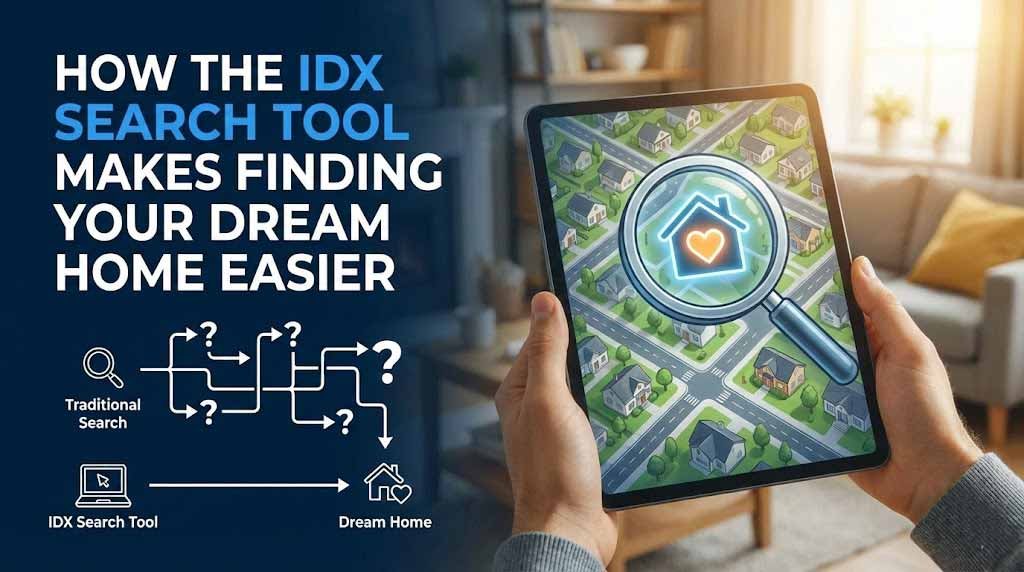
In the digital age of real estate, we are all guilty of “Zillow surfing.” It’s a national pastime. But when it comes time to actually buy a home—to make the largest financial transaction of your life—relying on third-party aggregators can be a mistake.
Serious buyers know that speed and accuracy are everything. In a market where inventory is tight (currently hovering around 3.1 months in Suffolk County), seeing a listing 24 hours after it hits the market often means you’ve already missed the open house.
Enter the IDX (Internet Data Exchange) search tool. It is the gold standard for property search, the direct pipeline to the Multiple Listing Service (MLS), and the secret weapon of savvy homebuyers in 2026. Here is why switching from a “portal” to a professional IDX feed is the upgrade your home search needs.
1. What is IDX? (The “Direct Feed” Advantage)
IDX stands for Internet Data Exchange. It is the policy and software standard that allows real estate brokers to display MLS data on their websites.
- The Aggregator Problem: Sites like Zillow, Trulia, and Realtor.com are advertising platforms. They aggregate data from thousands of sources, which often leads to lags. A home might be marked “Active” on Zillow when it has actually been “Under Contract” for three days.
- The IDX Solution: An IDX feed (like the one used by Paola Meyer at Realty Connect USA) is a direct, synchronized connection to the local MLS. When a listing agent updates a status from “Active” to “Pending,” that change is reflected on the IDX site almost instantly.
- Stat: In fast-moving markets, IDX feeds can update as frequently as every 15 minutes, whereas third-party sites may lag by 24–48 hours. (National Association of Realtors, 2025 Tech Survey).
2. The “No-Ghost” Policy: Accurate Status
Nothing is more frustrating than falling in love with a home online, driving by it, and seeing a “Sold” sign that wasn’t in the photos.
- Shadow Inventory: Third-party portals often leave sold or expired listings up to boost their “inventory numbers” and capture leads.
- The Clean Feed: Because IDX rules are strictly regulated by the local MLS (like OneKey MLS on Long Island), the data must be accurate. If a home is off the market, the IDX tool removes it. You never waste time analyzing a property you can’t buy.
3. Hyper-Local Filtering (Finding the “Needle”)
General search sites use broad, national criteria. They don’t understand the nuances of Long Island zoning or school districts. A professional IDX tool is often customized for the local market.
- School District Search: Instead of just searching by “Town,” you can often search specifically by “School District” (e.g., Mount Sinai vs. Miller Place)—a critical distinction for Long Island families.
- Specific Amenities: Want a home with a “legal accessory apartment” or “boat rights”? IDX filters are often granular enough to catch these specific MLS fields that get lost in the translation on bigger sites.
4. Privacy & “No-Spam” Browsing
When you click “Contact Agent” on a big portal, your information is often sold as a “lead” to multiple agents who pay for that zip code. You might get calls from three different strangers within minutes.
- The Relationship Model: When you use a specific broker’s IDX site (like Paola Meyer’s), your inquiry goes only to that broker. It is a one-to-one relationship. Your data isn’t broadcast to a lead-generation network; it is treated as a private client request.
5. The “Market Watch” Advantage
The best IDX tools don’t just show you homes; they show you the market.
- Sold Data: You can often view recent “Solds” in your target neighborhood to understand pricing trends before you make an offer.
- Instant Alerts: Because the data is real-time, setting up a “Saved Search” on an IDX site means you get the email the second the house hits the market—often hours before it pushes to the public apps.
Conclusion: Search Like a Pro
If you are just browsing for design ideas, the big apps are fine. But if you are pre-approved and ready to write an offer, you need professional-grade data.
Using an IDX tool is like trading a delay-ridden cable broadcast for a live fiber-optic feed. In the 2026 Long Island market, where “days on market” is the defining metric, that speed is your competitive advantage.
Watch: IDX vs. Zillow – What’s the Difference? For a visual explanation of how the data pipeline works and why “Direct to MLS” matters, this breakdown is essential viewing.
Real Estate Data Explained: MLS vs. Zillow
Ready to start your search?
- Search Now: Access the Direct MLS Feed with Paola Meyer
- Local Insight: Stop by the Heritage Diner to fuel up before your open house tour.
- Contact: Paola Meyer, Realty Connect USA for a custom “Market Watch” setup.