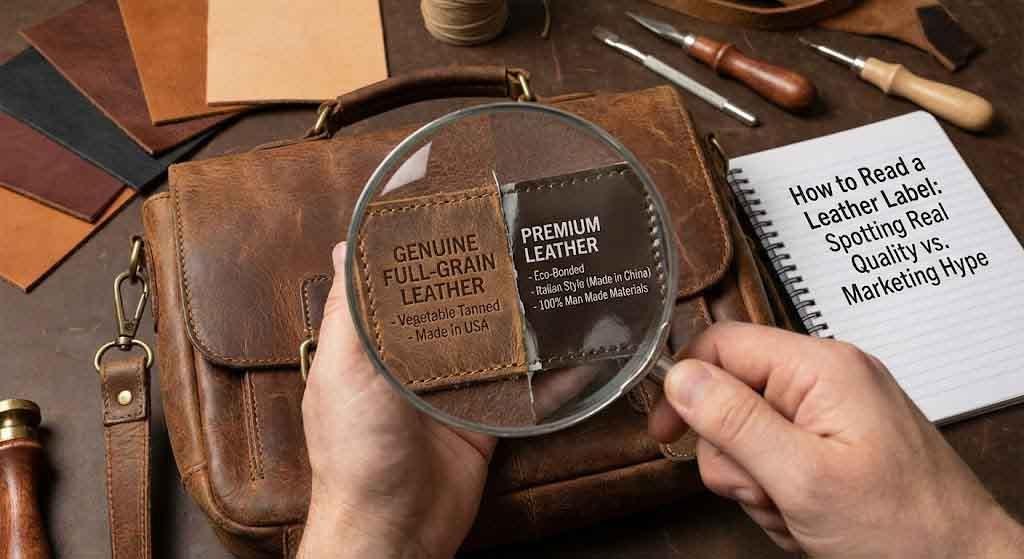
The label reads “Genuine Leather” in elegant gold foil, pressed into the underside of a briefcase that costs more than a decent dinner for two at any restaurant on the North Shore. The stitching looks clean. The hardware gleams. And somewhere between the price tag and the presentation, you have already been deceived. That phrase — “genuine leather” — may be the single most successful marketing sleight-of-hand in modern retail, a term engineered to sound like a guarantee of quality while actually signaling its near-absence. In a marketplace drowning in synthetic finishes, polyurethane coatings, and algorithmic advertising, understanding what a leather label truly communicates is no longer a luxury. It is a survival skill.
I write this as someone who has spent years selecting hides for Marcellino NY, my bespoke English bridle leather briefcase workshop in Huntington, where every piece is hand-cut, hand-stitched, and built to outlast the career of the professional who carries it. I also write this as a man who has spent a quarter century behind the counter at The Heritage Diner in Mount Sinai, where I learned early that the ingredient list is the only honest part of a menu — and that the same principle applies to leather. What follows is a comprehensive guide to decoding the language of leather labels, drawn from the workshop, the tannery, and two decades of working with materials that refuse to lie about what they are.
The Anatomy of a Hide: Understanding Where Quality Begins
Before you can read a label, you must understand the material it describes. A typical cowhide arrives at a tannery between six and ten millimeters thick — far too substantial for any single application. That hide is then split horizontally, much like slicing a side of beef into primal cuts, and each resulting layer carries fundamentally different structural properties (International Council of Tanners, 2020).
The outermost surface — the layer that bore the sun, the fences, the insect bites, the entire biography of the animal’s life — contains the tightest, most densely packed collagen fibers. This is where strength, breathability, and the capacity for patina reside. It is, in every functional and aesthetic sense, the best part of the hide. Products crafted from this undisturbed surface are classified as “full-grain leather.” At Marcellino NY, this is the only starting point that meets our standard, because everything that follows — the hand-stitching, the edge finishing, the months of breaking-in — depends on the integrity of what lies beneath.
Below that surface layer sits a secondary stratum with slightly looser fiber density. And beneath that, the innermost layers — the split, the scraps, the leftovers — which contain almost none of the hide’s original character. The entire grading system of the leather industry is essentially a map of this cross-section, and yet most consumers have never seen it explained clearly, because clarity is not in the interest of manufacturers selling inferior material at premium prices.
For an excellent visual explanation of how hides are split and graded, see Tanner Leatherstein’s educational series on YouTube: https://www.youtube.com/c/TannerLeatherstein
The Hierarchy of Leather Grades: A Field Guide for the Discerning Buyer
The leather industry operates on a grading system that functions, paradoxically, as both classification and camouflage. The terminology sounds authoritative. The reality is considerably more nuanced (Federal Trade Commission, 1996).
Full-Grain Leather sits at the apex. The complete grain surface remains intact — no sanding, no buffing, no correction. Natural markings such as scars, insect bites, and stretch marks are preserved because they represent structural integrity, not deficiency. Full-grain leather breathes, absorbs moisture and oils over time, and develops the rich, deepening patina that collectors and craftsmen prize above all other material properties. When I select J&E Sedgwick English bridle leather for a Marcellino briefcase, I am choosing a full-grain hide that has undergone more than three months of vegetable tanning by hand — a process largely unchanged since 1900 (J&E Sedgwick & Co., 2024). The imperfections are the proof of authenticity. They are, to borrow a culinary metaphor, the char on a properly seared steak: evidence that the real thing was used and that it was handled with knowledge.
Top-Grain Leather occupies the second tier. It originates from the same upper portion of the hide, but the outermost surface has been sanded or buffed to remove natural markings, then typically refinished with a pigment or sealant. The result is a more uniform appearance — smoother, more consistent, and considerably less expensive. Top-grain leather remains a legitimate material; it is used in high-end handbags, upholstery, and footwear by reputable manufacturers worldwide. However, the buffing process removes the strongest, densest fibers, compromising durability and eliminating the capacity for true patina development. A chrome-tanned top-grain bag will look its best on the day you buy it. A full-grain vegetable-tanned briefcase will look its best in five years. That distinction is the difference between fashion and legacy.
Genuine Leather is where the deception begins. Despite its reassuring name, this term typically refers to the lower split layers of the hide — the material left after the premium top portions have been removed for full-grain and top-grain products. These lower layers lack the natural grain structure entirely. Manufacturers compensate by applying heavy polymer coatings and embossing artificial grain patterns onto the surface, creating a product that resembles leather visually while possessing almost none of its essential qualities (Carl Friedrik, 2021). “Genuine Leather” is to quality leather what a laminated countertop is to marble: technically derived from a natural material, structurally irrelevant. The Federal Trade Commission’s guidelines permit this designation as long as the product contains some portion of actual animal hide, but the term communicates nothing about which portion, how it was processed, or how long it will last (16 CFR Part 24).
Bonded Leather occupies the bottom of the hierarchy, and many industry experts argue it should not be called leather at all. This material is manufactured from leather dust and scraps — the detritus of the tanning floor — mixed with polyurethane binders and pressed onto a paper or fiber backing. Most bonded leather products contain between ten and twenty percent actual leather content (LOOMLAN, 2024). They crack, peel, and delaminate within months of regular use. If full-grain leather is a hand-ground Heritage Burger made from local beef, bonded leather is the mechanically separated protein in a gas station hot dog. Both technically come from a cow. The comparison ends there.
The Tanning Divide: Vegetable vs. Chrome and Why It Matters
The tanning method is the second critical variable that leather labels rarely explain, and it may be even more consequential than the grade. Tanning is the chemical process that transforms raw animal hide into usable leather by stabilizing the collagen fibers to prevent decomposition. The method chosen determines virtually everything about the finished product — its feel, its longevity, its environmental footprint, and its capacity to age with grace (Gentleman’s Gazette, 2020).
Vegetable tanning is the ancient method, practiced since approximately 6000 BCE and refined by the Sumerians, the Egyptians, and the master curriers of the English Midlands. The process uses organic tannins extracted from tree bark — oak, chestnut, mimosa — which slowly bond with the collagen over a period of weeks to months. At J&E Sedgwick’s facility in Walsall, England, where my bridle leather originates, the tanning process alone requires twenty-eight days, followed by expert hand-finishing by curriers whose skills trace directly back to the techniques employed when the company was founded in 1900 (Sedgwick & Co., 2024). The leather that emerges is firm-tempered, deeply saturated, and structurally dense. It develops what bridle leather enthusiasts recognize as “bloom” — a white wax that rises to the surface and can be buffed to a magnificent sheen. Vegetable-tanned leather improves with age, absorbing oils and developing complexity in the way that a great cast-iron skillet builds its seasoning: slowly, with use, and irreplaceably.
Chrome tanning, developed in 1858, uses chromium sulfate salts to achieve in hours what vegetable tanning requires months to accomplish. Approximately ninety percent of the world’s leather is now chrome-tanned (Steel Horse Leather, 2025). The result is a softer, more pliable material that accepts dyes readily and resists water more effectively than its vegetable-tanned counterpart. Chrome-tanned leather has legitimate applications — it is well-suited to garments, fashion accessories, and products where suppleness is prioritized over structural rigidity. However, it does not develop patina. It does not age with the same grace. And the environmental cost of chrome tanning — toxic wastewater containing chromium, lead, and formaldehyde, particularly in unregulated tanneries across the developing world — represents a serious ecological concern that labels almost never disclose.
For a balanced and visually detailed comparison of these tanning methods, watch this breakdown from the Gentleman’s Gazette: https://www.youtube.com/watch?v=BkWE_JiVhvI
When you encounter a leather product and the label mentions neither the tanning method nor the specific tannery, treat that omission as information in itself. Craftsmen who invest in vegetable-tanned leather from heritage tanneries — Sedgwick, Wickett & Craig, Conceria Walpier — want you to know about it. Silence on the label usually means chrome-tanned split leather with a corrected grain and a story that cannot bear scrutiny.
The Vocabulary of Deception: Marketing Terms That Mean Less Than You Think
The leather goods industry has developed an entire lexicon of terms designed to evoke quality while communicating nothing legally actionable. Understanding these terms is the consumer’s most practical defense (One 4 Leather, 2024).
“Italian Leather” is perhaps the most abused geographic descriptor in the industry. Italy produces extraordinary leather — the vegetable-tanned hides from Tuscany’s Santa Croce sull’Arno district are among the world’s finest. But the phrase “Italian Leather” carries no legal quality standard. It can describe a masterfully tanned Buttero hide from Conceria Walpier or a cheap chrome-tanned split processed in a factory outside Naples. The origin tells you nothing about the grade, the tanning method, or the quality control. Ask instead for the specific tannery name. Legitimate artisans will tell you. Mass-market brands will not.
“Vegan Leather” is a marketing rebrand of what the industry has long called synthetic leather, PU leather, or faux leather. Research from One 4 Leather found that thirty percent of consumers believe vegan leather is partly made from animal hide, and fifty-five percent believe PU leather contains animal-derived material. Neither is true in the case of fully synthetic products — they are thermoplastic polymers bonded to fabric backing (One 4 Leather, 2024). There are genuinely innovative plant-based leather alternatives emerging — materials derived from pineapple leaves, cactus, mycelium, and cork — but the vast majority of products labeled “vegan leather” are polyurethane plastic with a three-to-five-year lifespan and a petrochemical origin that makes the term “eco-friendly” deeply problematic.
“Hand-Crafted” and “Artisan” have been diluted to near meaninglessness by mass application. At Marcellino NY, hand-stitching means precisely what it says: a craftsman using two needles and a length of waxed linen thread to create a saddle stitch that will not unravel even if a single thread breaks — a structural advantage over machine lock-stitching that constitutes the very foundation of bespoke leatherwork. But “hand-crafted” on a department store label might mean that a single component was handled manually during an otherwise fully automated production line. Without transparency about which specific operations were performed by hand, the term is atmosphere, not information.
“Premium Leather,” “Luxury Leather,” “Fine Leather” — these adjectives modify nothing. They are decorative language with no industry-standard definition, no FTC guidance, and no accountability. They exist to fill the space where a grade specification should be.
The Five-Point Inspection: What to Do in the Store
When you stand in front of a leather product and the label offers nothing beyond vague reassurances, your senses become your most reliable instruments. This is the protocol I teach clients who visit the Marcellino workshop, and it applies equally to a briefcase, a belt, a handbag, or a pair of shoes.
First, read the grain. Turn the product over and examine the surface closely. Full-grain leather will display natural variation — subtle differences in pore density, faint markings, the occasional healed scar. These imperfections are the material’s autobiography. Corrected-grain and genuine leather will present an unnaturally uniform surface, often with a repeating pattern that was mechanically embossed. If every square inch looks identical, you are looking at a corrected or split leather product, regardless of what the label claims.
Second, smell the material. Full-grain vegetable-tanned leather carries a warm, organic, almost sweet aroma — the olfactory signature of natural tannins. Chrome-tanned leather has a fainter, sometimes slightly chemical scent. Synthetic materials produce a distinctly plastic or chemical odor that no amount of conditioner can fully disguise. I often compare this to how you can tell the difference between a real sourdough and a commercially yeasted bread before your first bite: the nose knows what the label hides.
Third, test the flex. Bend the material gently. High-quality leather will wrinkle naturally and recover, the creases catching light differently as the fibers compress and release. It should feel substantial but not stiff, pliable but not limp. Synthetic materials tend to crease sharply and retain the crease, while bonded leather may feel papery or hollow.
Fourth, examine the edges. Unfinished or cut edges reveal the material’s true nature. Full-grain leather will show a consistent, fibrous cross-section with visible density. Split leather appears looser and more fibrous. Bonded leather often exposes a layered structure — the polymer coating clearly distinct from the substrate beneath. On a Marcellino briefcase, the edges are hand-burnished and sealed — a process that takes hours per piece but reveals, rather than conceals, the quality of the material.
Fifth, check the back. If accessible, examine the reverse side of the leather. Full-grain and quality top-grain leather will show a natural suede-like texture on the flesh side. Synthetic and heavily corrected materials will display a fabric or paper backing. This single observation eliminates ninety percent of the uncertainty that labels intentionally create.
For a practical demonstration of these techniques, the Rose Anvil channel on YouTube provides exceptional cross-section analyses of leather products: https://www.youtube.com/c/RoseAnvil
The Economics of Honesty: Why Quality Labels Cost More and Why That Price Is the Point
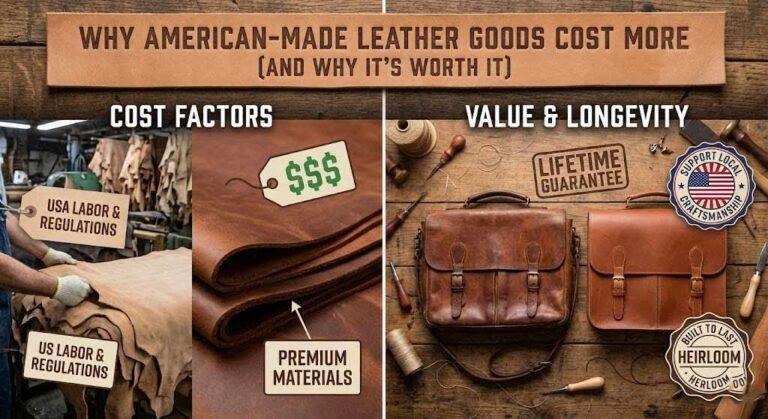
There is a reason that a Marcellino NY briefcase, hand-built from J&E Sedgwick English bridle leather with hand-forged hardware and saddle-stitched seams, costs what it costs. The Sedgwick tannery sources only the highest-quality UK hides, each one tracked by a unique number through the entire process. The vegetable tanning takes twenty-eight days. The hand-finishing by master curriers — craftsmen who must train for years before they are permitted to work independently on a hide — cannot be automated, accelerated, or outsourced. When Wickett & Craig, one of only two remaining vegetable tanneries in the United States, processes their leather at their facility in Curwensville, Pennsylvania, the cycle requires six full weeks (Wickett & Craig, 2024). These timelines, these skill requirements, these supply chain constraints — they are the cost of honesty. And they are the reason that a properly labeled, transparently sourced leather product will always cost more than its corrected-grain, chrome-tanned, deliberately ambiguous competitor.
This principle extends beyond my workshop. It is the same philosophy that guides the sourcing at The Heritage Diner, where after twenty-five years of operation at 275 Route 25A in Mount Sinai, the relationships with local producers are built on the understanding that quality ingredients are never the cheapest option. And it is the principle that will anchor the boutique real estate venture I am developing with my wife Paola for 2026 through Maison Pawli — the conviction that what is built with transparency and craftsmanship accumulates value, while what is assembled from shortcuts and euphemisms eventually fails, peels, cracks, and ends up in a landfill.
The Stoic philosopher Marcus Aurelius wrote that the object of life is not to be on the side of the majority, but to escape finding oneself in the ranks of the insane. In the context of leather goods, the insanity is paying two hundred dollars for a “genuine leather” briefcase that disintegrates in eighteen months when, for a considered investment in full-grain, vegetable-tanned craftsmanship, you acquire a companion that will be carried by your children. The label, honestly read, is the first step away from that insanity. The rest is a matter of choosing to see what was always there.
The Heritage Standard: A Philosophy of Provenance
The leather label, at its best, is a contract between maker and buyer — a declaration of origin, method, and intent. At its worst, it is a costume, a bit of theater designed to simulate authenticity while concealing the absence of it. The difference between the two is not merely economic; it is philosophical. It reflects what we believe about the relationship between time, craft, and value.
In the Marcellino workshop, every briefcase carries a label that specifies the tannery, the grade, the tanning method, and the name of the craftsman who built it. Not because regulation requires it, but because concealment is incompatible with the work. When you invest in bespoke English bridle leather — a material originally developed in fourteenth-century England for aristocratic equestrian use, engineered to withstand the force of a horse in full gallop — you deserve to know exactly what you are holding (GANZO, 2022). And when you encounter a label that refuses to offer the same transparency, you now possess the vocabulary to understand why.
The next time you pick up a leather product and turn it over to read the stamp, remember: in a world of corrected grains and polyurethane coatings, the imperfections are the truth. The scars tell the story. The patina is the proof. And the label — honestly read, critically assessed, and never taken at face value — is where that story begins.
Peter from The Heritage Diner is a restaurateur, bespoke leather craftsman at Marcellino NY, and North Shore community fixture. The Heritage Diner has served Mount Sinai at 275 Route 25A for over 25 years. Visit heritagediner.com for more.