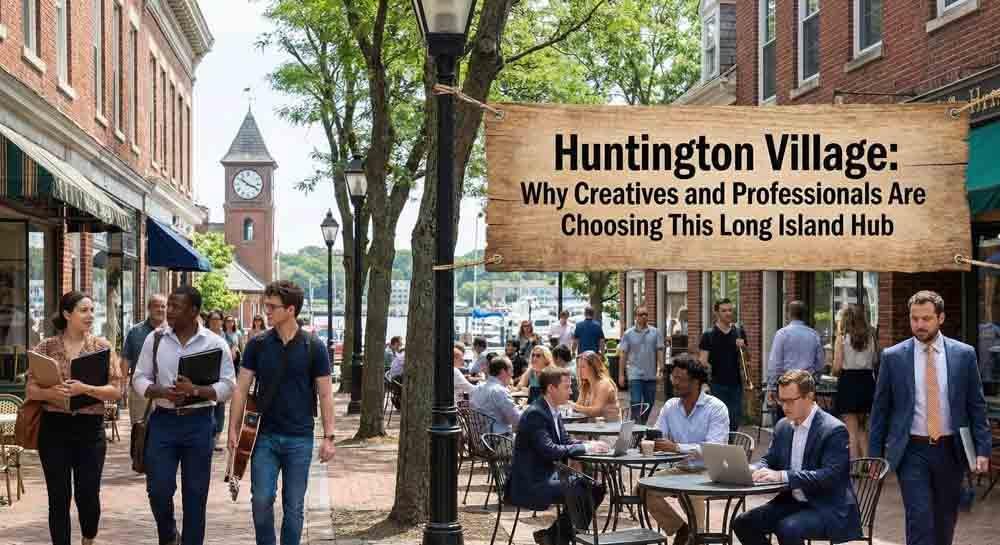
Late‑afternoon light along Main Street in Huntington Village takes on a quality that feels almost ancestral — golden, slanting, filtered through the old‑growth canopy that has watched this hamlet evolve since 1653. It’s the kind of light that makes you understand, in a way that bypasses language and goes straight to the gut, why a place endures: not because it resists change, but because it carries its history in the way the day ends. It is the same quality of light that falls across my workbench at the Marcellino NY workshop just a few blocks away, illuminating the grain of English bridle leather as I hand-stitch a briefcase for a client in Zurich or Beverly Hills. It is a light that speaks of provenance. And provenance, as any craftsman, restaurateur, or broker worth their salt will tell you, is the single most undervalued asset in an age that worships disruption for its own sake.
Huntington Village is not being discovered. It is being recognized. After decades as the North Shore’s quietly sophisticated town center—a place where Finnegan’s has been pouring pints since 1912 and the Heckscher Museum has been exhibiting American art since 1920—the Village is now attracting a new influx of creatives, entrepreneurs, and professionals who are making a deliberate choice. They are choosing texture over transaction. Depth over convenience. A community that was built by hand, and still values the hand that builds.
For someone who has spent twenty-five years running The Heritage Diner in Mount Sinai, watching the rhythms of Long Island’s North Shore from behind the pass, and simultaneously building a global luxury brand in leather craftsmanship from a Huntington workshop, the current momentum in this village is not a trend. It is a correction. The market—whether real estate, culture, or commerce—always returns to authenticity. And Huntington Village has authenticity in its marrow.
The Whitman Inheritance: A Literary and Creative DNA
You cannot understand Huntington’s appeal to the creative class without first reckoning with its literary patrimony. Walt Whitman was born in 1819 in a hand-built farmhouse in West Hills, just south of Huntington Village proper. His father, Walter Sr., was a Quaker carpenter who constructed the two-story cedar-shingled home with his own hands—a fact that resonates deeply with anyone who works in craft (Walt Whitman Birthplace Association, 2024). Whitman went on to found the Long Islander newspaper in Huntington, a publication that still circulates today, making it one of the longest continuously published newspapers in America.
The philosophical throughline from Whitman to the present creative ecosystem in Huntington is not accidental. Whitman wrote in Leaves of Grass about the dignity of labor, the holiness of the tangible world, the radical idea that a blade of grass or a carpenter’s hand contains the cosmos. That ethos—that the particular contains the universal—is the operating principle of every artisan workshop, independent bookshop, and gallery that lines Main Street and New York Avenue today. It is the same principle I apply every time I select a shoulder of J&E Sedgwick bridle leather for a Marcellino briefcase: the specific is where excellence lives.
The Walt Whitman Birthplace State Historic Site, listed on the National Register of Historic Places since 1985, now operates as a museum and interpretive center featuring over 130 Whitman portraits, original manuscripts, and—remarkably—an Edison wax cylinder recording believed to capture the poet’s own voice (New York State Office of Parks, Recreation and Historic Preservation, 2024). It is a pilgrimage site for writers and thinkers. But more importantly, it establishes a cultural DNA that attracts people who believe in the marriage of intellect and craft, of thought and labor. That DNA is Huntington’s most valuable real estate.
Watch: Walt Whitman: Champion of the Common Man — https://www.youtube.com/watch?v=mhAoTbNMH-E
Main Street as Living Workshop: The Artisan Economy in Full Bloom
Walk the length of Main Street on any given Saturday and you will encounter an economic model that most suburban planning committees can only theorize about. Independent boutiques, artisan chocolatiers like Bon Bons, the sprawling Sedoni Gallery with its curated selection of handcrafted jewelry and sculpture, and Long Island’s largest independent bookstore, Book Revue—a destination that draws bibliophiles from across the metropolitan region—all coexist within a walkable grid that functions as a living workshop (Discover Long Island, 2025).
The Huntington Arts Council, designated a “Primary Institution” by the New York State Council on the Arts—a title meaning “vital to the cultural life of New York State”—serves as the official arts coordinating agency for the Town of Huntington and the primary regranting agency on Long Island for NYSCA, distributing funds to over 600 member cultural organizations and individual artist members (Huntington Arts Council, 2024). In 2025, the Council awarded 40 Artist Fellowship Grants and 20 General Operating Support grants totaling $358,000 in funding—the first organization to administer an Artist Fellowship Grant on Long Island (TBR News Media, 2024). The Huntington Arts Council has received a Statewide Community Regrant totaling $1 million over two years, and as Executive Director Kieran Johnson has noted, every dollar invested in the local creative sector generates approximately $5.25 in regional gross domestic product.
This is not a cultural scene sustained by municipal subsidy alone. It is an organic ecosystem. Industry Lounge & Gallery, which operated on New York Avenue for seven years as a gallery, vintage market, and live music venue showcasing work from over 50 local artisans, embodied the spirit of Huntington’s creative economy before its recent relocation (Greater Long Island, 2025). The Calling Bell, a tattoo studio, gallery, and artist collective, carries forward the same mission of accessible creative space. Six Harbors Brewing Company, a family-owned operation with a nautical-industrial aesthetic, represents the artisan approach applied to craft beer. These are not franchises. They are expressions of individual vision—each one, in its own medium, doing what I attempt to do with leather at Marcellino NY: making something irreplaceable by hand, with intention, in a specific place.
As someone who built the Marcellino NY workshop in Huntington precisely because the village’s creative infrastructure supports the kind of slow, deliberate work that bespoke craftsmanship demands, I can attest that the local ecosystem matters. The conversations you have with neighboring artisans, the suppliers who understand your materials, the clients who walk in from Main Street and understand that a hand-stitched briefcase is not a commodity but a collaboration—these interactions are the invisible architecture of a maker economy. You cannot replicate them in a suburban office park. You can only cultivate them in a village.
The Cultural Triad: Heckscher, Cinema Arts Centre, and The Paramount
Huntington Village possesses something vanishingly rare among American suburban communities: a fully formed cultural infrastructure that spans fine art, independent cinema, and world-class live performance, all within walking distance of each other.
The Heckscher Museum of Art, founded in 1920 by Anna and August Heckscher, sits in the eighteen acres of Heckscher Park like a Beaux-Arts jewel in a setting of stone bridges, walking paths, and a serene pond. The museum’s collection has grown from Heckscher’s original 185-work donation to over 2,300 pieces spanning five centuries, with particular strength in nineteenth, twentieth, and twenty-first-century American art—including works by former Huntington residents Arthur Dove, Helen Torr, and George Grosz, whose Eclipse of the Sun (1926) remains the collection’s most celebrated painting (Heckscher Museum of Art, 2024). The museum is accredited by the American Alliance of Museums, a distinction held by fewer than three percent of the nation’s museums. The Dove/Torr Cottage, residence of the American modernist painters from 1938 to 1946, still stands today and is a member of the Historic Artists’ Homes and Studios program of the National Trust for Historic Preservation.
The Cinema Arts Centre, a nonprofit art-house theater on Park Avenue, has earned its reputation as what the Town of Huntington itself describes as “Long Island’s film window on the world.” With three intimate screening rooms and a café, the Centre programs films specifically chosen for their capacity to expand awareness—a curatorial philosophy that one long-time member described as “a little bit of a Manhattan art house in Huntington” (Town of Huntington, 2024). The Huntington Film and Discussion Meetup, born from Cinema Arts Centre screenings, exemplifies how cultural institutions in the Village generate community organically, without marketing departments or corporate sponsorship.
Then there is The Paramount, one of Long Island’s premier concert venues, located in the heart of the Village. Billy Joel, Ed Sheeran, and the Steve Miller Band have performed on its stage, alongside a constant rotation of rising performers, touring comedians, and tribute acts (Homes.com, 2025). The Paramount is not merely a venue; it is a gravitational center that keeps Huntington’s nightlife vital and its cultural calendar packed. For professionals considering relocation, the presence of The Paramount answers a question that most Long Island communities cannot: “What do we do on a Tuesday night?”
I think about cultural infrastructure the way I think about the construction of a briefcase. The exterior leather, the interior lining, the hardware—each element must be independently excellent, but the mastery is in the assembly, the way the components create a whole that exceeds their sum. Huntington’s cultural triad—museum, cinema, theater—functions the same way. Remove one element and you have a pleasant town. Together, they create something approaching a cultural district, and cultural districts, as any real estate professional understands, are the most durable drivers of property value on the planet.
The Real Estate Calculus: Walkability, Waterfront, and the Professional Commute
The Town of Huntington’s real estate market remains a seller’s market, with a median home price hovering around $790,000 to $838,000, reflecting year-over-year increases of approximately seven to eight percent across bedroom types (Rocket Homes, 2025; PropertyShark, 2025). Homes in Huntington spend an average of 33 days on the market, down roughly nineteen percent from the previous year—a velocity that signals sustained demand rather than speculative froth.
But the numbers alone do not explain why creatives and professionals are specifically gravitating toward Huntington Village. The explanation is structural. Huntington Station, located just over a mile from the Village center, is a major hub on the Long Island Rail Road’s Port Jefferson Branch, providing direct service to Penn Station in Manhattan in approximately 56 to 70 minutes (MTA/LIRR, 2025). The LIRR carries an average of 301,000 customers each weekday on 735 daily trains, making it the busiest commuter railroad in North America (MTA, 2025). For professionals who require Manhattan access but refuse to surrender their evenings to the commute—the lawyers, the consultants, the creative directors who are Marcellino NY’s core clientele—Huntington offers a calibrated equation: urban cultural density plus suburban space plus manageable transit.
The walkability factor compounds this advantage. Huntington Village’s downtown grid—Main Street, New York Avenue, Wall Street, Green Street—is dense with independent retail, dining, and services in a way that most Long Island communities can only approximate. Real estate professionals working the area describe it consistently as having an “extremely vibrant downtown village area” that “sort of resembles city life” while remaining firmly suburban (Homes.com, 2025). For creatives and remote workers who need a walkable daily routine—coffee shop, co-working space, lunch meeting, evening gallery opening—the Village provides a complete ecosystem without requiring a car.
My wife Paola, a licensed broker who is preparing to launch our boutique real estate venture, Maison Pawli, in 2026, understands this calculus intimately. The buyers she works with on the North Shore are not simply shopping for square footage. They are shopping for a lifestyle architecture—a daily environment that supports both productivity and creative nourishment. Huntington Village, perhaps more than any community between Manhasset and Northport, delivers that architecture as a walkable, integrated whole. When Paola and I discuss the future of North Shore luxury real estate over morning coffee at The Heritage Diner, Huntington is always at the center of the conversation—not because it is the most expensive market on the North Shore, but because it offers the most compelling value proposition for the kind of discerning professional who has outgrown the city but refuses to accept intellectual retirement.
The Gastronomic Village: Where Culinary Craft Meets Community
A village reveals its character most honestly through its food. Huntington Village’s dining ecosystem—from the century-old counter at Munday’s, which has occupied 259 Main Street for over 100 years, to the farm-to-table sophistication of The Farm Italy Restaurant & Bar, recognized as one of the Top 100 Restaurants in America by OpenTable in 2023—represents a culinary range that most small downtowns cannot sustain (OpenTable, 2023; Munday’s of Huntington, 2024).
The Shed offers made-from-scratch American comfort food in an airy, light-filled setting. Prime: An American Kitchen & Bar overlooks Huntington Harbor with a thousand-label wine list, a raw bar, and a patio where diners who arrive by boat dock directly below their table. Besito Mexican Restaurant brings the vibrancy of authentic Mexican cuisine, including occasional mariachi performances. Christopher’s Courtyard Café, Finnegan’s Restaurant & Tap Room with its century-plus of continuous operation, The Last Word with its crafted elegance in the heart of the Village—each establishment contributes to a dining landscape that rewards exploration over routine (Discover Long Island, 2025).
I have spent twenty-five years feeding a community at The Heritage Diner in Mount Sinai, and I know from the grease burns on my forearms that a restaurant survives a quarter-century only when it becomes woven into the social fabric of its neighborhood. Huntington Village supports its restaurants not merely as businesses but as third places—the sociological term for gathering spots that are neither home nor work, where civic life and casual community unfold. The density of high-quality, independently owned restaurants in the Village creates a self-reinforcing cycle: good food draws creative professionals, creative professionals demand good food, and the culinary standard ratchets upward with each new opening. It is the same dynamic that sustains the maker economy on Main Street, and it is the same dynamic that makes Huntington’s real estate market so resilient. People who eat well in a place tend to stay.
Nature as Infrastructure: Harbor, Parks, and the Gold Coast Landscape
Huntington’s natural setting is not incidental to its appeal—it is foundational. The Town of Huntington encompasses five harbors and nine beaches along the Long Island Sound, with Huntington Harbor itself providing direct waterfront access for kayaking, sailing, and recreational boating (Homes.com, 2025). The Huntington Lighthouse, an unusual Beaux-Arts structure built on a small island in the harbor in 1857, is one of the few offshore lighthouses in the United States open to public tours, accessible by guided boat excursions during summer months (Discover Long Island, 2025).
Heckscher Park’s eighteen acres function as the Village’s living room—a civic green with a pond, playground, athletic spaces, walking trails, and the outdoor stage that hosts the Huntington Summer Arts Festival, drawing over 40 free musical performances and crowds exceeding a thousand attendees per concert (Homes.com, 2025). Caumsett State Historic Park Preserve, a sprawling estate on Lloyd Neck, offers miles of hiking, biking, and horseback riding trails with sweeping views of the Long Island Sound. Nearby, Oheka Castle—the second-largest private residence ever built in America, a Gilded Age masterpiece that has hosted events from Ed Sheeran concerts to feature film productions—adds an irreplaceable layer of Gold Coast grandeur to the area’s landscape.
For the professional creative, the proximity of wild landscape to urban amenity is not a luxury—it is a necessity. The writer needs the harbor walk. The designer needs Heckscher Park at dusk. The craftsman needs to step away from the bench and stand at the edge of something larger. I have found, across twenty-five years of splitting my time between the heat of a diner kitchen and the quiet focus of a leather workshop, that the quality of one’s work is directly proportional to the quality of the environment in which it is made. Huntington Village provides the rare suburban condition where you can walk from your workbench to a harbor in fifteen minutes, and that proximity is not an amenity—it is fuel.
The Convergence: Why Huntington Village Is the North Shore’s Next Chapter
The question that every serious buyer, entrepreneur, and creative asks before committing to a place is not “What is it like now?” but “What is it becoming?” Huntington Village is becoming the answer to a problem that most of suburban America has not yet articulated clearly: how do you build a life of professional consequence and creative depth outside the city, without surrendering the density of culture, craft, and community that makes urban life vital?
The evidence is structural, not anecdotal. A $1 million biennial regrant from the New York State Council on the Arts flowing through the Huntington Arts Council. A $358,000 artist fellowship and grant program—the first of its kind on Long Island. A walkable downtown with an independent bookstore, an accredited museum, an art-house cinema, and a world-class concert venue within a half-mile radius. A real estate market that has sustained year-over-year price appreciation while homes move in roughly a month. A transit connection to Manhattan in under seventy minutes. A harbor. A heritage dating to 1653. A poet’s birthplace.
And in the middle of it all, workshops like Marcellino NY, where a briefcase takes shape over weeks of hand-stitching, each stitch a small commitment to the idea that the best things are still made slowly, by hand, in a place that matters. I chose Huntington for the workshop not because it was convenient, but because it was right—because the Village’s deep commitment to independent craft, its refusal to be homogenized, its insistence that quality is an ongoing conversation between maker and community, aligned perfectly with the Marcellino philosophy of bespoke excellence.
When Paola and I launch Maison Pawli in 2026, connecting discerning buyers with North Shore properties that embody this philosophy of curated, intentional living, Huntington Village will be central to our portfolio. Not because it is the flashiest market—there are louder communities, more aggressively marketed zip codes—but because it is the most genuine. It is a place where creatives and professionals are not arriving for the hype. They are arriving because they have done the math, walked the streets, tasted the food, browsed the galleries, and concluded what Whitman understood two centuries ago: that the best work, the deepest life, grows from a specific patch of ground, tended with care, over time.
The Heritage Diner has survived for twenty-five years on that principle. Marcellino NY has built a global reputation on it. And Huntington Village, entering a new chapter of creative and professional vitality, is proving it once again: provenance is not a marketing term. It is a way of life. And for the creatives and professionals who are choosing this Long Island hub, that distinction—like the patina on a well-used briefcase or the seasoning on a cast-iron skillet—is everything.
Peter from The Heritage Diner writes on the intersection of craft, culture, and community on Long Island’s North Shore. The Heritage Diner is located at 275 Route 25A, Mount Sinai, NY. Marcellino NY handcrafts bespoke English bridle leather briefcases from its Huntington workshop — visit marcellinony.com. For more, visit heritagediner.com/blog.