Before Jane Goodall arrived at Gombe Stream in 1960, science had a tidy definition of man. It rested on a single pillar: tool use. The argument ran that humans were the only creatures who made and used tools, and that this capacity — this deliberate reshaping of the environment to serve the will — separated us from everything else alive. It was a clean line. Philosophers liked it. Biologists liked it. It made the taxonomy feel morally comfortable.
Then a twenty-six-year-old woman with no formal scientific training sat in the Tanzanian forest and watched a chimpanzee strip the leaves from a twig, insert it into a termite mound, and pull it out coated in insects. David Graybeard — that was his name, the chimp who first let her close enough to observe — had just invalidated centuries of certainty about what made humans special. When Goodall reported the finding to Louis Leakey, his now-famous reply cut through the whole edifice: “Now we must redefine tool, redefine man, or accept chimpanzees as humans.”
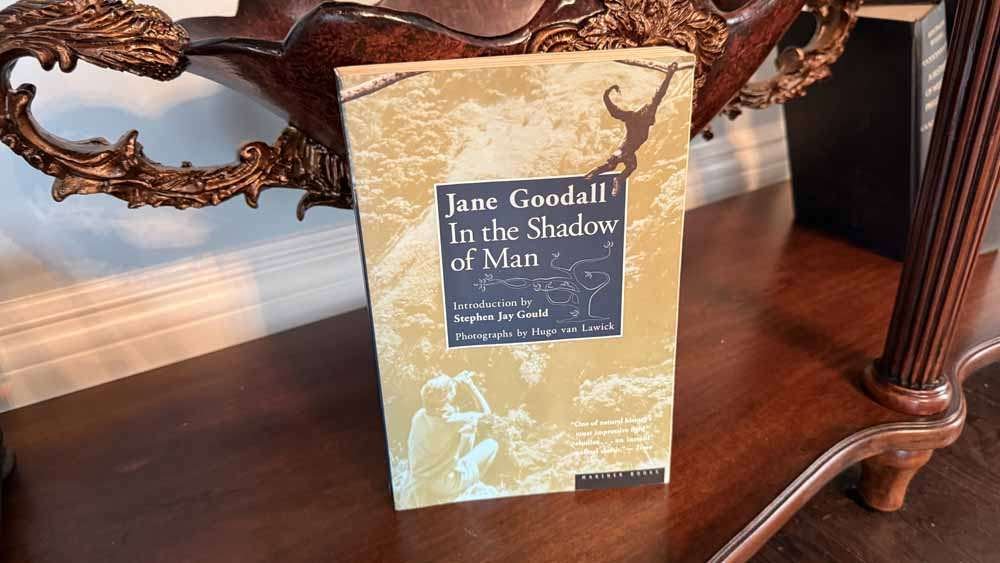
In the Shadow of Man, published in 1971, is the record of what Goodall witnessed during her first decade at Gombe. It reads — deceptively — like a nature memoir. Quiet mornings. Forest light. The gradual earning of trust from wild animals who had every biological reason to flee. But the real subject of the book is the boundary between human and animal, and Goodall’s achievement is not simply scientific. It is philosophical. She didn’t just observe chimpanzees. She collapsed a wall that Western thought had spent centuries constructing.
What Leakey Was Really Sending Her to Find
The backstory matters. Leakey, who had spent his career digging up the bones of early hominids in East Africa, believed that understanding living chimpanzees — our closest genetic relatives — could illuminate how our ancestors behaved before the fossil record could tell us anything useful. He needed an observer, not a trained scientist. In fact, he specifically did not want a trained scientist. As Goodall records, he “wanted someone with a mind uncluttered and unbiased by theory.” That sentence should land harder than it usually does. The establishment’s categories were the obstacle. Leakey needed someone who would report what was actually there, not filter it through what was supposed to be there.
What was supposed to be there was a kind of animated instinct. Chimpanzees, in the scientific consensus of the day, were reactive creatures — driven by stimulus and reflex, without the inner complexity that justified the language of personality, emotion, or individual identity. The standard protocol was to assign them numbers, not names. Goodall gave them names. Her Cambridge supervisors later pushed back. She was told that giving a chimpanzee a name implied a kind of subjectivity that science could not verify and should not assume. She pushed back harder.
The Chimps Themselves
The names in this book are not sentimental decoration. They carry the whole argument. Flo — an old, scarred, magnificently ugly female who turned out to be the most socially influential chimp in the community. David Graybeard — the first to trust her, the first to let her close, the one who handed her the termite-fishing discovery. Mr. McGregor — an aging male who became disabled during a polio epidemic and was subsequently abandoned by the others. Goblin. Flint. Passion.
Each of these animals had a recognizable character that persisted across years and across varying circumstances. Flo was patient, competent, and socially adept in ways that her offspring internalized — her parenting style had measurable effects on how her children navigated adult chimp society. Flint, her youngest, became so dependent on her that when Flo died, he refused to eat, stopped moving, and died himself within weeks — of what, by any reasonable description, could only be called grief.
Goodall describes the moment she understood the significance of what she was watching: “It seemed to me that it could only be through detailed knowledge of the lives of individual animals that one would ever be able to understand the significance of the social system as a whole.” That is a methodological argument, but it is also something else. It is the argument that the individual matters — that you cannot reduce a social animal to the aggregate data of its type without losing the very thing that explains the data.
Stephen Jay Gould, who called the book “one of the Western world’s great scientific achievements,” understood what Goodall had actually done. She had not just added observations to the literature on primate behavior. She had forced a methodological revolution — the recognition that scientific objectivity, in the study of complex social animals, might require more intimacy, not less.
The Tool Discovery and What Followed
The stripping of leaves from a twig — a modification of a natural object to create an instrument suited to a specific purpose — met every definition of tool-making that existed at the time. And when the scientific community absorbed the finding, there were essentially two responses. The first was to revise the definition of tool. The second was to quietly reclassify a range of other behaviors that had previously been filed away under “instinct” or “conditioning” and take another look.
What followed, over decades of research at Gombe, was a cascade of findings that kept moving the line. Chimps learned behaviors from each other and passed them across generations — cultural transmission, in a species without language. Different chimp communities in different parts of Africa had different traditions: specific ways of cracking nuts, specific grooming gestures, specific calls for specific situations. The vocabulary of culture — normally reserved for humans — had to be extended. It was extended reluctantly, and it was Goodall’s original decade of observations that made the extension unavoidable.
The Gombe chimps also hunted. Not occasionally or accidentally. They coordinated hunts of red colobus monkeys, with individuals taking different positional roles and the meat distributed afterward according to what looked unmistakably like social logic — to allies, to potential mates, to animals who had recently groomed the hunter. Meat-eating itself had been observed in captive chimps, but the assumption was that it was an artifact of captivity, an aberration induced by the abnormal conditions of the zoo. Goodall documented it in the wild. Another wall down.
The Rain Dance and the Waterfall
There is a passage in the book that does not fit neatly into any scientific category, and Goodall is honest enough not to try to force it. She describes male chimps performing what she calls a “rain dance” — a prolonged display at the onset of heavy rain, in which males charged through the undergrowth, swaying and calling, in what appeared to be a ritualized response to the environmental drama of the storm. And she describes chimps sitting in apparent contemplation at waterfalls, watching the cascading water for long stretches without any obvious behavioral purpose.
She does not claim these are spiritual acts. But she does not deny what she observed, either. In a later interview, she said that chimps in these moments seemed to be “feeling something like awe” — a word she chose carefully and defended carefully. The scientific establishment was uncomfortable with it. Which is itself worth examining. The discomfort was not really about evidence. It was about implication. Because if a chimpanzee can feel something that resembles awe, then awe is not uniquely human. And if awe is not uniquely human, then a significant piece of what we thought was our private inner life turns out to be much older than us — something we inherited from the forest, not something we invented in the cathedral.
The Harder Observations
It would be incomplete to review this book without acknowledging what Goodall also saw. The Gombe chimps were not only tool-users and mourners and apparent aesthetes. They were also capable of sustained, organized violence. Goodall documented what became known as the Four-Year War — a series of raids by one chimp community against a splinter group, in which the raiders killed every male in the smaller community, one by one, over four years. The attacks were not impulsive. They were coordinated, premeditated by chimp standards, and they continued until the target community was eliminated.
Goodall was shaken by this. She wrote that she had perhaps been naïve to assume that chimps were, at bottom, gentle. The raids forced her to confront something harder: that the full inheritance of our evolutionary lineage includes not only the capacity for grief and tool-use and social complexity, but the capacity for deliberate lethal violence against members of the same species. We did not invent war. We inherited a version of it.
This does not diminish the book. It deepens it. A more comfortable version of In the Shadow of Man would have given us noble primates who made us feel better about our own species. The version Goodall actually wrote gives us something far more honest: animals whose full behavioral range maps onto the full behavioral range of humans, including the parts we would rather not own. The boundary didn’t just collapse in the direction of elevating chimps. It collapsed symmetrically. We are not above them. We are also not below them. We are alongside them — a variation on a theme that evolution has been playing for millions of years.
What the Book Actually Asks
Goodall herself, in the final chapter — the one that shares the book’s title — lays out the question directly. She notes the similarities: the social hierarchies, the mother-infant bonds, the kissing in greeting, the embracing of allies, the mourning of the dead. She notes the differences: language, abstract thought, the capacity to accumulate knowledge across generations in written form. And then she poses the question that the book has been building toward the whole time — not as a rhetorical gesture, but as a genuine problem. Given everything we now know, how do we justify the way we treat chimpanzees?
She is not sentimental about this. She is precise. The same cognitive and emotional architecture that makes a chimpanzee recognizable to us as a social being also makes its captivity in a research laboratory — a fate common to tens of thousands of chimps in the decades after Goodall’s discoveries — a serious moral matter. She was not the first person to argue for animal welfare. But she was, by the time this book was written, the person who had done the most to make the argument unanswerable. You cannot read the first two hundred pages of In the Shadow of Man and then dismiss the last chapter as sentimentality.
The boundary between human and animal is not a scientific fact. It is a preference. In the Shadow of Man is the book that made that preference impossible to maintain without knowing you were choosing to.
Sources
- Goodall, Jane. In the Shadow of Man. Houghton Mifflin, 1971. Amazon
- Gould, Stephen Jay. Quoted in Barnes & Noble edition description. Barnes & Noble
- Cornell Daily Sun, “In the Shadow of Man: Remembering Jane Goodall,” October 2025. Link
- Jane Goodall Institute Official Store. JGI
- Goodreads quotes and reader commentary. Goodreads
- Britannica, “In the Shadow of Man.” Britannica