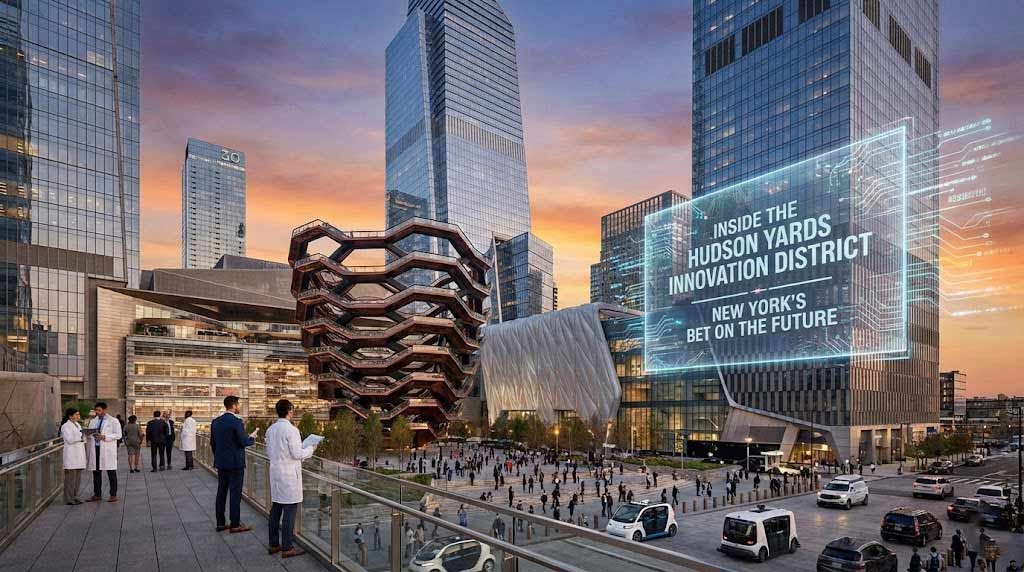
Rising from what was once a windswept rail yard on Manhattan’s far West Side, Hudson Yards represents one of the most ambitious urban redevelopment projects in modern history. Built atop active train tracks, financed through a complex mix of private capital and public infrastructure investment, and marketed as a prototype for the “city of tomorrow,” the district has become a global case study in how 21st-century cities attempt to merge real estate, technology, sustainability, and economic strategy into a single urban ecosystem. Urban planners compare its scale to Rockefeller Center’s creation during the Great Depression—another moment when New York doubled down on growth during uncertainty (NYC Planning Archive, 2022). Today, Hudson Yards is more than a development; it is a policy experiment testing whether cities can engineer innovation districts from scratch.
The Vision: Turning Rail Yards Into a Global Tech Corridor
The land beneath Hudson Yards was long owned by the Metropolitan Transportation Authority and used as a storage yard for Long Island Rail Road trains. For decades, it was considered impossible to build on due to engineering constraints. That changed in the early 2000s when the city rezoned the area and extended the No. 7 subway line westward—an infrastructure investment costing roughly $2.4 billion (NYC Comptroller, 2015).
The project was led primarily by Related Companies and Oxford Properties Group, who envisioned a mixed-use district combining offices, residences, retail, and public space. Their goal: create a neighborhood capable of competing with Silicon Valley and London’s Canary Wharf for global corporate headquarters.
Urban economists often cite this strategy as “cluster economics”—the theory popularized by Harvard scholar Michael Porter that innovation accelerates when companies, talent, and capital concentrate geographically (Porter, 1998). Hudson Yards was designed to be exactly that kind of cluster.
Engineering a City on Air
Constructing a neighborhood atop live rail lines required a platform supported by hundreds of caissons drilled into bedrock. This feat has been compared to building a ship in a bottle—only the bottle is a working transportation hub. Engineers installed a ventilation system powerful enough to remove diesel exhaust from trains below while supporting skyscrapers above (Engineering News-Record, 2020).
The district’s physical landmarks quickly became icons:
- The elevated park system linking to the High Line
- The honeycomb-like sculpture Vessel designed by Thomas Heatherwick
- Direct proximity to the Javits Center, anchoring convention tourism
Each element was deliberately planned to generate foot traffic, social media visibility, and economic spillover—what urban planners call “placemaking ROI.”
The Business Strategy Behind the Skyline
The district’s success depends heavily on corporate tenants. Major firms including BlackRock, McKinsey & Company, and global law and finance firms signed leases before construction finished. By 2024, Hudson Yards office towers reported occupancy rates exceeding 90%, outperforming much of Manhattan’s post-pandemic office market (CBRE Report, 2024).
Developers pitched the district as “Class A++” workspace: sensor-driven climate systems, touchless elevators, AI-powered building analytics, and floorplates optimized for collaborative work. Studies from MIT show that such smart-building technologies can reduce energy consumption by up to 30% (MIT Real Estate Innovation Lab, 2021).
This integration of infrastructure and software reflects a broader trend: cities are becoming platforms. Like smartphones, they now run on data.
Talent Wars and the Innovation District Model
Modern corporations don’t just choose cities—they choose talent pools. Hudson Yards’ location inside New York City gives companies access to one of the world’s largest concentrations of skilled workers. According to the U.S. Bureau of Labor Statistics (2023), the New York metro area employs over 1 million professionals in knowledge-based industries.
The innovation-district concept is modeled partly on academic-industry ecosystems like Stanford University’s relationship with Silicon Valley and New York’s own Cornell Tech campus on Roosevelt Island. Research shows proximity between universities and corporations significantly increases patent output and startup formation (Brookings Institution, 2019).
Hudson Yards attempts to replicate that synergy—minus the decades of organic growth those regions enjoyed.
Criticism, Controversy, and Economic Debate
No megaproject escapes scrutiny. Critics argue Hudson Yards prioritizes luxury and corporate interests over affordability and community integration. The median apartment price in the district surpassed $5 million shortly after opening (The Real Deal, 2022). Some urban scholars call it a “vertical gated community.”
Others question the public subsidies involved. New York issued billions in bonds tied to future property tax revenue to finance infrastructure—essentially betting that the development would succeed. Economist Paul Krugman warned in a 2019 column that such tax-increment financing models can strain city budgets if projections fail.
Even design sparked debate. Architecture critics praised its ambition but argued the district felt more like a private campus than a traditional neighborhood. Still, supporters counter that many beloved urban landmarks—from Rockefeller Center to London’s Docklands—faced similar skepticism at launch.
What the Data Says About Its Impact So Far
Early metrics suggest Hudson Yards is already reshaping Manhattan’s economic geography:
- Office rents in nearby neighborhoods rose nearly 15% after its opening (JLL Market Report, 2023).
- The project is projected to generate over $19 billion in tax revenue for the city over 40 years (NYCEDC, 2023).
- Tourism traffic to the West Side increased significantly, boosted by attractions and retail (NYC Tourism Board, 2024).
These figures reinforce a central principle of urban economics: large anchor developments can shift entire districts’ value curves, much like a new shopping mall revitalizes a suburb.
Watch: A Visual Look Inside the District
A concise documentary overview from The Wall Street Journal explores how the project was financed and built:
https://www.youtube.com/watch?v=Y0VQyEY-B2I
Why Cities Around the World Are Watching Closely
Global planners—from Dubai to Singapore—are studying Hudson Yards as a template for future development. Its mix of private financing, public transit investment, and integrated technology represents a hybrid model many governments hope to replicate.
The project’s chairman, Stephen Ross, described it as “a blueprint for future cities” in a 2020 interview. Whether that prediction proves accurate depends on long-term factors: tenant retention, economic cycles, and how well the district evolves beyond its corporate core.
Urban historians note that truly successful neighborhoods are rarely finished products. They mature over decades as culture, commerce, and community intertwine organically.
The Larger Meaning Behind the Glass Towers
Hudson Yards is not merely a real estate development—it is a test of an idea: that cities can deliberately manufacture innovation ecosystems through design, capital, and policy. If it succeeds, it may redefine how global capitals compete for talent and investment. If it fails, it will serve as a cautionary tale about the limits of top-down urban planning.
Either way, its existence signals something profound about the 21st century: the future of cities is no longer accidental. It is engineered.
Related Reading
- How Smart Cities Are Reshaping Real Estate Markets
- The Rise of Mixed-Use Megadevelopments
- Why Infrastructure Drives Economic Growth
Sources & References
NYCEDC (2023); CBRE Market Analysis (2024); JLL Office Report (2023); Brookings Institution (2019); MIT Real Estate Innovation Lab (2021); Engineering News-Record (2020); NYC Comptroller Infrastructure Review (2015); U.S. Bureau of Labor Statistics (2023); The Real Deal Market Data (2022); NYC Tourism Board (2024); Porter, Competitive Advantage of Nations (1998); Krugman, NYT Column (2019).