Plato wanted the world to be clean. Fixed types. Eternal forms sitting outside time and matter, the real things, with physical reality just a degraded copy stumbling toward them. It’s a seductive idea. Order for free. Certainty built into the universe before you even show up.
DeLanda doesn’t buy it. Neither do I.
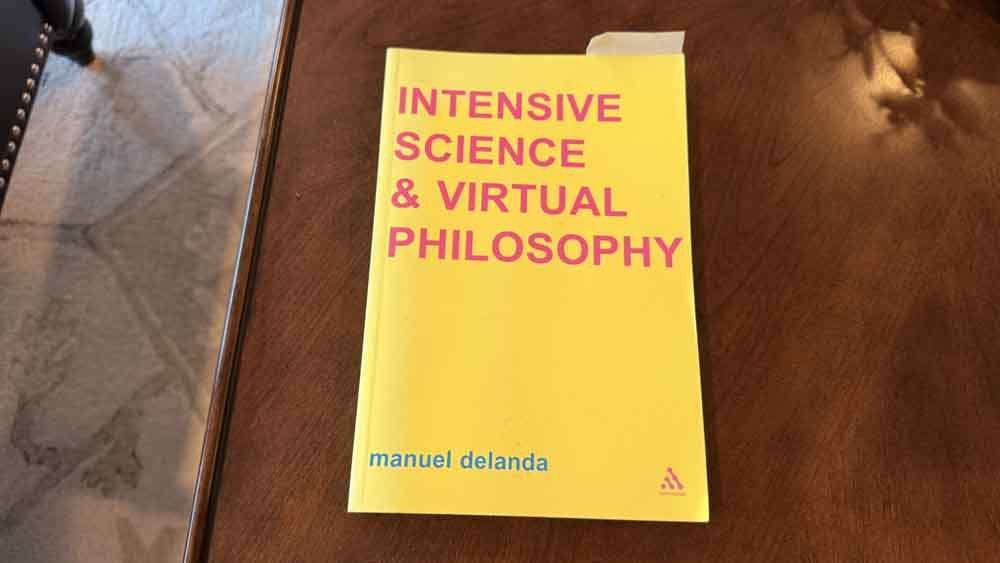
Intensive Science and Virtual Philosophy, published in 2002, is Manuel DeLanda’s attempt to reconstruct what reality actually looks like when you stop reaching for fixed essences and start paying attention to processes. It’s a dense book — philosophy tangled up with dynamical systems theory, thermodynamics, and Gilles Deleuze — but the argument at its core is simple and devastating: the world doesn’t run on types. It runs on differences. Intensive differences. And those differences are what generate everything you see.
The Problem With Platonism
DeLanda’s target isn’t just ancient philosophy. He’s going after a way of thinking that survived long past Plato and nested itself inside science, biology, and common sense. The typological approach — sorting things into fixed categories defined by essential properties — shows up everywhere. Species as natural kinds with necessary characteristics. Atoms as ideal billiard balls. Social classes as rigid boxes. The assumption, always, that the category precedes and explains the individual.
The problem is that it doesn’t. Individuals — actual rocks, actual organisms, actual social formations — don’t conform to types. They deviate. They vary. They exist in gradients and thresholds and transitions that the category can never fully capture. Typological thinking looks at the variation and calls it noise. DeLanda looks at the variation and says: that’s the whole story.
This is where he pulls Darwin in. Darwin’s contribution wasn’t just a mechanism for evolution — it was a philosophical break. Population thinking, as DeLanda reads it, means that the individual specimen is real and the type is an abstraction. The variation between organisms isn’t error; it’s the raw material. You can’t average it away and pretend the remainder is the true species. The remainder is nothing. There is no Platonic horse standing behind all the horses.
What Virtual Means
Here’s where people get lost with DeLanda, and it’s worth slowing down.
When he talks about the virtual, he doesn’t mean imaginary or potential in the ordinary sense. He means something closer to what mathematicians mean when they talk about a phase space or an attractor. A phase space is the full map of all possible states a system could occupy. An attractor is the region in that space the system tends toward — a sink, a limit cycle, a strange attractor in the case of chaotic systems. These structures are real. They shape behavior. But they don’t exist as things you can hold in your hand. They’re not actual; they’re virtual.
A multiplicity, in DeLanda’s Deleuzian vocabulary, is a structure in that virtual space — a set of singularities and the relationships between them that determine how actual processes unfold. When water cools to freezing, the phase transition is governed by a singularity in the virtual space of thermodynamic states. The transition is real. The singularity is real. But neither is a Platonic form and neither is a simple physical object. It exists as a capacity to differentiate, to drive processes toward particular outcomes without determining them in advance.
This distinction matters because it’s how DeLanda saves difference from Plato. Plato’s forms are transcendent — outside the world, unchanging, the original against which copies are measured. DeLanda’s virtual multiplicities are immanent — inside the causal process, worked through by intensive differences, inseparable from the physical world they structure. Nothing sits outside. Everything is in the mix.
Intensive Differences and How They Drive the World
Intensive is the key word. An intensive quantity is one where the whole is not simply the sum of the parts — temperature, pressure, concentration. These are differences that do work. A temperature gradient drives heat flow. A pressure differential drives fluid movement. A concentration gradient drives diffusion. Remove the difference and the process stops.
Extensive quantities are different. Length, volume, mass — these can be divided and added. If you split a bucket of water in two, each half has half the volume. But if you split it thermally, the temperature doesn’t halve. The temperature was never part of the bucket the way the water molecules were.
DeLanda argues that the intensive is what drives morphogenesis — the generation of form. Before a crystal, a mountain range, an embryo, a city reaches its final stable shape, it passes through a process driven by intensive differences. The form that emerges isn’t prescribed by a template. It’s the outcome of a process running through singularities in a virtual space, constrained by real physical thresholds and gradient flows. This is how the world makes new things. Not by copying ideal forms. By differentiating.
I’ve spent enough years watching a restaurant kitchen run on exactly this logic to know he’s right. A kitchen isn’t a Platonic ideal of a kitchen. It’s a process. Heat differentials, prep timelines, inventory thresholds, the pressure difference between a slammed Saturday night and a slow Tuesday morning — that’s what the kitchen actually is. What comes out of it isn’t a copy of some eternal diner. It’s the outcome of those intensities meeting, moment by moment.
DeLanda on Science
One of the more underappreciated parts of this book is what it does for the philosophy of science. DeLanda isn’t simply applying Deleuze to science as a literary exercise. He’s arguing that the mathematical tools scientists actually use — dynamical systems theory, bifurcation theory, the theory of attractors and phase transitions — already presuppose an ontology much closer to Deleuze than to Plato. Scientists who work with these tools are implicitly thinking in terms of virtual structures and intensive processes, even when their explicit philosophical framework is still typological.
This creates a gap between what scientists do and what they say they do. The gap matters because it produces confused thinking about what science is actually uncovering. DeLanda wants to close that gap — to give scientists a philosophical vocabulary adequate to the mathematics they’re already using. Real patterns. Immanent structure. Individuals all the way down.
His engagement with complexity theory and chaos carries this through. Strange attractors don’t fit the old picture. They’re deterministic but not predictable. They generate novelty within constraints. They’re the virtual made visible — a geometric structure in phase space that shapes the trajectory of an actual physical system without ever being that system. This is not the world Plato described. It’s not the world Newton assumed. It’s the world that DeLanda, following Deleuze, insists we’re living in.
What Makes the Book Difficult — and Why That’s Honest
This is not an easy book. DeLanda writes with precision but not mercy. The Deleuzian vocabulary — multiplicities, intensities, the virtual, singularities, haecceities — has to be earned through the argument; it can’t be paraphrased without losing the content. Readers who want clean definitions up front are going to be frustrated.
I’d also say that DeLanda sometimes leans so hard on the technical apparatus that the philosophical stakes briefly disappear behind the machinery. There are moments in the chapters on mathematics and on Deleuze’s theory of Ideas where you need to hold multiple threads simultaneously, and the prose doesn’t always help you do that.
But here’s the thing: the difficulty is appropriate. The book is arguing against shortcuts. Against the temptation to stabilize the world into easy categories. A book that made that argument while offering easy categories would be lying to you.
The Corrective
What DeLanda actually delivers is a realism without essentialism. Things are real. Processes are real. Virtual structures are real. The world is not a simulation and it is not a copy. But none of it is fixed. None of it is given in advance by some transcendent form that exists outside time and matter.
Plato wanted the real to be unchanging. DeLanda says the real is change — specifically, it’s the capacity to differentiate, to drive processes, to generate form through intensive difference rather than to receive form from a template. The virtual isn’t a realm of static ideals. It’s a field of differences, packed with singularities, and what happens in the actual world is the working-out of those differences through real physical processes over real time.
That’s not a comforting picture if you’re looking for certainty. It’s a good picture if you’re looking at the world as it actually behaves.
You Might Also Like: There are currently no other posts in the archive on this topic — but if the relationship between scientific method and philosophical ontology interests you, Intensive Science and Virtual Philosophy pairs well with the work of philosophers like Quine and Sellars who also pushed against essentialist frameworks from the direction of empirical science.
Sources
- DeLanda, Manuel. Intensive Science and Virtual Philosophy. Continuum, 2002.
- Deleuze, Gilles. Difference and Repetition. Translated by Paul Patton. Columbia University Press, 1994.
- Mayr, Ernst. “Typological versus Population Thinking.” In Evolution and the Diversity of Life. Harvard University Press, 1976.
- Prigogine, Ilya, and Isabelle Stengers. Order Out of Chaos: Man’s New Dialogue with Nature. Bantam Books, 1984.
- Strogatz, Steven. Nonlinear Dynamics and Chaos. Addison-Wesley, 1994.