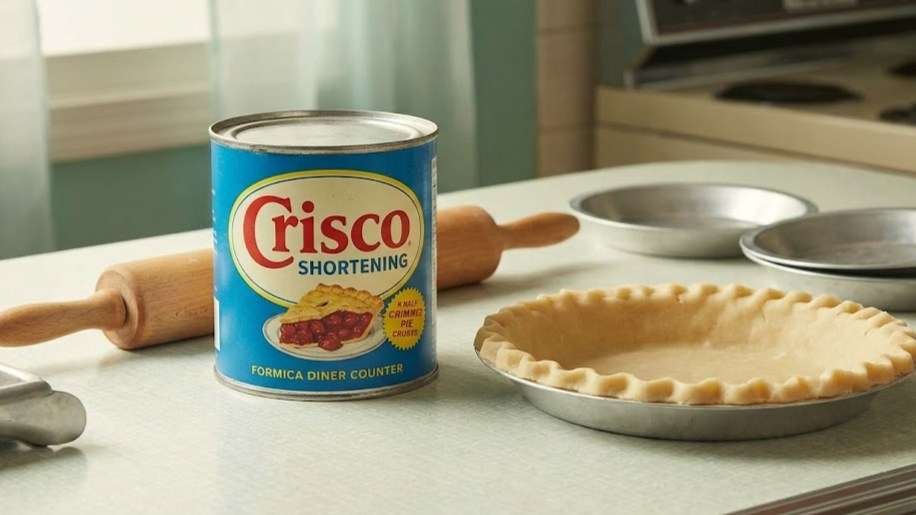
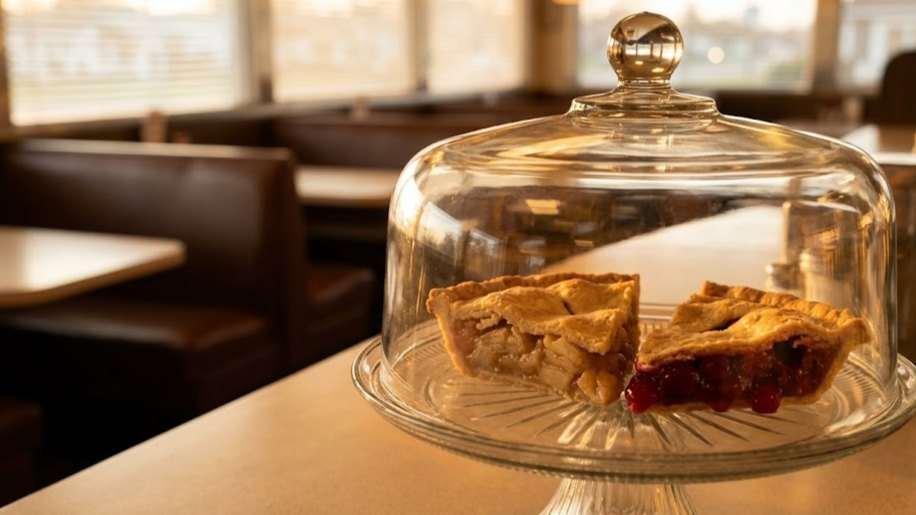
The pie sitting under the glass dome at the end of the diner counter is almost certainly made with vegetable shortening. The pie that should be sitting there — the one that existed in this same diner, or its predecessor, seventy years ago — was made with lard. The swap happened quietly, between roughly 1945 and 1965, driven by marketing that was as sophisticated as any campaign Procter & Gamble ever ran, and amplified by postwar anxieties about animal fat that turned out, a half century later, to be largely misplaced. What was lost in the substitution was not just a flavoring note. What was lost was a specific molecular architecture — the fat crystal structure that made the American diner pie crust what it was.
This is a story about chemistry, about a company that turned cottonseed oil into a white, lard-like substance and convinced America it was science, and about the Long Island diner slice that has not been the same since.
What Lard Actually Does
Harold McGee’s On Food and Cooking is the standard reference for fat behavior in pastry, and what it establishes is this: the texture of a pie crust is determined almost entirely by the size and structure of the fat crystals present in the dough. Lard forms what are called beta-prime crystals — small, stable, and uniformly distributed. Beta-prime crystals produce a fine, even lamination when the fat is cut into flour, which is what creates the characteristic flakiness of a well-made crust. The fat stays solid until the last possible moment in the oven, then melts and releases steam, producing the layers.
Hydrogenated vegetable shortening — Crisco being the primary example — forms larger, less stable beta crystals. The lamination is coarser, the crumb more uniform and tender in a way that reads as slightly mealy to a practiced palate rather than genuinely flaky. It is not a bad pie crust by any absolute measure. It is simply a different crust, and the difference is structural.
Rose Levy Beranbaum, in The Pie and Pastry Bible, is direct about this: lard’s fat crystal structure creates a more layered, complex crust than shortening produces. Pastry chefs who have worked with both materials consistently report that a well-made lard crust has a finish on the palate — a savory, porky undertone barely detectable in a dessert context — that vegetable shortening simply cannot replicate. It is not a strong flavor. Leaf lard, rendered from the visceral fat surrounding a pig’s kidneys, has almost no pork flavor at all. What it has is density, neutrality, and that beta-prime crystal structure that does its structural work invisibly and faithfully.
When you bite through a proper lard-based pie crust, the layers separate under pressure. They do not compress. They shatter, minimally, and then yield. A Crisco crust yields all at once, with more uniformity and less drama.
How Crisco Killed Lard Without Firing a Shot
Procter & Gamble’s launch of Crisco in 1911 was one of the most successful product introductions in American food history — not because Crisco was better than lard, but because P&G’s marketing was better than anything the lard industry could mount in response. The company positioned Crisco as a product of science: clean, pure, modern, and industrial in the best sense of the word. They gave away beautifully illustrated cookbooks with every purchase. They paid celebrity chefs to run cooking classes featuring Crisco. They avoided, as long as legally possible, any disclosure of what the product actually was — hydrogenated cottonseed oil, a category of fat that had no prior history as a food.
The dual marketing strategy was to promote the purity of Crisco while subtly undermining lard. The lard industry, controlled by a consortium that believed it held an eternal monopoly on shortening, failed to recognize the threat from Crisco in time, or to successfully defend and promote their product. Lard was demonized to the extent that even today the word lard itself invites disgust.
Two events accelerated the demonization. The first was Upton Sinclair’s The Jungle in 1906, which, though fiction, set American anxieties about meat-processing facilities running hot in ways that took decades to cool. The second was the postwar dietary guidance that emerged in the 1950s and 1960s, linking saturated animal fat to cardiovascular disease. The science behind this guidance was contested from the beginning, and significant elements of it have since been revised. But in the critical window between 1945 and 1965, when American diners were standardizing their menus and their purchasing around commercial institutional ingredients, lard lost the cultural argument.
Shortening became the fat of choice for pie baking in the fifties and sixties, and it never fully relinquished that position.
The Sensory Case for What Was Lost
A Crisco pie crust is tender. It is uniform. It holds its shape well during decorative work, which is why pastry chefs who make elaborate pies with cutout crust designs prefer it for that application. It is also, and this must be stated plainly, somewhat bland. If you do find high-quality lard, it offers more flavor compared to Crisco and other shortenings.
The mouth-feel difference is the argument that lard defenders make most emphatically. A lard crust has a cleaner finish — it melts away rather than lingering. Vegetable shortening has a slightly higher melting point than body temperature, which means a crust made with it can leave a faint coating sensation on the palate. This is not unpleasant in the context of a single slice of pie. It becomes noticeable when you’re finishing a second piece.
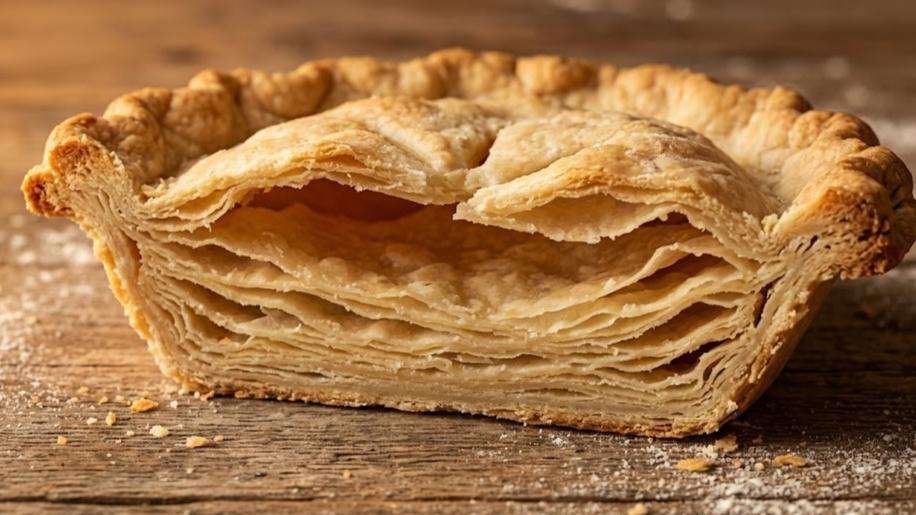
The lamination argument is the one that matters most to the visual. Pull apart a proper lard crust — one made with cold, fresh leaf lard, correctly cut into flour, not overworked, properly rested — and you will find distinct, paper-thin layers. The interior is not homogeneous. There is a structure to it, the way there is structure to puff pastry or croissant dough, just less pronounced. Pull apart a well-made shortening crust and you find a uniform crumb, tender throughout, with no distinct layering. Both are called flaky in common usage. They are not the same phenomenon.
What Long Island Diners Are Working With
The honest answer is that most Long Island diners today are sourcing their pies — or their pie crust materials — from commercial suppliers who are not using lard. The reasons are practical: good leaf lard is genuinely difficult to source at scale, it has a shorter shelf life than vegetable shortening, and the institutional restaurant supply chain has been optimized around vegetable fat for fifty years. The infrastructure that supported lard as a commercial ingredient largely does not exist anymore.
There is a counter-current in specialty baking. Artisan bakeries on Long Island and in Brooklyn have returned to lard pie crusts, citing both the texture advantage and the improved flavor profile. Rendering your own leaf lard from local butchers is a project — a day of work — but not an impossible one for a kitchen that cares about the result.
The diner that made the switch sometime between 1950 and 1965 did not do so out of malice or indifference. It did so because the supply chain offered Crisco in consistent, institutional quantities at a stable price, and because the cultural moment had decisively declared lard to be old-fashioned and unhealthy. The diner was responding to its customers. The customers were responding to a marketing campaign of remarkable sophistication.
The irony, which landed fully in the 1990s when scientists revealed the truth about trans fats — the very thing that hydrogenated vegetable shortening contains — is that the product substituted for lard on health grounds turned out to carry its own significant health liabilities. Crisco’s product health claims were seriously challenged in the 1990s when scientists revealed the truth about trans fats. Despite numerous product reformulations, Procter and Gamble divested itself from the Crisco brand in 2001. Lard, which had never contained trans fats, looked considerably better in retrospect.
Understanding what goes into any baked good starts with understanding the fat — something we explored more broadly in The Flour Beneath the Bread: What Goes Into a Proper Sourdough Loaf. The science of fat behavior in dough — what crystalizes, what lamination means in practice, what your palate actually detects as “flaky” — is a story that runs through every baked thing on a diner menu, from the biscuits to the pie.
A Closing Argument for the Crust That Isn’t There
The next time you are at a Long Island diner — any diner, Babylon to Bellmore, Port Jefferson to Patchogue — and you are handed a slice of pie with a crust that compresses uniformly under your fork and coats your palate just slightly too long after you’ve swallowed, you are experiencing the downstream consequence of a marketing war that Procter & Gamble won in the 1950s.
The crust your grandmother made, or her grandmother made, had more layers. It had more finish. It shattered a little before it yielded. It came from a fat that a pig produced and that someone rendered and kept cold and worked with cold hands into cold flour, quickly, without overworking it, because overworking it was the only real enemy.
That crust is not gone. It is on hiatus, waiting for the institutional supply chain to catch up with what baking science has been quietly saying for the last decade. Some diners will get there. Most will not. In the meantime, the glass dome at the end of the counter holds what it holds, and the slice is still worth eating.
It’s just not what it was.
You Might Also Like
- The Flour Beneath the Bread: What Goes Into a Proper Sourdough Loaf
- The Forgotten Montauk Surfman’s Chowder: Cooking with Seawater at the 1800s Life-Saving Stations
- Rum Row and the Freeport Bootleggers: Long Island’s Clandestine War on the Water
Sources
- Harold McGee, On Food and Cooking: The Science and Lore of the Kitchen (Scribner, 2004)
- Rose Levy Beranbaum, The Pie and Pastry Bible (Scribner, 1998)
- Four String Farm, “The Story of Crisco” (2013): fourstringfarm.com
- Live Science, “The Fascinating History of Crisco”: livescience.com
- King Arthur Baking, “Butter vs. Shortening”: kingarthurbaking.com
- HuffPost Life, “What’s The Best Fat For Pie Dough”: huffpost.com
- Food52, “Pie Fats: Butter vs. Oil vs. Shortening vs. Lard”: food52.com