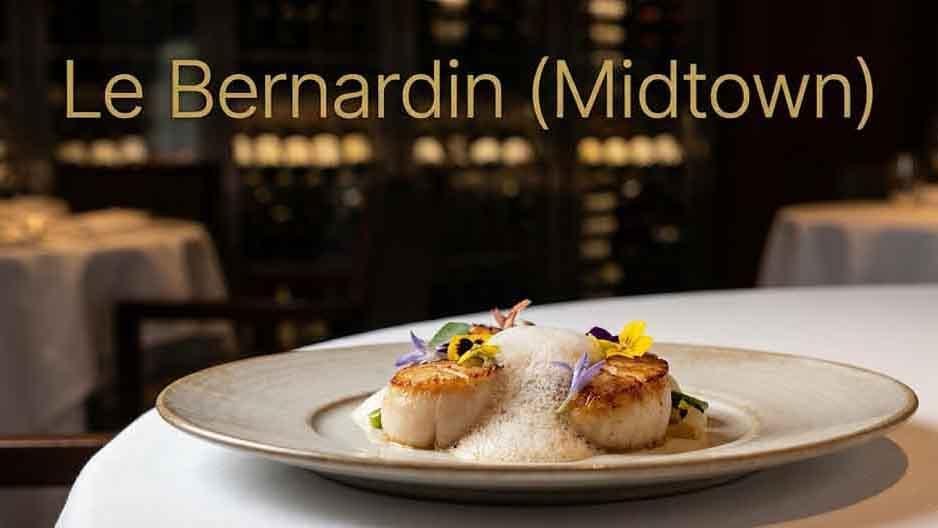
Fifty-three years after siblings Maguy and Gilbert Le Coze hauled their obsession with Breton fishing villages across the Atlantic, the dining room at 155 West 51st Street still operates on a principle so elemental it borders on the spiritual: the fish is the star of the plate. That single conviction — ruthlessly distilled, never compromised, applied with the precision of a Zen master — explains how a seafood restaurant born in a modest Left Bank space across from Notre Dame became the only establishment in New York City history to hold four stars from The New York Times continuously for nearly four decades (The New York Times, 2023). It explains how Le Bernardin earned three Michelin stars the moment the Guide arrived in America in 2005 and has never relinquished a single one (Michelin Guide, 2025). And it explains why anyone who claims to understand what hospitality means at its highest altitude must eventually find their way to this stretch of Midtown Manhattan, where the Equitable Building rises over Seventh Avenue and the scent of 1,000 pounds of fresh fish delivered daily fills a basement kitchen before most of the city has finished its first cup of coffee.
As someone who has spent twenty-five years behind the griddle at The Heritage Diner in Mount Sinai, I have a deep respect for businesses that outlast trends, survive ownership transitions, and somehow — against all rational odds in an industry with a seventy-percent failure rate — continue to operate at the peak of their powers. Le Bernardin is not just a restaurant. It is a masterclass in the persistence of craft.
From Paris to the Equitable Building: A Transatlantic Origin Story
The name itself carries a kind of poetry most branding consultants would kill for. “Le Bernardin” derives from a French folk song the Le Coze children’s father sang to them — “Les Moines de St. Bernardin” — about Franciscan monks who, in the words of Maguy Le Coze, “loved life — the good life especially” (Eric Ripert, ericripert.com, 2024). Gilbert and Maguy opened their first iteration in Paris in 1972, a tiny seafood-only restaurant that broke convention in a culinary culture obsessed with red meat and heavy sauces. The gamble paid off: a Michelin star arrived in 1977, a second in 1982, and by the mid-1980s the Le Coze siblings had built an international reputation powerful enough to warrant crossing an ocean.
They opened the New York incarnation in 1986, anchoring the ground floor of the Equitable Building on West 51st Street. Within three months — an almost unheard-of velocity — The New York Times delivered a four-star review (The New York Times, 1986). That review inaugurated a streak of critical perfection that has been reaffirmed six consecutive times across nearly four decades, a feat no other restaurant in the city has matched. The Times’ Pete Wells, writing in January 2023, delivered Le Bernardin’s historic sixth four-star review, calling it a restaurant that remains at the summit of fine dining in a city that devours its institutions like appetizers (The New York Times, 2023).
Tragedy struck in 1994 when Gilbert Le Coze died suddenly of a heart attack at age 49. The restaurant world held its breath. Maguy, devastated but resolute, turned to a young French chef who had already proven himself in the kitchen: Eric Ripert. Her instructions, as she has recalled them, carried the weight of a mandate and a benediction: “I don’t want to have the menu of my brother. You have to do your own menu with your style and your creation” (CBS News, 2022).
Eric Ripert: The Philosopher-Chef of Midtown
Born in Antibes, France in 1965, Eric Ripert’s path to the helm of one of the world’s greatest restaurants wound through some of the most demanding kitchens in culinary history. By seventeen he was working at La Tour d’Argent in Paris, a restaurant with over four hundred years of continuous operation. He apprenticed under Joël Robuchon at Jamin, served as a sous chef for Jean-Louis Palladin at the Watergate Hotel in Washington, D.C., and worked briefly under David Bouley before Gilbert Le Coze recruited him to Le Bernardin in 1991 (Eric Ripert, Wikipedia, 2026).
When Ripert assumed the executive chef title three years later, at twenty-nine years old, he faced the task every successor dreads: honoring the founder’s vision while establishing an entirely new identity. He accomplished both. The four-star rating from the Times was reaffirmed under his watch within a year. By 1996, he had become co-owner alongside Maguy, and together they have guided Le Bernardin through three decades of reinvention without ever abandoning the founding principle that pristine seafood requires reverence, not reinvention.
What distinguishes Ripert from many of his contemporaries is a philosophical depth that extends well beyond technique. A practicing Buddhist who meditates for an hour every morning, Ripert approaches his kitchen with a mindfulness that would not feel out of place in a seminar on Heidegger’s concept of Gelassenheit — the notion of releasement, of letting things be what they are. His menu, famously organized into three categories — “Almost Raw,” “Barely Touched,” and “Lightly Cooked” — reflects this restraint (The World’s 50 Best Restaurants, 2025). Each preparation is designed to amplify the essential character of the ingredient rather than impose the ego of the chef upon it. In an era when many high-end kitchens operate as theaters of spectacle, Ripert’s approach feels almost monastic.
He is also a recipient of France’s highest honor, the Légion d’Honneur, a distinction that places him in the company of cultural luminaries across centuries. His five published cookbooks — from the original Le Bernardin Cookbook (1998) to the accessible Seafood Simple (2023) — reveal a craftsman who is as generous with his knowledge as he is exacting in his execution (Avec Eric, aveceric.com). His Emmy-winning PBS series Avec Eric brought viewers inside the Le Bernardin kitchen and around the world in search of inspiration, and his deep friendship with the late Anthony Bourdain became one of the most celebrated relationships in the food world. Bourdain wrote in Kitchen Confidential that Le Bernardin was the one restaurant where he would order fish on a Monday — the ultimate compliment from a man who trusted almost nobody.
The Dining Room: Where Ran Ortner’s Ocean Meets Bentel & Bentel’s Architecture
In 2011, Le Bernardin underwent a complete redesign by the architectural firm Bentel & Bentel, the husband-and-wife team responsible for some of New York’s most iconic restaurant interiors, including Gramercy Tavern and The Modern. Ripert’s directive to the architects was both specific and evocative: he wanted the space to feel “convivial, warm, sexy, and serene” (Bentel & Bentel, bentelandbentel.com).
The firm retained the iconic teak ceiling — the sole survivor of Philip George’s original 1986 interior — and reimagined everything beneath it. They introduced an onyx-wrapped bar with mother-of-pearl tile, a curved lounge designed for conviviality, screens woven from fabric strips, dried vines, and metallic threads that modulate the street-level light, and a custom carpet combining silvery grays and pale browns in a pattern inspired by tidal pools (Interior Design Magazine, 2012).
The room’s emotional center, however, is a painting. “Deep Water No. 1” by Brooklyn artist Ran Ortner — a six-by-twenty-four-foot oil-on-canvas triptych depicting surging green ocean waves with no horizon line — dominates the far wall of the dining room. The work was not commissioned. Ripert and the Bentels discovered the painting already completed in Ortner’s studio, its dimensions fitting the wall as though it had been destined for that space (Interior Design Magazine, 2012). Ortner, who won the inaugural ArtPrize competition in 2009 and whose work has been featured everywhere from the United Nations to The New York Times, created a seascape so hyperrealistic that first-time guests routinely mistake it for a photograph. In a room devoted to the bounty of the ocean, the painting functions as both backdrop and thesis statement. The redesign earned Le Bernardin the James Beard Award for Best Restaurant Design in 2012.
The Cellar and the Sommelier: Aldo Sohm’s 15,000-Bottle Cathedral
Any discussion of Le Bernardin that neglects its wine program commits an act of critical negligence. Wine Director Aldo Sohm, an Austrian native who arrived in New York in 2004 to improve his English and never left, was named Best Sommelier in the World by the World Sommelier Association in 2008 (Robb Report, 2025). He oversees a 15,000-bottle cellar that has earned the Wine Spectator Grand Award, the James Beard Award for Outstanding Wine Service, and the quiet awe of every serious oenophile who has ever opened the restaurant’s list.
Sohm’s philosophy mirrors Ripert’s in its emphasis on humility and service. Rather than intimidating guests with arcane terminology, he steers diners toward discoveries with a warmth and lack of pretension that Ripert himself has described as defining. In 2014, Ripert and Maguy Le Coze invited Sohm to partner with them in opening the Aldo Sohm Wine Bar, located steps from Le Bernardin across the building’s 6½ Avenue pedestrian plaza. The wine bar, designed by Bentel & Bentel in a more casual register, offers a curated selection of wines alongside a food menu overseen by Ripert — a space where the formality of Le Bernardin relaxes into something approaching a Viennese wine parlor on the best night of the year (Robb Report, 2025).
Sohm has also authored two books — Wine Simple (2019) and Wine Simple: Perfect Pairings (2025) — and produces wine under the Sohm & Kracher label, a collaboration with Austrian winemaker Gerhard Kracher focused on Grüner Veltliner. His presence at Le Bernardin completes a trinity of excellence: Maguy’s hospitality, Ripert’s kitchen, Sohm’s cellar.
Awards, Accolades, and the Weight of Sustained Greatness
The sheer accumulation of honors attached to Le Bernardin can, if listed in full, read like a kind of absurdist poem about institutional perfection. A selective accounting: three Michelin stars every year since 2005; four New York Times stars across six consecutive reviews spanning 1986 to 2023 — the only restaurant to achieve this distinction in the paper’s 170-year history; more James Beard Foundation Awards than any other restaurant in New York City, including Outstanding Restaurant (1998), Outstanding Chef for Ripert (2003), Outstanding Wine Service (2009), Outstanding Pastry Chef for Michael Laiskonis (2007), Best Restaurant Design (2012), and Outstanding Restaurateur for Maguy Le Coze (2013), making her the first woman to receive that honor (Le Bernardin, le-bernardin.com).
La Liste, the French algorithm-driven global restaurant ranking, has placed Le Bernardin at the number one position worldwide since 2022 (La Liste, 2025). The Infatuation has ranked it the best restaurant in New York City with a 9.5 rating since 2022 (The Infatuation, 2025). Zagat named it the most popular restaurant in the city across multiple years. The World’s 50 Best Restaurants has consistently included it in its global ranking.
What these numbers obscure, however, is the emotional reality of sustained excellence. Running at peak performance across five decades is not a matter of resting on accumulated reputation. It requires the daily discipline of predawn fish market visits, the constant training of a kitchen brigade that must execute hundreds of covers without a single deviation, and a philosophical commitment to treating every service as though the critics were returning for a seventh review. Ripert himself has put it plainly: “It’s a work in progress. If I was satisfied and not think it’s a work in progress, I’m behind, I’m bored. It’s time to go” (CBS News, 2022).
City Harvest: The Ethics of the Full Plate
Le Bernardin’s relationship with City Harvest — New York City’s first and largest food rescue organization — extends back nearly three decades and represents one of the most sustained chef-charity partnerships in American dining. Ripert serves as Vice Chairman of City Harvest’s Board of Directors and is a member of its Food Council, a coalition of New York’s top chefs working to raise funds and awareness for food insecurity in the five boroughs (Crain’s New York Business, 2023).
The partnership operates on multiple levels. Le Bernardin donates approximately 500 pounds of prepared and fresh food to City Harvest weekly — the zucchini peels stripped for garnish chips, the bread from yesterday’s service, the madeleines and protein trimmings that fall below the restaurant’s exacting visual standards but remain nutritionally impeccable (Nancy Matsumoto, nancymatsumoto.com). Ripert has pledged one dollar to City Harvest for every meal served in the restaurant’s dining room and private spaces. The lounge offers a dedicated three-course City Harvest prix fixe menu priced at $94, with five dollars from each order directed to the organization (Le Bernardin, Wikipedia, 2026). City Harvest distributed over 100 million pounds of rescued food across New York in the past year, serving 400 food pantries and shelters (CBS News, 2022).
During the pandemic, Ripert and his wife Sandra volunteered directly with City Harvest, distributing fresh produce to Bronx residents at the organization’s Mobile Markets. Annually, Ripert’s fundraising efforts generate enough resources to feed nearly 9,000 families in need (Crain’s New York Business, 2023). For a man whose professional life revolves around creating transcendent pleasure through food, the commitment to ensuring that New Yorkers facing hunger also eat well is not a contradiction. It is a completion.
Practical Information: Dining at Le Bernardin
Address: 155 West 51st Street (The Equitable Building), Midtown Manhattan, New York, NY 10019
Telephone: (212) 554-1515
Website: le-bernardin.com
Reservations: Required for the dining room; available via Resy. Reservations open at 7:00 AM Eastern on the first day of each month (excluding Sundays). The lounge operates on a first-come, first-served basis.
Hours: Lunch Monday–Friday, 12:00 PM – 2:30 PM; Dinner Monday–Saturday, 5:00 PM – 10:30 PM (11:00 PM on Fridays and Saturdays). Closed Sundays.
Dress Code: Business casual. Jackets preferred but not required. Athletic wear, loungewear, shorts, T-shirts, short-sleeved shirts, sneakers, and flip-flops are not permitted.
Dining Room Menus: Three-course prix fixe lunch ($130–$135); four-course prix fixe dinner ($210); Le Bernardin tasting menu; ten-course Chef’s tasting menu; vegetarian tasting menu ($250 with six savory courses and two desserts). Wine pairings available for all tasting menus.
Lounge Menu: À la carte selections including the signature thinly pounded yellowfin tuna with foie gras, organic caviar service, oysters, and the three-course City Harvest menu ($94, including a $5 donation).
Private Dining: Les Salons Bernardin (upstairs, separate entrance, up to 80 guests); Le Bernardin Privé (ground-floor Galleria space, up to 200 guests for weddings, receptions, and corporate events).
Also Visit: Aldo Sohm Wine Bar, located steps from Le Bernardin on West 51st Street, offering curated wines, shareable plates, and a lounge atmosphere designed by Bentel & Bentel.
Delivery: Le Bernardin does not participate in third-party delivery platforms. The experience is designed to be consumed in the room where Ran Ortner’s ocean rolls in eternal silence across the far wall.
Social Media: Instagram — @lebernardinny | Chef Ripert — @ericripert | Aldo Sohm — @aldosohm
Watch: CBS Sunday Morning’s feature on Le Bernardin at 50, including Eric Ripert’s behind-the-scenes kitchen tour and tuna carpaccio demonstration — available at cbsnews.com/video/inside-eric-riperts-le-bernardin
In the craft of bespoke leatherwork — a discipline I practice daily at Marcellino NY — we speak often about the concept of “hand.” It refers to the tactile quality of a hide: its suppleness, its grain, the way it communicates its origin and its treatment through the fingertips of anyone who touches it. Great leather, like great seafood, cannot be faked. It carries within it the accumulated evidence of how it was sourced, handled, and finished. You can chrome-tan a hide in a factory and produce something that looks superficially impressive, but it will never develop the deep, burnished patina that comes from vegetable tanning, from hand-stitching, from the passage of honest time. Eric Ripert understands this at a molecular level. His pounded yellowfin tuna — draped like translucent silk over toasted baguette and foie gras — is not a dish. It is an argument for the irreducible value of materials treated with reverence.
Le Bernardin endures because it was built on this argument and has never abandoned it. In an age when restaurants chase viral moments and algorithmic relevance, Ripert and Maguy Le Coze have chosen the harder path: the quiet, relentless pursuit of a standard so high it becomes invisible. The fish arrives at 4:00 AM. The kitchen fires at noon. The guests arrive expecting perfection. And fifty-three years after two siblings from Brittany named their restaurant after singing monks who loved the good life, the standard holds.
From a diner on Route 25A in Mount Sinai, where the griddle has been seasoned by twenty-five years of continuous use, to a three-Michelin-star temple on West 51st Street where Ran Ortner’s ocean never stops breaking — the principle is the same. The unseen details define the masterpiece.
—
Peter, Owner of The Heritage Diner, Mount Sinai, NY | Founder, Marcellino NY | Graduate Studies in Philosophy, Long Island University & The New School