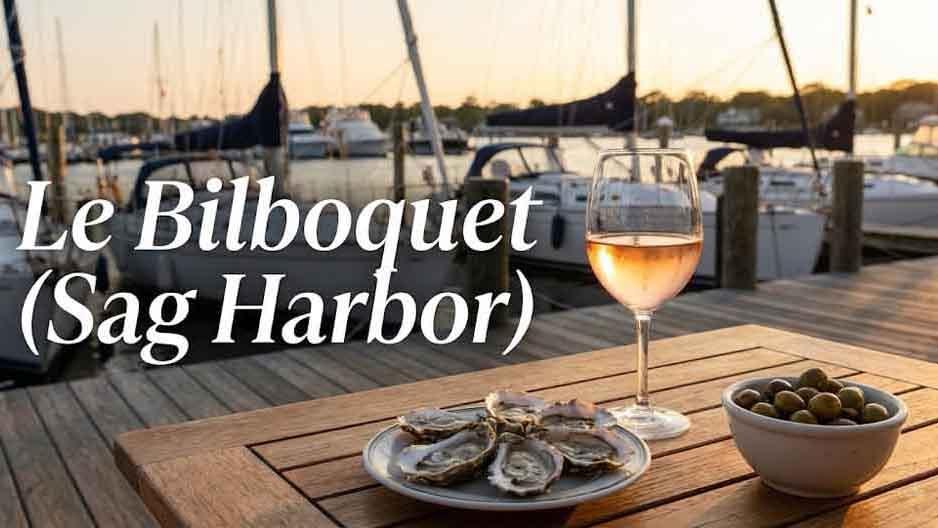
Forty years ago, a young Frenchman from Cambrai biked bottles of wine from the nearest liquor store to a 450-square-foot dining room on East 63rd Street because he could not secure a liquor license. Philippe Delgrange had thirty-two seats, no proper kitchen—food was prepared in a private apartment a few floors above—and a name borrowed from a sixteenth-century French cup-and-ball game that seemed, by every reasonable measure, an impossible bet to win. That tiny boîte became Le Bilboquet. And in 2017, when its Manhattan regulars demanded a summer outpost worthy of their loyalty, Delgrange planted the flag on Long Wharf in Sag Harbor, transforming a former B. Smith location into one of the most electrifying waterfront dining destinations on Long Island’s East End (Social Life Magazine, 2025). Today, yachts rock gently behind the terrace, DJs spin past midnight on weekends, and the Cajun chicken—Delgrange’s own accidental invention from the earliest days—continues to arrive at every other table like a sacrament. This is not merely a restaurant profile. From where I sit at my own counter at The Heritage Diner in Mount Sinai, twenty-five years deep in the business of feeding a community, Le Bilboquet Sag Harbor reads as a masterclass in what happens when authenticity, showmanship, and an almost irrational devotion to personal standards converge at the edge of the Atlantic.
The Origin: From a Parisian Dream to an American Empire
Philippe Delgrange’s trajectory through the restaurant world reads less like a résumé and more like a picaresque novel. Born in Cambrai in the Nord-Pas-de-Calais region, he began his hospitality apprenticeship in France at fourteen years old, so young that his parents required a special work permit signed by President Charles de Gaulle himself (L’Alliance New York, 2025). By eighteen, he had crossed the Atlantic, landing in 1970s New York with nothing but an accent and ambition. He worked in a perfume factory. He picked up odd jobs. Eventually he found his way into the nascent nightclub and restaurant scene, training at the storied Atrium Club, then under the legendary nightclub impresario Régine Zyleberg, and finally at Le Relais, one of Madison Avenue’s most celebrated French eateries (Avenue Magazine, 2021). Each stop deposited another layer of understanding—not just about cuisine, but about theater, about energy, about the alchemy of making a room feel alive.
In 1986, with barely enough capital and far too little square footage, Delgrange opened Le Bilboquet on East 63rd Street. The dining room held thirty-two seats. The space measured 450 square feet. There was no liquor license, no proper kitchen in the conventional sense, and absolutely no reason for it to succeed. It succeeded spectacularly. Models danced on tables. Celebrities claimed corners. Strangers sat at each other’s tables, and if someone unfamiliar walked in, the entire room turned to ask who they were (Haute Living, 2016). By 2013, the original space had served its final meal on New Year’s Eve, and it was Eric Clapton—not merely a regular but a partner and friend—who insisted Delgrange reopen. With Ron Perelman and real estate developer Steven Witkoff joining as investors, the new Le Bilboquet rose three blocks south on East 60th Street inside L’Alliance New York’s building, ten times the original size, seating over 120, and immediately reclaiming its status as one of Manhattan’s most impossible reservations (Dan’s Papers, 2025).
Sag Harbor: Where Whaling History Meets the Horseshoe Bar
Sag Harbor is no accidental setting. This two-square-mile village straddles the Towns of Southampton and East Hampton, and its identity runs far deeper than Hamptons glamour. Settled in the early eighteenth century, Sag Harbor rose to prominence as one of America’s most vital whaling ports—by the 1840s, sixty-four whaling ships called the harbor home, and in 1847 alone, nearly 64,000 barrels of whale oil passed through Long Wharf (27east.com, 2020). In 1789, the village was designated an official port of entry into the United States—one day before New York City itself—and at that time it boasted more tonnage of square-rigged vessels than Manhattan (Village of Sag Harbor, 2025). Herman Melville wrote about the place in Moby Dick. John Steinbeck lived here from 1955 until his death in 1968, setting The Winter of Our Discontent within its streets and winning the Nobel Prize while gazing out from Bluff Point.
When Le Bilboquet arrived in 2017, occupying the former B. Smith space at 1 Long Wharf directly on the marina, it did not simply add another restaurant to the village’s roster. It imported Manhattan’s social infrastructure to summer territory, creating continuity for a clientele accustomed to finding familiar excellence wherever the season takes them. Tom Brady, Emily Blunt, Hugh Jackman, and Amber Heard have all been spotted at waterfront tables—but the celebrity magnetism matters less than what it signals about the standard being maintained (Social Life Magazine, 2025). The horseshoe-shaped main bar became the heartbeat of the space, generating an energy that spills outward to the teak-floored terrace where sunset light paints Shelter Island in the distance and rosé flows by the magnum.
The Menu: Cajun Chicken and the Philosophy of the Signature Dish
I have spent twenty-five years at The Heritage Diner understanding that a signature dish is not merely a best-seller—it is a covenant between a kitchen and its community. Le Bilboquet’s Cajun Chicken, or Le Poulet Cajun, occupies precisely this territory. Delgrange invented it himself in the early days, born from the constraints of a microscopic kitchen where improvisation was not creative choice but survival strategy. The preparation is deceptively straightforward: chicken breasts kissed with a proprietary Cajun spice blend, finished with beurre blanc sauce, tomatoes, and parsley, served alongside a generous pile of crispy pommes frites and green salad (Hamptons Social, 2021). It has survived ownership shifts, chef rotations, and nearly four decades of evolving food trends. The dish endures because it achieves what the finest bespoke work achieves—an apparent simplicity that conceals layers of calibration. At Marcellino NY, I understand this principle intimately: the best English bridle leather briefcase looks effortless, but each saddle stitch is the product of a hundred decisions made before the needle touches the hide.
Beyond the Cajun Chicken, the Sag Harbor menu draws from the Manhattan flagship’s greatest hits while honoring its waterfront setting. Tuna tartare with sesame dressing and crispy wonton. Crab and avocado salad. Dover sole sourced from Brittany. A Wagyu beef burger on a potato bun with balsamic onion and Emmental cheese. Le Bar à Huîtres brings the freshest East End seafood, prepared with daily specials curated by the head chef. Burrata arrives with grilled corn, peaches, and pistachios during the summer months—a dish that acknowledges the Hamptons agricultural bounty without abandoning the bistro’s French spine. Entrées range from approximately $36 to $68, positioning the restaurant firmly in the luxury tier while delivering portions and quality that justify the investment for those who understand what they are purchasing.
Philippe Delgrange: The Last of the Hands-On Restaurateurs
In an era of hospitality conglomerates, algorithm-driven menu optimization, and celebrity chef branding detached from the stove, Delgrange represents something almost anachronistic: the owner who is physically present, reading the room, adjusting the lighting, greeting regulars by name. He has described his philosophy with characteristic directness, noting that the contemporary pressure to operate ten or fifteen locations runs counter to his instincts as an old-fashioned restaurateur who prefers to occupy his own space and see his clients and friends (Dan’s Papers, 2025). And yet he now oversees nine locations across New York, Sag Harbor, Palm Beach, Dallas, Atlanta, and Denver—plus Café Bilboquet and the Mediterranean concept Fleming near the Manhattan flagship. The contradiction is only apparent. Delgrange manages the expansion by treating each outpost not as a franchise unit but as an extension of his living room.
In June 2025, L’Alliance New York honored Delgrange with the prestigious Art de Vivre Award, placing him alongside previous recipients including publishers Martine and Prosper Assouline, hairstylist Frédéric Fekkaï, and perfumer Frédéric Malle (L’Alliance New York, 2025). The citation described him as the embodiment of the American Dream—a man who crossed the ocean at eighteen and built a culinary empire through charm, conviction, and an unshakable belief that dining should feel like a celebration. At sixty-eight, when not orchestrating evenings at his restaurants, Delgrange gardens, keeps bees, and sea-fishes—pursuits that share the same essential quality as his hospitality: patience, presence, and reverence for what the natural world provides.
The Experience: St. Tropez on the South Fork
Dining at Le Bilboquet Sag Harbor is less a meal than a passage into an atmosphere so deliberately constructed that the boundary between restaurant and resort dissolves. The outdoor dockside space, with its teak floors and pastel-hued table décor, overlooks super-yachts and the marina’s gentle choreography of arrivals and departures (DuJour, 2020). Weekend evenings bring a resident DJ, transforming the late dinner service into something approaching a Mediterranean beach club—guests who came for the Dover sole discover they are still dancing at midnight. The indoor space features a fireplace for the shoulder-season evenings when the East End air carries its first autumn chill. The horseshoe bar functions as its own ecosystem, welcoming walk-ins for cocktails, lighter fare, and the particular energy that emerges when well-dressed strangers decide they are going to enjoy each other’s company.
A dress code exists, and it matters. Delgrange has never wavered on this point. He views dressing well as a form of respect—to the establishment, to its staff, to the other diners, and ultimately to oneself (Avenue Magazine, 2021). Business casual is the baseline; a jacket elevates the experience. Flip-flops, as more than one surprised diner has learned, do not pass muster. The restaurant’s waterfront setting also enables private events—weddings, milestone birthdays, and corporate gatherings benefit from partial or full buyouts that transform the space into something exclusive and deeply personal. Event inquiries flow through jb@lebilboquetny.com, with dedicated coordination ensuring the execution matches the occasion.
The Sag Harbor Context: Why This Location Matters
As someone preparing to launch Maison Pawli, a boutique real estate venture with my wife Paola on the North Shore in 2026, I read Le Bilboquet’s Sag Harbor success as a case study in location intelligence. The village’s preserved Greek Revival and Victorian architecture, its literary pedigree from Melville through Steinbeck, its multi-ethnic heritage extending back to the freedmen’s community of Eastville in the early 1800s—these are not amenities. They are provenance. And provenance, whether you are evaluating a whaling village, a piece of vegetable-tanned leather, or a waterfront property listing, is the one quality that cannot be manufactured retroactively.
Le Bilboquet understood that Sag Harbor’s authenticity functions as an unfair advantage. The yachts in the background, the sunsets over Shelter Island, the walkable Main Street lined with independent bookstores and galleries—these elements existed before the restaurant arrived, and they will persist after every trend cycle passes. McKinsey’s State of Tourism and Hospitality research confirms that demand for luxury experiential travel now outpaces every other segment, with consumers prioritizing experiences over possessions at rates that accelerate annually (McKinsey, 2024). Le Bilboquet didn’t create the experience; it positioned itself at the precise intersection where Sag Harbor’s historic character meets contemporary desire for curated celebration. The restaurant is seasonal—closed during winter months, returning each spring—and that scarcity only intensifies the demand.
Essential Information
Address: 1 Long Wharf, Sag Harbor, NY 11963
Phone: (631) 808-3767
Website: lebilboquetsag.com
Online Ordering / Catering: hellobilbo.com
Reservations: Via Resy — strongly recommended, especially for waterfront seating during summer months
Event Inquiries: jb@lebilboquetny.com
Cuisine: French Bistro / Seafood
Price Range: $$$$ (Entrées approximately $36–$68)
Dress Code: Business Casual / Jacket Preferred — No flip-flops, no athletic wear
Season: Typically spring through fall; closed during winter months. Check website or call to confirm seasonal hours before visiting.
Amenities: Full bar, outdoor waterfront terrace, indoor fireplace, weekend DJ, private events, weekend brunch, wheelchair access, takeout available
Signature Dishes: Le Poulet Cajun, Tuna Tartare, Crab and Avocado Salad, Dover Sole, Wagyu Burger, Le Bar à Huîtres
Rating: 4.6 stars (OpenTable, 159 diners)
Parking: Limited on-site parking; plan accordingly or take advantage of the village’s walkability
Merchandise: Exclusive Le Bilboquet branded items including the Bilbo Basket Tote, numbered embroidered hats, and Bilbo Rosé by Château La Gordonne
Le Bilboquet Sag Harbor does not attempt to be everything to everyone. It serves a specific clientele with specific expectations, and it does so with a precision that four decades of accumulated instinct make possible. For those who understand that the finest things in life—a hand-stitched briefcase, a perfectly seasoned cast-iron griddle, a table overlooking the harbor at golden hour—are defined by the unseen details, this is where you want to be when the East End summer opens its arms.
— Peter, The Heritage Diner, Mount Sinai, NY
Peter holds graduate degrees in Philosophy from Long Island University and The New School in New York City.