What If Mt. Sinai Isn’t Real? (It Is. Buy a House.)
In 2003, Oxford philosopher Nick Bostrom published ‘Are You Living in a Computer Simulation?’ — a paper arguing that at least one of three propositions must be true: (1) human civilizations almost always go extinct before reaching the technological capability to run simulations, (2) advanced civilizations choose not to run such simulations, or (3) we are almost certainly living in a simulation right now. Elon Musk has publicly stated he believes there is a ‘one in billions’ chance we are in base reality. Neil deGrasse Tyson has put the odds at 50-50.
This raises a profound real estate question: if Mt. Sinai is a simulation, does your mortgage still count? The answer, philosophically and practically, is yes. Whether simulated or not, the experience of living in Mt. Sinai — the smell of salt air at Cedar Beach, the sound of your kids in the backyard, the satisfaction of watching your home appreciate 12% annually — is real to you. And that’s what matters. But let’s have some fun exploring the comparison anyway.
1. The Simulation Hypothesis: A Primer for Homebuyers
The simulation hypothesis rests on a simple observation: if a sufficiently advanced civilization could simulate conscious beings inside a computer, and if they chose to do so, the number of simulated beings would vastly outnumber ‘real’ ones — making it statistically more likely that any given conscious being (including you, reading this blog post) is simulated rather than biological.
Philosophers have debated this idea’s implications for everything from ethics to physics. But nobody — not Bostrom, not Musk, not Tyson — has addressed its implications for real estate. Until now.
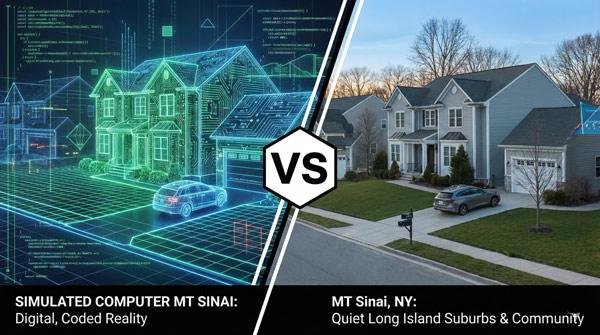
| Metric | Simulated Mt. Sinai | Real Mt. Sinai, NY |
|---|---|---|
| Median Home Price | 0 bits (or infinite, depending) | $640,000–$733,000 |
| Appreciation Rate | Determined by algorithm | +11.6–16.3% (market-driven) |
| Cedar Beach | Procedurally generated | 455 acres of real protected wetland |
| Schools | NPC teachers (non-player characters) | Real educators, real diplomas |
| Property Tax | Simulated ($0 to you, maybe) | $10,000–$16,000/yr (definitely real) |
| Pizza | Rendered pixels | Actual mozzarella |
| Home Equity | Illusory wealth? | Spendable, inheritable wealth |
| Existence Confirmed? | Unknowable | Confirmed (you’re reading this) |
2. What a Simulated Mt. Sinai Would Need to Replicate
To accurately simulate Mt. Sinai, a computer would need to model: 12,326 conscious residents with full inner lives, memories, and free will; 455 acres of harbor ecosystem including every clam, fish, and reed; the complete tidal dynamics of Long Island Sound; every grain of sand on Cedar Beach; the structural integrity of every home; the real-time flow of traffic on Route 25A; the LIRR schedule; the economic behavior of the entire New York metropolitan real estate market; and the precise flavor of a 2 AM omelet at Heritage Diner.
In 2024, the fastest supercomputer in the world — Frontier at Oak Ridge National Laboratory — achieves 1.2 exaflops (1.2 quintillion floating-point operations per second). Scientists estimate that simulating a single human brain at full neural fidelity would require approximately 1 exaflop of sustained computing power. Simulating 12,326 Mt. Sinai residents would require roughly 12,326 exaflops — about 10,272 times the world’s current total computing capacity. And that’s before you add the harbor, the weather, and the pizza.
The point: if this IS a simulation, whoever built it went to extraordinary trouble to make Mt. Sinai feel real. Which means it’s worth investing in either way.
3. Pop Culture & the Simulation Question
The simulation hypothesis has permeated popular culture. ‘The Matrix’ (1999), directed by the Wachowskis, depicted humanity enslaved inside a simulated reality by machine overlords. Its iconic scene — Morpheus offering Neo the choice between a red pill (truth) and a blue pill (comfortable ignorance) — has become a universal metaphor. In the film, ‘reality’ is a devastated wasteland. In our version, ‘reality’ is a colonial on a cul-de-sac with a pool. We recommend the blue pill.
‘The Truman Show’ (1998) explored a man who discovers his entire life has been a constructed reality. Rick and Morty, Black Mirror, Westworld, and countless other works have examined what it means to live in a world that may not be ‘real.’ The philosopher René Descartes raised this question in 1641 with his ‘evil demon’ thought experiment. Plato’s Allegory of the Cave (circa 380 BCE) posed it even earlier. The question is ancient. The answer for homebuyers is modern: if it looks like a house, feels like a house, and appreciates like a house — buy the house.
Video game designer Will Wright (creator of SimCity and The Sims) has observed that real estate is one of the most satisfying elements to simulate — which is perhaps why ‘The Sims’ franchise has sold over 200 million copies worldwide. People love building homes, even virtual ones. Imagine how much more satisfying it is to build equity in a real one.
▶ Video: Nick Bostrom: Are We Living in a Simulation? — Watch on YouTube
▶ Video: Mt. Sinai NY Neighborhood Walkthrough — Watch on YouTube
4. The Practical Philosophy of Homeownership
Here is the essential insight: whether reality is simulated or not, the experience is identical. Your mortgage payment is real. Your equity growth is real. Your children’s education is real. The joy of walking Cedar Beach at sunset is real — or at the very least, indistinguishable from real, which amounts to the same thing.
The philosopher David Chalmers, in his 2022 book ‘Reality+: Virtual Worlds and the Problems of Philosophy,’ argues that even if we are in a simulation, the objects and experiences within it are genuinely real — they are ‘digital objects’ with real properties and real effects on our lives. A simulated dollar buys a simulated sandwich that provides simulated but experientially real nutrition. A simulated home provides real shelter, real community, and real equity. Chalmers’ conclusion: simulated reality IS a kind of genuine reality.
So: whether Mt. Sinai is base reality, a simulation, or a dream within a dream, the correct financial and lifestyle decision remains the same — invest in a home that appreciates, in a community that thrives, near a beach that is beautiful regardless of its metaphysical status.
5. Active Listings: Real Homes in (Possibly Simulated) Mt. Sinai
New Construction on 0.69 Acres — Mt. Sinai
Price: $1,199,000
Details: 5 Beds | 3 Baths | 3,500+ Sq Ft
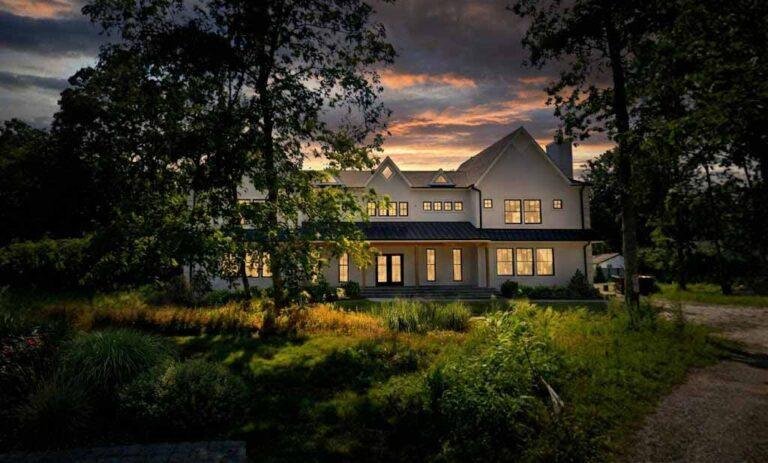
Newly constructed colonial with dramatic cathedral ceilings, tilt-and-turn windows, elegant moldings. If this is a simulation, the rendering quality is extraordinary. If it’s real, it’s even better.
View This Listing on Heritage Diner IDX: https://search.heritagediner.com/idx/search/address
Colonial Overlooking Willow Creek — Mt. Sinai
Price: $1,175,000
Details: 5 Beds | 3.5 Baths | 3,941 Sq Ft
8th hole views, cherry wood floors, pristine gated community. Neo chose the red pill. We recommend choosing this home.
View This Listing on Heritage Diner IDX: https://search.heritagediner.com/idx/search/address
Designer Showpiece on Corner Lot — Mt. Sinai
Price: $699,000
Details: 4 Beds | 2.5 Baths | 2,500 Sq Ft
White oak plank flooring, cathedral ceilings, Belgian block driveway. Low taxes. Whether you’re in the Matrix or not, this is a good deal.
View This Listing on Heritage Diner IDX: https://search.heritagediner.com/idx/search/address
Move-In Colonial with Pool — Mt. Sinai
Price: $749,000
Details: 4 Beds | 1.5 Baths | 2,200 Sq Ft
Updated kitchen, in-ground pool, oversized Andersen windows. The Sims could never.
View This Listing on Heritage Diner IDX: https://search.heritagediner.com/idx/search/address
6. The Final Thought Experiment
Imagine two scenarios. In Scenario A, you discover definitively that we ARE living in a simulation. Does that change the fact that your home shelters your family, your equity is growing, and Cedar Beach is beautiful? No. In Scenario B, you discover we are in base reality. Same house, same equity, same beach. The outcome is identical. The investment thesis holds in both realities.
The only scenario where buying a Mt. Sinai home is a bad investment is one where the simulation crashes — and in that case, everyone’s portfolio looks equally bad. Diversification into real estate can’t protect against the heat death of the universe or a server reboot, but it can protect against inflation, rent increases, and the regret of not buying when you had the chance.
Conclusion: Whether It’s Real or Rendered — Mt. Sinai Is Home
Philosophers will debate the nature of reality for centuries to come. Homebuyers cannot afford to wait that long. Mt. Sinai’s market is appreciating now. Cedar Beach is beautiful now. The schools are excellent now. The Heritage Diner omelet is delicious now. Whether ‘now’ is computed or concrete, the right move is the same: call Paola Meyer at Realty Connect USA and find your home in Mt. Sinai. Reality — whatever it is — awaits.
SEO Keywords: simulation hypothesis real estate, Mt Sinai NY homes for sale, Long Island real estate 2025, are we in a simulation, matrix real estate, Cedar Beach Mt Sinai, Heritage Diner, Paola Meyer broker, North Shore Long Island, Suffolk County homes, philosophy of homeownership
Related Articles from Heritage Diner Real Estate
Search Mt. Sinai Listings: https://search.heritagediner.com/idx/search/address
About Paola Meyer, Associate Broker: https://heritagediner.com/about-paola/
More Real Estate Insights: https://heritagediner.com/category/real-estate/
Heritage Diner Blog: https://heritagediner.com/blog/
Heritage Diner Real Estate — Powered by Paola Meyer, Associate Broker, Realty Connect USA
Search All Listings: https://search.heritagediner.com/idx/search/address
Visit Heritage Diner Blog: https://heritagediner.com/blog/About Paola Meyer: https://heritagediner.com/about-paola/