The Building Across the Street
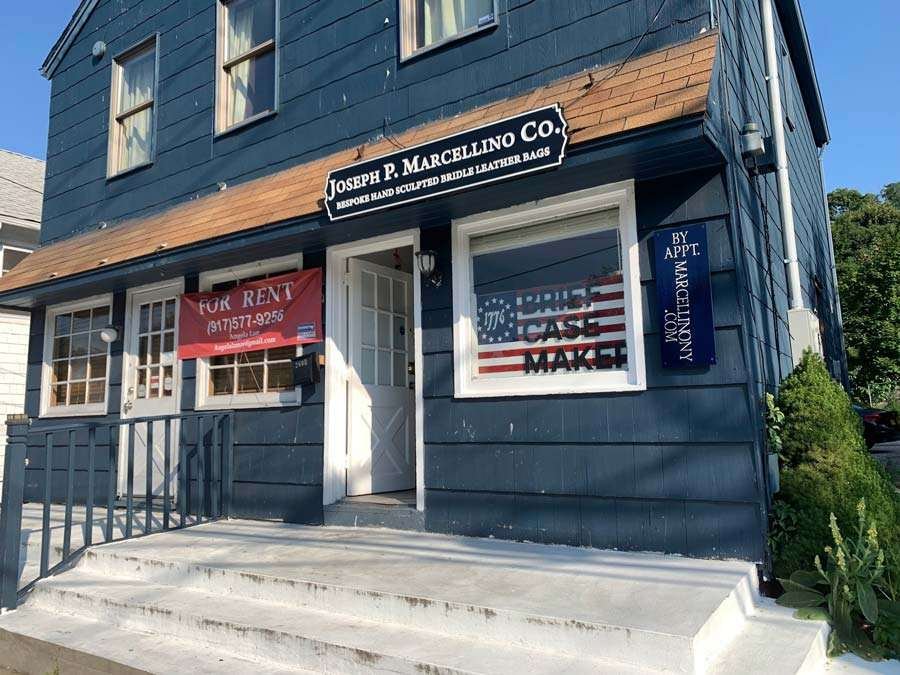
I picked the Setauket spot for reasons I understood at the time. Good light. The right scale. A room that smelled like a workshop should smell. Rent I could live with while I was still building the thing I was trying to build.
What I didn’t fully account for was the building directly across the street.
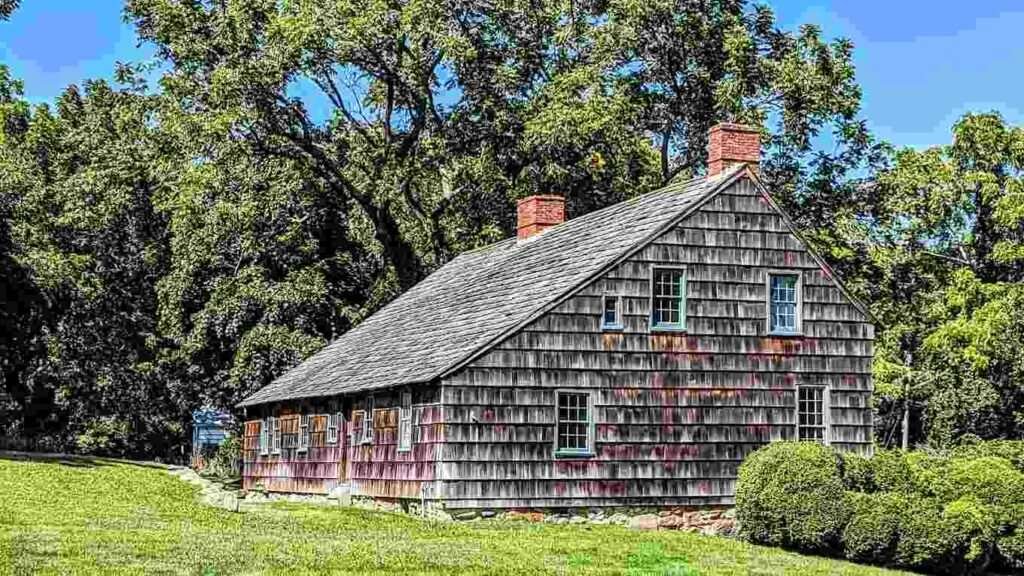
The Brewster House at 18 Runs Road in East Setauket was built in 1665. That’s not a typo. Three hundred and sixty years ago, give or take, someone built a house on that ground, and that house is still standing. The Ward Melville Heritage Organization maintains it now — it’s listed on the New York State and National Register of Historic Places, and it’s considered the oldest house in the Town of Brookhaven. Nine generations of Brewsters lived inside it. During the American Revolution, Joseph Brewster ran it as a tavern and general store, and British troops ate and drank there while Caleb Brewster — Joseph’s cousin — was rowing intelligence across Long Island Sound to George Washington’s side of the line.
You can see it from the street. Cedar shingles weathered silver. Two brick chimneys. A saltbox roofline that started as a single room in 1665 and grew over the centuries the way old things grow — slowly, under pressure, adding what the moment required.
I set up my workshop directly across from that.
What the Culper Ring Actually Did in Setauket
Most people know the Culper Ring through AMC’s Turn, and most of what they know from that show is either compressed or invented. The real story is harder and better. Major Benjamin Tallmadge, operating as Washington’s chief intelligence officer from late 1778, built his spy network out of the one thing he had left after the British occupied Long Island: people he trusted since childhood. Abraham Woodhull, a Setauket farmer. Caleb Brewster, a former whaler. Austin Roe — a tavern keeper a few miles up the road. They weren’t recruited. They were chosen. There’s a difference.
The British had been on Long Island since August 1776. They occupied farms, stabled horses in churches, commandeered provisions, and turned the whole eastern half of the island into a forward supply base. The First Presbyterian Church of Setauket — you can still see it, across the village green — served as a British stable during the occupation. That’s the kind of detail that doesn’t fit easily into a television drama, but it’s the detail that explains everything about the ring’s method: the spies moved through a world that was theirs, that they’d grown up in, that they knew down to the coves and the pastures and the roads, and the British — for all their military power — never quite learned the texture of it.
The Brewster House, built in 1665 and considered the oldest house in the Town of Brookhaven, was home to six generations of Brewsters. During the Revolution, Joseph Brewster’s position as tavern keeper — entertaining British troops at his own table — gave Caleb Brewster plausible cover for his visits. The house sits approximately 150 feet from one of the six coves on the Setauket shoreline where Caleb pulled his whaleboat ashore to collect intelligence from Woodhull before rowing it across the Sound to Tallmadge in Connecticut.
Think about the geometry of that. Intelligence gathered in Manhattan by Robert Townsend traveled fifty-five miles east with Austin Roe to Woodhull’s farm. Woodhull passed it to Brewster. Brewster launched from a cove 150 feet from his cousin’s house — the same house his family had lived in for multiple generations — and rowed it across the water to Washington.
The whole operation ran on the grain of daily life. Nobody was acting out of character. A tavern keeper buying supplies in New York. A farmer attending to his field. A whaler who knew the Sound better than the British navy did. The house across from my workshop was part of all of it.
Halesite, Nathan Hale, and the Pattern I Didn’t Plan
Before Setauket, I built Marcellino NY in Halesite.
Halesite is a small hamlet in the Town of Huntington — it sits along the harbor, tucked into the fold between Huntington Bay and the Sound. It’s named after Nathan Hale. Not figuratively named for the memory of him. Named because Nathan Hale, in September of 1776, landed on the shores of Huntington Harbor by sloop from Norwalk, Connecticut, on a spying mission for George Washington. He crossed enemy lines disguised as a Dutch schoolteacher, gathered what intelligence he could, and was captured — reportedly near Flushing Bay — then hanged in New York City on September 22, 1776. He was twenty-one years old. The hamlet that carries his name marks the site of his arrival.
I didn’t choose Halesite because of Nathan Hale. I chose it because it was where I was. My workshop was in my Huntington home, and that’s where I built the foundation of what Marcellino NY became — the first briefcases, the first commissions, the reputation that made the next move possible. But I’ve been thinking about it since. Hale began his intelligence mission in Huntington. Two years later — two years of brutal British occupation of Long Island — Benjamin Tallmadge built the network that actually worked, and he built it east of Huntington, in Setauket. I built my craft in Halesite, and then I moved east to Setauket, across from the house that was at the center of the ring.
I’m not making a mystical claim. I’m a craftsman and a diner owner, not a historian of fate. But I do pay attention to the ground I’m standing on.
The Leather and the Time
Here’s where I have to be honest about what I know and what I’m imagining.
I don’t have documentation of a leather workshop at that particular address in Setauket in the colonial period. I’m not going to invent one. What I can tell you is that English bridle leather — the specific type I work with at Marcellino NY — has a history that runs directly through the colonial American period. Bridle leather was the working material of the 1700s. Saddle bags. Harnesses. Cartridge pouches. The bags that carried documents across enemy lines. The straps that held a whaleboat together on a long pull across Long Island Sound.
Tanners were essential tradespeople in every colonial settlement. I wrote about this in my piece on the tannery towns of New York — the leather industry was the infrastructure of early American life, as foundational as milling and blacksmithing. The natural vegetable tanning process I use at Marcellino NY, the same process that gives my vachetta leather its pale, mutable surface before the patina sets in, is essentially unchanged from what would have been used in a colonial tannery. Bark. Time. Water. The hide doing what hides do when you give them the conditions they need.
When I look across the street at the Brewster House and I imagine a leatherworker in that neighborhood in the 1770s, I’m not asserting history. I’m following a reasonable line of craft. Setauket was a working community. Working communities need leather. The tools I use and the material I handle connect to something that predates the Republic. That’s not a marketing claim. That’s just the nature of what I make.
What I know for certain: I sat in a workshop across from the oldest building in the Town of Brookhaven, making a type of bag by hand that was being made by hand in that same century the building was new, in a hamlet named for a spy who landed two towns west. And I’m moving back to Setauket. A post-modern colonial, not far from the Brewster House. The new workshop will be there.
Why the Photographs Were Taken There
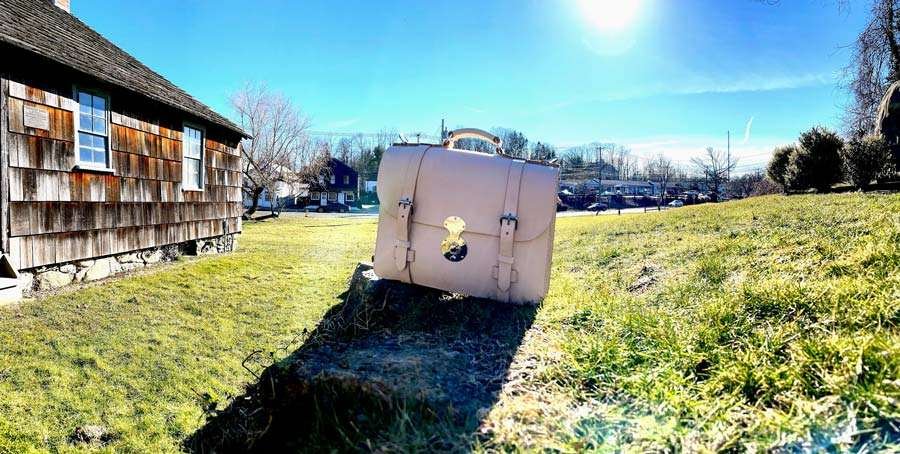
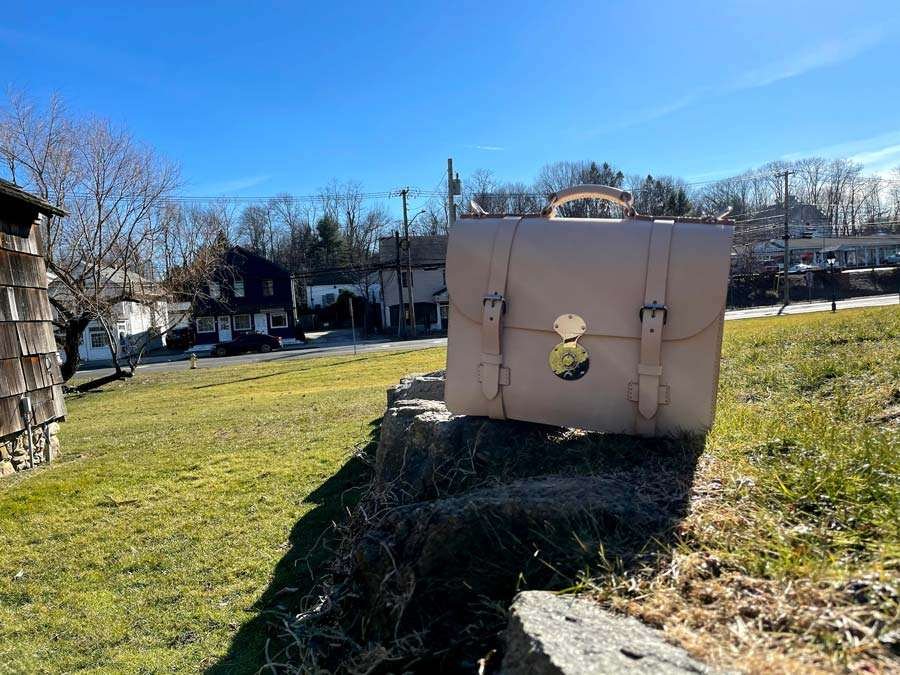
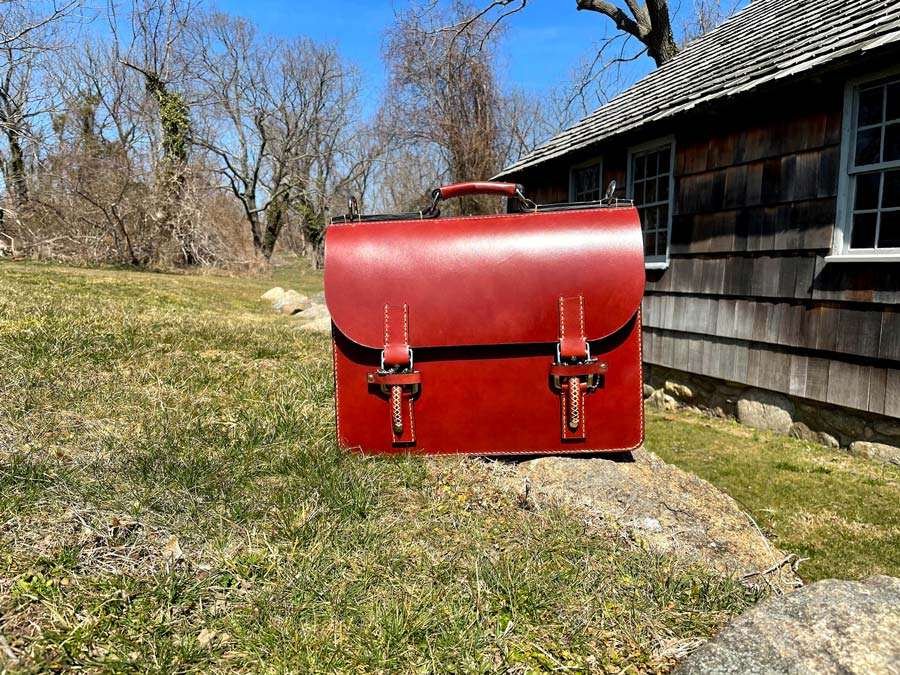
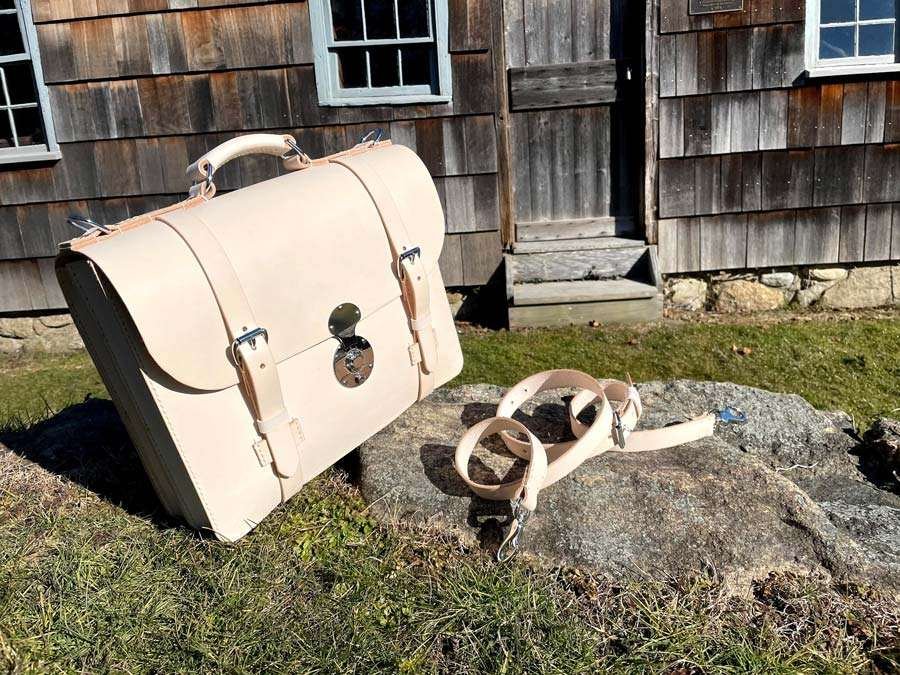
The images in this piece aren’t coincidental. I photographed the briefcases at the Brewster House because the relationship between what I make and where that building has been felt true enough to document.
The burgundy briefcase — that’s the signature Marcellino style, the deep antique bridle leather with the double-latch hardware I developed, the specific curve of the flap that makes it recognizable at a distance. I photographed it with the Brewster House visible behind it, in the summer when the cedar shingles catch the light and the trees are heavy. The natural-tanned vachetta briefcase — pale bone before the patina starts, straps coiled on the stone — I shot it in early spring with bare trees and the Setauket street visible behind it. The building is the same in both. Different seasons, same ground.
The natural leather will darken to a deep honey and eventually to amber over years of handling. It starts as something almost blank — all potential, no story yet. The burgundy has already been through its transformation in the tannery; it arrives with color and character. Two different relationships with time. Both hand-stitched. Both English bridle leather. Both made in the same place, across from a building that has been standing since Louis XIV was running France.
Coming Back
I’ve been on this stretch of the North Shore long enough to feel its rhythm. The light on the Sound in November is different from the light anywhere else I’ve been. Route 25A from Huntington to Setauket passes through the same ground that Austin Roe rode twice a week for three years carrying intelligence past British checkpoints, which is a thing I think about every time I drive it. I wrote about the ride down 25A from a different angle, but the history runs through it the same way.
Setauket is the kind of place that rewards paying attention. The Brewster House is still there. The village green where the British set up their encampment is still there. The coves where Caleb Brewster pulled his whaleboat are still there, mostly. The road is the same road. The ground is the same ground.
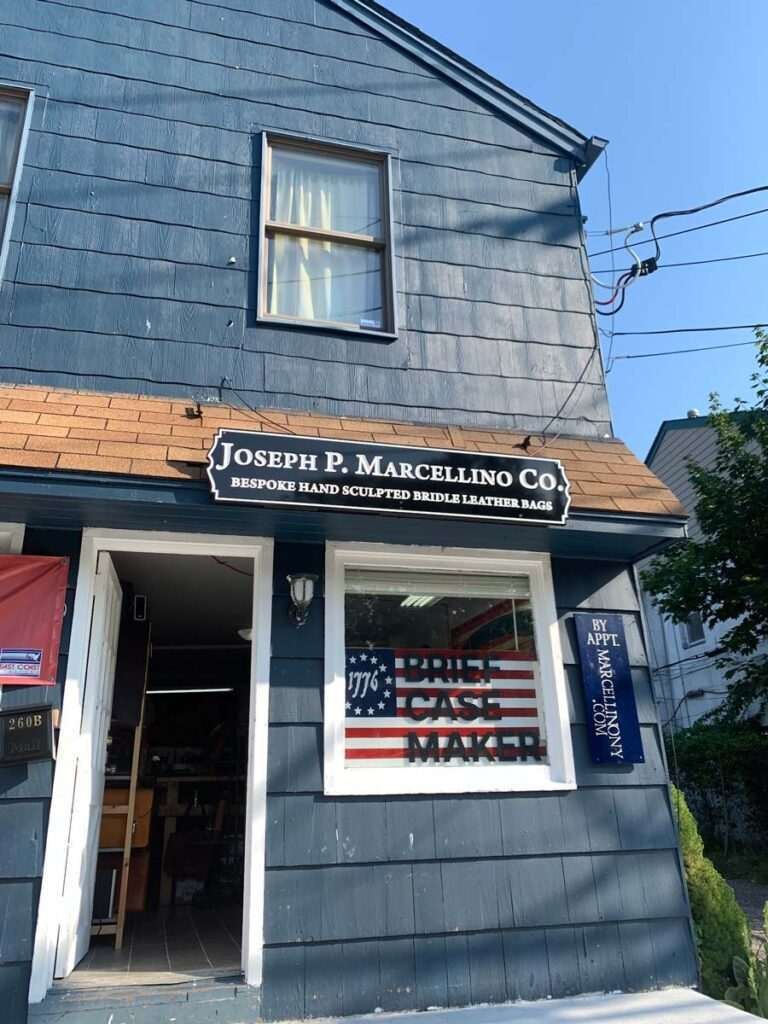
I’m moving into a post-modern colonial not far from all of it. The new workshop will be there. I don’t know yet exactly what it’ll look like — the layout, the light, the way the work will sit in the space. I know it’ll be in the same neighborhood that produced the most effective intelligence network of the American Revolution, built out of farmers and tavernkeepers and whalers who knew the ground under their feet.
That seems like the right place to make something that lasts.
You Might Also Like
- The Tannery Towns of New York: A History of Leather Manufacturing in the Empire State
- The Ride Down 25A: A Historic Motorcycle Journey Along Long Island’s North Shore to The Heritage Diner
- Rum Row and the Freeport Bootleggers: Long Island’s Clandestine War on the Water
Sources
- The Brewster House — Ward Melville Heritage Organization
- Brewster House (East Setauket, New York) — Wikipedia
- Town Honors Three Village House Rooted in History — TBR News Media
- Halesite, New York — Wikipedia
- Nathan Hale — Wikipedia
- Captain Nathan Hale’s Last Words — Town of Huntington
- Culper Ring — Wikipedia
- Alexander Rose, Washington’s Spies: The Story of America’s First Spy Ring (2006)
- Morton Pennypacker, General Washington’s Spies on Long Island and in New York (1939)
- Secrets on the Washington Spy Trail