The slow boat takes two days. There is no Wi-Fi. The river decides the speed. This is the condition, and the condition is the point.
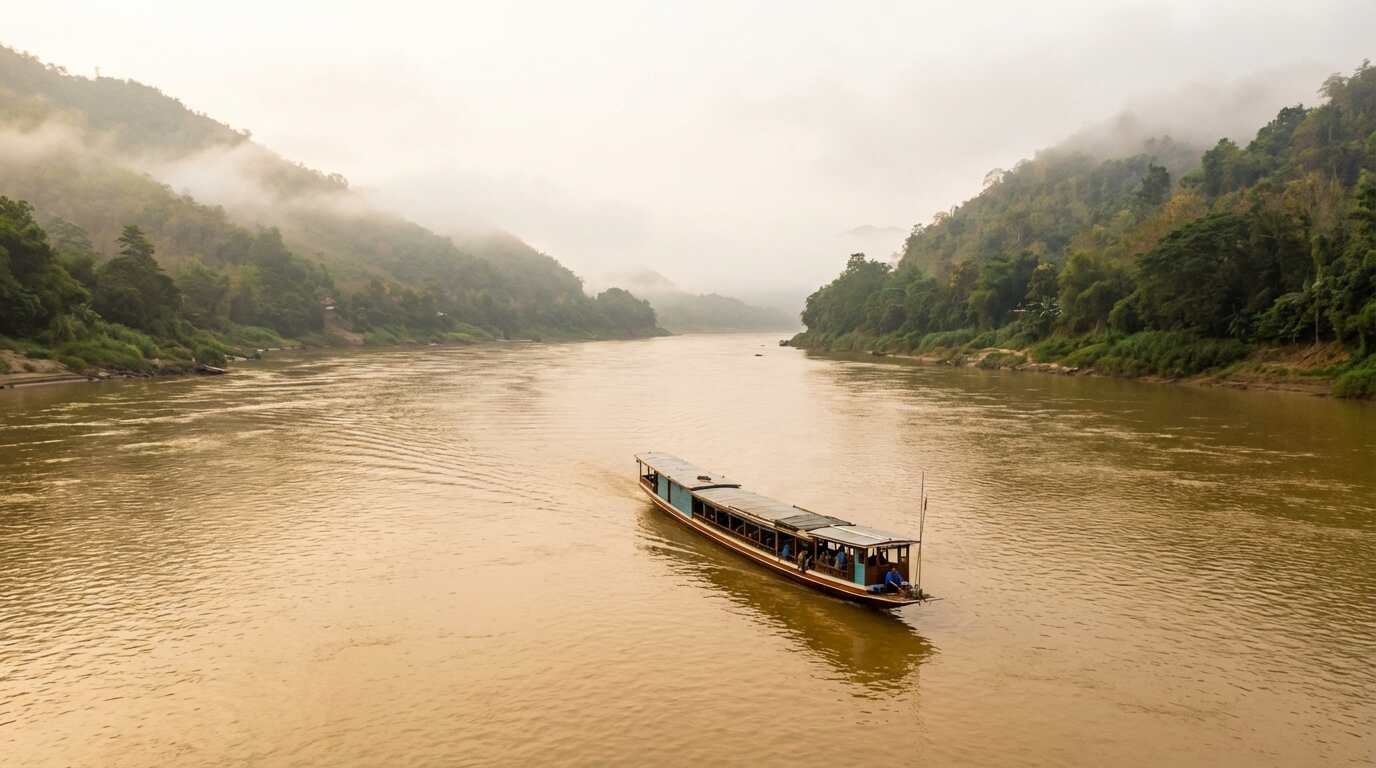
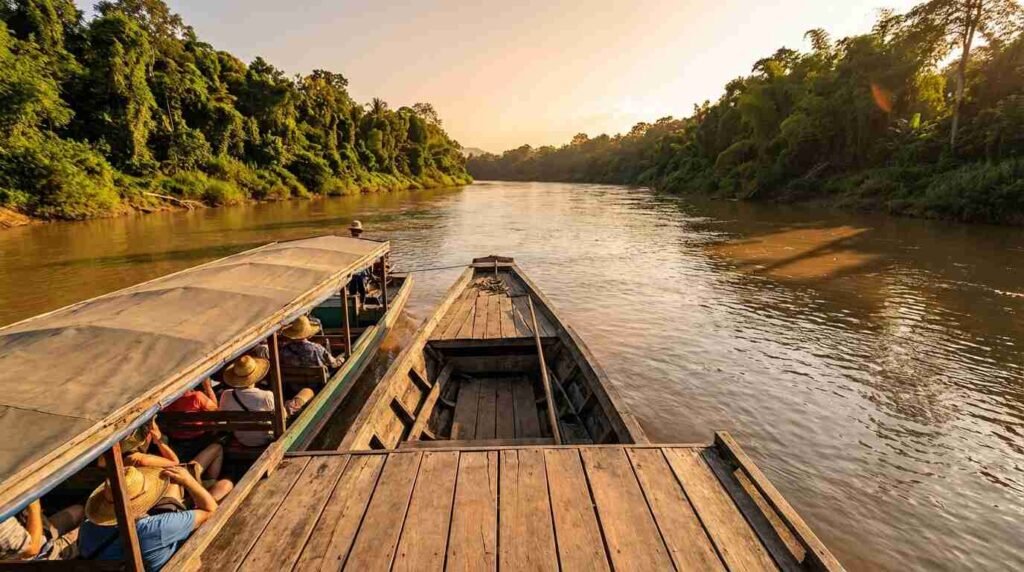
The boat departs Huay Xai, the border town on the Mekong where Thailand ends and Laos begins, early in the morning. It is a wooden vessel roughly twenty meters long, low to the water, bench seating cushioned with thin foam pads worn flat by years of use. The boatman and his assistant do not introduce themselves. They start the engine. The Mekong, which has been moving at its own pace since long before anyone thought to travel it commercially, continues doing so.
The River as Argument
The Mekong is not a romantic river. The Rhine is romantic. The Thames has accumulated enough cultural mythology to stand in for itself. The Mekong is something else — four thousand kilometers of water originating in the Tibetan Plateau and passing through six countries before reaching the South China Sea, carrying, as the Mekong River Commission has documented, approximately 160 million tons of sediment annually. It is a working river. Fish traps extend from bamboo poles staked into the banks. Villages appear and disappear. A boy stands on a rock watching the boat pass with an expression of complete indifference. The river has been watched from that rock, probably, for longer than the category of “tourist” has existed.
Pico Iyer, whose writing on enforced stillness and slow travel has mapped this territory better than most, has argued that the greatest luxury of the modern world is not speed but its opposite — the permission to stop moving at the rate the world demands. The Mekong slow boat is not comfortable in the resort sense. It is slow in the way that water is slow: completely, without apology, without the option of acceleration.
This is, for the first several hours, intolerable. That discomfort is where the thing begins.
On Restlessness as Habit
Marcus Aurelius, in Book II of the Meditations, returns repeatedly to the problem of the mind that will not be still. He was writing from military camps and imperial courts and sickbeds — environments that produced their own kind of enforced attention. He had learned, or was in the process of learning, that the mind’s restlessness is not a response to circumstances but a habit of the mind itself. The circumstances change; the restlessness remains.
On the Mekong, the habit announces itself with unusual clarity. By noon of the first day the river is still moving, the forest still on both banks. A white-throated kingfisher appears on a dead branch and is gone before it can be established as something worth watching. The mind, which expected input proportional to its capacity, begins negotiating with the absence of it.
The habit of restlessness is the assumption that something should be happening — that stillness is a condition to be remedied rather than used. The Mekong disagrees. The Mekong has been moving at this pace since the Pliocene epoch. It has no investment in whether the rate of input is adequate.
Pak Beng at Dusk
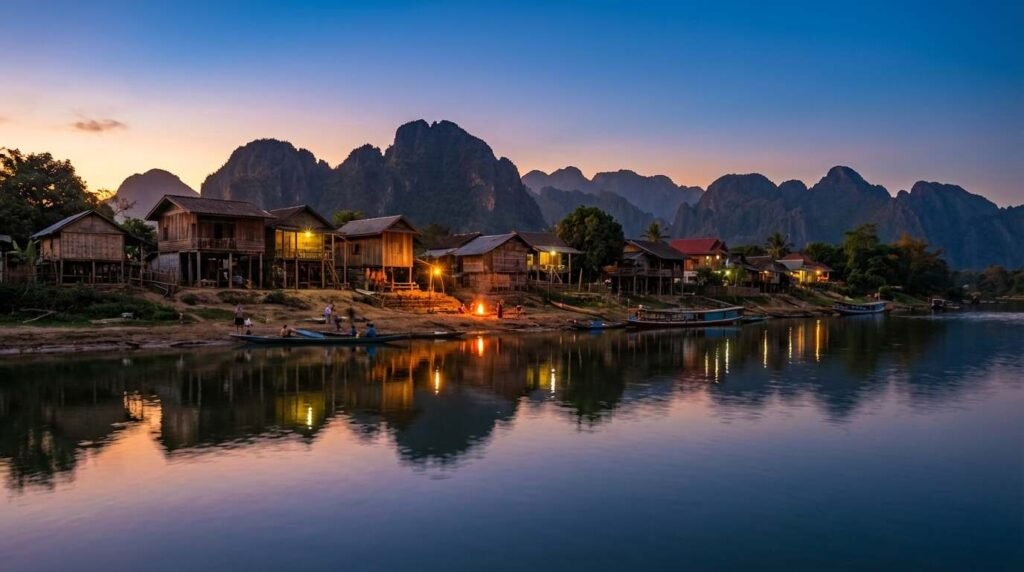
The first night is spent at Pak Beng, a village on the Laotian bank where the slow boat regularly overnights. The village exists largely because the slow boat stops there — guesthouses, a few restaurants serving noodle soup and Beer Lao, a temple at the top of a hill where monks rise before dawn for reasons having nothing to do with tourism. The sunset over the river from any high point in the village is the kind of sunset that stops the eye without asking permission.
The monks’ bell from the hilltop temple carries across the water at five in the morning. The second day on the river begins in darkness and birdsong. The engine starts. The Mekong resumes at the pace it never abandoned.
The Compulsion to Document
The second day on the water produces, in the attentive traveler, an awareness that rarely surfaces at home: how much energy normally goes toward managing the record of experience rather than the experience itself. There is no signal on the river. Photographs taken will be uploaded later, or not at all. Notes written will be written in the actual sense — words on paper, in a notebook, with a pen, without the option of revision before the thought has landed.
The compulsion to document is a form of insurance against experience. If you photograph it, you have it. If you post it while it is happening, it has been witnessed, which makes it more real than the witnessed event itself. The Mekong, which has been witnessed by nobody and everybody for several million years depending on how you count, offers no position on this.
By the second afternoon, somewhere between a village without a name on any map and the sound of a distant bell across the water — which may be a temple never identified, or the same bell from Pak Beng carried impossibly far by the river’s acoustics — the compulsion to capture what is happening gives way, gradually, to simply being in it. The distinction is the whole journey.
What the Body Teaches
Aurelius on the body and its resistance: “At dawn, when you have trouble getting out of bed, tell yourself: I have to go to work — as a human being.” He meant the daily labor of living with integrity. The slow boat applies the principle differently. The body, deprived of its usual stimuli and its usual pace, teaches proportion. The problem that felt urgent at departure — the decision delayed, the message unanswered, the question of whether any of this is worth the time — has been reduced, by the river’s scale, to its actual size.
The Mekong moves at approximately three to five kilometers per hour. A human walks at about five. On the slow boat, you are moving at something close to the speed of walking — horizontally, on water, through a country you are passing through rather than arriving in. Luang Prabang, the UNESCO World Heritage city at the journey’s end, is not the destination in any meaningful sense. It is where the river delivers you. The distinction matters.
What Clarity Looks Like
The clarity that arrives on the second day does not arrive as insight. It does not present itself as a thought that can be extracted and applied elsewhere. It is more structural — a reorganization of priority that happens below the level of articulation, the way the body reorganizes after sleep.
What moves to the front is attention. Not the managed, task-oriented attention of a person with a schedule, but the older, less directed attention of a person sitting in one place while the world moves past, watching without agenda. A buffalo standing in the shallows. An old woman washing something on a flat rock. Two boys in a dugout canoe who watch the slow boat with the particular expression of people observing a large and irrelevant object pass. Life happening at its own speed, which is not the speed of the slow boat, which is not the speed of Wi-Fi, which is not the speed of the ambient expectation that something should be happening at all times.
Aurelius again: “How much more grievous are the consequences of anger than the causes of it.” The same proportion holds for restlessness. How much more is lost in the effort to escape the pace of things than is ever gained by arriving faster.
The ferryman on the Mekong does not ask where you are going. He knows where he is going. The river knows where it is going. What the journey offers, for two days, is the experience of accompanying something that was in motion long before you arrived and will continue long after you leave. That is not a small thing. It may be the only thing worth learning on the journey — if you are willing to be still long enough to receive it.
You Might Also Like: The Hudson Valley in Reverse: Why You Should Start in Beacon and Work Your Way South
Sources
- Mekong River Commission: mrcmekong.org
- UNESCO World Heritage listing for Luang Prabang: whc.unesco.org/en/list/479
- Laos National Tourism Administration: tourismlaos.org
- Marcus Aurelius. Meditations. (Gregory Hays translation, Modern Library, 2002)
- Iyer, Pico. The Art of Stillness: Adventures in Going Nowhere. TED Books / Simon & Schuster, 2014.