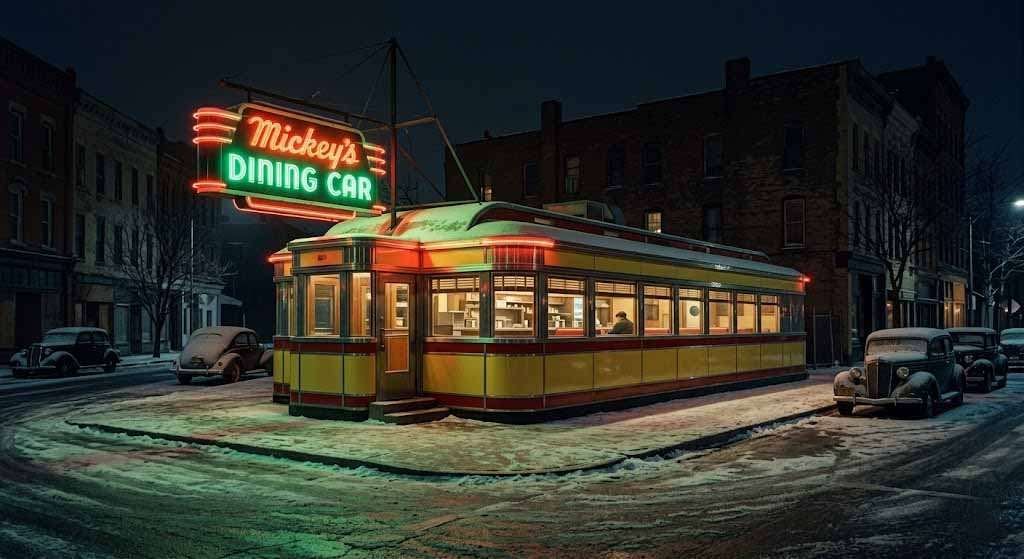
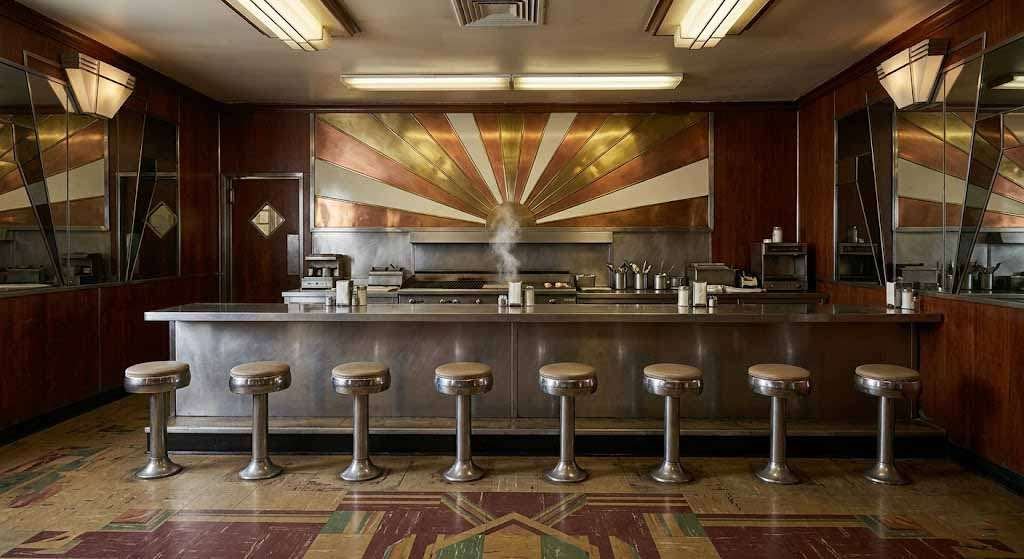
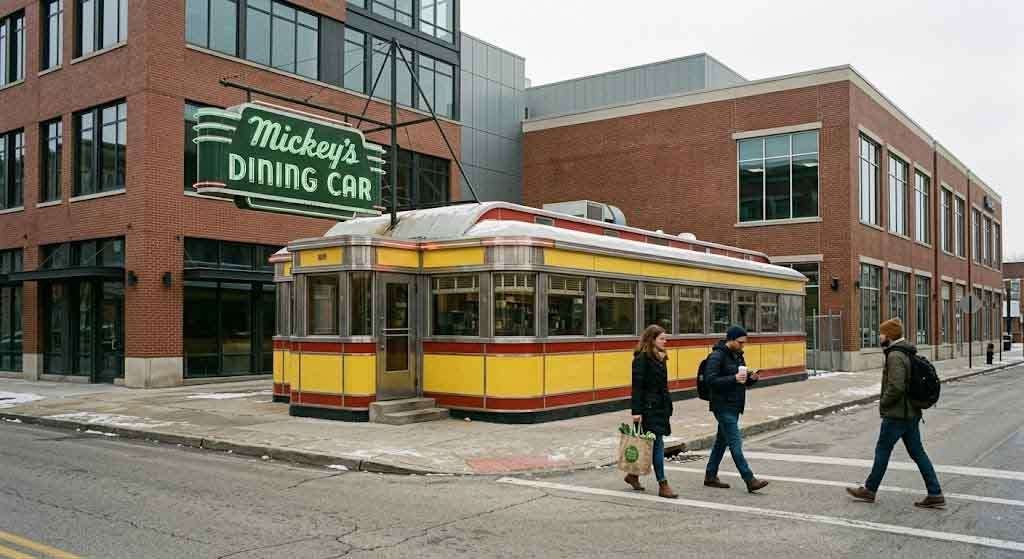
The Jerry O’Mahony Diner Company of Elizabeth, New Jersey built Mickey’s Dining Car in 1937 — prefabricated, in the factory, the way they built all their units. Shipped it to Minnesota by rail. The owners, John “Bert” Mattson and David “Mickey” Crimmins, dropped it at 36 West 7th Street in downtown St. Paul and opened in 1939. It has been in essentially the same spot, essentially unchanged, ever since. Fifty feet long. Ten feet wide. Yellow and red porcelain enameled-steel panels. A horizontal band of plate glass windows. Art Deco lettering on a projecting neon sign that reads Mickey’s Dining Car in green. Ten stools along a counter facing a sunburst-patterned stainless steel back wall. Booths that have held approximately everyone who ever passed through downtown St. Paul over eighty-five years.
The National Register nomination form says Mickey’s is the only known dining car of its type to survive in Minnesota. It calls the diner “a beloved, longstanding and unique social institution.” Both statements are true. The second one is also, if you think about it long enough, the beginning of a problem.
What the O’Mahony Company Was Building
The Jerry O’Mahony Diner Company did not think of itself as building cultural artifacts. It thought of itself as manufacturing restaurants. This is a distinction that matters.
The O’Mahony units were designed for a specific economic reality: someone without a lot of capital who wanted to feed people quickly and profitably. The prefab model solved the cost problem. You ordered your diner from a catalogue, essentially. The company built it in New Jersey. You received it by rail. You put it on whatever land you had access to and opened for business. The form followed the economics as tightly as any modernist manifesto: every curve, every chrome strip, every stool bolted to the floor was there because it served a function. Nothing was decorative. The thing that looks decorative now — the Art Deco lettering, the sunburst pattern on the back wall, the green neon — was, in 1937, simply the visual language of the period, no more self-conscious than a manila envelope.
The genius of the diner form, historically, is that it never intended to be lasting. Lunch wagons — the horse-drawn predecessors of the prefab diner — were, by definition, mobile. The streamlined steel-and-glass unit was a step up from the wagon but still carried the assumption of impermanence. You could move it. You could replace it. You could, if the business failed, sell it to someone else in another city. The form was built for a world in which nothing was supposed to last.
The National Register of Historic Places is built for a world in which some things are supposed to last forever. These are not the same world.
The Mechanics of Preservation
The nomination form submitted to the National Park Service in 1982 made several arguments. Mickey’s was architecturally significant — an unaltered example of the railroad car-style diner, one of the few surviving in the Midwest. It was commercially significant — a continuous operation at the same location since 1939. And it was socially significant — a “beloved, longstanding and unique social institution.” The form was approved. Mickey’s was listed on February 24, 1983.
What the listing actually requires is, in practice, less than most people think. The National Register does not compel an owner to do anything. It does not freeze the menu. It does not freeze the prices. It does not put a velvet rope around the counter stools. The designation has teeth mainly when federal funds are involved in any proposed change to the property. Otherwise, it is largely honorific. The building becomes an official historical fact. The government has acknowledged that it matters.
But acknowledgment has consequences, even when it has no legal teeth. Once a diner is on the National Register, it becomes a destination for a specific kind of visitor: the person who comes not because they are hungry, but because they want to experience the place as a historical artifact. The Smithsonian has written about Mickey’s. National Geographic has written about Mickey’s. Sports Illustrated ran it. Playboy ran it. Al Roker came for television. Rachael Ray came for television. Robert Altman shot the opening and closing scenes of A Prairie Home Companion there in 2006. The Mighty Ducks franchise filmed there three times. Mickey’s appeared on the front and back cover of R&B singer Alexander O’Neal’s 1985 debut album.
None of this is bad. All of it is, in some sense, a different thing from running a diner.
The Tourist and the Regular
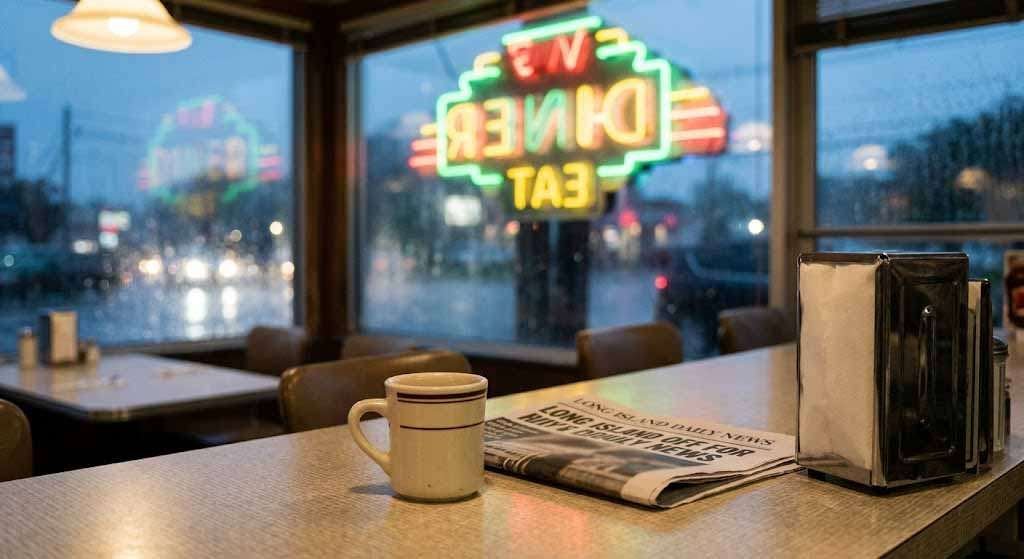
There is a version of Mickey’s that exists for regulars — the overnight shift workers who ate there at three a.m. because it was open and cheap and nobody bothered you; the downtown employees who grabbed breakfast on the way in; the cab drivers; the people in the neighborhood who knew the counter people by name. This version of Mickey’s operated continuously from 1939 until the pandemic closed it in March 2020.
There is another version of Mickey’s that exists for people who have read about it in the Smithsonian. They arrive with cameras. They want the stool at the counter. They want the neon sign to be on. They want the experience to match what they read about, which is to say they want the experience to be historical.
These two versions of the same diner have been coexisting for decades, and the tension between them is the tension at the center of every preservation conversation that anyone ever has about any building. The building that serves its original community is doing one thing. The building that has been officially recognized for serving its original community is doing something slightly different. Once recognition arrives, the original use becomes a performance of itself. The grease trap becomes a prop.
I think about this at Heritage Diner, which opened in 2000 and has been, since then, a working restaurant that is also — whether I planned it or not — a document of a certain kind of North Shore Long Island life. The artwork on the walls is mine; the sourdough loaves come out every morning. None of it is a museum exhibit. But I understand, better than I would like to, the moment when a place stops being a place and starts being a representation of itself. It is a subtle shift. You rarely feel it happening. You just notice one day that certain customers are there to photograph the counter, not eat at it.
What Happened When They Closed
Mickey’s closed in March 2020 along with everything else. The difference was that it stayed closed. While other restaurants reopened, pivoted, reinvented, Mickey’s remained dark at 36 West 7th Street for over four years. The neon sign stayed off. The counter stools sat empty through however many Minnesota winters.
When the diner finally reopened on October 3, 2024, there were changes. The menu looked the same — eggs, pancakes, hash browns, the patty melt, the mulligan stew, the ice cream shakes — but the laminate was new. New management was in place. The kitchen now offered beef bacon and other kosher and halal options. The once-cash-only diner began taking credit cards. Co-manager Sam Hashish told the Minnesota Star Tribune he didn’t know if you could make it greater than it already was, but they were hoping.
That is a careful statement. It acknowledges the burden. You cannot make Mickey’s more Mickey’s. The pressure is not to improve it; the pressure is to not diminish it. Every decision made in that kitchen, every modification to the menu, every change to the laminate or the hours or the payment policy happens inside the frame of the monument designation. The building has been officially recognized as irreplaceable. That is a weight to carry into a kitchen every morning.
The original owners, Mattson and Crimmins, ran a diner. They made decisions based on what their customers needed and what kept the lights on. Bert bought Mickey out in the 1950s — Mickey went on to run a McDonald’s, a detail that would make a good short story — and Bert’s son Eric took over in 1970. The family ran it until the pandemic. Their operating principle was, by all accounts, straightforwardly utilitarian: serve good food, be open when people need you, don’t change what works.
A monument cannot operate on that principle. A monument has to preserve what it is, which is different from doing what it does.
The Condition of the Surviving Thing
There are, by some accounts, approximately eight Googie coffee shop restaurants remaining in Los Angeles. There is one Jerry O’Mahony dining car of Mickey’s type surviving in Minnesota. The number of original prefab diners of any kind still in operation across the country is a fraction of what it once was. The rest were demolished, converted, sold for parts, or simply abandoned when the economics stopped working.
The ones that survive do so for different reasons. Some survived because they found new owners with the money to maintain them. Some survived because they became tourist destinations before they had a chance to fail. Some survived because a neighborhood changed around them in ways that made them newly interesting to people who had not historically been their customers. And some survived because someone cared enough, over decades, to keep the lights on and the grill hot and the door open at three a.m. even when it was not profitable to do so.
Mickey’s is the last kind, improbably preserved by a family that ran it for generations without apparent concern for its cultural significance. The Mattsons did not think of themselves as custodians of American architectural heritage. They thought of themselves as people who ran a diner. The designation arrived after the fact, an official acknowledgment of what they had already, without planning to, accomplished.
The problem with that story — the reason it becomes complicated — is that the designation changes the terms of the thing going forward. The next generation of owners is not running a diner that happens to be historically significant. They are running a historical landmark that happens to still serve eggs. That is a different job. The menu is the same. The building is the same. The neon sign is the same. But the relationship between the institution and its own existence has shifted in ways that are hard to name and harder to manage.
You cannot freeze-dry a grease trap. But the National Register of Historic Places is, in some essential way, in the business of trying.
You Might Also Like:
- How to Build the Perfect Diner Breakfast Platter — Step-by-Step Assembly Guide
- The Ride Down 25A: A Historic Motorcycle Journey Along Long Island’s North Shore to The Heritage Diner
- Rum Row and the Freeport Bootleggers: Long Island’s Clandestine War on the Water
Sources:
- Wikipedia — Mickey’s Diner: https://en.wikipedia.org/wiki/Mickey’s_Diner
- MNopedia / Minnesota Historical Society: https://www.mnhs.org/mnopedia/search/index/structure/mickeys-diner
- SAH Archipedia — Mickey’s Diner: https://sah-archipedia.org/buildings/MN-01-123-0035
- MinnPost — 30 Years Ago, Mickey’s Diner Awarded Historic Status: https://www.minnpost.com/minnesota-history/2013/03/30-years-ago-mickeys-diner-awarded-historic-status/
- Minnesota Star Tribune — An Icon Returns: Mickey’s Diner Is Open in St. Paul: https://www.startribune.com/an-icon-returns-mickeys-diner-is-open-in-st-paul/601156430
- St. Paul Publishing — An Ode to Mickey’s Diner: https://www.stpaulpublishing.com/an-ode-to-mickeys-diner/