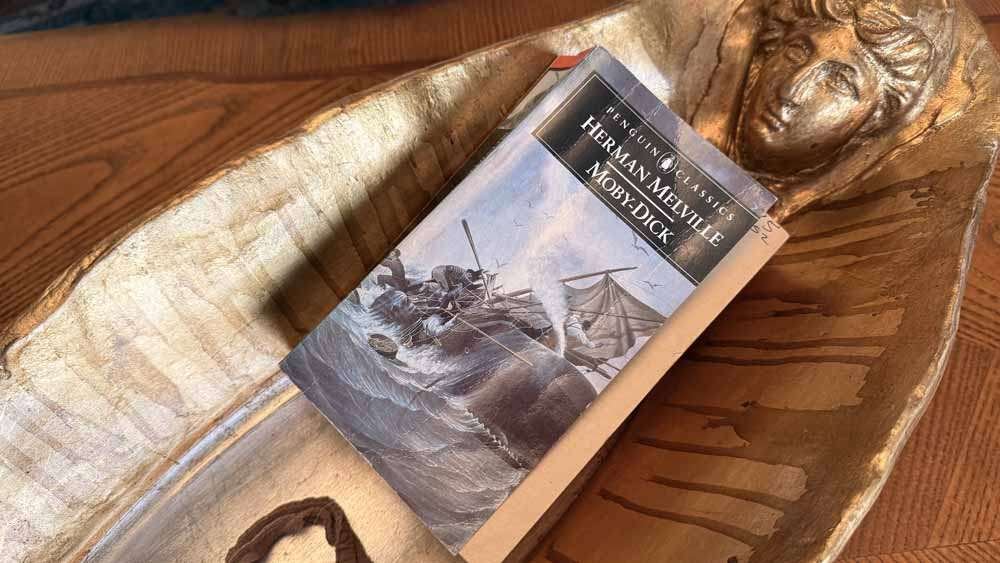
Published in 1851, Moby-Dick sold fewer than four thousand copies before Melville died in near-total obscurity. The book he’d staked everything on — the one that was supposed to cement his reputation — failed commercially, baffled critics, and left him so financially broken he had to take a job as a customs inspector to survive. He worked that job for nineteen years. The great American novel, as it turned out, wasn’t recognized as one until decades after the man who wrote it was gone.
That story alone should tell you something about what kind of book this is.
Moby-Dick is not a comfortable novel. It is not a whaling adventure, though it contains one. It is not a psychological portrait of obsession, though it contains that too. At its core — and this is the reading I keep coming back to — it is a portrait of America at the moment of its fullest, most dangerous self-belief. It is a book about a country that decided it could conquer everything it pointed at, and what that decision costs the people who get swept up in the wake of someone else’s certainty.
The Ship as America
The Pequod is not just a whaling vessel. It is a microcosm of mid-nineteenth century America assembled almost deliberately: Starbuck the Quaker first mate from Nantucket, representing Protestant restraint and moral hesitation; Stubb the pragmatic second mate who does the work without asking why; Flask the third mate who kills whales the way a man clears brush — as a matter of habit, without ceremony. And then the crew itself: Polynesian harpooners, African sailors, immigrants from everywhere the expanding American economy had touched and absorbed. The Pequod is pluralist, multiracial, and run by a monomaniac who steers it toward destruction.
Melville knew what he was building. The ship departs from Nantucket — historically the capital of the American whaling industry, which was itself a capital enterprise, extracting oil from the bodies of wild animals to light the lamps of a civilization that called itself civilized. You can read that sentence in 1851 or in 2026 and it lands the same way.
Ahab and the Logic of Conquest
Captain Ahab is not insane in the clinical sense. That reading sells him short and lets the reader off too easy. Ahab is the logical endpoint of a certain kind of American ambition — the belief that will and force can overcome nature itself, that any obstacle is merely an enemy yet to be defeated. He lost his leg to the white whale on a previous voyage, and what he cannot tolerate is not the pain of that loss but what it implies: that the world is indifferent to him. That something out there does not recognize his authority over it.
The philosopher in me thinks about this every time I read the famous quarter-deck scene, where Ahab nails the gold doubloon to the mast and declares the whale his enemy. He is not mad. He is making a metaphysical argument: that meaning comes from conquest, that identity is forged in the defeat of resistance, that the self is proven only against something that fights back. It’s the same logic that drove manifest destiny, the same logic behind every extraction economy that ever stripped a landscape to demonstrate dominion over it.
What Melville understood — and what his contemporaries mostly missed — is that this logic doesn’t just destroy the whale. It destroys the ship. I’ve written elsewhere about the Nietzschean will to power and what it costs the man who exercises it; Ahab is Nietzsche’s Übermensch without the redemption, a man who made himself the center of the universe and burned everyone around him to prove it.
The Whale as National Myth
Moby Dick the whale is white, and Melville spends an entire chapter — “The Whiteness of the Whale” — on what that whiteness means. It is one of the strangest chapters in American literature: a catalogue of the ways white inspires dread rather than purity, the way blankness and absence can be more terrifying than any visible threat. The whale is blank. It carries no malice, no agenda, no recognition of Ahab’s grievance. It is simply there, immense and indifferent, existing on its own terms.
That indifference is the point. The whale is what America kept encountering in its westward march — a continent that didn’t care about the story being told about it. The forests, the plains, the peoples who already lived there: none of it acknowledged the narrative of divine right and commercial destiny that the nation had built around itself. So the narrative was simply enforced. Ahab doesn’t argue with the whale. He hunts it.
There’s a companion reading in The Grapes of Wrath, where Steinbeck shows you what happens to the people on the wrong side of that enforcement, generations later. Melville shows you the mechanism. Steinbeck shows you the wreckage.
Ishmael and the Question of Survival
The novel’s narrator is not Ahab. That matters. Ishmael is the one who survives, and his survival isn’t heroic — it’s almost accidental. He floats on a coffin that Queequeg, his Polynesian friend and shipmate, had built for himself. The instrument of his survival is made by a man from a culture America was actively in the process of dismissing as savage. Melville was not subtle about this.
Ishmael watches, records, survives. He does not try to impose meaning on the whale. He doesn’t come away from the wreck with a theory of what it all meant. He just comes away. And I think that’s Melville’s answer to Ahab — not that obsession is wrong because it’s irrational, but that it’s wrong because it forecloses the possibility of surviving. Meaning, for Ishmael, comes not from conquering the world but from remaining curious about it long enough to see what it actually is.
That tension between Ahab’s certainty and Ishmael’s openness is, in some ways, the central argument of American intellectual life. You see versions of it everywhere — in Sartre’s closed room versus the open sea, in the rigid systems of ideology versus the messy empiricism of Darwin’s patient observation. The man who knows exactly what the world owes him versus the man still genuinely wondering what the world is.
Why Melville Failed and Why It Matters
The novel failed in 1851 because American readers in 1851 were not ready to be told that their national project was a doomed whale hunt captained by a man who couldn’t admit the universe didn’t owe him anything. They wanted sea adventure. They wanted confirmation. Melville gave them a mirror and they looked away.
The 20th-century recovery of Moby-Dick — it was largely Carl Van Doren and then D.H. Lawrence who began rehabilitating it in the 1920s — happened precisely because the 20th century had enough evidence of what Ahab-style certainty produced on a national scale. Two world wars, an economic collapse, empires losing limbs. Suddenly a 19th-century novel about a captain who couldn’t stop looked less like a failed adventure story and more like prophecy.
Read it now and you feel that again. The Pequod’s crew — multiracial, multinational, mostly doing their jobs competently, mostly wanting to go home — dragged under because one man at the helm decided his wound was the most important fact in the universe. The whale swam away. It always does.
Sources
- Melville, Herman. Moby-Dick; or, The Whale. Harper & Brothers, 1851. Project Gutenberg
- Lawrence, D.H. Studies in Classic American Literature. Thomas Seltzer, 1923. Archive.org
- Olson, Charles. Call Me Ishmael. Reynal & Hitchcock, 1947. Archive.org
- Delbanco, Andrew. Melville: His World and Work. Knopf, 2005. Penguin Random House
- Parker, Hershel. Herman Melville: A Biography, Vol. 2. Johns Hopkins University Press, 2002.