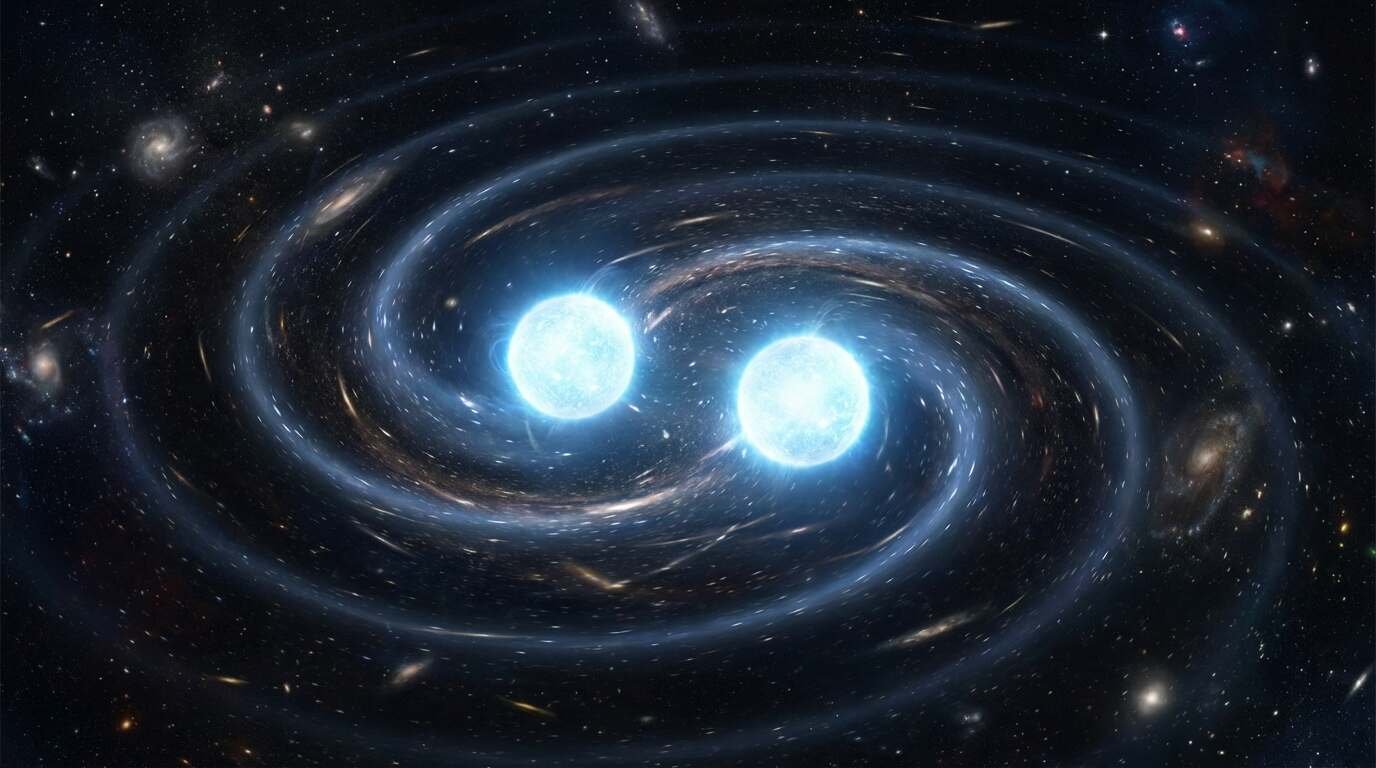
The gold you own was made in a catastrophe. Not metaphorically — not in the sense that all wealth is forged in conflict, though that too may be true — but literally, physically, in an astrophysical event of staggering violence: two neutron stars, each more massive than the sun and each roughly the size of a city, spiraling into each other at a third the speed of light and merging in a collision so energetic that it distorted the fabric of spacetime, created a flash of gamma radiation detectable across the universe, and scattered into the surrounding space a quantity of gold that, when later calculated by astrophysicists, was found to exceed the mass of all the gold in the solar system combined. By a large margin.
The underground man of Dostoevsky — that radical, maddening, self-devouring figure from beneath the floorboards — hoards his coin. He counts it. He assigns to it the weight of his self-worth and the proof of his contempt for those who have more. But the coin, the ring, the ingot in the vault: these are the corpse-light of collapsed gods. This is not poetry. This is astrophysics. And the question of what it means to own something whose origin is this violent, this indifferent, this incomprehensibly old — that question is not answered by the price per ounce.
The Event
On August 17, 2017, at 12:41:04 UTC, the LIGO detectors in Livingston and Hanford and the Virgo detector in Italy simultaneously registered a gravitational wave signal lasting approximately 100 seconds — far longer than the quarter-second chirp of GW150914, the first gravitational wave detection two years earlier. Longer because the inspiraling objects were lighter than black holes, their death spiral more gradual, the gravitational wave frequency audible to the instruments for nearly two minutes before the merger. The signal was designated GW170817.
What made GW170817 categorically different from any preceding gravitational wave event was what happened 1.7 seconds after the merger: the Fermi Gamma-ray Space Telescope, orbiting Earth, detected a short gamma-ray burst. The same event. Two separate physical phenomena, detected by completely separate instruments, produced signals arriving at Earth within two seconds of each other. This was the first multi-messenger astronomical observation of a gravitational wave source — the first time an event had been seen simultaneously in gravitational waves and in light.
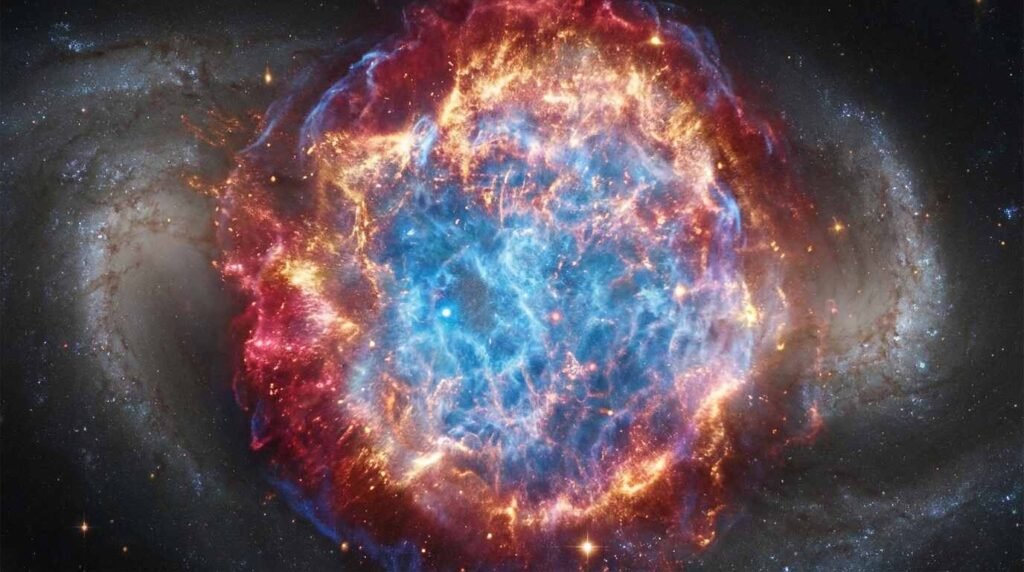
Over the following hours and days, dozens of telescopes worldwide turned toward the galaxy NGC 4993, roughly 130 million light-years away in the constellation Hydra, where the optical counterpart of the merger had been identified. What they observed was a kilonova — a rapidly evolving transient source that brightened and faded over days, its spectrum shifting from blue to red as different heavy elements were synthesized in the expanding debris cloud and then decayed through radioactive processes. The spectra revealed the unmistakable signatures of r-process nucleosynthesis: the rapid neutron capture process through which elements heavier than iron are forged.
The r-process requires extreme densities of neutrons and extreme temperatures. It cannot occur in ordinary stars. It cannot occur in supernovae with sufficient efficiency to account for the abundance of heavy elements we observe in the universe. Theorists had long suspected that neutron star mergers were the primary site of r-process nucleosynthesis — that the gold in the crust of the Earth, the platinum in a laboratory’s electrode, the uranium in a reactor, were produced in events like GW170817. The observation confirmed it.
The Arithmetic of Violence
The numbers from the GW170817 kilonova are not easily absorbed.
The merger produced, according to estimates by Edo Berger at the Harvard-Smithsonian Center for Astrophysics and other researchers who analyzed the kilonova spectra, roughly 10 Earth masses of gold and platinum combined. Ten times the mass of the entire planet Earth, composed of gold and platinum, ejected in a single event lasting fractions of a second. The synthesis happened in real time — in the hot, neutron-rich environment of the rapidly expanding debris cloud, atomic nuclei capturing neutrons faster than they could decay, building up the heavy elements of the periodic table in a process that cannot be replicated in any terrestrial laboratory.
The average gold concentration in Earth’s crust is approximately 0.004 parts per million by mass. The total mass of gold ever mined in human history is estimated at roughly 200,000 metric tons — a cube about 22 meters on a side. Every gram of that gold was produced in a neutron star merger, or more precisely in many such mergers, whose debris seeded the interstellar medium over billions of years, was incorporated into the nebula that collapsed to form the solar system, settled by density into the young Earth’s crust, and waited there for approximately 4.5 billion years until a person with a tool came along and removed it.
Consider the sequence. Two neutron stars formed from the cores of massive stars that lived and died billions of years before the sun existed. They were bound by their mutual gravity and spiraled slowly inward over eons, radiating energy as gravitational waves so weak that no detector yet built could register them. They merged. In the merger, gold was made. That gold traveled through interstellar space, was incorporated into a new solar system, was buried in planetary rock for four billion years, was found, was shaped, was placed on a finger at a ceremony someone called meaningful.
All of that is contained in a gold ring. The ring does not know this. The person wearing it almost certainly does not know this. Knowing it does not change the ring. It changes only the person who knows.
The Question of Ownership
Dostoevsky’s characters are obsessed with money, with what it represents, with the violence it conceals and the dignity it confers and the corruption it enables. The underground man’s relationship to money is one of wounded pride — he does not have enough, and this fact is intolerable not because he is hungry but because the lack means he cannot perform the autonomy his self-image requires. Raskolnikov’s murder is entangled with money. The Karamazovs’ conflicts are partly financial. The question of who owns what, and on what grounds, and what ownership does to a person — these are Dostoevskian obsessions.
The astrophysics of GW170817 does not resolve these questions. But it subjects them to a pressure that changes their shape. If ownership is understood as a relationship between a person and an object — a relationship of control, of exclusion, of the right to use and dispose — then the discovery of the gold’s actual origin puts the object in a relationship of a different kind first: a relationship with the universe’s history, with a violence no human chose or controlled, with a scale of time that makes the entire span of human civilization look like a rounding error.
The gold does not belong to its owner in the deep sense. It passed through the universe for longer than the sun has existed before arriving at the moment someone called it theirs. This does not mean property rights are meaningless — they are institutionally meaningful, practically necessary, socially real. It means something subtler: that the weight we assign to ownership, the moral freight we load onto the concept of having, the pride and the shame and the power relations organized around who owns what — all of this sits atop a physical reality that is utterly indifferent to it, and vastly older.

Multi-Messenger Astronomy and What It Opens
The observation of GW170817 with both gravitational wave detectors and electromagnetic telescopes was the opening of a new mode of astronomical inquiry. Previous astronomy was done in light alone — different wavelengths, different telescopes, but all electromagnetic radiation. Gravitational wave astronomy, inaugurated by GW150914 in 2015, added a second channel. GW170817 combined both for the first time.
The combination resolved a longstanding debate: the 1.7-second delay between the gravitational wave arrival and the gamma-ray burst confirms that gravitational waves travel at the speed of light, as general relativity predicts, with precision that can be stated as: the difference in speed is at most three parts in one quintillion. This measurement alone has significant implications for modified gravity theories and for alternatives to general relativity.
The kilonova observation also provided an independent measurement of the Hubble constant — the same tension discussed elsewhere in connection with the dark energy discovery. The measurement from GW170817 sits between the high value from the cosmic distance ladder and the low value from the cosmic microwave background, contributing data to a tension that has not yet resolved. Each new gravitational wave event with an electromagnetic counterpart adds another Hubble constant measurement. As the catalog of such events grows — LIGO and Virgo detected dozens of gravitational wave events in their third observing run — the statistical weight of these independent measurements will grow, either resolving the tension or confirming that it represents genuine new physics.
This is how science accumulates its knowledge: not in single dramatic revelations but in the slow aggregation of evidence, each measurement constrained by the previous ones, each constraint tightening the picture. GW170817 is a landmark. It is also a data point. The field that opened with it is young, and what it will eventually reveal about the universe’s history, composition, and fundamental constants remains genuinely open.
What the Underground Man Does Not Know
The underground man cannot act because he thinks too much and because the thinking makes every action seem futile. The world is too large, the forces too indifferent, the self too small and too ridiculous for any gesture to carry real meaning. This is recognizable as a psychological condition, and it is also, from a certain philosophical angle, a reasonable response to the actual facts of the universe.
But the underground man has made an error. He has taken the indifference of the universe — its vastness, its violence, its utterly mechanical operation across scales of time and space that his consciousness cannot compass — and concluded from that indifference that nothing is worth doing. He mistakes scale for meaning. He thinks that because the universe does not care about his actions, his actions do not matter.
What the astrophysicists who detected GW170817 understood — not philosophically but operationally, in the way they went to work and kept building and kept analyzing — is that the universe’s indifference is not a verdict. It is a condition. The gold on a finger is not diminished by its violent origin; it is deepened. The act of choosing to wear it, of assigning it to a ceremony of human significance, is not made ridiculous by the neutron star that made it; it is made more interesting. You are doing, with the wreckage of dead stars, something those stars could not do: you are making meaning of the material.
The underground man does not know where his gold came from. It would not help him to know. But it might help you.
For more on the physics underlying these discoveries, see the review of Relativity: The Special and the General Theory by Albert Einstein and the post on Gravitational Waves and the Confession of Light.
You Might Also Like
- The Fabric of Reality by David Deutsch — Knowledge Has No Ceiling, and That Should Change Everything
- Just Six Numbers by Martin Rees — A Review
Sources
- Abbott, B.P. et al. “Multi-messenger Observations of a Binary Neutron Star Merger.” The Astrophysical Journal Letters 848, no. 2 (2017): L12. https://iopscience.iop.org/article/10.3847/2041-8213/aa91c9
- Berger, Edo et al. “An r-process Kilonova Associated with the Short-hard GRB 130603B.” The Astrophysical Journal Letters 774, no. 2 (2013): L23.
- NASA Fermi Gamma-ray Space Telescope Mission. “Fermi Detects Gamma Rays from Gravitational Wave Source.” https://fermi.gsfc.nasa.gov/
- Kasen, D. et al. “Origin of the heavy elements in binary neutron-star mergers from a gravitational-wave event.” Nature 551 (2017): 80–84.
- Nicholl, M. et al. “The Electromagnetic Counterpart of the Binary Neutron Star Merger LIGO/Virgo GW170817.” The Astrophysical Journal Letters 848, no. 2 (2017): L18.
- LIGO Scientific Collaboration and Virgo Collaboration. Mission documentation and GW170817 event page. https://www.ligo.org/science/Publication-GW170817/