Most people think morality is the thing that stops evil. Nietzsche thought that was the most dangerous assumption in Western history — and he spent three essays proving it.
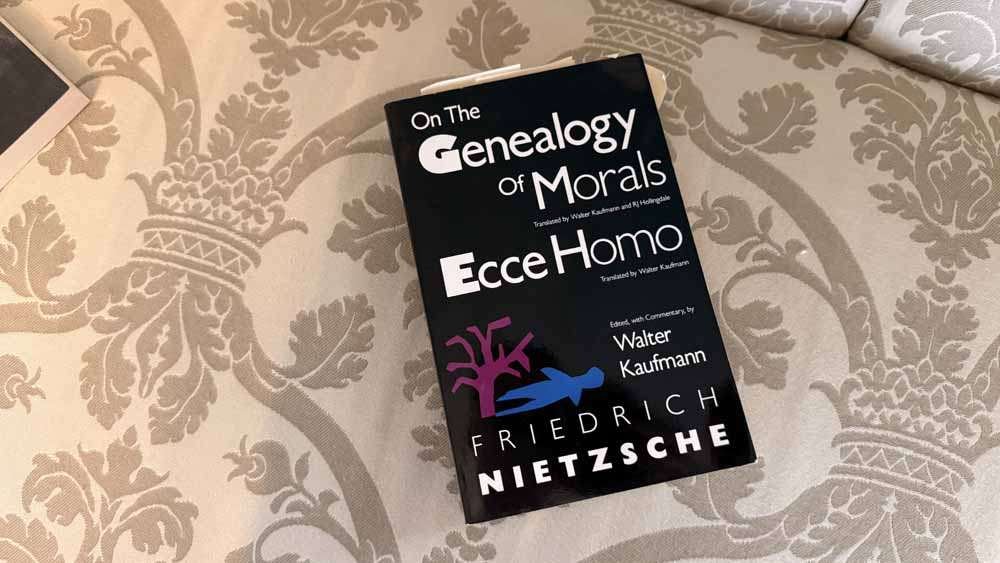
On the Genealogy of Morals, published in 1887, is the book where he does the forensic work. Not the poetry of Thus Spoke Zarathustra, not the aphoristic heat of The Gay Science. This one is structured. Methodical. He builds the case essay by essay, and by the end you are looking at concepts you thought you understood — good and evil, guilt, conscience, punishment — and they look nothing like what you thought they were.
The argument cuts like this: what we call morality is not a natural truth. It is not handed down from God, not discovered through reason, not woven into the fabric of the universe. It is a historical invention. And when you trace it back to its origins, what you find is not enlightenment. What you find is resentment.
The Slave Revolt
Nietzsche opens by dividing the world into two moralities — not good versus evil, but what he calls master morality and slave morality. This is the hinge on which everything else turns.
Masters — the nobles, the strong, the self-defined — coined “good” to describe themselves. Not as a moral judgment against others. As a description. I am good. I am strong. I am the kind of man who acts from power rather than fear. The weak, the low, the defeated — they were simply “bad.” Bad in the sense of lesser. Not evil. Not damned. Just not of the type.
Then something happened. Nietzsche calls it the slave revolt in morality, and he dates it to the Jewish priestly class, though he’s making a structural argument, not an ethnic one. The weak had no power to win the game being played. So they changed the game.
They inverted the values. Good became what was humble, suffering, compliant, meek. Evil became what was strong, proud, dominant — the very things the master class called good about themselves. The nobles didn’t lose their power on the battlefield. They lost it because the definition of winning changed underneath them, slowly, over centuries, until the whole civilization agreed that strength was sinful and weakness was holy.
That is the slave revolt. And Nietzsche is relentless about what it required. Not courage. Not love. Resentment. The accumulated fury of the powerless, transformed into a moral framework. The resentful cannot act, so they imagine. They project evil onto the enemy until the enemy begins to believe it. This is what he calls ressentiment — a French word he uses deliberately, because the French captured something about this specific, slow-burning hatred that German didn’t quite have.
The man who lives by master morality creates values. The man who lives by slave morality negates them. He defines himself not by what he is but by what he opposes. Good means: not like them. Noble means: not that. The whole identity is reactive, not generative. You see this everywhere once you start looking. Political movements that can only define themselves by what they hate. Religions that measure virtue by what is forbidden. People who can only tell you who they are by naming their enemies.
What Good and Evil Actually Cost
The second essay is where it gets heavier. This is the piece on guilt, bad conscience, and debt — and it is one of the most unsettling things Nietzsche ever wrote.
He traces guilt back to the creditor-debtor relationship. The oldest moral concept is not love, not fairness. It’s owing. You owe me. You took something. There will be a reckoning. The word Schuld in German means both guilt and debt, and Nietzsche says that is not a coincidence — it is the origin. When you couldn’t pay your debts, the creditor was permitted to inflict pain. Not because the pain recovered the debt. But because causing suffering was pleasurable, and pleasure had a cash value. Pain given, pain received — this was the original economy of morality.
From that seed grew the whole architecture of conscience. When civilization internalized the debt relationship — when there was no longer an external creditor but instead an internal one — the result was what he calls bad conscience. The instincts turned inward. The aggression that used to flow outward toward enemies now turned on the self. Man became interesting to himself, Nietzsche says. Also: man became sick.
This is the part where I had to put the book down. Not because it was wrong. Because I recognized the mechanism. I grew up watching people carry weight they didn’t earn — guilt for circumstances that had nothing to do with them, for being poor, for not believing enough, for wanting more than they were supposed to want. The machinery described this. Bad conscience is not a moral achievement. It is the instinct of a creature that has been caged so long it began to chew on itself.
The Ascetic Priest and the Management of Suffering
The third essay examines the ascetic ideal — the priest who tells suffering people that their suffering has meaning. Nietzsche is not dismissive here. He is precise. The ascetic priest is a genius of a particular kind. He faces a population in pain and he gives that pain a direction. You suffer because you are sinful. You suffer because the world is fallen. You suffer because you deserve to. And the brilliance of this move is that it works. It doesn’t cure the suffering — it interprets it. It gives people something to do with the pain.
He calls the priest a physician who is also a wound. The sick are kept alive, kept relatively calm, but never healed. Because healing would require changing the conditions that produce the suffering, and those conditions are the same conditions that produce the priest’s power.
What Nietzsche wants — what he’s building toward across all three essays — is not the abolition of values but the creation of values that do not originate in weakness. He wants to know if it’s possible for human beings to generate meaning from strength rather than from resentment, from creation rather than negation. He doesn’t answer this in the Genealogy. The answer, to whatever degree he has one, is in Thus Spoke Zarathustra. But he has to ask the question here first.
How to Read This Book
This is the most accessible entry point into Nietzsche’s serious philosophy. Not the most readable — The Gay Science is more playful — but the most systematically argued. You can track his reasoning step by step, which you can’t always do with Zarathustra or Beyond Good and Evil. If you read it alongside The Complete Works it stops being a stand-alone provocation and becomes a piece of architecture.
The translation matters. Walter Kaufmann’s version, published with R.J. Hollingdale, is the standard. Kaufmann spent decades pushing back against the Nazi misappropriation of Nietzsche — his sister Elisabeth had edited the manuscripts selectively, weaponizing the philosophy in directions Nietzsche himself explicitly rejected. Kaufmann restored the record. His footnotes are worth reading. Douglas Smith’s Oxford World’s Classics translation is also solid and more compact.
The philosophical context worth having before you start: Kant built a moral system on universal reason — the categorical imperative, the idea that morality is what reason demands of all rational beings. Nietzsche is attacking that foundation. Not the conclusions Kant reached but the entire method of grounding morality in reason as if reason were neutral and ahistorical. It isn’t, Nietzsche says. Nothing is. Kierkegaard came at it differently — from faith, from the individual’s leap into the subjective — but both of them were refusing the same comfortable Enlightenment settlement that said reason alone could tell us how to live.
What It Does to You
The Genealogy doesn’t leave you with a clean position to stand on. That’s not a flaw. That’s the intent.
When you trace any moral conviction back far enough — not philosophically, but genealogically, through history, through power relations, through who needed what belief to survive — the conviction starts to look different. Not necessarily wrong. But not simply true, either. You find yourself asking: do I believe this because it’s right, or do I believe this because it serves me? Or worse: do I believe this because I’ve been taught to believe it serves someone who needed me to?
I’ve thought about this more than I should admit. When I read the section on ressentiment — the reactive identity, the man who can only define himself by his enemy — I think of every group I’ve ever watched build itself around what it hates. I’ve seen it in politics. I’ve seen it in religion. I’ve seen it in business, in neighborhoods, in families. The resentment dressed up as principle. The grievance consecrated into morality.
It doesn’t mean the grievance isn’t real. That’s not what Nietzsche is saying. He’s saying: notice the mechanism. Notice when suffering gets converted into righteousness, when weakness gets translated into virtue, when the powerless gain power not by becoming stronger but by convincing the strong that their strength is evil.
Notice it. Then decide what you actually believe.
That’s the hardest thing the book asks you to do. Most people put it down before they get there.
You Might Also Like
- Thus Spoke Zarathustra by Friedrich Nietzsche — The Book That Rewired My Understanding of Everything
- The Gay Science by Friedrich Nietzsche: God Is Dead, and Heavy Metal Has Known It Longest
- A Kierkegaard Anthology — The Thinker Who Refused to Let Me Go
Sources
- Nietzsche, Friedrich. On the Genealogy of Morals. Translated by Walter Kaufmann and R.J. Hollingdale. Vintage Books, 1967. penguinrandomhouse.com
- Nietzsche, Friedrich. On the Genealogy of Morality. Translated by Douglas Smith. Oxford World’s Classics, 2009. global.oup.com
- Kaufmann, Walter. Nietzsche: Philosopher, Psychologist, Antichrist. Princeton University Press, 1950. press.princeton.edu
- Leiter, Brian. “Nietzsche’s Moral and Political Philosophy.” Stanford Encyclopedia of Philosophy, 2021. plato.stanford.edu
- Reginster, Bernard. The Affirmation of Life: Nietzsche on Overcoming Nihilism. Harvard University Press, 2006. hup.harvard.edu