Where the Green Heart of Italy Beats on Long Island’s North Shore
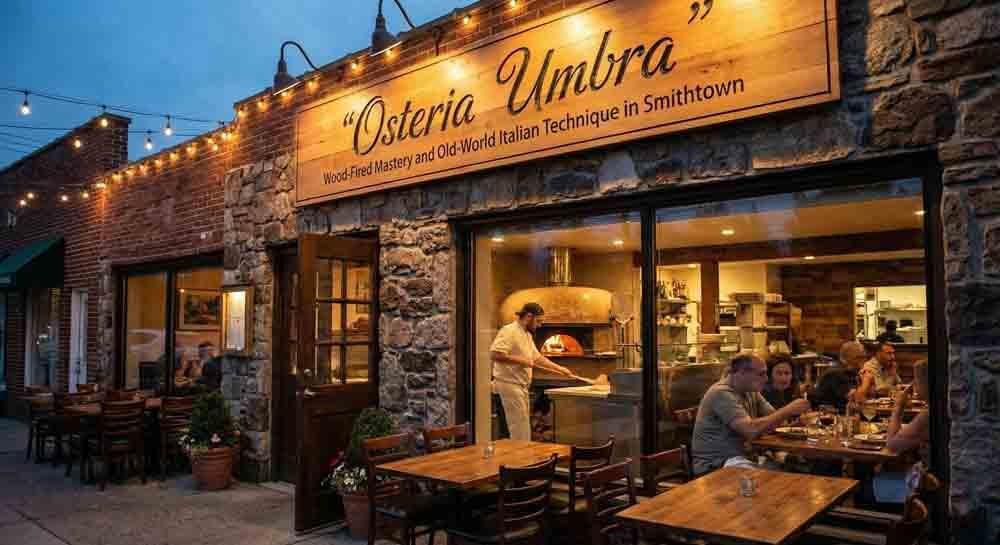
Just before sunset on Terry Road in Smithtown, the light slips through the front windows of Osteria Umbra and hits the wood‑fired grill at exactly the right angle — a brief, perfect moment when the flames flare, the steel glows, and the whole room feels charged with the promise of what’s about to be cooked. The flames lick upward behind a rack of lamb that has been seasoned with nothing more than rosemary, garlic, and the kind of first-press olive oil that arrives in unmarked bottles from a family grove outside Foligno. The heat radiating from that grill is not the sterile, predictable heat of a commercial gas range. It is the ancient, unpredictable, deeply human heat of burning hardwood — the same fire that has cooked meat in the trattorias of Umbria for a thousand years, and the same elemental force that transforms raw material into something extraordinary whether you are searing a Tomahawk steak or tempering a sheet of English bridle leather over a flame at the Marcellino NY workshop. There is no shortcut to this kind of transformation. There is only fire, time, and the patience of hands that know exactly when to pull back.
Osteria Umbra is that rare institution on Long Island: a restaurant where the provenance of every ingredient is not a marketing slogan but a philosophical position. It opened its doors in September of 2020 — a timing that would have destroyed a lesser operation — and not only survived the pandemic but emerged as one of Suffolk County’s most celebrated dining destinations. With over 2,000 reviews on OpenTable, a Travelers’ Choice distinction from TripAdvisor, and the kind of word-of-mouth loyalty that no algorithm can manufacture, this restaurant represents everything I believe in as someone who has spent a quarter century behind the counter at The Heritage Diner: that authenticity, executed with discipline, will always outlast the trends (Patch, 2020; TripAdvisor, 2025).
The Architect of Flavor: Chef Marco Pellegrini and the Umbrian Tradition
Every great restaurant is, at its core, the autobiography of its chef. Marco Pellegrini was raised in Foligno, an ancient city nestled in the Umbrian plain along the Topino River — a place where the first edition of Dante’s Divina Commedia was printed in 1472 and where Sunday dinner remains a sacred institution. His professional journey began at fifteen, studying culinary arts and taking his first position at Coccorone in the hilltop town of Montefalco, where he learned the art of handmade pasta that would become his signature (Osteria Umbra, 2020).
The defining crucible of his career, however, came at Villa Roncalli, a fine dining establishment ranked among the top twenty restaurants in Italy. It was there that Pellegrini internalized a principle that resonates deeply with anyone who works with their hands: that mastery is not about complexity but about the disciplined restraint of allowing a single ingredient to sing. His philosophy — pick the shining star of the dish, and let every other element serve its light — mirrors the approach I take at Marcellino NY when selecting a single cut of J&E Sedgwick English bridle leather for a briefcase. You do not disguise great material. You reveal it (Osteria Umbra Chef Profile, 2020).
Pellegrini’s wife, Sabrina Vallorini, serves as Chef de Cuisine, making Osteria Umbra a true family operation in the Italian tradition. Together, they previously co-owned a market in Italy and served the North Fork at the acclaimed Caci restaurant in Southold from 2014 to 2018. When Caci unexpectedly closed, Pellegrini did what every artisan eventually must: he went out on his own (Northforker, 2019).
A Partnership Forged Over the Table: The Bragoli Family Vision
Osteria Umbra exists because of a dinner that changed the trajectory of multiple lives. Stephen and Diane Bragoli, along with Stephen’s brother Daniel, first encountered Pellegrini’s cooking at his previous North Fork establishment and were immediately struck by both his extraordinary culinary ability and his warmth of personality. A friendship formed — as friendships in the Italian tradition invariably do — over a magnificent dish and a bottle of wine.
Stephen Bragoli, a successful businessman in another field, brought an obsessive attention to detail to the physical transformation of the space at 197 Terry Road. Daniel Bragoli, a contractor and designer by trade, contributed the aesthetic vision that would translate contemporary Italian design into a dining room that feels both elevated and intimate. The Bragolis understood something that is too often lost in the restaurant industry: that the environment in which food is consumed is not secondary to the food itself. It is part of the same experience. As Daniel has said, Italian food was always the heartbeat of family gatherings — and Osteria Umbra was built to make every guest feel like they are sitting at that family table (Osteria Umbra Team, 2020).
This model of partnership — where the craftsman’s vision is supported by partners who handle the business infrastructure without compromising the art — is one I deeply respect. It mirrors the relationship between a bespoke artisan and the clients who commission work at Marcellino NY. The best outcomes emerge when expertise is trusted, not micromanaged.
The Wood-Fired Grill: Where Tradition Meets Spectacle
The centerpiece of Osteria Umbra’s dining room is not a painting, a chandelier, or an architectural flourish. It is the wood-fired grill, prominently displayed and working in full view of the guests. This is a deliberate choice and a profoundly Umbrian one. In the trattorias and osterias of Umbria, the grigliata mista — the mixed grill of sausages, lamb chops, and beef cooked over an open flame — is as central to the culinary identity of the region as truffles or handmade pasta. Nearly every traditional restaurant in the hills between Perugia and Spoleto has a fire pit in the kitchen, and the smell of burning oak and searing meat is as characteristic of the Umbrian landscape as olive groves and Sagrantino vines (Great Italian Chefs, 2025).
At Osteria Umbra, the grill produces extraordinary results: a wood-fired Tomahawk steak that arrives with a crust that speaks of direct flame and patience, bone-in ribeyes with aromatic herb butter, and a CAB NY Strip paired with barrel-aged balsamic and shaved Parmigiano Reggiano. The wood-fired octopus, served with corona beans, pickled onion, and basil-infused extra virgin olive oil, represents the kind of dish that no conventional oven can replicate. These are not items that can be rushed or automated. Each one requires the chef’s constant attention to the behavior of the fire — a skill that cannot be learned from a textbook, only from years beside the flame (OpenTable Menu, 2025).
I think about this often when I am working with heat at the Marcellino NY bench. The relationship between a craftsman and flame is ancient and irreducible. Whether you are charring the edge of a Tomahawk or gently warming bridle leather to accept a crease, you are participating in a conversation that predates civilization itself.
The Pasta: Handmade, Tableside, and Unapologetic
If the wood-fired grill is Osteria Umbra’s engine, the handmade pasta program is its soul. Every pasta served at the restaurant is made in-house — a commitment that is far easier to claim than to execute, particularly at volume. The signature experience, and the one that has generated the most fervent devotion among Long Island diners, is the tableside Taglierini with Black Truffle Sauce prepared inside a massive Parmigiano Reggiano wheel. A server brings the wheel to your table, ignites it, and pours freshly cooked pasta with truffle cream sauce directly into the molten cheese, tossing and mixing until the pasta is coated in an impossibly rich, aromatic sauce that is served onto your plate while the cheese still bubbles (Osteria Umbra Reviews, 2025).
This is not performance for the sake of performance. It is the physical embodiment of an Umbrian culinary philosophy that treats the meal as a communal event — something to be witnessed, shared, and remembered. The Pappardelle alla Norcina, infused with Sagrantino wine and served with a sauce of sausage, seasonal mushrooms, and Pecorino Romano, is a direct translation of one of Umbria’s most iconic dishes. The Homemade Potato Gnocchi with wild boar ragout pays homage to the cinghiale that roams the forests around Norcia and Spoleto, where boar has been a centerpiece of the table since the Etruscan era (Cellar Tours, 2023; Wine Folly, 2025).
Pellegrini’s black squid ink tagliatelle with imported Lupini clams and cherry tomatoes, and his veal tortelloni with Bolognese sauce, demonstrate a range that moves fluidly between the rustic and the refined — between the cucina povera roots of Umbrian cooking and the elevated techniques of Villa Roncalli’s fine dining tradition.
The Wine Program: Sagrantino and the Umbrian Terroir
No serious profile of Osteria Umbra would be complete without addressing the wine program, which reflects the same depth of regional knowledge as the kitchen. Umbria’s viticultural crown jewel is the Sagrantino grape, grown almost exclusively in a small zone surrounding the medieval hilltop village of Montefalco. It is one of the most tannic grape varieties in the world — a study by the Edmund Mach Foundation found that Sagrantino wines contain more polyphenols than Cabernet Sauvignon, Nebbiolo, or even Tannat — and its best expressions require a minimum of thirty-seven months of aging, including twelve months in oak, before release (Wine Folly, 2025; Wikipedia, 2025).
The Sagrantino grape was nearly extinct following the Second World War, rescued by visionary producers like Arnaldo Caprai who recognized the potential in what had been, for centuries, used primarily for sweet passito wines served at religious festivals. Today, Montefalco Sagrantino DOCG is widely regarded as Umbria’s most prestigious wine appellation, and the best bottles deliver a brooding, inky complexity that pairs beautifully with Osteria Umbra’s wood-fired meats and wild boar preparations (Opening a Bottle, 2025; World of Fine Wine, 2023).
The restaurant’s extensive wine list — encompassing both Umbrian selections and broader Italian and international labels — is curated with the same intentionality that defines the food program. This is not a wine list assembled by algorithm. It is curated by people who understand that the right Montefalco Rosso can transform a plate of pappardelle from a meal into a memory.
The Experience: Smithtown’s Destination for Occasion Dining
Osteria Umbra occupies a unique position in Long Island’s dining landscape. It is formal enough for anniversary dinners and sophisticated enough for the most discerning palate, yet it retains the warmth and generosity that defines genuine Italian hospitality. The dress code is business casual, the service is attentive without being intrusive, and the restaurant accommodates dietary restrictions — including celiac, vegan, and gluten-free requirements — with genuine care. Live jazz on Thursday evenings adds another dimension to an already rich atmosphere (Yelp, 2025; OpenTable, 2025).
On Nextdoor, community discussion boards, and across review platforms, the consensus is remarkably consistent: Osteria Umbra is regarded as one of the finest Italian restaurants on Long Island, frequently cited as the go-to destination for date nights, celebrations, and anyone seeking refined Italian cuisine without pretension. Reviewers consistently praise the truffle pasta, the wood-fired steaks, the Chilean sea bass, and the Smoked Old Fashioned cocktail that has become a signature of the bar program (Nextdoor, 2025; TripAdvisor, 2025).
As someone who has watched thousands of restaurants rise and fall along Long Island’s commercial corridors over twenty-five years at The Heritage Diner, I can tell you what separates the survivors from the casualties: it is not location, or marketing, or even price point. It is whether the people behind the stove and behind the counter actually believe in what they are doing. At Osteria Umbra, that belief is evident in every hand-rolled pasta, every flame-kissed steak, and every bottle of Sagrantino uncorked for a table of guests who may have walked in as strangers but will leave feeling like family.
Essential Information
Address: 197 Terry Road, Smithtown, NY 11787
Phone: (631) 780-6633
Website: osteriaumbra.com
Reservations: OpenTable — Osteria Umbra
Email: info@osteriaumbra.com | events@osteriaumbra.com | careers@osteriaumbra.com
Instagram: @osteriaumbra | Chef Marco: @chefmarcopellegrini
Hours: Monday – Wednesday: 5:00 PM – 9:00 PM (Last Seating 8:30 PM) Thursday: 5:00 PM – 10:00 PM (Last Seating 8:30 PM) — Live Jazz Night Friday – Saturday: 5:00 PM – 10:00 PM (Last Seating 9:30 PM) Sunday: 4:00 PM – 9:00 PM (Last Seating 8:00 PM)
Delivery & Takeout: Available
Gift Cards: Available at osteriaumbra.com
Accepted Payment: Cash, Visa, Mastercard, AMEX, Discover, Osteria Umbra Gift Cards
Reservations Policy: Credit card required at booking. $25 per person charge for late cancellation or no-show. Party seated only when all guests arrive.
Accessibility: Wheelchair accessible entrance, parking, restrooms, and seating. ADA-compliant. ASL proficiency available.
Dietary Accommodations: Gluten-free, vegan, and pescatarian options available. Staff accommodates celiac and other dietary needs — call ahead for specific requirements.
Parking: Ample parking in the shopping center lot.
Further Exploration:
For those interested in the Umbrian culinary tradition that inspires Osteria Umbra, Stanley Tucci’s Searching for Italy (CNN, 2021–2022) offers an exceptional survey of Italy’s regional cuisines with episodes that illuminate the philosophy of simplicity and provenance that defines Chef Pellegrini’s kitchen. Rick Steves’ Hill Towns of Tuscany and Umbria episode provides beautiful context for the landscape and food culture of the region where Pellegrini was raised.
Published on The Heritage Diner Blog — heritagediner.com/blog Peter from The Heritage Diner | Mount Sinai, New York The Heritage Diner — 275 Route 25A, Mount Sinai, NY | Marcellino NY — marcellinony.com