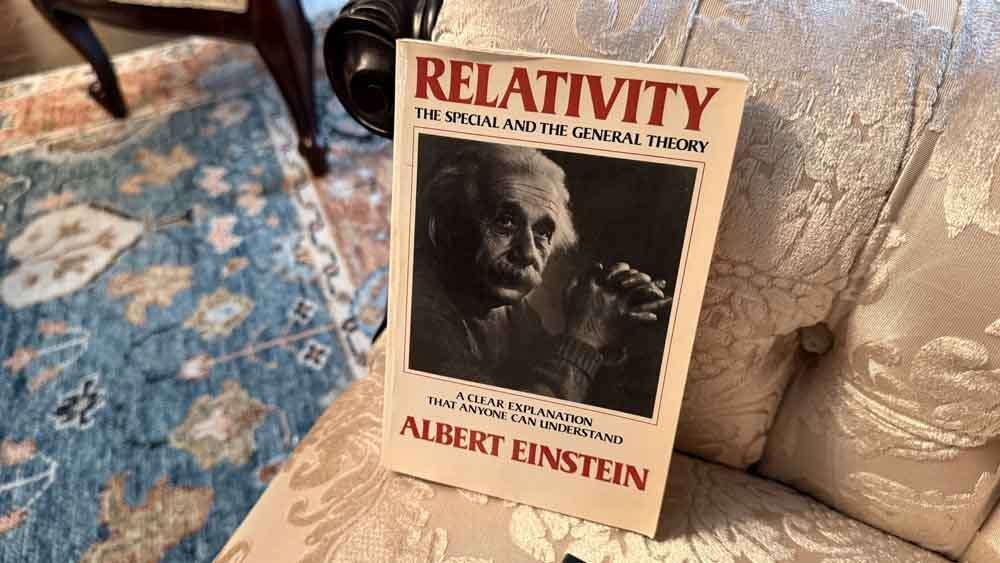
Most books about difficult ideas are written by people who have spent years learning to explain what someone else discovered. This one is different. Relativity: The Special and the General Theory was written by the man who discovered it — and he wrote it not for physicists, but for you. That distinction matters more than it might seem. What Einstein was attempting in 1916, when this book first appeared, was not a simplification. It was an act of radical intellectual generosity: here is the theory that reshapes your understanding of space, time, and gravity, delivered in plain language, stripped of the mathematics that would otherwise wall it off from ordinary readers.
The audacity of that project tells you something essential about genius — not just Einstein’s genius, but what genius at its highest actually looks like.
What the Book Actually Is
This is a slender volume. Depending on the edition, you’re looking at roughly 160 to 200 pages, divided into three parts: Special Relativity, General Relativity, and a final section on the broader cosmological implications. Einstein uses no calculus. He builds the argument instead with what he calls “thought experiments” — imaginary scenarios involving moving trains, flashes of light, and observers on embankments — to walk the reader through concepts that overturned centuries of Newtonian certainty.
The Special Theory, established in 1905, attacks the assumption that time and space are fixed, universal constants. Einstein shows that the speed of light is the one constant, and that both time and space warp and flex relative to the observer’s motion. A clock moving at high velocity genuinely ticks more slowly than one sitting still. Two events that appear simultaneous to one observer are not simultaneous to another moving at a different speed. These aren’t philosophical riddles or poetic metaphors. They are measurable physical realities.
The General Theory, which took Einstein another decade to complete, extends the framework to include gravity. Mass curves spacetime itself. What we experience as gravitational pull is not a mysterious force acting across empty space, as Newton described it, but the geometry of curved spacetime guiding the paths of objects. The Earth doesn’t orbit the Sun because the Sun is pulling it — it follows a curved path through spacetime shaped by the Sun’s mass. The difference between those two descriptions is not semantic. It is the difference between an approximation and the truth.
The Thought Experiment as Pedagogical Instrument
What makes this book remarkable — and what separates Einstein from merely brilliant scientists — is his almost complete reliance on intuition as a teaching tool. The train thought experiments are famous now, embedded in physics education at every level, but reading them in Einstein’s own words retains a freshness that no textbook reproduction quite captures. There is something in the directness of his prose that suggests he is not simplifying the theory for your benefit but genuinely thinking alongside you, rebuilding the argument from the ground up in real time.
The key move in Special Relativity involves the relativity of simultaneity. Einstein asks you to picture a train moving at high speed with an observer riding it, and an observer standing on the embankment outside. Two bolts of lightning strike the front and rear of the train at the same moment — or do they? The embankment observer says yes. The train observer says no. Both are right. There is no privileged viewpoint from which “now” can be universally defined. The concept of absolute simultaneity, which every human being prior to 1905 accepted without question, does not survive contact with the consistency of light speed.
This is the kind of idea that, when you truly absorb it, doesn’t just rearrange your understanding of physics. It reorganizes something deeper — your intuition about what it means for something to be real, to be true, to be fixed. I’ve read other efforts to convey this. Brian Greene’s The Elegant Universe does it with extraordinary flair. Richard Feynman’s lectures capture the mathematical music beneath the surface. But there is something irreplaceable about sitting with Einstein’s own account, following the exact chain of reasoning that produced the theory in the first place. The Cohen and Nagel Introduction to Logic and Scientific Method I wrote about recently gives you the formal scaffolding for scientific reasoning — but Einstein’s book shows you what that scaffolding looks like when a mind of unusual power actually uses it.
On the Limits of Intuition — and Einstein’s Honesty About Them
Einstein is candid, at several points, about where intuition breaks down. The non-Euclidean geometry required by General Relativity — the idea that space itself is curved, that the shortest path between two points near a massive object is not a straight line but a geodesic through warped spacetime — is not something human intuition handles naturally. He says so directly. What he asks of the reader is not that you feel this geometrically but that you follow the logic and accept that the math, which he largely sets aside in this text, confirms what the reasoning implies.
This is intellectually honest in a way that popular science writing sometimes isn’t. Einstein doesn’t pretend the theory is fully imaginable. He offers you the conceptual architecture — the bones of the argument — and trusts you to hold it without the muscle of full geometric intuition underneath it. That trust is part of what makes the reading experience so distinctive. He doesn’t condescend. He assumes that if you follow carefully, you will arrive at understanding. Whether that understanding is complete is a separate question he leaves to the mathematics, which he points you toward in the appendices.
Why Genius Writes Plainly
The temptation for any expert writing for a general audience is to demonstrate mastery through complexity — to let the difficulty of the subject reflect and amplify your status as its possessor. Most technical writing, even the good kind, carries some trace of this. Einstein’s book does not. The prose is workmanlike, even dry in places. He reaches for the clearest possible word and the shortest possible sentence. He builds arguments the way a careful carpenter builds a joint: fit, test, fit again.
This is not a small thing. The history of science is full of people who understood their subject and could not explain it. Einstein could do both, and the fact that he bothered — that he considered the education of non-specialists a worthy project for his own time and pen — says something about his understanding of what science is for. Science that cannot be communicated is science that dies in the laboratory. Ideas that cannot be shared cannot do the cultural work that makes them matter beyond their immediate technical applications.
The same principle applies to Darwin, who wrote On the Origin of Species for the educated general reader, not for professional biologists. I’ve written about that book and the same quality strikes me there: a mind of revolutionary power choosing clarity over complexity, not because the ideas are simple, but because the author respects the reader enough to try. That tradition — the scientist who writes for everyone — is one of the most valuable strands in intellectual history, and Einstein belongs squarely in it.
The Cosmological Implications
The final section of the book deals with what Einstein calls the broader cosmological considerations of General Relativity: the structure of the universe at large scales, the question of whether space is infinite or finite, and what the curvature of spacetime implies about the universe as a whole. This section is the most technically demanding and, for some readers, the least satisfying — not because Einstein writes it poorly but because the concepts are genuinely at the edge of what language can carry without mathematics.
What he describes, with careful qualification, is a universe that is not static but shaped dynamically by the distribution of matter within it. This was 1916. The observational confirmation that the universe is expanding — Hubble’s measurements of galactic redshift — came more than a decade later. Reading this section knowing what we now know about cosmic expansion, dark matter, gravitational waves, and the Fermi Paradox is a peculiar experience. Einstein is standing at the threshold of modern cosmology with his hand on the door, describing its shape from the outside.
What You Take Away
This is not a book you read for pleasure the way you read a novel or a history. It requires patience and occasional re-reading of paragraphs that carry more than a single pass can absorb. But it repays that effort in a way that most books do not, because what it offers at the end is not just information but a genuinely altered relationship to the concepts of time, space, and physical reality.
When you finish it, the world around you looks the same. The coffee is still hot, the traffic still moves, the morning light still comes from the east. But you know, now, that the clock on your wall ticks at a rate that would differ, measurably, if it were placed on a faster-moving object. You know that the geometry of space near a massive body is not the geometry of a Euclidean plane. You know that the constancy of light speed is not an assumption but an experimentally verified fact from which enormous and verifiable consequences follow.
That is what good popular science does at its best: it changes your relationship to the ordinary. Einstein’s own account of his own theory is, still, one of the finest examples of that project ever produced.
Sources
- Einstein, Albert. Relativity: The Special and the General Theory. Originally published 1916; numerous English translations. Crown Publishers edition widely available. Amazon
- Stachel, John, ed. Einstein’s Miraculous Year: Five Papers That Changed the Face of Physics. Princeton University Press, 1998. Princeton University Press
- Norton, John D. “Einstein’s Special Theory of Relativity and the Problems in the Electrodynamics of Moving Bodies that Led Him to It.” University of Pittsburgh, Department of History and Philosophy of Science. pitt.edu
- Isaacson, Walter. Einstein: His Life and Universe. Simon & Schuster, 2007. Simon & Schuster
- Galison, Peter. Einstein’s Clocks, Poincaré’s Maps: Empires of Time. W.W. Norton, 2003. W.W. Norton