Somewhere in the attic of an old North Shore estate — the kind with a wraparound porch and a view of the Sound — a steamer trunk sits in the dark. Its brass hardware has gone green. Its vegetable-tanned hide has cracked along the corners where the weight of a century has pressed hardest. The linen lining inside, once white and crisp, carries the faint ghost of cedar and lavender and the specific silence of a life well-traveled. Nobody throws these things away. Not on the Gold Coast.
Between 1890 and 1930, more than a thousand opulent estates rose along Long Island’s North Shore — the Guggenheims at Sands Point, the Vanderbilts at Eagle’s Nest in Centerport, Otto Hermann Kahn’s 109,000-square-foot French chateau at Oheka, built at an estimated cost of $11 million and still the second-largest private residence ever constructed in America. These families didn’t travel light. They traveled with purpose and preparation, and their luggage reflected the full weight of that intention. Steamer trunks, leather hat boxes, valet cases, and wardrobe trunks followed them from Fifth Avenue to Southampton, from the Gold Coast docks to the ocean liners that carried them across the Atlantic. The pieces they packed with weren’t accessories. They were architecture.
Those trunks still exist. Some are in museums. Others are in storage units in Commack or basement stairwells in Stony Brook. And some — the ones worth saving — are finding their way back to life through restoration.
What Made Gold Coast Luggage Different
The Gilded Age built its luggage the way it built its mansions: with imported materials, uncompromising joinery, and the quiet assumption that these objects were meant to outlast the people who commissioned them. The finest steamer trunks of the era were constructed on pine or poplar frames, wrapped in full-grain vegetable-tanned leather or heavy canvas, reinforced with hand-cut wooden slats, and secured with forged iron or solid brass hardware. The interiors were lined in period papers or cotton twill, fitted with removable trays and hat boxes and specialized compartments for the particulars of Gilded Age life.
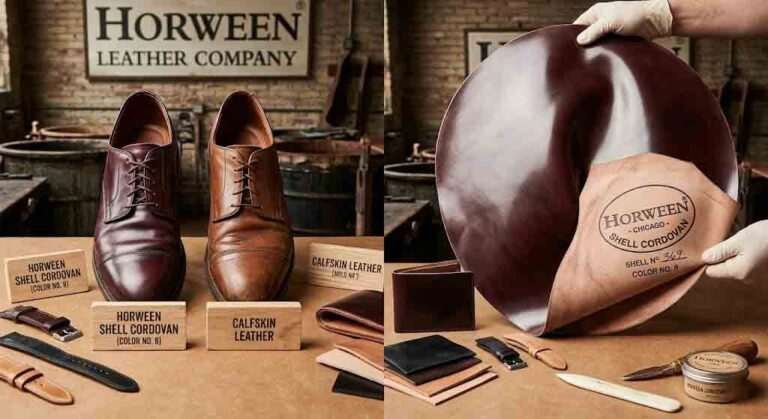
French maisons like Goyard and Louis Vuitton defined the top tier of the market, but American trunk makers — Hartmann, Innovation, Mendel, Drucker & Hill — produced pieces of comparable structural integrity. What distinguished all of them was the quality of the leather. Vegetable-tanned hides, processed slowly in oak or hemlock bark pits over periods of months rather than days, developed a structural density that chrome-tanning has never replicated. The leather was stiff, breathable, and designed to age. Properly cared for, it develops a patina — a deepening, darkening quality that reveals the life it has absorbed rather than masking it. It is the same quality that distinguishes a worked-in English bridle leather from a factory bag bought on impulse. Time, in this material, is not an enemy. It is the artist.
The tragedy is that most of these pieces were never cared for past a certain point. Once the estates were sold or demolished — and the great majority were, by some counts, torn down — the luggage went into storage, where humidity and neglect finished what the Atlantic crossings could not. Brass oxidized. Pine frames warped. Leather dried to the brittleness of old parchment. What remains is salvageable — but only if approached with the right knowledge and the appropriate patience.
The First Principle: Diagnosis Before Treatment
Every restoration begins with an honest assessment. Pick up the piece. Press gently on the leather panels. Listen for creak, watch for crack. Check the hardware — brass corners, draw bolts, lid stays, locks, handles — for structural integrity versus purely cosmetic deterioration. Open the lid and examine the lining for mold, odor, and water damage. Smell the interior: a musty sweetness suggests mildew; a sharp chemical smell suggests a previous amateur restoration attempt with the wrong products.
There are four broad conditions a trunk arrives in: surface patina that needs cleaning and conditioning; active leather deterioration (cracking, splitting, powdering red rot); structural damage to the frame; and hardware failure. Each calls for a different approach, and attempting to address cosmetics before structure is the amateur’s first mistake — the equivalent of painting a house with a failing foundation. Restoration is triage before it is art.
A full professional restoration for a large steamer trunk, from structural repair through relining and hardware refinishing, typically ranges from $550 to over $2,000 depending on the extent of damage and the quality of replacement materials specified. Turnaround time at reputable restoration shops can run 18 to 24 months for full rebuilds. These are not projects for the impatient. They are, in that sense, very much like the trunks themselves — built on the assumption that permanence requires time.
Caring for Leather: The Chemistry of Survival
The leather on a Gilded Age trunk is, at its most fundamental level, a biological material that was arrested mid-decay by the tanning process and has been drying out ever since. Animal hide is composed of collagen fibers kept supple by the natural oils present in living tissue. When the hide is removed from the animal and processed, those oils begin to evaporate. The tanning agents — whether bark tannins, or the chromium salts of modern industrial production — replace some of that structural moisture, but not indefinitely. Left unattended, leather desiccates, and desiccated leather fractures.
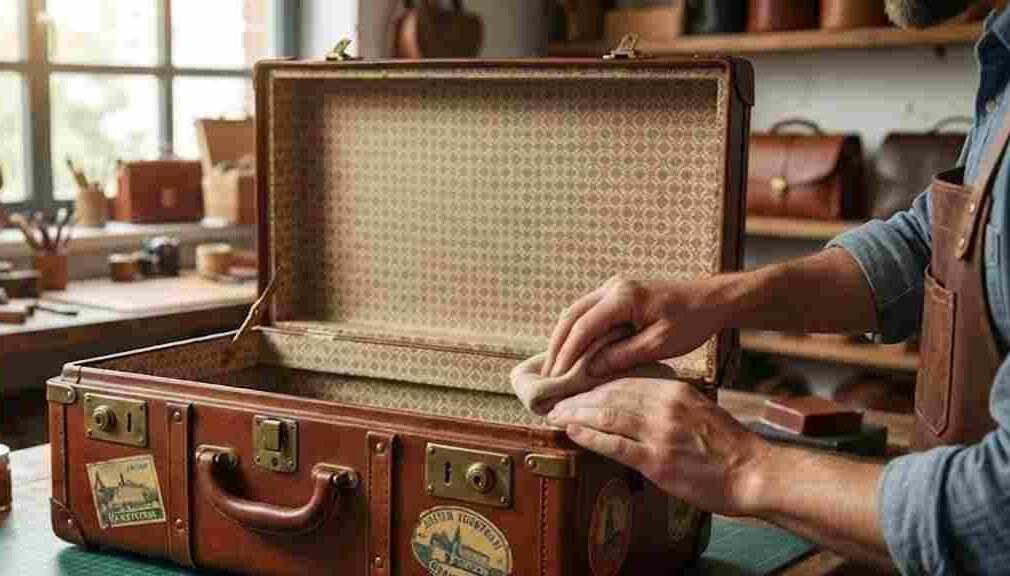
The remedy is oil — specifically, the right oil applied in the right quantity to the right type of leather. For vegetable-tanned hides, the traditional standard is pure neatsfoot oil: rendered from the shin bones and feet of cattle, it closely approximates the natural fats of animal tissue and penetrates deeply into the hide without sitting on the surface like a film. Pure neatsfoot oil will darken the leather — this should be expected and, by anyone with aesthetic sense, welcomed. It deepens the color by one or two shades, enriches the grain, and after absorption and buffing with a clean terry cloth, leaves a surface that is supple rather than greasy. Apply it sparingly on a microfiber cloth, work it into the leather in slow circular motions, allow several hours for full absorption, and remove the excess.
Beeswax follows oil as a finishing layer — it sits on the surface rather than penetrating it, providing a measure of water resistance and a subtle sheen without blocking the breathability that makes vegetable-tanned leather superior to its modern alternatives. Obenauf’s Heavy Duty LP, a commercial blend of beeswax, propolis, and natural oils used originally by firefighters for their boots, has become a respected standard among leather restorers working with thick, full-grain hides. It is the kind of product that performs as advertised without requiring a philosophy degree to use.
What to avoid: olive oil (stains and leaves a tacky surface), coconut oil (spotty, patches), anything petroleum-based, and silicone sprays that seal the surface and prevent the leather from breathing. These are the shortcuts that accelerate deterioration while creating the illusion of improvement. The leather on a trunk that survived a century does not need shortcuts. It needs attention.
Hardware: The Skeleton of the Piece
The hardware on a Gilded Age trunk is frequently the most revealing indicator of its quality. Solid brass corners, lock plates, and draw bolts survive in a way that plated steel hardware cannot. Oxidation on genuine brass is a surface condition — a green-black film of copper carbonate that yields readily to fine steel wool (never pot scrubbers, which scratch too aggressively) and a light application of brass cleaner or, in a pinch, a paste of flour, salt, and white vinegar. What remains beneath is the warm amber of genuine alloy, with the slight irregularity of hand-forged edges that machine-stamped hardware cannot reproduce.
Replacement hardware, when necessary, is available from specialty suppliers like Brettuns Village, which stocks antique-style trunk hardware across dozens of profiles. The cardinal rule of hardware replacement is period accuracy: match the original profile as closely as possible, use nails rather than screws to preserve the structural integrity of the frame, and resist the temptation to polish everything to a uniform shine. A trunk that has lived for a hundred years should carry that history in its hardware. The goal of restoration is not the appearance of newness. It is the appearance of rightness.
The Interior: Lining, Smell, and Memory
The interior of a period trunk is, in many ways, its most intimate geography. The linings — original paper, cotton twill, or in finer pieces, moiré silk — carry the fragrance of their history: cedar, lavender, salt air, the specific chemistry of stored wool and old paper. This is the part of the trunk that connects the object to the people who used it, and it should be approached accordingly.
Musty interiors respond to a thorough airing — ideally several days in dry, indirect sunlight — followed by a light treatment with white vinegar and water on a cloth, allowed to dry completely before any other work. Activated charcoal packets or cedar blocks placed inside a sealed trunk for several weeks will draw out persistent odors without chemical intervention. For relining, period-appropriate papers are available from restoration suppliers; the goal is to select a weight and pattern consistent with the era of manufacture, not necessarily the most expensive option available.
Where the original lining is intact, preserve it. Even faded, even imperfect, the original lining is documentary evidence of the piece’s manufacture — its precise paper pattern, its period-correct color, its way of telling you exactly where and when this object was made. Strip it only when structural considerations demand it.
The Gold Coast Context: Why This Matters Here
There is a particular resonance to this conversation on Long Island’s North Shore. The estates are largely gone — fewer than a third of the original thousand remain, most repurposed as museums, wedding venues, and county parks. What survives of their material culture is scattered and undervalued: furniture at auction, portraits in regional museums, and luggage in attics. The Vanderbilt Museum at Eagle’s Nest in Centerport holds some of the most remarkable collections of this era accessible to the public. Oheka Castle in Cold Spring Harbor, restored from abandonment in the 1980s by developer Gary Melius, stands as proof that genuine restoration — patient, expensive, architecturally faithful — produces results that no modern construction can approximate.
The same principle applies to a steamer trunk. The communities of the North Shore — from Port Washington to Northport to Mount Sinai — sit in the physical shadow of a material history that demands active stewardship rather than passive admiration. A trunk restored properly will outlast its restorer. It will accumulate new patina, new story, new evidence of the life it continues to travel through. This is the logic of the heirloom: not the logic of the antique, which is preserved unchanged, but the logic of the living object, which continues to change and improve with care.
Heidegger wrote about objects in terms of their Zeug — their tool-being, the quality of being present-to-hand in the way that a hammer is most fully itself when being used, not when being admired behind glass. A steamer trunk left in an attic has been removed from its nature. Restored and returned to use — as a coffee table, a library storage piece, a centerpiece of a room that understands its own history — it recovers something essential. The patina deepens. The leather drinks the oil. The brass goes warm in the light. The object resumes its life.
That is what restoration means. Not the simulation of newness. The continuation of something genuine.