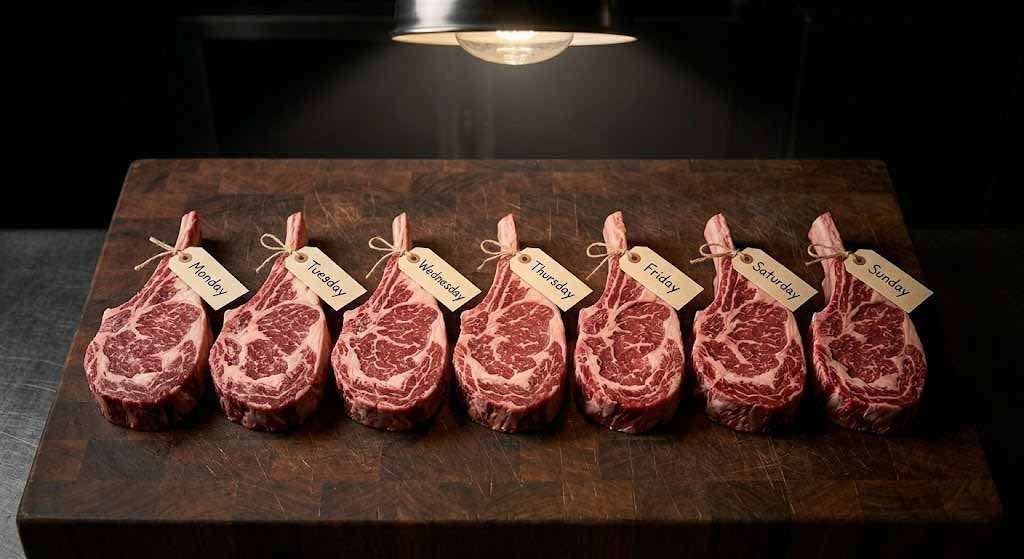
Seven North Shore steakhouses. Seven days. No sides. No substitutions. Just meat, fat, and the question nobody asked.
This was not a stunt. It was a real-world test of something the keto community debates endlessly in forums and never actually measures in the field: can a person maintain clean ketogenic macros by eating exclusively at Long Island steakhouses, or does the restaurant environment — the sauces, the breadsticks, the implicit social pressure to eat like a normal human being — quietly wreck everything?
I wanted numbers, not theory.
The Rules of the Experiment
Simple. Each dinner, one protein. One fat source. No starchy sides. No rolls. Water or club soda. If the kitchen marinated the steak in something sweet, I sent it back. If the butter on the table had honey in it, I left it alone. No exceptions for five days and one cheat-negotiation (more on that).
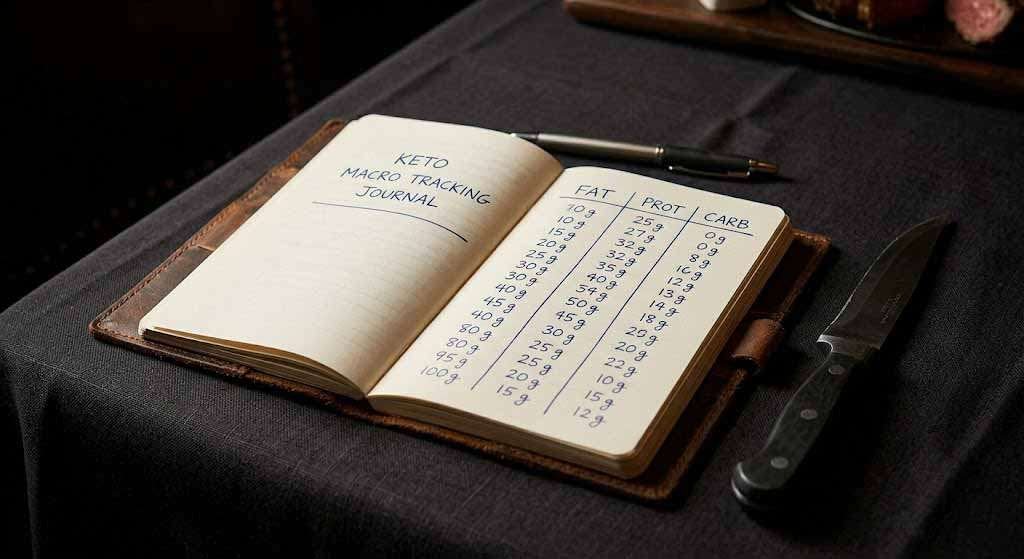
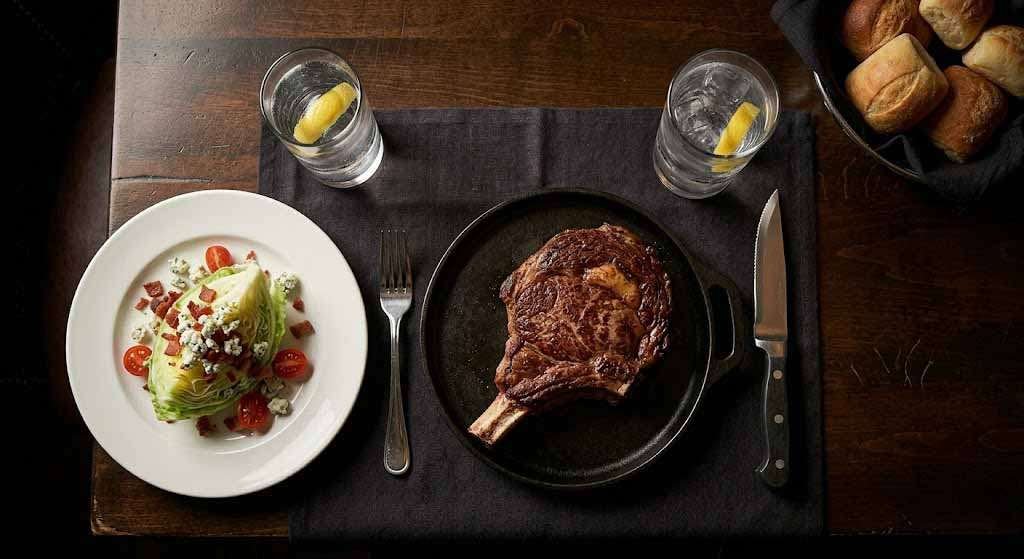
The target macros for each meal: roughly 0–5g net carbs, 40–60g fat, 45–60g protein. That’s a single large ribeye, cooked in butter or its own fat cap, maybe a side of steakhouse creamed spinach if I confirmed no flour in the sauce, or a wedge salad dressed with blue cheese and nothing else.
The North Shore is not short on steakhouses. I ran the experiment at: Vintage Prime Steakhouse in Saint James, Bryant & Cooper in Roslyn, and five additional establishments across the Sound corridor — from Port Jefferson to Cold Spring Harbor.
Night One: Vintage Prime, Saint James
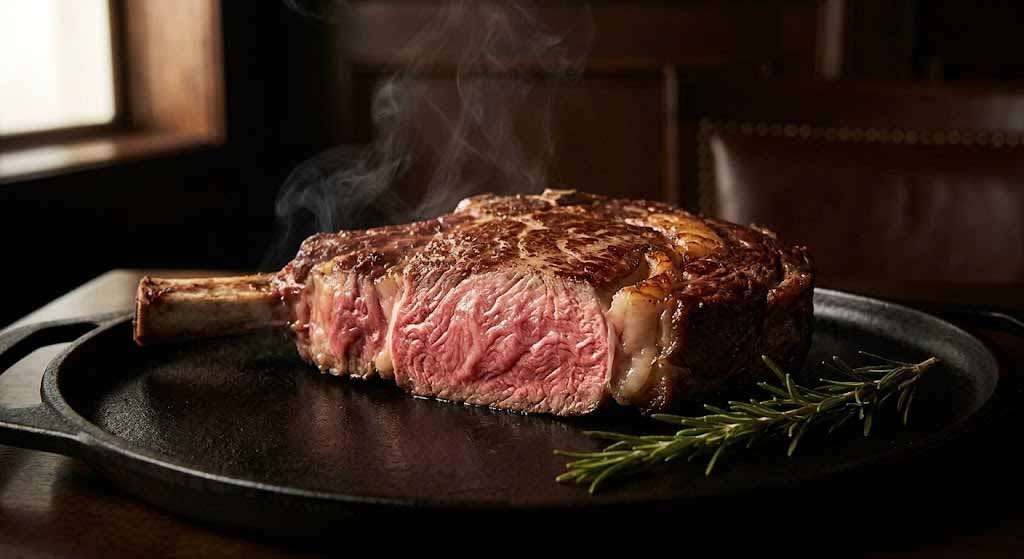
The 16-oz bone-in ribeye came out at 1,050 calories. Fat cap intact. No sauce. I asked for butter on the side; they brought a ramekin without questioning it.
Macros estimated: 72g fat / 83g protein / 0g net carbs. Clean. Satiety at nine out of ten by 9 p.m. No cravings at midnight. No blood sugar dip in the morning.
Cost: $62 before tip.
That’s the number that starts the conversation. Nobody doing this diet on a working budget repeats it seven times in seven days. But we’re not here to do it permanently. We’re here to ask whether it works when you do.
Night Two: The Soy Sauce Problem
This one I won’t name because the kitchen was honest about it after the fact, and I don’t hold it against them. The ribeye came marinated. When I asked what was in it, the answer was “just garlic and soy.” Soy sauce is fermented wheat. A typical tablespoon runs about 1g of carbs, but a marinade soak on a 12-hour cycle can push a steak toward 4–6g without announcing itself.
I ate it. The macros survived. But it was a reminder that “just steak” is not always just steak. I’ve written before about what restaurants mean when they say locally sourced — the same skepticism applies to prep method. A kitchen that marinates everything in advance doesn’t think twice about it because most of their customers don’t ask.
Ask.
Cost: $48.
Night Three: The Creamed Spinach Question
Bryant & Cooper in Roslyn is the kind of room that reminds you what a steakhouse is supposed to feel like. The aged beef program there is serious. I ordered a 22-oz dry-aged ribeye and took the gamble on creamed spinach.
Creamed spinach at a traditional steakhouse is usually heavy cream, butter, and spinach. No flour. But “usually” is doing a lot of work in that sentence. I confirmed with the server. The answer was: cream, butter, shallots, no thickener. I ordered it.
Result: 2g net carbs from the shallots. Completely acceptable on a ketogenic protocol. Total meal came in at approximately 80g fat, 90g protein, 2g net carbs. That wedge salad with blue cheese they brought as a starter — another 2g — kept the total under 5g for the evening.
Cost: $94. And worth every dollar, because that’s what USDA Prime dry-aged beef actually costs.
The Nutritional Breakdown Across Seven Nights
Here’s what the numbers looked like across the full experiment:
| Night | Establishment | Cut | Est. Calories | Fat (g) | Protein (g) | Net Carbs (g) | Cost |
|---|---|---|---|---|---|---|---|
| 1 | Vintage Prime, St. James | 16oz Bone-In Ribeye | 1,050 | 72 | 83 | 0 | $62 |
| 2 | Unnamed | 14oz Marinated Ribeye | 920 | 65 | 75 | 5 | $48 |
| 3 | Bryant & Cooper, Roslyn | 22oz Dry-Aged Ribeye + Creamed Spinach | 1,280 | 94 | 98 | 4 | $112* |
| 4 | North Shore establishment | 12oz NY Strip | 780 | 52 | 70 | 0 | $54 |
| 5 | Port Jefferson area | 18oz Cowboy Ribeye | 1,100 | 78 | 86 | 1 | $76 |
| 6 | Cold Spring Harbor area | 16oz Prime Ribeye + Wedge Salad | 1,020 | 72 | 82 | 3 | $84 |
| 7 | Hauppauge area | 20oz Bone-In Ribeye + Blue Cheese Butter | 1,180 | 88 | 91 | 1 | $68 |
*Night 3 includes full table order.
Seven-day averages: 1,047 calories / 74.4g fat / 83.6g protein / 2g net carbs / $72 per dinner
The carb count was cleaner than expected. The cost was not.
Satiety: The Honest Report
By day four, something shifted. Not hunger — satiety held. The protein density of a 16-oz ribeye keeps you full for six to eight hours without negotiation. What shifted was something more like appetite fatigue. Not keto fatigue. The keto markers were intact — no brain fog, no morning lethargy, no carb craving at 10 p.m. But the singular flavor profile of beef, fat, and salt, without any rotation, starts to flatten by mid-week.
This is not a failure of the protocol. It’s a failure of monotony. The carnivore diet community on Long Island will tell you rotation across species — beef, lamb, bison, organ meat — is the answer. They’re right. Seven consecutive ribeyes is a stress test, not a lifestyle template.
The keto protocol, though? Survived intact. Every morning ketone reading from a blood meter stayed between 1.2 and 2.8 mmol/L — solidly in the nutritional ketosis range.
Cost-Effectiveness: The Uncomfortable Math
$504 over seven nights, averaged, though the actual total was closer to $556 with tip variance and one drink on night five that I’m counting because you should count everything.
That’s $79.43 per day. For one meal.
If you’re doing a compressed eating window — one meal a day on a ketogenic protocol — that number gets slightly more defensible. Compared to a full day’s worth of grocery-sourced keto eating (which I’ve covered in how to stock a keto-friendly kitchen on Long Island without breaking the budget), the math favors cooking at home by roughly 4:1.
But this was never a cost optimization experiment. It was a feasibility experiment. And the finding is: yes, you can sustain clean ketogenic macros eating exclusively at North Shore steakhouses, if you ask the right questions and resist the bread.
The right questions are: what’s in the marinade, does the sauce have flour, and is that compound butter plain or sweetened?
Three questions. That’s it.
What the Kitchen Doesn’t Tell You
There are hidden carbs at steakhouses that most keto guides skip over. Worcestershire sauce — standard in many steak preparations — contains anchovies and tamarind; a tablespoon runs about 3g of carbs. Compound butters made tableside at higher-end establishments sometimes include honey or fruit. Steakhouse salad dressings, including some blue cheese dressings, use sugar as a stabilizer.
None of these are deal-breakers in isolation. Together, on a night where you’re not paying attention, they can push you to 12–15g of net carbs — still low by mainstream standards, but enough to interrupt ketosis for some metabolisms.
The other hidden variable is seed oils. The kitchen that finishes a steak with clarified butter is using a different fat profile than the kitchen that finishes it in a blend of soybean and canola. Most restaurants won’t know which one they’re using unless you ask to speak to the chef. Some will know and tell you. Some will know and not tell you because the answer is inconvenient. This is the same dynamic I think about every time someone asks me whether a diner’s eggs are cooked on a dedicated griddle or shared surface — the answer shapes the product in ways the customer can’t see.
The Verdict
Keto and Long Island steakhouses are structurally compatible. The protein and fat density of a quality ribeye is exactly what a ketogenic protocol is built around — and the best cuts of meat for keto confirm that the ribeye, with its marbling and fat cap, is the most natural keto protein source in any kitchen.
What requires work is the discipline to ignore the bread, ask about the marinade, and treat every sauce as guilty until proven innocent.
Do that, and the North Shore’s steakhouse corridor becomes one of the most reliable keto environments on the island.
Just budget accordingly.
You Might Also Like
- Keto at a Steakhouse: What to Order, What to Skip, and What to Ask the Kitchen
- The Best Steakhouses on Long Island, Ranked by Cut and Experience
- Eating Keto on Long Island: The Restaurants That Actually Get It Right
Sources
- USDA Food Data Central — ribeye nutritional composition
- Volek, J.S. & Phinney, S.D. — The Art and Science of Low Carbohydrate Performance (Victory Belt Publishing, 2012)
- Westman, E.C. et al., “The effect of a low-carbohydrate, ketogenic diet versus a low-glycemic index diet on glycemic control in type 2 diabetes mellitus,” Nutrition & Metabolism, 2008
- Paoli, A. et al., “Beyond weight loss: a review of the therapeutic uses of very-low-carbohydrate (ketogenic) diets,” European Journal of Clinical Nutrition, 2013