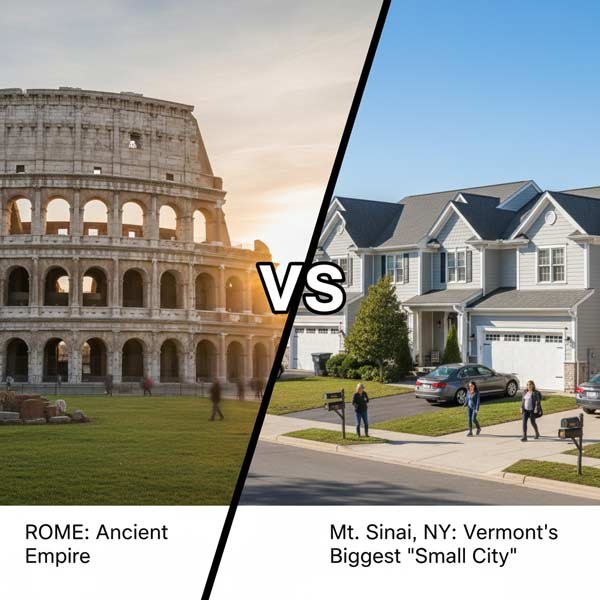
Two places separated by 4,300 miles and 2,400 years of history. One built the Western world. The other built… well, really nice suburban homes. Let’s explore what Rome, Italy and Mt. Sinai, New York have in common (and where they hilariously diverge).
The Founding Stories: Wolves, Needles, and Divine Intervention
Rome: Founded by Brothers Raised by a She-Wolf (753 BC)
According to Roman legend, Rome was founded on April 21, 753 BC by twin brothers Romulus and Remus, sons of the war god Mars. Left to drown in the Tiber River by a jealous king, the infants were rescued and nursed by a she-wolf (Lupa Capitolina). When they grew up, they decided to found a city. After a dispute about where to build it, Romulus killed Remus and became Rome’s first king, naming the city after himself.
This legendary founding is immortalized in countless works of art, including the famous Capitoline Wolf statue. While modern archaeology suggests Rome actually developed gradually from several villages around the Palatine Hill in the 8th century BC, Romans preferred the dramatic wolf story—and honestly, who can blame them?
Mt. Sinai: Named by a Postmaster with a Bible and Needle (1841)
Mt. Sinai, New York was founded in 1664 as an early European settlement by colonists from nearby Setauket, who obtained a deed from the Seatocot family of Native Americans. The area was originally called “Nonowatuck” (meaning “stream that dries up”) by indigenous peoples.
The Europeans first named it “Old Mans”—origin unknown, though legend says it involved an elderly Englishman named Major John Gotherson getting swindled by Captain John Scott. In 1840, residents applied for a post office and decided “Old Mans” wasn’t dignified enough. They tried “Mount Vernon,” but that was already taken in New York.
So in 1841-1842, the first postmaster Charles Phillips allegedly closed his eyes, opened his Bible, and pointed a knitting needle at the page. The needle landed near Mount Sinai (the biblical mountain), and the name stuck.
Comparison: Rome: Divine twins, she-wolf, fratricide, empire. Mt. Sinai: Confused postmaster, knitting needle, “good enough!” Very different origin stories, equally memorable.
Population & Size: Empire vs. Hamlet
Ancient Rome at Its Peak (2nd Century AD)
- Population: Approximately 1 million people—the first city in history to reach this size
- Modern Rome: 2.76 million in the city; 4.2 million in the province
- Land area (ancient empire): 2 million square miles at its height, stretching from Britain to Syria
- Famous feature: Built on Seven Hills—Palatine, Capitoline, Aventine, Caelian, Esquiline, Quirinal, and Viminal
Mt. Sinai, NY Today
- Population: About 13,000 people
- Land area: 6.4 square miles
- Famous feature: Cedar Beach on Long Island Sound
- Growth: From 1,239 people in 1960 to current population as NYC suburbanization spread eastward
Fun fact: Ancient Rome’s population of 1 million would fit into Mt. Sinai 77 times over. Or to put it another way, the entire Roman Empire could have hosted about 154,000 Mt. Sinais.
Historical Significance: Empires vs. Quiet Suburban Life
Rome’s Impact on Western Civilization
Rome didn’t just change history—it created Western civilization as we know it. Here’s what Rome gave the world:
- Language: Latin spawned Italian, French, Spanish, Portuguese, Romanian, and influenced English
- Calendar: The Julian calendar (365.25 days, leap years) – July named after Julius Caesar, August after Augustus
- Law: Roman law is the foundation of legal systems across Europe and beyond
- Engineering: Aqueducts, roads (53,000 miles by 4th century!), concrete, arches, domes
- Government: The concept of a republic, senate, checks and balances inspired the US founding fathers
- Architecture: Columns, basilicas, amphitheaters still copied worldwide
- Religion: Became the spiritual center of Catholicism, home to Vatican City
- Saying: “All roads lead to Rome” (because they literally did—the road network was that good)
Rome ruled for over 1,000 years as a kingdom, republic, and empire. It dominated Europe, North Africa, and the Middle East. Its collapse in 476 AD marked the end of antiquity and the beginning of the Middle Ages.
Mt. Sinai’s Contribution to Civilization
Mt. Sinai’s contributions are… more localized. Here’s what this Long Island hamlet offered:
- American Revolution: In 1780, Major Benjamin Tallmadge and Continental Army dragoons landed at Cedar Beach to attack British forces at Manor St. George—now marked as the historic Tallmadge Trail
- Resort town heritage: Became a popular summer destination when the LIRR reached Port Jefferson in 1879 (the train even went through Mt. Sinai to Wading River from 1895-1938)
- Agriculture: Provided wood for shipbuilding in nearby Port Jefferson; had mills along streams
- Community: Founded Mt. Sinai Civic Association in 1917, still active today
- Cedar Beach: One of the most popular North Shore beaches, preserved since common lands set aside in 1664
- Heritage Diner: Okay, we’re biased, but we’ve been feeding generations of Mt. Sinai families for decades!
Comparison: Rome invented Western civilization. Mt. Sinai provides a really nice place to raise kids and enjoy beach weekends. Different scales of ambition.
Architectural Marvels: Colosseum vs. Colonial Homes
Rome’s Monuments That Changed Architecture Forever
The Colosseum (70-80 AD)
- Massive amphitheater holding 50,000-80,000 spectators
- Gladiatorial battles, public spectacles, mock sea battles
- Engineering marvel with underground passages, trap doors, animal lifts
- Still standing 2,000 years later as Rome’s most iconic symbol
- Watch a tour: Rick Steves’ Colosseum Tour on YouTube
The Pantheon (126 AD)
- Best-preserved Roman building; dome was world’s largest for 1,300 years
- First large-scale use of concrete in architecture
- Oculus (opening in dome) is still the building’s only light source
- Now a Catholic church, burial site of Renaissance artists including Raphael
Roman Forum
- Center of political, religious, and commercial life for 1,000+ years
- “The most important piece of real estate in Western civilization”
- Where Julius Caesar was cremated, where Cicero gave speeches
- Ruins include temples, basilicas, triumphal arches
Other Masterpieces: Trevi Fountain (one of 2,000+ fountains!), Spanish Steps, St. Peter’s Basilica, Sistine Chapel, Castel Sant’Angelo, Roman Aqueducts, Trajan’s Market (world’s first shopping mall!)
Mt. Sinai’s Historical Structures
- No 17th-century structures survive
- Six buildings from 1705-1790 with structural elements from early colonial period
- Largest number from 1800s: Colonial homes, farms, mills
- Notable: Historic vacation houses along Mt. Sinai Harbor (many converted to year-round homes)
- Crystal Brook Park Association: Private community created in 1892 on former care facility land
- Modern era: Suburban developments from 1960s onward, including Davis Peach Farm (404 acres developed in 2000s)
Comparison: Rome has structures that defined architecture for millennia. Mt. Sinai has some really charming 18th-century homes. Rome wins on grandeur; Mt. Sinai wins on “not being overrun by tourists.”
Cultural Impact: Artists, Writers & Thinkers
Rome’s Cultural Giants
Ancient Roman Authors & Poets:
- Virgil (70-19 BC): Wrote The Aeneid, Rome’s national epic about Aeneas founding the Roman race
- Ovid (43 BC-17 AD): Metamorphoses influenced Western literature for 2,000 years
- Cicero (106-43 BC): Orator, philosopher, politician—his writings defined Latin prose
- Julius Caesar (100-44 BC): Not just a general—wrote Commentaries on the Gallic Wars
- Tacitus, Livy, Pliny the Elder: Historians whose works are our primary sources on ancient Rome
Renaissance & Baroque Artists (Rome as Center):
- Michelangelo (1475-1564): Sistine Chapel ceiling, St. Peter’s Basilica dome, David (in Florence but worked extensively in Rome)
- Raphael (1483-1520): Vatican frescoes, School of Athens—buried in the Pantheon
- Caravaggio (1571-1610): Revolutionary Baroque painter, dramatic use of light/shadow
- Bernini (1598-1680): Baroque sculptor and architect—fountains, St. Peter’s Square colonnade
Watch Simon Schama’s documentary on Bernini: Bernini Documentary on YouTube
Mt. Sinai’s Notable Figures
Uh… this is where things get tricky. Mt. Sinai is a residential community, not a cultural epicenter. However:
- Charles Phillips: First postmaster, needle-pointer extraordinaire, named the town
- Major Benjamin Tallmadge: Revolutionary War hero who landed here (though he wasn’t FROM Mt. Sinai)
- Generations of Long Island families: Who’ve built a tight-knit community over centuries
- Heritage Diner staff: Okay, seriously, we’re reaching here
Comparison: Rome produced some of history’s greatest minds and artists. Mt. Sinai produces hardworking families and the occasional Little League all-star. Different legacies.
YouTube Video Tours: Explore Both Places
Rome Video Resources
Ancient Rome History:
- PBS History in a Nutshell: Ancient Rome – Excellent 20-minute overview of Rome’s rise and fall
- Ancient Rome Live YouTube Channel – Educational channel dedicated to Rome’s cultural legacy
- History Civilis YouTube channel – Highly recommended for detailed Roman history
Modern Rome Tours:
- Rick Steves’ Rome: Ancient Glory – Free video tour of the Forum, Colosseum, Palatine Hill
- Rick Steves’ Rome: Eternally Engaging TV Special – Hour-long exploration of the Eternal City
- BBC’s “Italy Unpacked” series – Art and food through Italian regions including Rome
Food & Culture:
- Rick Stein’s Mediterranean Escapes – British chef explores Roman cuisine
- Katie Parla’s Google Talk on Cucina Romana – Rome’s traditional dishes and street food
Mt. Sinai… Well…
Mt. Sinai doesn’t have much of a YouTube presence because, frankly, most people who live here are too busy enjoying it to film it. But here’s what you CAN find:
- Local real estate tours showing homes and neighborhoods
- Cedar Beach drone footage (search “Cedar Beach Mt. Sinai NY”)
- Long Island local history channels occasionally mention Mt. Sinai
- North Shore trail and beach videos
Comparison: Rome has thousands of professional documentaries. Mt. Sinai has GoPro footage from somebody’s kayak trip. Both valid!
Events & Festivals: Millennia of Tradition vs. Beach Season
Rome’s Legendary Events (Then & Now)
Ancient Rome:
- Gladiatorial Games: Colosseum spectacles with combat, wild beast hunts, mock naval battles
- Chariot Races: Circus Maximus held 250,000 spectators for chariot racing—Rome’s most popular sport
- Triumphal Processions: Victorious generals paraded through streets with captives, treasure, elephants
- Saturnalia (December): Festival where social norms reversed—gifts exchanged, gambling allowed, masters served slaves
- Lupercalia (February): Fertility festival involving semi-naked priests running through streets
Modern Rome:
- Easter Mass at Vatican: Pope’s blessing draws hundreds of thousands
- Rome’s Birthday (April 21): Celebrates legendary founding in 753 BC
- Opera performances at Baths of Caracalla: Ancient ruins as dramatic backdrop
- New Year’s Eve in Piazza del Popolo: Massive celebration
- Ferragosto (August 15): Major summer holiday, city empties as Romans flee heat
Mt. Sinai’s Community Events
- Summer at Cedar Beach: Families enjoying the North Shore’s most popular beach
- Community concerts and movie nights: At local parks
- Little League games: Major community gathering every spring/summer
- Fire Department events: Community volunteer fire department celebrations
- School district events: Graduations, sports championships, theater productions
- Heritage Diner breakfast traditions: Three generations showing up on Saturday mornings
Comparison: Rome: Gladiators fighting to the death for entertainment. Mt. Sinai: Parents arguing about Little League umpire calls. Different types of combat.
Interesting & Quirky Facts
Rome Fun Facts
- Fountains galore: Rome has over 2,000 fountains—more than any city in the world
- Trevi Fountain cash: Nearly 700,000 euros worth of coins tossed in annually (donated to charity)
- First shopping mall: Trajan’s Market (113 AD) had 150+ shops across multiple levels
- Toilet hygiene: Ancient Romans used communal sponges on sticks instead of toilet paper
- Julius Caesar’s vanity: He made it illegal for anyone to look down on him from above (he was embarrassed by baldness)
- Gladiators rarely died: Professional gladiators were expensive investments; most fights didn’t end in death
- Urine was valuable: Used for cleaning clothes and even brushing teeth (ammonia properties)
- Concrete invention: Romans pioneered concrete mixing; the Pantheon’s dome is still world’s largest unreinforced concrete dome
- City within a city: Vatican City is the world’s only independent country located entirely within another city
- Road network: 53,000 miles of roads by 4th century—every Roman mile (4,800 feet) marked by a milestone
- Monte Testaccio: A 115-foot-tall hill made entirely of ancient broken pottery (mostly olive oil amphoras)
- Cats everywhere: Rome has an estimated 300,000+ feral cats; they’re protected by law and have official caretakers
Mt. Sinai Fun Facts
- Name origins: Chosen by randomly pointing a knitting needle at a Bible (allegedly)
- Name changes: Went from “Nonowatuck” to “Old Mans” to “Mount Vernon” to “Mount Sinai” in less than 200 years
- Revolutionary War route: The Tallmadge Trail runs from Cedar Beach to Mastic Beach, marking the 1780 raid
- Common lands from 1664: Still used for recreation 360 years later
- Former railroad: LIRR ran through Mt. Sinai from 1895-1938
- Beach preservation: Cedar Beach’s marine sanctuary and dunes have been protected since early settlement
- Tight-knit schools: Most kids attend the same schools K-12, building lifelong friendships
- Peach farm legacy: 404-acre Davis Peach Farm sold and developed in early 2000s
- Heritage Diner: Where generations of families celebrate birthdays, team victories, and lazy Sundays
Comparison: Rome’s fun facts involve empire-building, engineering marvels, and bizarre grooming habits. Mt. Sinai’s fun facts involve naming confusion and peaches. Both charming in their own ways.
What They Have in Common (Surprisingly!)
Despite the obvious differences, Rome and Mt. Sinai share more than you’d think:
- Water-centric locations: Rome on the Tiber River, Mt. Sinai on Long Island Sound—both civilizations built around water access
- Founding legends: Rome has Romulus & Remus; Mt. Sinai has the Bible needle story—both communities love their origin myths
- Revolutionary history: Rome overthrew its kings in 509 BC to become a republic; Mt. Sinai played a role in the American Revolution
- Agriculture roots: Both started as agricultural communities before developing other identities
- Community gathering spaces: Rome had the Forum; Mt. Sinai has Heritage Diner—places where locals meet and build bonds
- Preservation of history: Rome preserves ancient ruins; Mt. Sinai preserves 18th-century homes and common lands from 1664
- Family traditions: Both places emphasize multi-generational presence and continuity
- Beach culture: Romans loved coastal resorts (Pompeii, Herculaneum); Mt. Sinai’s identity includes Cedar Beach recreation
Tourism: Millions vs. “Wait, Where Is That?”
Rome Tourism
- 25 million foreign visitors annually
- UNESCO World Heritage Site (entire historic center)
- Top attractions: Colosseum, Vatican Museums (7+ million visitors/year), Sistine Chapel, St. Peter’s Basilica, Trevi Fountain, Pantheon
- Rick Steves and every other travel guide dedicates extensive coverage
- Infrastructure designed for tourist crowds (sometimes overwhelming)
- Pickpockets, expensive restaurants near landmarks, tour bus chaos
Mt. Sinai Tourism
- Mostly visited by: Residents, their families, and people who got lost looking for Port Jefferson
- Main attraction: Cedar Beach (popular with locals, not international tourists)
- No Rick Steves coverage (Rick, if you’re reading this, we’d love to have you at Heritage Diner!)
- Quiet, peaceful, no crowds—exactly how residents like it
- No pickpockets, just neighbors who say hello
Comparison: Rome is buckling under tourism pressure. Mt. Sinai residents are more worried about parking at the beach in July. Different problems.
Cost of Living: Empire Prices vs. Long Island Taxes
Rome
- Apartment rental: €1,200-2,500/month for 2-bedroom in decent areas
- Buying a home: €300,000-€600,000+ depending on location
- Meals: €12-25 for casual dining; €40+ for nice restaurants
- Espresso: €1-1.50 at a bar (standing), €3-5 if you sit
- Cost of living: Lower than NYC, higher than most Italian cities
Mt. Sinai
- Home prices: $550,000-$700,000 for 3-4 bedroom single-family
- Property taxes: $12,000-16,000/year (the Long Island special!)
- Breakfast at Heritage Diner: $10-15 per person for generous portions
- Coffee: $2-3, free refills included, nobody cares if you sit for an hour
- Cost of living: High by US standards, typical for Long Island suburbs
Comparison: Rome’s high costs come from being a world capital. Mt. Sinai’s high costs come from Long Island property taxes and proximity to NYC. Pick your poison.
Modern Life: What It’s Like Living There Today
Living in Rome
Pros:
- You live in one of the world’s most beautiful and historic cities
- Incredible food, wine, and café culture
- World-class art and architecture everywhere
- Vibrant social life, piazzas full of people
- Mediterranean climate with mild winters
Cons:
- Overwhelming tourist crowds year-round
- Traffic congestion and parking nightmares
- Bureaucracy can be slow and frustrating
- Public transportation crowded
- High unemployment compared to northern Italian cities
Living in Mt. Sinai
Pros:
- Peaceful suburban life with excellent schools
- Beautiful Cedar Beach and Long Island Sound access
- Tight-knit community where everyone knows everyone
- Safe, family-friendly environment
- Proximity to NYC (when you want it) without living there
- Yards, driveways, space to breathe
Cons:
- Property taxes will make you weep
- Long commute if you work in Manhattan (2 hours door-to-door)
- Need a car for everything
- Limited dining and cultural options locally
- Can feel isolated if you’re used to city energy
The Verdict: Which One Is “Better”?
This is like asking whether the Colosseum or a suburban ranch house is better—they’re not comparable, and that’s okay!
Choose Rome If You Want:
- To live immersed in 2,700 years of continuous history
- World-class museums, restaurants, and cultural events
- To walk ancient Roman roads and touch structures from antiquity
- Mediterranean lifestyle with outdoor café culture
- To tell people you live in Rome (unbeatable dinner party opener)
- European travel hub for weekend trips
Choose Mt. Sinai If You Want:
- To raise a family in a safe, tight-knit community
- Excellent schools without navigating complex lotteries
- Beach access for summer weekends
- Space—yards, driveways, basements, actual square footage
- Access to NYC when needed without the daily chaos
- Saturday morning breakfast at Heritage Diner as a family tradition
- A place where your kids’ teachers know them by name
A Love Letter From Heritage Diner
Look, we’re not going to pretend Mt. Sinai rivals Rome’s historical significance. Rome built aqueducts that still work 2,000 years later. We build memories over pancakes and coffee.
Rome gave the world Latin, concrete, and Republican government. Mt. Sinai gives families a place to call home and raise kids who know their neighbors.
But here’s the thing: not every place needs to be Rome. Sometimes you need a quiet harbor, a good school system, a beach where kids can play freely, and a diner where three generations show up on Saturday mornings because it’s just what you do.
Rome is the Eternal City, a masterpiece of human civilization. Mt. Sinai is a Long Island hamlet with a quirky naming story and really great peach farm memories.
Both matter. Just in very different ways.
So whether you’re planning a pilgrimage to the Colosseum or just looking for a place to raise your kids with good schools and beach access, both Rome and Mt. Sinai have something special to offer.
And if you choose Mt. Sinai, we’ll be here at Heritage Diner with a cup of coffee and a warm welcome. That’s our promise—and unlike Romulus, we won’t kill anyone to keep it.
Further Reading & Resources
Rome Research Links:
- Britannica: Ancient Rome
- History.com: Ancient Rome
- National Geographic Kids: Ancient Rome
- Wikipedia: Rome
- Rick Steves’ Rome Travel Guide
Mt. Sinai Research Links:
Visit us at Heritage Diner in Mt. Sinai, where we may not have 2,000 years of history, but we’ve been serving this community long enough to know that breakfast with neighbors beats gladiatorial combat any day of the week.