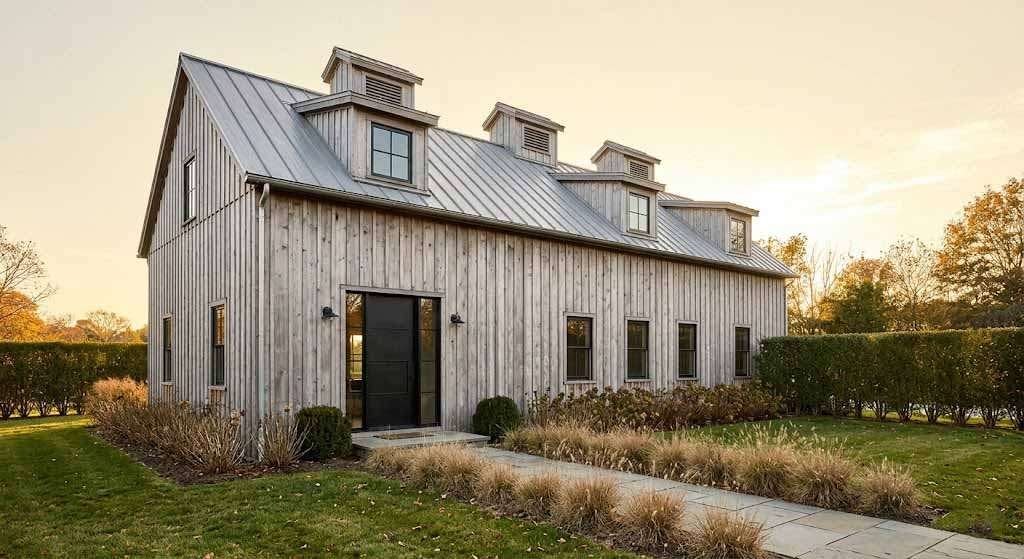
Whatever sentiment attaches to a place, the land keeps score in its own way. Out on Long Island’s East End — past the vineyards, past the farm stands with the hand-lettered signs, past the last gas station before the speed limit drops and the light turns gold — the old potato barns are still standing. Fewer of them, sure. But the ones that made it didn’t make it quietly.
They got swimming pools. They got gallery lighting and exposed timber and cathedral ceilings that stretch thirty feet toward reclaimed pine. They got listing prices north of four million dollars. The buildings that once stored a dirty, essential vegetable in the dark now store sports cars and Montauk rosé.
This is a story about what happens when a working landscape runs out of work — and what gets built in its place.
Long Island Was the Country’s Potato Capital
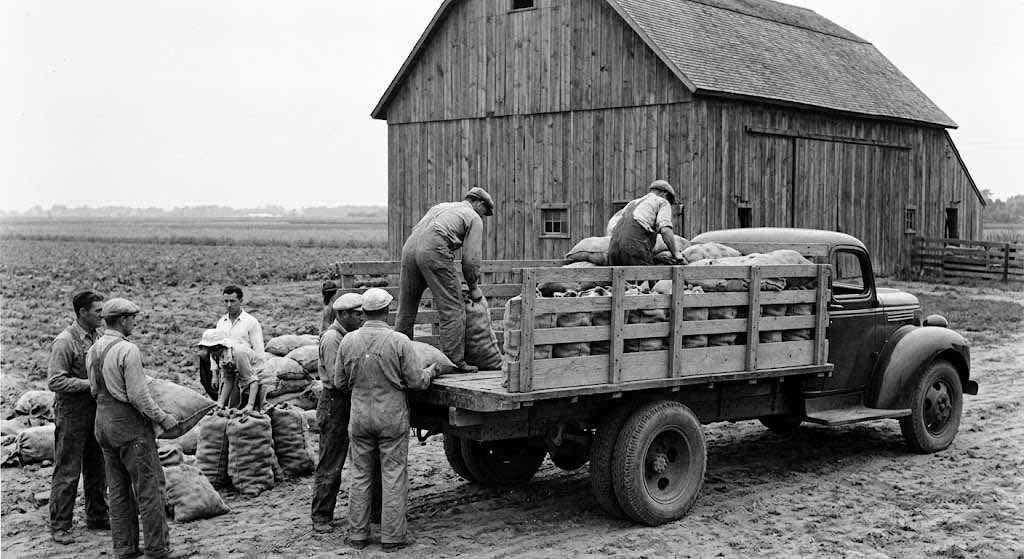
It is easy to forget this now, driving east through the Hamptons with the boutique hotels and the paddle tennis courts, but Long Island was for decades one of the most productive potato-growing regions in the country. In the 1950s, an estimated 75,000 acres of potatoes were grown on Long Island — the North and South Forks home to hundreds of acres well into the mid-1980s. The East End wasn’t glamour. It was labor, dirt, and yield.
The workers were largely Polish immigrant families who had come over in the late 19th and early 20th centuries and put down roots so deep that the names are still on the mailboxes. By the 1940s, up to 80% of all farming on Long Island was dedicated to potatoes. The barns built to store and sort that crop were built accordingly — large, utilitarian, constructed with the structural honesty of people who needed something to work, not something to admire. Post-and-beam frames, high ceilings for airflow, wide open floor plates for moving produce. The bones were serious because the purpose was serious.
Then the bottom fell out. In the mid-1980s, market prices fell so low many farmers called it quits. Old-timers talk about the sad spectacle of regularly occurring farm auctions, comparing them to funerals where a family said goodbye to a loved one. The land, meanwhile, was quietly becoming some of the most expensive agricultural real estate in the state. An acre on the East End came to cost roughly $100,000 to $150,000. You couldn’t grow potatoes profitably on land worth that much. The math simply didn’t work.
By the late 1960s, Long Island looked a lot less like farmland and a lot more like an extension of the city. In 1974, Suffolk County launched one of the first farmland preservation programs in the nation to protect working farms — purchasing development rights to keep acreage in agricultural use. It slowed the tide. It didn’t stop it. And for many barns, preservation was never really the question. The question was: what do you do with a structure this honest when the purpose it was built for disappears?
What Good Bones Actually Mean
The answer, it turns out, has been hiding in plain sight since the first developer looked up at a forty-foot post-and-beam ceiling and understood what they were standing under.
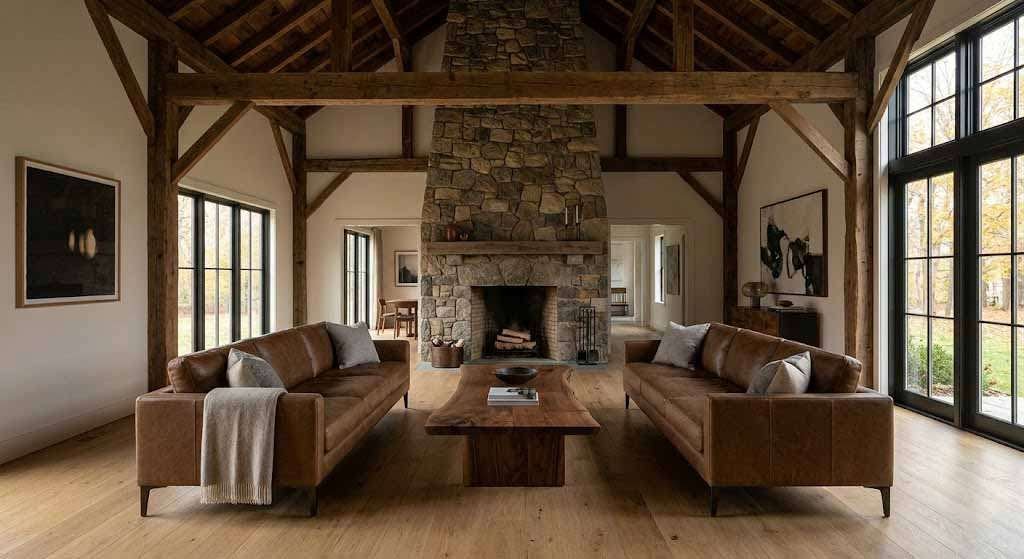
Potato barns were not built to be charming. They were built to hold thousands of pounds of root vegetables in controlled darkness. The traditional barn architecture of Long Island’s East End — big open floor plans, high ceilings, and open space — is reminiscent of loft architecture in Chelsea. That comparison isn’t accidental. The same qualities that made a barn functional for storage — volume, height, structural clarity — make it extraordinary as a residence. You can’t fake those proportions. You can’t buy them new.
Firms like Plum Builders in East Hampton have turned the modern barn into something of a regional trademark, designing homes with exterior materials such as stone, clapboard siding, cedar roofs, and wood trim used in strikingly modern ways, while always leaving one interior room with an open, trussed ceiling that reads unmistakably as barn. That retained trace of agricultural origin isn’t an accident of preservation — it’s a selling point. Buyers want to feel the history. They just want underfloor heating in it.
Some of the conversions have stayed closer to the original structures. A former potato barn in Southold at 380 Gin Lane — on the grounds of a historic farm, converted in the 1960s into a multi-family home with rustic details — has a legal one-bedroom apartment upstairs, an open format main floor, and a location two miles from Cedar Beach Park. It listed at $1.395 million. Not the splashiest conversion on the East End, but real: a working barn that became a working home, and held its character in the process.
Then there are the ones that didn’t hold back. The converted potato barn at 488 Ocean Road in Bridgehampton — the longtime home and creative workspace of artists Karl Mann and Hector Leonardi — listed at $4.45 million. Listing agent Kyle Rosko described the property as “one of the most unique assets you’re ever going to find.” A barn embedded in the ground, now fitted with loft-like studios and landscaped gardens, an 18th-century Parisian spiral staircase sourced specifically for the space. That staircase would have looked ridiculous in a new construction home in a cul-de-sac. In the bones of a century-old potato barn, it lands exactly right.
The North Fork Model
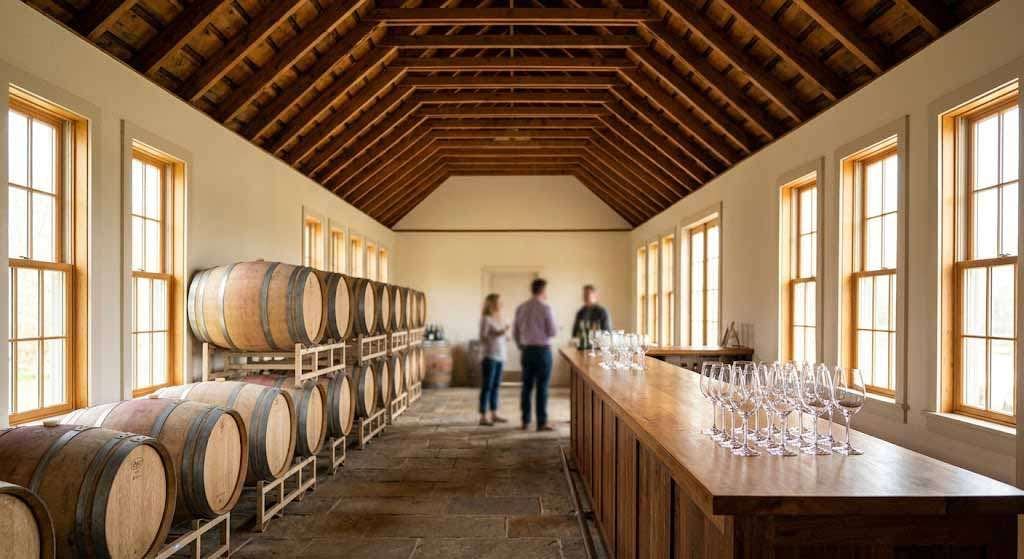
The North Fork has been, in many ways, the lab for this transformation. Where the South Fork became about mansions on flattened farmland, the North Fork retained more of the agricultural texture — and found creative uses for it. Today a barn on the North Fork can be the frame of a modern home, the studio space of an art gallery, an idyllic bed and breakfast, the architectural interior of a state-of-the-art distillery, or the multi-use space of a vineyard tasting room.
Bedell Cellars operates its tasting room out of a renovated 1919 historic potato barn, with cathedral ceilings and exposed rafters framing Michael Lynne’s private art collection overhead. You taste the wine and you’re also inside agricultural history, which is a thing money cannot reproduce from scratch. The Peconic Land Trust, founded in 1983, has continued brokering deals to preserve farmland across the region — fighting to keep some of this land in agricultural use even as the development pressure intensifies. That organization understands something the market sometimes forgets: once the barn is gone, it doesn’t come back.
The Cedar House on Sound in Mattituck — a bed and breakfast purchased from the Perrin and Scarola families — was originally a potato-packing barn built in the 1930s, rebuilt in 2006 on the same footprint using reclaimed cedar wood from the original roof as window trim and floorboard, with old beams and collar ties integrated into the décor to maintain agricultural integrity. The interior is very modern. The owners call it “rustic chic.”
That phrase — rustic chic — captures the entire design conversation of the North Fork in two words. The roughness is the aesthetic. The function that created the roughness is what makes it irreplaceable.
The Price of History
None of this is cheap. The cost of converting a historic agricultural structure into a code-compliant luxury residence involves remediation, structural reinforcement, insulation, mechanical systems, and the peculiar problem of making a building designed to breathe feel airtight and climate-controlled. That gap between what a barn was and what a home needs to be is where most of the money goes.
But the value equation has held. The East End real estate market has continued to reward provenance. Buyers pay for the story. They pay for the scale that can’t be built from scratch. They pay for the specific quality of light through a forty-foot timber frame on a late afternoon in October when the vineyards are starting to go gold.
Pawli is the Broker at Maison Pawli Realty, has worked this market and understands what distinguishes adaptive reuse properties from conventional inventory: authenticity is not a finish selection. You can’t specify it. A barn conversion either has it or it doesn’t, and buyers who want it know immediately when they walk through the door.
For a broader read on what’s moving across Long Island’s North Shore — not just the East End — the Long Island Real Estate Market Update: Q1 2026 is worth a look. And if the relationship between old buildings and their environmental value interests you, I wrote about that in a different context in Heritage as a Climate Strategy: Why Old Buildings Are Greener than New Glass.
What Gets Saved and What Gets Lost
There is a version of this story that is a simple triumph: the barn survives, the history is honored, everyone wins. The reality is more complicated.
When rapid transformation of the South Fork landscape came in full force, farmhouses where generations were raised were remodeled into lavish summer homes; old potato barns were repurposed or torn down. Super-sized mansions sprawled across old farmland. For every barn that got a second life, several others didn’t make it. The ones that survived often survived because their bones were so strong that demolition was more expensive than conversion. They saved themselves through sheer structural stubbornness.
And the farming itself? A farmer whose family had worked the North Fork since 1661 left for Maine because, as he put it: “The island is now for the rich and famous. Long Island for years was the number one potato producing area in the country. Now there are more potatoes on one farm in Maine than on the whole Island. It’s heartbreaking to leave, but at the same time it is liberating.”
That quote carries a weight that no amount of reclaimed wood or exposed beam can fully address. The barn is still standing. The farming family is gone.
There’s a version of that reckoning worth sitting with. Long Island’s East End was built by working people — Polish immigrants, family farmers, seasonal laborers — who fed New York City out of exhausted, sandy soil. The land that absorbed that labor is now some of the most valuable residential real estate on the Eastern Seaboard. The buildings those workers built are selling at prices those workers’ great-grandchildren could never afford. I wrote about Long Island’s agricultural identity from a different angle in Long Island Potato Candy: The Sugar-Saving Confection of the 1940s Farm Hub — that older food history context matters when thinking about what the East End actually was before it became what it is now.
Good Bones, Complicated Soil
The barn conversions of the North Fork and the Hamptons represent something real in architecture and real estate: the recognition that structure built for honest purpose has a quality that cannot be manufactured after the fact. High ceilings because airflow was necessary. Wide spans because produce needed to move. Heavy timber because the building had to last. Those decisions, made by farmers without a designer in the room, produced spaces that a designer would spend a career trying to approximate.
The barns that became homes are, in that sense, a piece of Long Island’s agricultural identity preserved in the only form the market was willing to sustain. That is something. It is not the whole story, but it is something.
The dirt is still under the floorboards. They pressure-washed it before the listing photos.
You Might Also Like
- Heritage as a Climate Strategy: Why Old Buildings Are Greener than New Glass
- The Craftsman Home Revival on Long Island: Architecture, History, and Market Value
- Long Island Potato Candy: The Sugar-Saving Confection of the 1940s Farm Hub
Sources
- Northforker — “Potato Farming Hangs On: Legacy North Fork Potato Farmers Dwindle as the East End Changes”
- North Fork Real Estate Showcase — “Barn Again”
- Hamptons Real Estate Showcase — “Barn Again: The Barn Makes a Comeback in the Hamptons”
- James Lane Post — “A Timeless Artistic Haven: Converted Potato Barn in Bridgehampton Lists for $4.45 Million”
- Northforker — “North Fork Dream Home: Home Sweet Barn”
- Modern Farmer — “The Lasting Legacy of the First Farmland Preservation Program”
- Dan’s Papers — “East End Farmers Increasingly Turning to Livestock”
- Potato News Today — “Down History Lane: Old Time Pictures of Potato Farming on Long Island”
- Peconic Land Trust