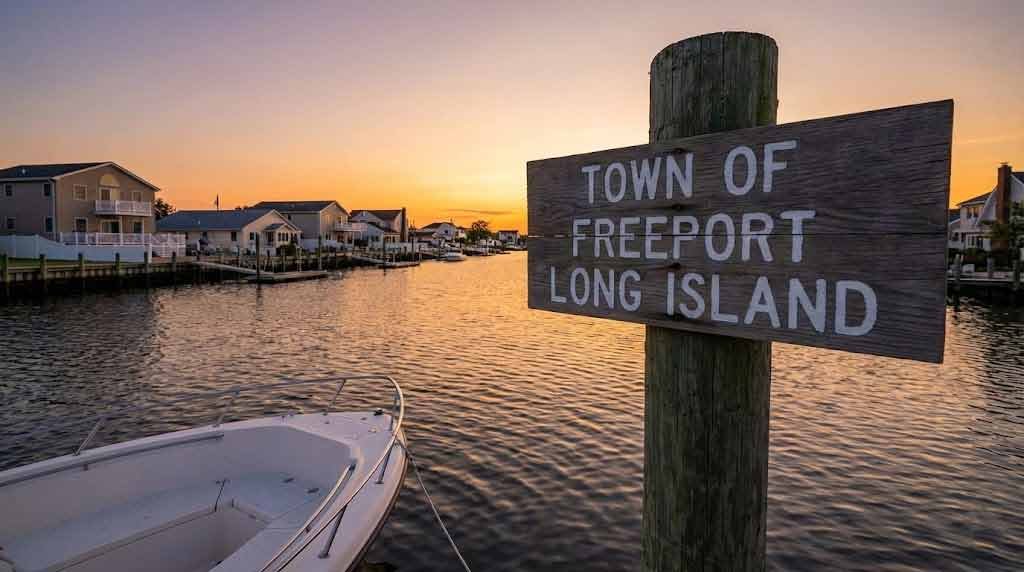
Twelve miles off the South Shore of Long Island, beyond the reach of the law and just inside the treacherous geography of international waters, a flotilla of schooners, steamers, and converted freighters rode at anchor through the fog of the early 1920s. They came from Canada, the Caribbean, and Europe — loaded with Canadian whiskey, French champagne, Scottish single malt, and Caribbean rum. They were not fishing vessels. They were floating liquor stores, and they constituted what the press quickly dubbed “Rum Row,” one of the most audacious criminal enterprises in American history. And right at the center of it all, on Long Island’s South Shore, sat a quiet village called Freeport — a place that, once the sun set, operated as the beating heart of a bootlegger’s empire.
The story of Rum Row is not simply a crime story. It is a story of engineering ingenuity, institutional corruption, economic desperation, and the spectacular failure of government to legislate human desire out of existence. It unfolded along these very shores, in these very bays, and it left an indelible mark on the character of Long Island that still echoes today.
The Noble Experiment Meets the South Shore Waterways
On January 17, 1920, the Eighteenth Amendment became enforceable law, launching what Herbert Hoover would later call “a great social and economic experiment, noble in motive and far-reaching in purpose.” (Hoover, Letter to Senator William Borah, February 1928.) Within weeks, that experiment collided with the simple geographic reality of Long Island’s coastline.
Long Island possessed more than 1,600 miles of shoreline — bays, inlets, canals, tidal marshes, hidden coves, and remote barrier beaches that had sheltered fishermen and baymen for generations. (Long Island in the 1920s, Stonybrook University, LIHJ.) These men knew every channel, every sandbar, every predictable shift in the tides. They were indispensable. And they were broke. Fishing seasons were irregular, income was seasonal, and the Depression was already beginning to pinch working-class Long Island years before Wall Street collapsed in 1929. When the syndicates came calling with offers of $150 a night to store crates of Scotch in a barn or to run a skiff out to a mother ship anchored in international waters, the baymen did not deliberate long.
Suffolk County District Attorney Alexander Blue put it plainly: “It is a recognized fact that the landing of liquor on the shore of Suffolk County has added materially in keeping New York City wet.” (LongIsland.com, Prohibition Facts.) Nearly one-third of all the illegal liquor that reached Manhattan during Prohibition arrived through Long Island. That is not a footnote. That is a supply chain.
Rum Row: The Floating Black Market
The mechanics of Rum Row were elegant in their simplicity. Large “mother ships” — old schooners, converted freighters, and purpose-built Canadian rum runners — would anchor just beyond the legal limit in international waters, initially three miles from shore and later extended to twelve miles in 1924 following a U.S.-British-Canadian treaty. (National Archives, Prologue Magazine, Fall 2011.) Aboard these vessels, handwritten signs on the rigging advertised available brands and prices — Johnny Walker, Dewar’s, French champagne, Irish whiskey. It was, in effect, a drive-through liquor store operating under maritime law.
The most celebrated figure of Rum Row was Captain William “Bill” McCoy, a yacht builder from Florida who became the gold standard of the trade. McCoy famously refused to dilute his product or pass off cheap rotgut as quality spirits — a practice so common among his competitors that his customers coined a phrase that passed into everyday English: “the real McCoy.” (Prohibition: An Interactive History, The Mob Museum.) His schooner Tomoka anchored off the Long Island coast in 1921 and helped catalyze what would become a vast floating marketplace. McCoy’s run ended in November 1923 when the Coast Guard Cutter Seneca confronted him outside U.S. territorial waters and eventually fired a warning shot. He surrendered, served nine months, and retired to Florida. But Rum Row kept operating long after he was gone, now controlled not by romantic independent operators but by the syndicates of organized crime.
By the mid-1920s, crime bosses like William “Big Bill” Dwyer — dubbed “King of the Bootleggers” by the New York press — had taken over much of the waterborne operation. Dwyer’s method was elegant in its efficiency: he bribed the Coast Guard. (Greater Long Island, “The Beginning of the End of Big Bill’s Rum Row,” 2021.) Officers at the Jones Beach Coast Guard Station were implicated. Commanding officers Percy Arnold and John Seaman were relieved of duty on Christmas Eve 1924 after federal authorities discovered they had been guiding rum runners safely to shore. The system worked seamlessly until it didn’t.
Freeport: Bootleggers’ Port, USA
No village in America bore the imprint of Rum Row more completely than Freeport. By 1923 — just three years into Prohibition — it had acquired a nickname: “Rumrunners’ Port.” Merrick Road, its central commercial artery, was rechristened “Bootleggers’ Boulevard.” (Freeport Memorial Library, Encyclopedia of Rumrunners and Speakeasies.) The Brooklyn Daily Eagle ran stories about it. Residents heard gunshots in the night. A young girl on a camping trip caught a stray bullet in the arm. Local law enforcement, caught between the jurisdictional confusion of federal, state, county, and village policing — the Nassau County Police Department did not even exist until 1925 — was essentially powerless, and often complicit.
Otto St. George’s restaurant on Woodcleft Canal served drinks to rum runners and Prohibition agents with equal hospitality. A reporter for the Brooklyn Daily Eagle catalogued fifteen operational speakeasies in the village in 1929 alone, including the notorious 300 Club at 300 West Merrick Road, the site of a double homicide in 1926. (LongIsland.com, Prohibition Facts.) By 1929, one of every three arrests in Freeport was alcohol-related. Regina Feeney, archivist at Freeport Memorial Library, summarized the era with characteristic directness: “There was not a sober person in the village.” (Southforker, “Bootleggers’ Bounty,” July 2024.)
Dutch Schultz — born Arthur Simon Flegenheimer in the Bronx, one of the most feared gangsters of the era — set up his Long Island bootlegging operations in Patchogue and maintained a visible footprint across the South Shore. He purchased three 42-foot rum-running speedboats directly from the Freeport Point Shipyard. (Freeport Memorial Library, Scopinich.) The bodies of lesser-known hoods appeared with some regularity on Long Island’s quiet roads, riddled with bullets, the collateral of a trade that played for keeps. (NY State Archives Trust, “Bootlegging on Long Island,” 2003.)
The Scopinich Shipyard: Building Both Sides of the War
Perhaps the most extraordinary detail in this entire chapter of Long Island history is what happened at the Freeport Point Shipyard, located at 405 Woodcleft Avenue. In 1922, brothers Fred and Mirto Scopinich established what became the most consequential boatyard in the region’s history. During Prohibition, they built fifteen patrol boats for the United States Coast Guard and thirty purpose-built rum runners for the bootleggers — sometimes simultaneously. (Stonybrook LIHJ; Wikipedia, Rum-running.)
The physics of this arrangement were deliberately skewed. The Coast Guard, bound by federal specifications and procurement rules, received vessels capable of roughly 24 miles per hour. The rum runners, unencumbered by any such constraints, received boats fitted with surplus World War I Liberty aircraft engines — twelve-cylinder powerplants producing upward of 500 horsepower — that could reach 35 to 40 miles per hour fully loaded with 600 cases of liquor. (Power and Motor Yacht, “The Rumrunners.”) Frederick Scopinich, 94 years old when interviewed years later, remembered his mother’s accounts clearly: “The rumrunners had high-powered Liberty aircraft engines installed in them left over from World War I and traveled about 35 mph. The Coast Guard boats only went 24 mph.” (Power and Motor Yacht, “The Rumrunners.”)
The rum runners also kept cans of used engine oil aboard to pour on hot exhaust manifolds when pursued, generating smoke screens dense enough to swallow a destroyer whole. Witnesses recalled them running circles around Navy four-stack destroyers, disappearing into the chemical haze before the larger ships could complete a turn. (Island Institute, “Will Frost’s Rum Runner Boats,” 2025.) Some boats were armored with bulletproof gas tanks. Some carried machine guns. One vessel, the Maud F., was captured with $30,000 in specialized upgrades specifically engineered to prevent the hull from sinking if struck by high-caliber fire. (Greater Long Island, 2021.)
The Authentication Network: Half a Hundred-Dollar Bill
The logistical architecture of the South Shore operation was more sophisticated than romanticized accounts typically suggest. It was not simply a matter of loading a skiff and motoring out to a mother ship. The syndicates ran a structured intermediary system designed to prevent both fraud and infiltration.
Fishermen hired as middlemen would receive half of a $100 bill — split lengthwise, with the serial numbers intact on both halves. The matching half was held by the captain of the mother ship anchored at Rum Row. (Power and Motor Yacht, “The Rumrunners.”) Only when the torn edges and serial numbers aligned perfectly would the transaction proceed. No match, no liquor. The system screened out opportunistic thieves, undercover agents, and hijackers who might attempt to impersonate regular contact boat operators. It was, in operational terms, a pre-digital authentication protocol operating by lamplight in the middle of the Atlantic.
Once cargo was confirmed, the contact boats — often the same fishing skiffs and baymen’s vessels that worked legitimate runs during daylight — raced the contraband to shore. Freeport’s inlets provided ideal conditions: the boats could be beached on desolate stretches of barrier island, the liquor offloaded and covered with canvas, and the vessels returned to their moorings before dawn. High-powered cars fitted with false bottoms — sometimes disguised as newspaper delivery trucks or bakery wagons — completed the final leg of the journey to Manhattan’s 30,000-plus speakeasies. (Rum Runners on Long Island, LI Boating World.)
The Code Breakers and the Beginning of the End
The Coast Guard did not simply absorb the humiliation of being outrun and outbribed indefinitely. By 1927, a cryptanalytic unit had been established within the Coast Guard’s intelligence division, staffed by one of the most remarkable figures in American intelligence history: Elizebeth Friedman, a gifted codebreaker whose work would later be partially credited to her more famous husband, William. Between 1928 and 1930, Friedman’s unit decrypted approximately 12,000 messages transmitted between rum-running syndicates, enabling real-time interception of shipments and the unraveling of major networks. (National Archives, Prologue Magazine, Fall 2011.) The convictions of three dozen bootleggers and ringleaders followed.
The technology gap was also closing. As Congress allocated funds for Coast Guard modernization, newer and faster patrol vessels began appearing on Rum Row. The international treaty extending the legal enforcement boundary to twelve miles — one hour’s sailing distance — complicated the operations of the larger mother ships, which could no longer anchor as close to shore. The economics shifted. Each run became longer, riskier, and more expensive. The networks that depended on corruption began to fracture as federal heat intensified.
Big Bill Dwyer was ultimately arrested, convicted, and sentenced for bribing public officials. His era on Rum Row ended not with a dramatic open-water confrontation but with the quiet, grinding work of investigators who followed the money. (Greater Long Island, 2021.)
After the Last Run: What Freeport Left Behind
Prohibition ended on December 5, 1933, and Freeport celebrated with characteristic excess. Members of the American Legion and a fifty-piece band staged a mock execution of “Old Man Prohibition” on Sunrise Highway, complete with a firing squad. The body was buried with theatrical ceremony. (Freeport Memorial Library, Encyclopedia of Rumrunners.) The speakeasies closed, or converted, or simply dropped the pretense. The rum runners found other work, or retired, or didn’t. Some of the boats that had outrun Coast Guard destroyers became ferries — the rum runner Artemis, for instance, ended her outlaw career carrying passengers between Bay Shore and Fire Island. (LI Boating World.)
In the mid-2010s, a homeowner in north Freeport uncovered a speakeasy in her basement, untouched since 1937: tiled floors, a full bar, a copper still, and sealed bottles of homemade alcohol. (Freeport Memorial Library.) The Freeport Historical Society now displays the still. A ghost of the trade, perfectly preserved beneath a quiet neighborhood house.
The story of Rum Row and the Freeport bootleggers resists the reduction of simple morality. It was corruption, certainly — of officials, of institutions, of the social contract itself. But it was also a case study in what happens when law and desire diverge so completely that an entire economy springs up in the gap. The baymen who ferried whiskey through the inlets were not romantic outlaws in any cinematic sense. They were working people supplementing inadequate incomes in a period of genuine economic hardship, doing what working people on waterfronts have always done when the legal economy failed to provide. The shipyard that built both the patrol boats and the vessels they were chasing was not practicing cynical hypocrisy — it was practicing capitalism in its most unadorned form.
What remains, beneath the modern surface of Freeport’s Woodcleft Canal and the restaurants along its waterfront, is the residue of an era when Long Island’s South Shore was among the most consequential stretches of coastline in the country — not for what was produced here, but for what moved through here, in the dark, at 35 miles per hour, past a Coast Guard vessel that could only manage 24.
Sources:
- National Archives, Prologue Magazine, Fall 2011 — Ellen NicKenzie Lawson, “Smugglers, Bootleggers, Scofflaws”: https://www.archives.gov/publications/prologue/2011/fall/smugglers-bootleggers-scofflaws
- Long Island History Journal, Stony Brook University, “Long Island during Prohibition, 1920–1933”: https://lihj.cc.stonybrook.edu/2017/articles/long-island-during-prohibition-1920-1933/
- Freeport Memorial Library, Encyclopedia of Rumrunners and Speakeasies: https://libguides.freeportlibrary.info/Prohibition
- Power and Motor Yacht, “The Rumrunners”: https://powerandmotoryacht.com/at-sea/the-rumrunners/
- Greater Long Island, “The Beginning of the End of Big Bill’s Rum Row” (2021): https://greaterlongisland.com/7493-local-history-the-beginning-of-the-end-of-big-bills-rum-row/
- The Mob Museum, Prohibition: An Interactive History — Rum Running: https://prohibition.themobmuseum.org/the-history/the-rise-of-organized-crime/rum-running/
- Island Institute, “Will Frost’s Rum Runner Boats” (2025): https://www.islandinstitute.org/island-journal/will-frosts-rum-runner-boats/
- LI Boating World, “Rum Runners on Long Island”: https://liboatingworld.com/rum-runners-on-long-island/
- Southforker, “Bootleggers’ Bounty: When Prohibition Hit, the East End of Long Island Hit Back” (July 2024): https://southforker.com/2024/07/22/bootleggers-bounty-when-prohibition-hit-the-east-end-of-long-island-hit-back/
- LongIsland.com, “Crazy Facts About Prohibition on Long Island”: https://www.longisland.com/news/05-03-22/crazy-facts-about-prohibition-on-long-island.html
- NY State Archives Trust, “Bootlegging on Long Island,” NY Archives, Winter 2003: https://www.nysarchivestrust.org/application/files/9915/6831/6222/Bootlegging_NYArchives-2003_Winter.pdf
- Edible Long Island, “Putting on the Ritz” (2014): https://www.ediblelongisland.com/2014/11/17/putting-ritz/
- Wikipedia, Rum-running: https://en.wikipedia.org/wiki/Rum-running