There is a corner in Mount Sinai where North Country Road meets Pipe Stave Hollow Road, and if you have lived on Long Island’s North Shore long enough, you know that corner the way you know the weight of your own front door key. It is the corner where Savino Sguera—an Italian immigrant who arrived in this country with little more than calloused hands and an unshakable conviction that food was the highest form of generosity—planted a flag in 1976 and built something that would outlast nearly every trend, recession, and cultural upheaval the restaurant industry could throw at it. Savino’s Hideaway is not merely a restaurant. It is the living, breathing archive of a family’s half-century commitment to Mount Sinai, and it is, by any honest measure, one of the most important dining institutions on the entire North Shore corridor. I write that not as hyperbole, but as a man who has spent twenty-five years behind the counter of The Heritage Diner, less than a mile east on Route 25A, watching restaurants rise and collapse like ocean swells while Savino’s endured. The National Restaurant Association reports that roughly sixty percent of new restaurants fail within the first year and nearly eighty percent shutter before their fifth anniversary (National Restaurant Association, 2024). Savino’s Hideaway is approaching its fiftieth. That is not luck. That is legacy.
The Sguera Family: An American Story Written in Marinara
The origin story of Savino’s Hideaway reads like the kind of narrative that used to define entire neighborhoods in Brooklyn and the Bronx before the old Italian-American corridors gave way to gentrification and algorithmic dining guides. Savino Sguera and his wife Rita relocated from Nassau County to Mount Sinai in 1976, having spent years operating pizza shops and building the kind of grassroots culinary reputation that cannot be manufactured by a PR firm or a viral TikTok moment (Patch, 2012). When they found the property at the intersection of North Country Road and Pipe Stave Hollow, Savino saw more than square footage—he saw a canvas. The restaurant that emerged was formal at first, perhaps too formal for a community that was still finding its suburban identity in the late 1970s. But the Sguera family adapted. They stripped away the pretension, kept the quality, and transformed the Hideaway into a family restaurant where the prices were honest and the portions were unapologetic.
Maria Carson, Savino’s daughter, was eight years old when the restaurant first opened. She and her younger brother Joseph worked the kitchen alongside their father, making garlic bread and pounding veal while their eldest brother Leo, then fifteen, stood shoulder to shoulder with Savino at the stove (Patch, 2012). That image—three children and their father, working a commercial kitchen as a unit—tells you everything you need to know about what Savino’s Hideaway actually is. It is not a business model. It is a family covenant.
The restaurant was sold in 1998, but the Sguera family reclaimed it roughly a decade later, enduring a period of legal disputes and property complications that kept the doors dark for several years. When Savino’s Hideaway reopened in August 2012, the bones were the same but the skin had been refreshed: a more upscale interior, a new lounge area, an expanded menu that included thin-crust pizzas—something Savino himself had deliberately avoided for years because, as his daughter explained, he had spent so long making pizza that he was done with it (Patch, 2012). The evolution was characteristically Sguera: respectful of tradition, responsive to the present, and utterly devoid of cynicism.
The Passing of a Patriarch
On May 30, 2025, Mount Sinai lost a patriarch. Savino Sguera—known to many simply as “Mr. Savino” or “Sam”—passed away after a life that his family described as the embodiment of the American dream (Newsday, 2025). His obituary, published in Newsday, captured the man with a precision that transcended eulogy. He was a provider, a builder, and a man whose restaurant served as a first job for countless young people in the community—a place where they learned not just the mechanics of work, but their own worth. He and Rita had been married for sixty-five years, a partnership so visible in its devotion that even strangers could feel it.
The wake was held at Savino’s Hideaway itself—the restaurant transforming one final time from a place of celebration into a place of mourning, and then, inevitably, back into a place of celebration again. The family requested that donations be made to Hope House Ministries in Port Jefferson, a cause they described as close to their hearts (Savino’s Hideaway, 2025). It is worth noting that the Sguera family chose their own restaurant as the venue for this farewell. There is no architectural metaphor more potent than that. The building was not just where Savino worked. It was where Savino lived, in the deepest sense of the word.
The restaurant continues under the stewardship of the next generation—Maria Carson and the extended Sguera family—carrying forward the standards that Savino established while navigating the considerable challenges of operating an independent Italian restaurant in an era dominated by corporate chains and delivery-app economics.
The Menu: Tradition Without Apology
Savino’s Hideaway operates in a culinary register that I would describe as Southern Italian-American vernacular—the food of immigrant kitchens elevated to restaurant scale without losing the essential character that made it beloved in the first place. The menu is extensive, anchored by homemade sauces, house-prepared soups, and a commitment to portion sizes that would make a corporate food-cost analyst weep into their spreadsheet.
The signature appetizer is the Spiedini Mozzarella alla Savino—lightly breaded and pan-sautéed mozzarella topped with the house’s proprietary sauce, described on the menu as “a true Savino’s classic.” The Maryland crab cakes arrive with a homemade remoulade that speaks to careful preparation rather than shortcuts. The antipasto platter is a full Italian charcuterie experience: capicola, hot and sweet soppressata, salami, prosciutto, provolone, and fresh mozzarella, served alongside artichokes, Italian olives, roasted red peppers, and stuffed cherry peppers.
The pasta program deserves particular attention. The Stuffed Rigatoni—lobster-filled, sautéed with shrimp and baby spinach in a creamy sauce—has earned a devoted following. The pancetta ravioli, stuffed with prosciutto and bacon in a creamy plum tomato sauce, is a dish that walks the line between indulgence and refinement. The Chicken Marsala, the Flounder Francese, the Veal preparations—these are dishes executed with the confidence of a kitchen that has been making them for nearly half a century.
The pizza program, introduced during the 2012 reopening, features thin-crust pies that reflect Italian sensibility rather than New York slice-shop convention. The “Nonna’s Pizza”—Mr. Savino’s Italian hometown favorite with mozzarella, mushrooms, olives, artichokes, and prosciutto—is a direct line to the family’s roots. The Prosciutto & Arugula pie, the lightest offering, balances pecorino romano with the peppery bite of fresh greens. For those who prefer heat, the Fra Diavolo pizza with fried shrimp and spicy marinara delivers without compromise.
The Lobster Savino—baked in garlic and white wine sauce—stands as the menu’s crown jewel, a dish that commands the table the way a centerpiece commands a room. The Crispy Pork Chop Milanese in cherry pepper gravy represents the kitchen’s willingness to push beyond standard Italian-American expectations while keeping one foot firmly planted in tradition.
The Atmosphere: White Tablecloths and Honest Warmth
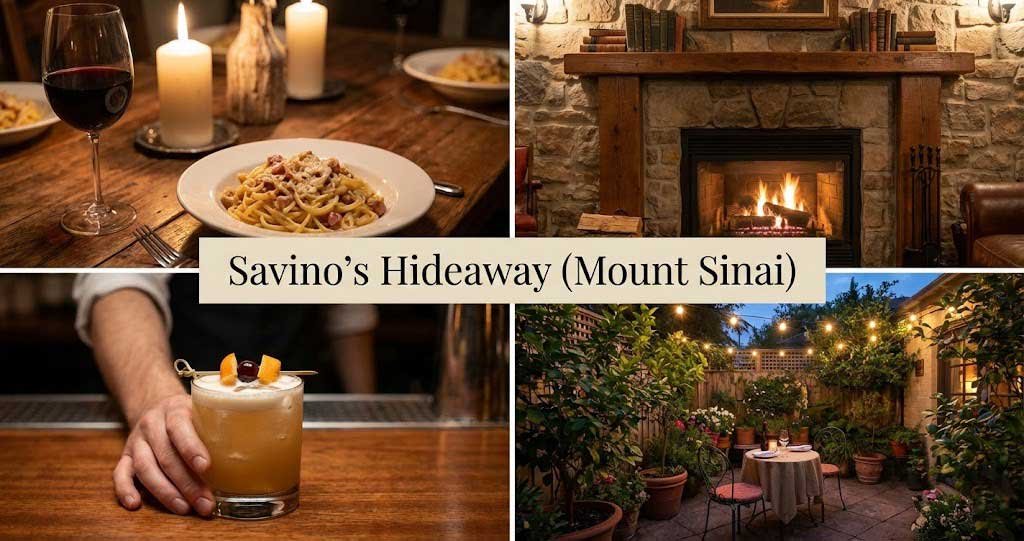
Walk into Savino’s Hideaway on a Friday evening and you will understand immediately why it has survived where so many others have not. The space is divided into multiple dining rooms—intimate enough that a couple celebrating an anniversary feels attended to, spacious enough that a family of twelve for a christening never feels cramped. White tablecloths cover every table. The bar area, where Joe Sguera has become a fixture, generates the kind of convivial energy that cannot be engineered by an interior designer. There is a pool table. There is free Wi-Fi. There is outdoor seating when the weather cooperates. And there is a wheelchair-accessible side entrance—a detail that speaks volumes about the Sguera family’s understanding that hospitality means everyone.
The private event space in the back room has hosted bridal showers, baby showers, birthday celebrations, engagement parties, and memorial gatherings for decades. On Tripadvisor, where Savino’s Hideaway holds the number-one ranking among all twenty-seven restaurants in Mount Sinai, reviewers consistently note the generosity of portions, the attentiveness of the staff, and the rare quality of feeling unhurried (Tripadvisor, 2025). One reviewer described lingering over lunch for nearly three hours without once being made to feel that the table was needed elsewhere. That kind of patience—that willingness to let a meal breathe—is a philosophy, not a business strategy.
On Google, Savino’s carries a 4.5-star rating across more than 1,100 reviews, a remarkable consistency for a restaurant of its tenure and volume (Google, 2025). Yelp tallies over 300 reviews with 187 photos, and the business page identifies Liliana M. as a business owner actively responding to customer inquiries—a level of personal engagement that chain restaurants cannot replicate.
Community, Charity, and the North Shore Fabric
One of the metrics I use to evaluate a restaurant’s true value to its community—beyond food quality, beyond ambiance—is whether the restaurant exists as a civic institution or merely as a commercial enterprise. Savino’s Hideaway has always operated in the former category. The Sguera family’s longstanding support of Hope House Ministries in Port Jefferson, a nonprofit organization serving at-risk youth, speaks to a commitment that extends well beyond the dining room. When Savino Sguera passed, the family directed mourners to donate to Hope House rather than send flowers—a final act of generosity that was entirely consistent with how the man had lived.
On Nextdoor, where neighborhood sentiment is expressed with an honesty that Yelp reviews sometimes lack, Savino’s Hideaway is repeatedly recommended for engagement parties, christenings, family celebrations, and the kind of mid-week lunch that transforms an ordinary Tuesday into an event. The Sguera family also owns additional restaurant interests in the area, further embedding themselves in the North Shore’s economic and social infrastructure.
For a community like Mount Sinai—where the character of the hamlet is defined not by corporate anchor tenants but by the family businesses that line Route 25A and North Country Road—establishments like Savino’s Hideaway function as load-bearing walls. Remove them and the entire structure feels different. This is something I think about constantly as I consider what the North Shore will look like in the coming decades, and it is one of the reasons Paola and I are building Maison Pawli as a boutique real estate venture rooted in the same philosophy: that the places people love are the places where someone had the stubbornness to stay.
Practical Information: Getting to the Table
Address: 258 North Country Road, Mount Sinai, NY 11766
Telephone: (631) 928-6510
Website: savinoshideaway.com
Instagram: @savinos_hideaway
Hours: Tuesday through Thursday: 12:00 PM – 10:00 PM Friday and Saturday: 12:00 PM – 11:00 PM Sunday: 12:00 PM – 10:00 PM Monday: Closed
Reservations: Gladly accepted by phone. For private events and catering inquiries, call directly.
Delivery & Takeout: Available through DoorDash (Order on DoorDash), Uber Eats, Grubhub, and Slice. The restaurant also offers direct takeout and both on-site and off-site catering.
Accessibility: Wheelchair-accessible side entrance. Free Wi-Fi available.
Price Range: Moderate. House wines available by the glass and carafe at reasonable prices. The menu balances accessible price points with premium seafood and specialty entrées.
Parking: Available on-site with accessible parking near the entrance.
Kids Menu: Available.
Ratings: Google: 4.5 stars (1,100+ reviews) Tripadvisor: Ranked #1 of 27 restaurants in Mount Sinai (188 reviews) Yelp: 300+ reviews
The Unseen Thread
I have written extensively about the concept I call “the patina of time”—the way that certain objects, certain buildings, certain institutions acquire a depth and richness that cannot be replicated through shortcuts. In the leather workshop at Marcellino NY, I see it in the way English bridle leather develops its character over decades of handling, the surface becoming more beautiful precisely because it has been used, touched, lived with. In the kitchen of The Heritage Diner, I see it in the seasoning of a cast-iron griddle that has absorbed twenty-five years of heat and oil until it has become something greater than the sum of its mornings.
Savino’s Hideaway possesses this same quality. Nearly fifty years of continuous family operation have infused the walls, the menu, the staff culture, and the community relationships with a depth that no amount of capital investment can manufacture. When Maria Carson told Patch in 2012 that the family wanted to keep the same concept while evolving with the times, she articulated a principle that the greatest artisans and the most enduring businesses have always understood: that tradition is not the enemy of progress, but its foundation.
Savino Sguera built something lasting. His children and grandchildren carry it forward. And on the corner of North Country Road and Pipe Stave Hollow, the lights stay on—not because of market analysis or investor pressure, but because a family made a promise to a community, and they have kept it for nearly half a century.