
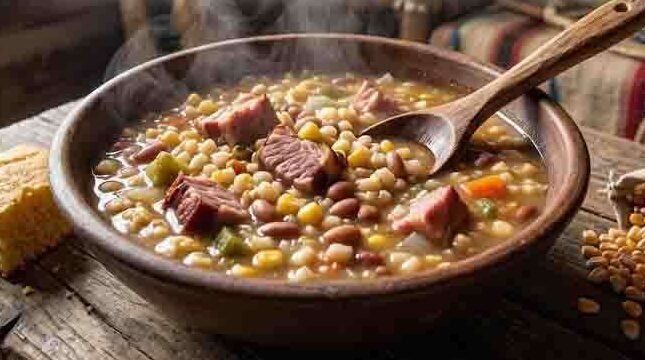
Four centuries before the term “farm-to-table” entered the culinary lexicon, the Shinnecock people of eastern Long Island were already living it. Their samp — a slow-cooked porridge of cracked corn and smoked meat — was not a recipe so much as a relationship: between fire and grain, between a people and their land, between patience and nourishment. It is one of the oldest dishes on this island, and it deserves to be remembered.
What Samp Actually Is
Samp begins with hominy — dried corn kernels treated with an alkaline solution to loosen the hull, a process called nixtamalization that predates European contact by thousands of years. The treated kernels are cracked or coarsely ground into a rough, open meal, then simmered low and slow until they bloom into something thick, earthy, and deeply satisfying. The Shinnecock added smoked meat — historically venison or fowl, though pork entered the tradition after colonial-era trade made it available — along with whatever the season and the bay provided: beans, wild onion, herbs gathered from the margins of the forest.
The result is something between a porridge and a stew. Rustic, yes. But rustic the way a hand-adzed timber frame is rustic — intentional, structural, built to last.
The Shinnecock Nation and Their Foodways
The Shinnecock are not a historical artifact. They are a federally recognized Native American nation whose ancestral territory spans the South Fork of Long Island — the same shores that today host the Hamptons and their parade of seasonal wealth. For generations, the Shinnecock harvested the bay’s blue claw crabs, hard clams, and fish, pairing the sea’s offerings with the garden’s corn, beans, and squash — the Three Sisters of Indigenous agriculture.
Samp was central to this life. It was winter food, festival food, communal food. It was shared across generations at long fires, the kind of meal that asks nothing of you but time and attention.
Why It Disappeared — and Why It Shouldn’t Have
Colonial displacement disrupted not just land ownership but the entire infrastructure of Indigenous foodways. When the land goes, the gardens go. When the gardens go, the seeds go. When the seeds go, the recipes quietly follow. Samp didn’t vanish overnight — it faded slowly, the way dialects do, and for the same reason: the dominant culture saw no particular reason to preserve what it hadn’t invented.
But there is a revival underway. Indigenous chefs across North America are reclaiming ancestral ingredients and techniques with the same precision and pride that any serious cook brings to their craft. Nixtamalized corn is back in serious kitchens. Heritage grain movements are reconnecting consumers to pre-industrial agriculture. And the Shinnecock Nation continues to hold its Powwow — one of the oldest in the Northeast — where food remains a living expression of cultural continuity.
How to Cook It Today
A faithful version of Shinnecock samp requires three things: good cracked hominy (available from heirloom grain suppliers and increasingly from specialty markets), genuine patience, and smoked meat with real depth — not the pale approximations that line most grocery shelves.
Start the corn in cold water and bring it up slowly. Let it cook for two to three hours before you introduce the meat. This is not a dish that rewards shortcuts. The corn needs time to open fully, to release its starch and become something unified with the broth. Add smoked pork — shoulder or shank, bone-in if you can find it — and let everything marry over low heat for another hour. Season with salt, a little rendered fat, and wild herbs if you have them. The dish is done when it moves like a slow tide in the pot: thick, unified, alive.
Serve it in deep bowls. It does not need garnish. It does not need explanation.
A Dish Worth the Conversation
Every serious food region has its foundational ingredients — the things that grew here before anything else, that fed the people who named the rivers and the bays. On Long Island, that foundation belongs in part to the Shinnecock. Their samp is not a novelty or a trend. It is a legitimate culinary heritage, sitting quietly beneath four centuries of other people’s food stories, waiting to be recognized.
The least we can do is cook it.
Sources: Shinnecock Indian Nation (shinnecockindianation.com); National Museum of the American Indian, Smithsonian Institution; “Braiding Sweetgrass” by Robin Wall Kimmerer; Slow Food USA Indigenous foodways documentation.