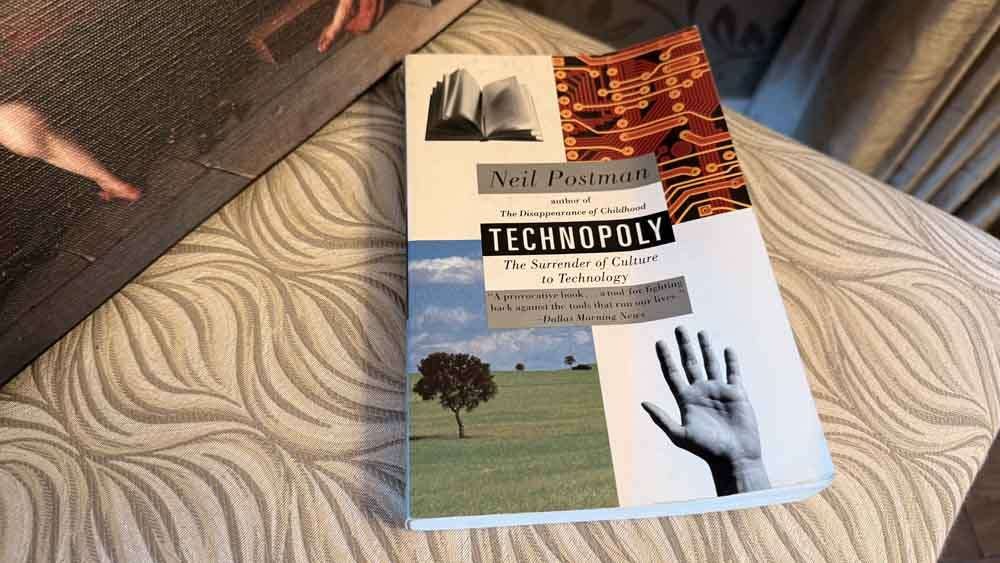
Neil Postman wrote Technopoly in 1992. I want you to hold that date in your mind the entire time you read this. 1992. The World Wide Web was barely a public concept. Facebook was twelve years away. The iPhone was fifteen. There was no Google. No algorithm deciding what you were allowed to think about. And yet Postman saw all of it — not the specific gadgets, but the logic underneath them, the invisible ideology that would make the gadgets inevitable.
That’s what separates a prophet from a pundit. A pundit tells you what’s happening. A prophet tells you why it had to happen.
The Argument in Plain English
Postman’s central claim is this: technology is never just a tool. It is never neutral. When a culture adopts a technology, the technology reorganizes the culture — its values, its institutions, its definition of what counts as knowledge, intelligence, truth. The culture doesn’t stay the same and gain a new capability. The culture becomes different.
He traces three stages. Tool-using cultures, where tools serve human ends decided by human values — a plow, a loom, a printing press. Technocracies, where tools begin to compete with human ends, where the logic of efficiency starts colonizing domains it was never designed for. And then Technopoly — his word for the final stage, where technology becomes sovereign. Where there is no institution, no authority, no value system left that can stand outside technology’s logic and say: not here, not this.
America, he argues, is the world’s first Technopoly. We didn’t just adopt technology. We surrendered to it. We handed it our epistemology.
Why 1992 Reads Like 2019
I keep coming back to a particular passage where Postman describes what happens to information in a Technopoly. The problem, he says, is not a shortage of information. The problem is a glut — a torrent of information so vast, so fast, so disconnected from any framework of meaning, that the individual is left defenseless. Without a way to sort signal from noise, without an institution capable of saying this matters and this doesn’t, the human mind is overwhelmed. And an overwhelmed mind is a manipulable mind.
Read that again in 2019. Think about your phone. Think about the notifications. Think about the news cycle that refreshes every four minutes with something new to be furious about.
Postman was describing it in 1992. He couldn’t name Twitter, but he named the condition that Twitter would create.
His diagnosis of television is equally precise. Television, he wrote, restructures thought around entertainment. Not just entertainment programming — all programming. News becomes entertainment. Education becomes entertainment. Religion becomes entertainment. Politics becomes entertainment. The medium’s demand for visual stimulation and emotional immediacy doesn’t care what subject it’s carrying. It reshapes the subject to fit its own requirements. A twenty-second political ad is not a compressed argument. It is a different thing entirely from an argument. It operates on an entirely different cognitive register — image, music, feeling — while wearing an argument’s clothing.
Postman is working directly in Marshall McLuhan’s tradition. McLuhan gave us “the medium is the message” — the idea that the form of a communication technology shapes thought independently of its content. Postman takes that insight and drives it into specific cultural institutions, asking: what has each medium actually done to us? The answers are not flattering.
The Technopoly Condition: What Gets Lost
Three things collapse under Technopoly, as Postman maps it.
The first is what he calls “the great symbol drain.” Symbols — flags, crosses, marriages, diplomas — carry accumulated meaning built up over generations. They orient people within a culture, give them a story to inhabit. Technology doesn’t respect symbols. It reproduces them, commodifies them, strips them into aesthetic objects. A flag on a t-shirt is no longer a flag. A wedding broadcast as reality television is no longer quite a wedding. Repetition without context is a kind of erosion. What’s left after long enough isn’t meaning. It’s a logo.
The second is the collapse of expertise. Not the end of specialists — there are more of them than ever — but the end of any authority capable of adjudicating between competing knowledge claims. When technology can disseminate any claim with equal ease, the question of who decides what’s true becomes suddenly urgent. In a Technopoly, the answer is: the machine decides, by what it amplifies. Which means no one decides. Which means everyone decides. Which in practice means the loudest, most emotionally provocative claims win.
In 2019, I don’t think I need to explain why this feels prescient.
The third collapse is the one Postman cares about most: the collapse of a coherent narrative. Every culture, he argues, needs a story — a reason why things are the way they are, why some things are worth doing, why suffering has meaning. Technology offers progress as a substitute. The story of the machine: things were worse, now they’re better, soon they’ll be better still. But this narrative has no moral dimension. It can tell you that infant mortality has dropped. It cannot tell you how to live. And a culture that has no story about how to live is a culture in serious trouble.
Where Postman Strains
He is not without his weaknesses. Postman’s solution — a return to humanistic education, to critical reading, to Socratic inquiry in schools — is earnest but thin. He describes the disease in clinical detail and prescribes aspirin. You feel the gap between his diagnostic power and his therapeutic imagination.
There is also something in his critique that occasionally tips toward nostalgia in a way that isn’t fully examined. He is aware of this — he explicitly says he is not anti-technology — but the rhetorical weight of the book falls so heavily on the costs of technological change that the benefits are handled with a kind of perfunctory fairness, like a disclaimer at the bottom of a contract. He knows the printing press transformed human consciousness as radically as television has. He knows Socrates complained about writing. He knows every generation fears the newest medium. But the awareness doesn’t entirely dissolve the elegiac undertone.
Still. These are the weaknesses of a serious thinker working a problem at its hardest edge. They are not the weaknesses of a shallow book.
The Part That Stayed With Me
There is a chapter on the doctor and the computer that I’ve thought about many times since I first read it. Postman describes what happens when a physician, trained in the art of listening — of reading a patient’s history, manner, tone, the things said and unsaid — is given a diagnostic computer. The computer is faster. The computer processes more variables. The computer is, in certain measurable respects, more accurate. And so the culture concludes: use the computer.
What disappears? The physician’s attention. The physician’s ear. The physician’s trained capacity to read a human being rather than a symptom set. These things don’t disappear because the computer is bad. They disappear because the culture has redefined what medicine is — from an art of care to a science of diagnosis — and in that redefinition, something irreplaceable was quietly put down.
I think about this in the context of craft. The machine can produce a thousand wallets where a craftsman produces one. Consistent, fast, cheap. What the machine cannot produce is the thing that happens between a craftsman and his material — the reading of a hide, the adjustment of a cut, the decision made by hand based on forty things simultaneously understood but not all named. You don’t get that in the machine’s output. You can’t photograph it. You can barely explain it. But it’s the whole point.
Postman is talking about medicine. He’s also talking about everything.
Final Verdict
Technopoly is a book that has only gotten more right with time. Postman wrote it as a warning. We read it today as a historical record of a warning we ignored. That makes it uncomfortable in the best possible way — the discomfort of recognizing that someone handed you the map and you took the road anyway.
Read it alongside McLuhan’s Understanding Media and you’ll have the full theoretical scaffolding for what Postman is building. Together they form a two-part case that our communication technologies don’t just carry messages — they carry assumptions about what a message is, what truth is, what a mind is for.
Postman wasn’t anti-technology. He was anti-surrender. The distinction matters. Tools are fine. Handing your mind to the tool — letting it define what intelligence means, what truth means, what a human life should optimize for — that’s the thing he couldn’t forgive.
Neither can I.
Sources
- Postman, Neil. Technopoly: The Surrender of Culture to Technology. Alfred A. Knopf, 1992. https://www.penguinrandomhouse.com/books/93916/technopoly-by-neil-postman/
- McLuhan, Marshall. Understanding Media: The Extensions of Man. McGraw-Hill, 1964.
- Postman, Neil. Amusing Ourselves to Death: Public Discourse in the Age of Show Business. Viking Penguin, 1985.
- Postman, Neil. Teaching as a Subversive Activity. Delacorte Press, 1969.