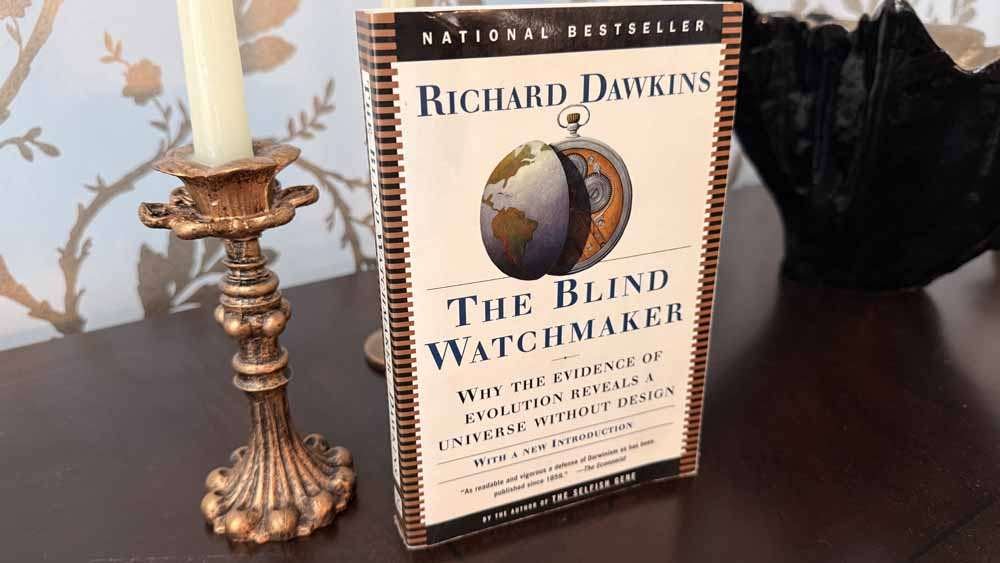
I came to The Blind Watchmaker already suspicious of design. I had been through enough to know that if someone had built this world with a purpose in mind, that purpose was not the one advertised. But suspicion is not the same as understanding. You can reject a thing without being able to replace it. Dawkins replaced it. He handed me the mechanism and said: here, this is how it actually works. And I sat with that for a long time.
The Watchmaker Argument, and Why It’s So Hard to Shake
William Paley’s argument is almost 225 years old and it still gets people. You find a watch in a field. The watch is complex. The watch is obviously designed. Therefore a complex biological organism — obviously more complex than any watch — must also be designed. Therefore a designer. Therefore God.
It feels airtight because complexity is hard to sit with. The eye. The immune system. The enzyme cascade that makes your blood clot before you bleed out. These things feel engineered. They feel intentional. Something in the human brain reaches for agency when it sees organization — and the brain is very good at seeing organization whether it is there or not.
Dawkins knows this. He does not wave the argument away. He takes it seriously enough to build the whole book around it, which is why the book works. His counter is not that complexity is an illusion. It is that complexity, accumulated through enough time and enough selection pressure, is exactly what you would expect from a process with no mind behind it at all. As he writes: “Biology is the study of complicated things that give the appearance of having been designed for a purpose.” That word — appearance — is the whole game. Not deception. Appearance. There is a difference, and the difference matters.
Cumulative Selection Is the Thing Nobody Explains Right
The part of this book that deserves more attention than it gets is the WEASEL program and the concept of cumulative selection. Dawkins builds a simple computer simulation to demonstrate the difference between single-step selection and cumulative selection. In single-step, every generation starts from scratch — the odds of producing any specific outcome remain impossibly small. But cumulative selection builds on what worked before. Each step is improbable. The chain is not.
He is patient about this in a way that I appreciated. He does not assume you already understand it. He walks you through it with the programmer’s instinct for showing rather than asserting. By the time he is done, you understand viscerally — not just intellectually — why the standard objection to evolution (“the eye could not have evolved by chance”) is built on a misunderstanding of how selection actually accumulates. Chance is not the driver. Selection is the driver. Chance provides the variation; selection does the ratcheting.
It is a simple distinction. It is also one of those simple distinctions that, once you really get it, reorganizes a lot of other things you thought you understood.
The Deeper Problem the Book Creates
Here is the honest thing: this book is uncomfortable in a way that has nothing to do with religion.
Once you accept that cumulative selection produces complexity without design, you have to sit with what that means for everything you assumed had a purpose. Not just God. Purpose itself. The sensation that things are for something — that your life has a direction it is aimed at — that sensation is old wiring. It was useful. Selection favored it. It is not a read-out of how the universe is organized.
Dawkins writes: “Natural selection, the blind, unconscious, automatic process which Darwin discovered, and which we now know is the explanation for the existence and apparently purposeful form of all life, has no purpose in mind.” No purpose in mind. It did not build the eye because seeing was useful. It built the eye because organisms that could see survived longer and reproduced more, and the ones that could not see did not. The purpose is a story we tell after the fact. The process does not know the story.
That is the hardest idea in the book and Dawkins does not soften it. I respect him for that.
Darwin Made Room for the Rest of Us
The line that hit me hardest in this book is the one about Darwin and atheism: “Darwin made it possible to be an intellectually fulfilled atheist.” Before Darwin, atheism required you to hold a position that was almost impossible to defend — that all this complexity, all this apparent intention baked into living systems, arose from nothing directed. There was no mechanism. You were just rejecting one mystery in favor of another. Darwin gave atheism a spine. He gave it a mechanism that actually explains what it needs to explain.
I thought about that line for a long time. Not because I needed permission for anything, but because the word intellectually fulfilled is doing real work. There is a difference between disbelieving in God and not needing God to explain what you see. The first is a refusal. The second is understanding. Dawkins is writing about the second.
I have written elsewhere — in my review of The Selfish Gene and in my review of The God Delusion — about why Dawkins consistently gets under the skin in a way that other science writers do not. It is because he refuses to manage the implications. He follows the argument where it goes. The Blind Watchmaker is the purest version of that. The argument goes to: complexity is explicable without design. Dawkins follows it there and stays there, without flinching and without decorating the conclusion with false comfort.
Compare this to Darwin’s own hesitation in On the Origin of Species — a book that changed everything but was written by a man who understood what it would cost, and who spent years managing the fallout in his own conscience. Darwin earned his uncertainty. Dawkins, writing 130 years later, had the luxury of standing on what Darwin built and taking it further. He took it further.
The Bat Chapter Is Worth the Price Alone
Midway through the book, Dawkins spends a sustained chapter on bat echolocation. He uses it to make a point about the overlap between what evolution can produce and what human engineering can barely match. A bat’s sonar system is not a rough draft of something. It is precise, adaptive, and tuned over millions of years to do something that our best radar engineers in the mid-twentieth century could not replicate from scratch. If you saw that system in a piece of technology, you would call it brilliant design. It is not. It is selection operating over time.
That chapter is the best illustration in the book of what Dawkins is actually arguing: not that nature is unimpressive, but that our instinct to call impressive things designed is a cognitive habit, not an inference. The bat chapter earns that argument in a way that the philosophical sections, strong as they are, cannot quite match. It makes you see.
What I Keep Thinking About
Michael Ruse, a philosopher of biology who has spent decades thinking about evolution and its critics, once said that Dawkins is at his best when he is explaining and at his most dangerous when he is dismissing. I think that is fair. The Blind Watchmaker is mostly explaining, which is why it is the best Dawkins book I have read. When he is building the positive case — showing you how cumulative selection works, showing you what the bat ear can do, showing you why Paley’s watch analogy breaks down — he is doing something genuinely rare: making a hard idea feel not just correct but inevitable.
The design illusion does not collapse on first contact with this book. That is not how it works. But it gets cracked. And once it is cracked, you start to see the outline of something more honest — a universe that produced all of this through a mechanism that doesn’t care, doesn’t plan, doesn’t know your name. That is not nothing. That is not depressing, either, unless you needed it to be something else.
I didn’t need it to be something else. I needed it to be true.
Sources
- Dawkins, Richard. The Blind Watchmaker. W. W. Norton & Company, 1986. Amazon
- Paley, William. Natural Theology. 1802.
- Ruse, Michael. Darwinism and Its Discontents. Cambridge University Press, 2006. Amazon
- The Selfish Gene by Richard Dawkins — The Book That Unlocked Darwin for Me — Heritage Diner
- The God Delusion by Richard Dawkins — A Review — Heritage Diner
- On the Origin of Species by Charles Darwin — Heritage Diner
- Darwin’s Dangerous Idea by Daniel Dennett — Heritage Diner