
I came to Feuerbach the way you come to most of the thinkers who really stick — sideways, through someone else. Nietzsche kept pulling me back, and somewhere in that orbit I found people who were mapping Nietzsche’s intellectual debts, tracing the veins back through the 19th century. Some of those lines ran through Marx. And Marx, before he turned everything into economics, had sat with Feuerbach long enough for the ideas to calcify into something permanent. Friedrich Engels would later write that when The Essence of Christianity appeared, “the spell was broken” — that the book had “with one blow pulverised the contradiction” between German idealism and the material world. I wanted to know what kind of book could do that.
What I found was a work that did something I hadn’t expected: it treated religion not as error, but as revelation. Just not revelation of God. Revelation of us.
The Basic Move
Feuerbach’s argument is not complicated at its core. The complication is in accepting it. He says: look at every attribute you assign to God. Infinite. Perfect. All-loving. All-knowing. Eternal. Now look at what you say man is. Finite. Flawed. Partial in love, partial in knowledge. Temporary. His question is: where did you get the God-attributes? You got them from human nature — from what you know about consciousness, love, reason, will — and you stripped away the limits. You idealized. Then you projected the idealized version outward, called it God, and went on your knees before it.
“God is not what man is,” Feuerbach writes, “man is not what God is. God is the infinite, man the finite being; God is perfect, man imperfect; God eternal, man temporal; God almighty, man weak; God holy, man sinful.” He isn’t disagreeing with that description. He’s pointing to its origin. The gap between man and God, in his reading, isn’t a fact about the universe. It’s a transaction. “Man denies his own excellence in order to create a being above himself.” That sentence took me a minute. Read it again. You impoverish yourself first. Then you worship what you stripped away.
He calls the whole system alienation — a word that would later travel to Marx and take on industrial weight, but here it has a quieter, more personal meaning. Religion alienates man from his own nature by externalizing it. The qualities that are most human — love, reason, conscience — get assigned to an otherworldly being. Then man kneels before them in a foreign form. “Religion is the dream of the human mind,” he writes. You’re not reaching toward God. You’re reaching toward yourself, through a fog.
What the Mirror Shows
The image that does the most work in the book — and in my own head since reading it — is the mirror. Not Feuerbach’s language, exactly, but his logic. God is a mirror in which humanity sees its own reflection, but backward. Perfected. The mirror flatters because it removes all the dirt, the failure, the smallness you live with daily. It gives you what you couldn’t give yourself — infinite worth, infinite love, judgment that matters.
Feuerbach put it with the planet analogy that I keep coming back to: “Each planet has its own sun. The relation of the Sun to the Earth is therefore at the same time a relation of the Earth to itself, or to its own nature.” Every culture builds a God that reflects it. The God of conquerors conquers. The God of the suffering suffers. The God of the law-givers legislates. It isn’t that God is different in different eras — it’s that the humans projecting are different. “Wherever morality is based on theology,” he writes, “wherever right is made dependent on divine authority, the most immoral, unjust, infamous things can be justified and established.” He saw this clearly: if God is a projection of whoever holds the projector, then God’s authority can be pointed at anything.
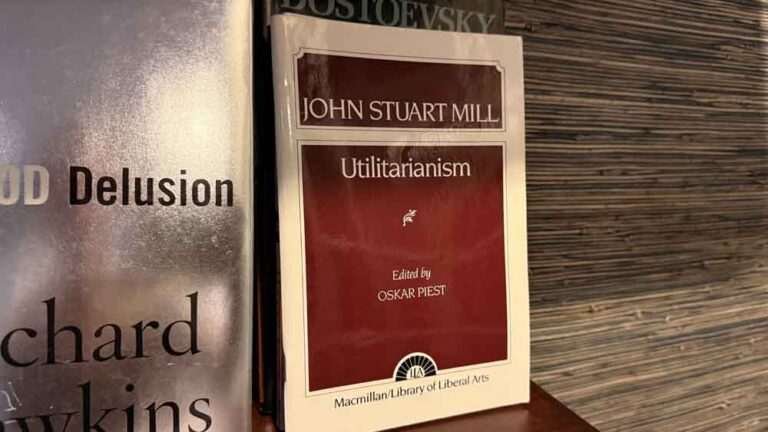
What disturbed me most — and I mean this as a compliment to the book — is not the atheism. I’d read Dawkins. I’d worked through The God Delusion and come out the other side with my doubts arranged differently. What disturbed me about Feuerbach is that the critique lands harder on the believer who genuinely means it. The sincere man who prays for patience, for kindness, for the strength to love his enemies — according to Feuerbach, that man is reaching for his own best nature while convinced he’s reaching outward. The prayer is real. The reaching is real. Only the address is wrong.
Christianity’s Specific Damage
Feuerbach doesn’t stop at the general. He takes Christianity in particular and reads it against itself. “Christianity set itself the goal of fulfilling man’s unattainable desires, but for that very reason ignored his attainable desires. By promising man eternal life, it deprived him of temporal life; by teaching him to trust in God’s help it took away his trust in his own powers.” That’s the specific charge. The promise of heaven is purchased with the devaluation of earth. The comfort of divine love is purchased with the devaluation of human love.
I kept thinking about the Greek Orthodox church of my Brooklyn childhood — the incense, the gold, the bearded priests, the icons with their unreachable faces. The whole aesthetic of Orthodoxy is constructed to remind you that you are small and God is immense. That distance is not an accident. It’s the architecture of the thing. And Feuerbach would say: yes — the distance is the point. The more you diminish man, the more magnificent the projected being becomes. “Man denies his own excellence in order to create a being above himself.” I sat in those pews as a kid, and I felt small. That was the correct response. That was the intended response. What I didn’t understand then was who built the building.
There’s a line in the Feuerbach that I found myself sitting with for days: “If man is to find contentment in God, he must find himself in God.” He means this as a critique — he’s saying the only way the system works at all is if what you’re worshipping has enough of you in it to feel like home. But read it another way and it’s almost tender. The whole apparatus of religion, in his account, is a long and elaborate way of looking for yourself. Of not being able to say directly: I deserve love. I deserve dignity. My life has meaning. So you build a God who knows your name. Who counts the hairs on your head. Who grieves when you’re lost.
That’s not stupidity. That’s not weakness. That’s a particular kind of longing, and Feuerbach — to his credit — treats it seriously.
Nietzsche Read This Book
It matters to say that. When Nietzsche walked out onto that ledge in Thus Spoke Zarathustra and announced that God was dead, he had done his Feuerbach. The death of God in Nietzsche’s framing is not a triumph — it’s a catastrophe, because the Western moral structure had been rented entirely to a being who no longer held the lease. Feuerbach is, in a sense, the earlier diagnosis: God was always a projection. Nietzsche is the consequence: what happens when the projection fails. In The Gay Science he wrote that the death of God meant the collapse of the entire horizon of values. Feuerbach, two decades earlier, had shown where that horizon came from in the first place.
Marx absorbed it differently. He took the structural insight — that religion alienates man from his own nature — and applied it to labor. The worker who builds something and cannot claim it, who pours his life into a product that belongs to someone else, is doing the same thing the believer does: externalizing his own essence, then kneeling before it in a foreign form. The parallel is exact. The Theses on Feuerbach are partly a quarrel with him, but you can’t get to Marx’s theory of alienation without Feuerbach having gotten there first.
Kierkegaard went the other direction — refused Feuerbach’s anthropology, refused to reduce faith to human psychology, insisted that the leap was irreducible and real. His response is worth knowing. So is Augustine, who built the entire architecture of the City of God on the premise that man’s restlessness was not a projection but a wound in the shape of something real. These thinkers were building in opposite directions from Feuerbach’s ground, and the argument between them has not resolved.
The Cost
There is a scene I wrote about in my memoir — my son waking from a coma in Stony Brook Hospital, a month-long induced sleep after a motorcycle accident that would leave him paralyzed. I watched him wake up. I watched him try to move his legs. And I said the only honest thing I could say in that moment: My dear God, you really don’t exist.
That wasn’t a theological conclusion. That was the sound a man makes when the mirror shatters. When what you’ve projected onto the sky doesn’t show up where you needed it most.
Feuerbach would say I was simply meeting my projection face-to-face. That the prayer I offered — the desperation under it, the love underneath the desperation — was entirely human, and therefore entirely real, and that no God needed to be real for that to be true. I’m not sure that’s comfort. But it might be more honest than the alternative.
He ends the work with something close to a program: “My only wish is to transform friends of God into friends of man, believers into thinkers, devotees of prayer into devotees of work, candidates for the hereafter into students of the world.” You can read that as cold. I don’t read it as cold. I read it as a man who thought human beings had given away their best qualities to a fiction, and who wanted them back.
The question is whether you can take them back without losing the warmth that drove the gift in the first place.
The Essence of Christianity was published in 1841. It’s available through multiple editions — I’d recommend the George Eliot translation, which is the standard, and which carries a weight and precision that fits the material. George Eliot — yes, the novelist — translated this before she became a novelist, and you can feel in the prose a future writer learning how to think.
Feuerbach doesn’t resolve anything. He diagnoses. The diagnosis is worth sitting with, whether you stay in the pew or don’t.
Sources
- Ludwig Feuerbach, The Essence of Christianity, trans. George Eliot (1854): marxists.org
- Friedrich Engels, introduction to the English edition (1892): marxists.org
- Wikipedia: The Essence of Christianity
- Philosophy Teaching Library, Notre Dame: For the Love of Humanity
- EBSCO Research Starters: ebsco.com