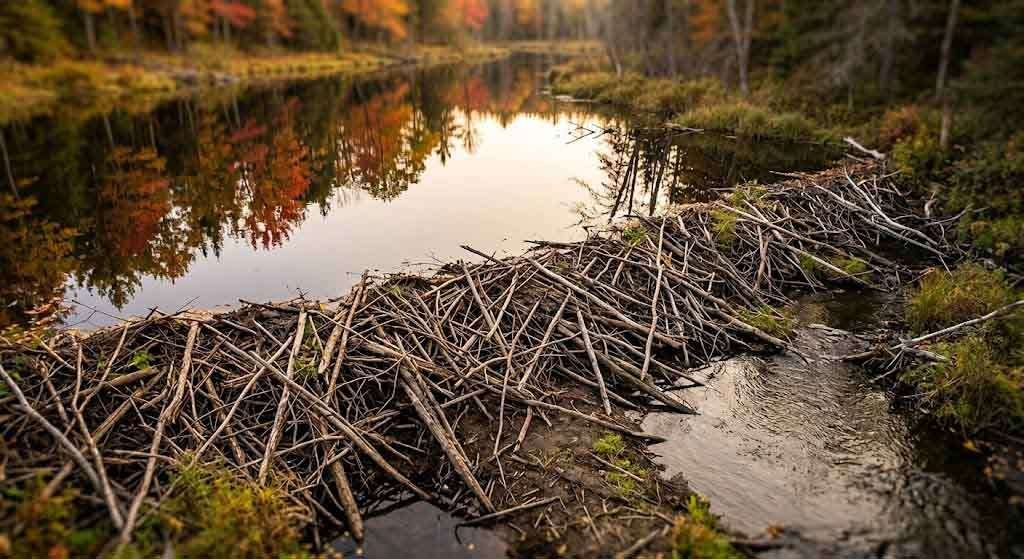
Beaver dams do not appear in nature by accident. They are not random assemblages of sticks and mud that happen to hold back water. They are precision-engineered hydrological systems — temperature-regulated, predator-proof, multi-chambered structures that reshape entire river ecosystems. And the blueprint for every dam, every lodge, every carefully placed branch, does not live in some beaver construction manual passed from parent to kit. It lives in the genome. The genes of a beaver don’t stop expressing themselves at the edge of the beaver’s fur. They reach outward, into the river, into the forest, into the landscape itself. This is the extended phenotype — Richard Dawkins’s most radical and arguably most underappreciated contribution to evolutionary biology — and once you understand it, you will never look at a spider’s web, a bird’s nest, or even the roof over your head quite the same way again.
The Gene Doesn’t End at the Skin
When Dawkins published The Extended Phenotype in 1982, he intended it as a sequel to The Selfish Gene — but aimed squarely at professional biologists rather than the general reader. The central argument was deceptively simple: if the gene is the true unit of natural selection, then we should measure a gene’s phenotypic effects not just by what it builds inside the body, but by everything it causes in the external world. A gene that codes for a beaver’s dam-building instinct is just as much a “phenotype gene” as one that codes for the beaver’s flat tail or waterproof fur. The dam is the gene’s expression. The lake the dam creates is the gene’s expression. The entire altered ecosystem downstream is, in a meaningful sense, the gene’s expression.
This was not merely a philosophical reframing. It was a reclassification of what counts as biology. Before Dawkins drew this line, evolutionary theory had a clean boundary: genes build bodies, bodies interact with environments, natural selection picks the winners. The extended phenotype dissolved that boundary. Genes build bodies, yes — but they also build structures, alter landscapes, manipulate other organisms, and reshape the selective pressures acting on everything around them.
Architecture Without Architects
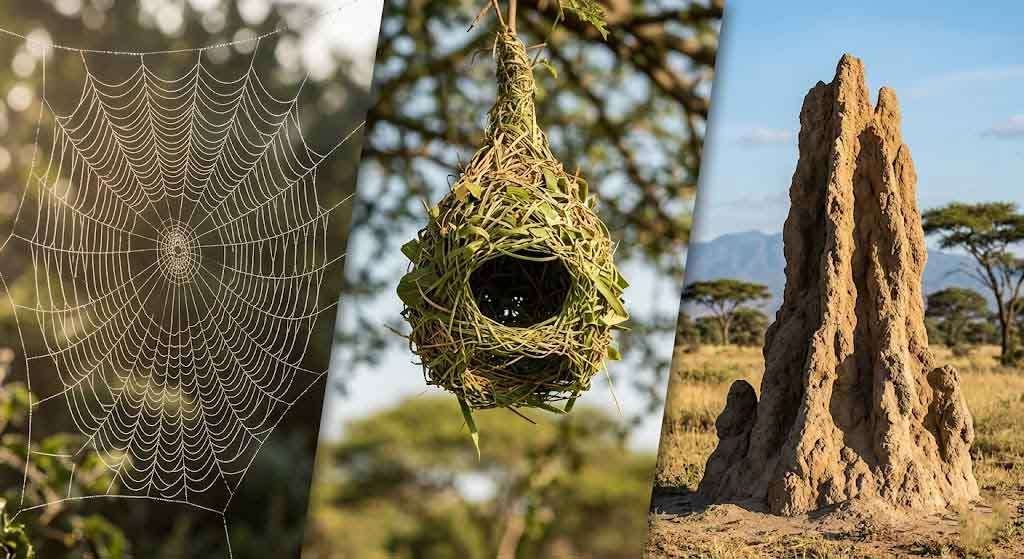
The animal kingdom is saturated with construction projects that would humble most engineering firms. Caddisfly larvae build portable protective cases from silk, sand grains, and tiny pebbles — each species constructing a case with geometry so consistent that entomologists can identify the species from the case alone, without ever seeing the insect inside. The weaver bird constructs an inverted, gourd-shaped nest with an entrance tunnel that discourages predators, woven from strips of grass with a structural integrity that can support dozens of times the bird’s own weight. The Australian bowerbird builds elaborate display stages decorated with colored objects — blue bottle caps, berries, flowers — arranged with an aesthetic precision that researchers have compared to forced perspective in Renaissance painting.
None of these animals attended engineering school. None of them learned their construction techniques from YouTube. The information that produces these structures is encoded in their DNA and refined by millions of years of natural selection acting on the outcomes — the structures themselves. A spider whose web-geometry catches more flies leaves more offspring carrying the alleles for that geometry. A termite colony whose mound better regulates internal temperature and gas exchange outcompetes neighboring colonies with inferior architecture. Selection doesn’t just act on bodies. It acts on what bodies build.
This is the critical insight that separates the extended phenotype from ordinary animal behavior studies. It’s not enough to say “beavers build dams” as though dam-building were a quirky hobby. The dam is under genetic control. Variations in dam quality correlate with variations in alleles. Superior dams confer superior fitness. The dam, in every evolutionary sense that matters, is part of the beaver’s phenotype — it just happens to exist outside the beaver’s skin.
Parasites and the Hijacked Phenotype
Dawkins identified three categories of extended phenotype, and the second is far more disturbing than construction projects. Parasitic manipulation — where the genes of one organism commandeer the body and behavior of another — represents perhaps the most dramatic demonstration that genetic influence doesn’t respect bodily boundaries.
Consider the nematode Myrmeconema neotropicum, which infects canopy ants in Central and South American rainforests. The parasite’s eggs accumulate in the ant’s abdomen, causing it to swell and turn a vivid red — mimicking a ripe berry. The infected ant then raises its swollen abdomen skyward in a posture no healthy ant would ever adopt, and frugivorous birds, mistaking the ant for fruit, consume it. The nematode eggs pass through the bird’s digestive system, are deposited in droppings collected by other ants, and the cycle begins again. Every step of this — the color change, the postural shift, the fruit mimicry — is a phenotypic effect of the parasite’s genes expressed in the body of the host.
The cuckoo provides a more familiar example. Cuckoo chicks, deposited in the nests of reed warblers or meadow pipits, produce begging calls so exaggerated that the host parents feed the intruder at the expense of their own offspring. The host’s behavior — its parental care, its food provisioning, its tolerance of a chick that looks nothing like its own — is effectively a phenotypic expression of cuckoo genes. The cuckoo’s genome reaches across species boundaries and rewires another bird’s behavioral program.
When Construction Becomes Co-Evolution
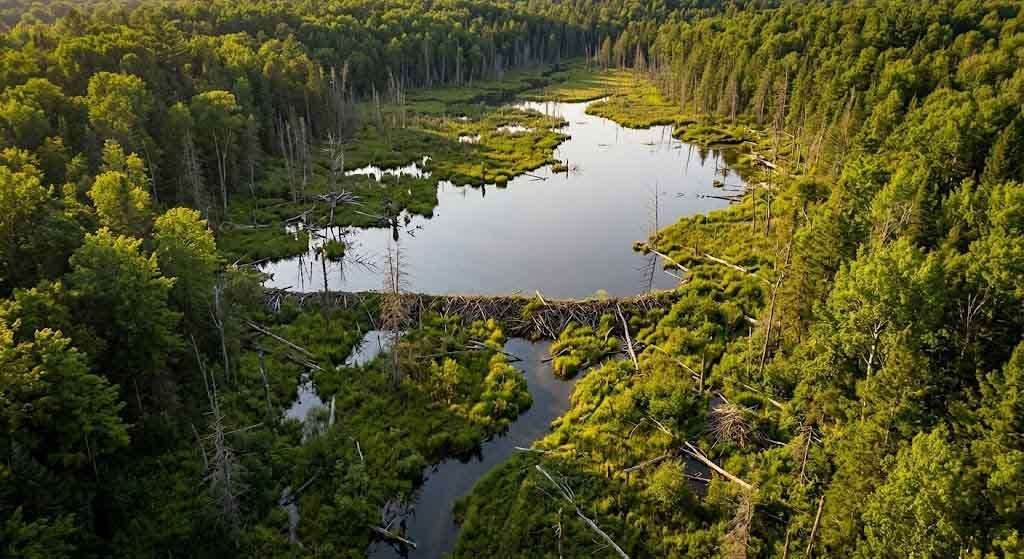
The extended phenotype becomes especially powerful when you recognize that construction doesn’t just serve the builder — it changes the selective environment for everything in the vicinity. A beaver dam creates a pond. That pond creates habitat for fish, amphibians, insects, and aquatic plants that would not otherwise exist in that stretch of river. The dam raises the local water table, altering vegetation patterns on the surrounding banks. It traps sediment, changing the chemistry of downstream water. Over decades, a single beaver family can transform a narrow stream valley into a broad, fertile wetland.
This is where Dawkins’s framework intersects with a related but distinct concept: niche construction theory, championed by biologists like Kevin Laland and John Odling-Smee. Where Dawkins focuses tightly on the gene — asking whether allelic variation correlates with variation in the extended phenotype — niche constructionists take a broader view, arguing that organisms routinely modify their environments in ways that alter selective pressures on themselves and others, creating evolutionary feedback loops that standard theory tends to overlook.
The two perspectives sometimes clash. Dawkins himself has pushed back on overly expansive interpretations, insisting that a true extended phenotype must show a direct correspondence between genetic variation and variation in the external structure. Not every environmental modification qualifies. A beaver’s dam is an extended phenotype because alleles that produce better dams are directly selected. But the fish that move into the pond the dam creates aren’t part of the beaver’s extended phenotype — they’re beneficiaries, not expressions.
The distinction matters because it keeps the concept analytically sharp. Without it, everything becomes everyone’s extended phenotype, and the term loses its explanatory power.
Lactose, Wheat, and the Human Extended Phenotype
The most provocative question Dawkins raised — and largely left for others to answer — is whether human architecture qualifies as an extended phenotype. Could a building be to an architect what a dam is to a beaver?
The honest answer is: it’s complicated. Human construction involves cultural transmission, learned knowledge, conscious intention, and collaborative design — none of which apply to a spider spinning a web. A spider’s web is a direct genetic readout. A skyscraper is the product of engineering degrees, zoning laws, financial instruments, and thousands of individual decisions made by people who have never met.
But the extended phenotype framework illuminates human biology in subtler ways. The best-documented example is lactose tolerance in adults — a genetic adaptation found primarily in populations with long histories of dairy farming. Human ancestors who domesticated cattle and consumed milk created a new selective environment in which individuals capable of digesting lactose past infancy had a survival advantage. The cultural practice — herding, milking, dairy consumption — was the niche construction. The genetic response — persistence of the lactase enzyme into adulthood — was natural selection operating within that constructed niche. In this case, human culture functioned much like a beaver’s dam: it altered the environment, and the altered environment selected for new alleles.
Similarly, populations with long agricultural histories show elevated copy numbers of the salivary amylase gene, which aids in the digestion of starchy foods. The decision to farm grain — a cultural, not genetic, innovation — created the selective pressure that reshaped the genome. Our genes didn’t just build our bodies. Our bodies built farms, and the farms rebuilt our genes.
The Fermi Paradox Revisited Through Construction
One final implication of the extended phenotype deserves mention, and it connects to territory we’ve explored before on this blog when discussing the Fermi Paradox. If the extended phenotype is a universal feature of life — if genes everywhere tend to express themselves beyond the boundaries of the organisms that carry them — then any sufficiently advanced biology should produce detectable construction. Beaver dams are visible from space. Termite mounds cover millions of square kilometers of the African and Australian landscape. Coral reefs, which are arguably the extended phenotype of coral polyps, are the largest biological structures on Earth.
If life exists elsewhere, and if the extended phenotype is a general principle rather than an Earthly peculiarity, then alien biology should leave marks on its environment that we could, in theory, detect. The absence of such evidence — the silence that Enrico Fermi found so troubling — might tell us something profound about how rare complex life truly is, or how fragile the bridge between genes and grand construction really is.
Dawkins wrote The Extended Phenotype as a thought experiment for professional biologists. Forty-four years later, it reads like a blueprint for understanding why organisms — from bacteria to beavers to human beings — are fundamentally incapable of leaving their environments alone. We don’t just live in the world. We extend into it. And the structures we leave behind are as much a part of our biology as the bones beneath our skin.
Sources
- Dawkins, Richard. The Extended Phenotype: The Long Reach of the Gene. Oxford University Press, 1982.
- Dawkins, Richard. The Selfish Gene. Oxford University Press, 1976.
- Laland, Kevin N. and Odling-Smee, John. “Niche Construction Theory and Human Architecture.” Biological Theory, 2012.
- Odling-Smee, F. John, Laland, Kevin N., and Feldman, Marcus W. Niche Construction: The Neglected Process in Evolution. Princeton University Press, 2003.
- Hunter, M.D. “The Extended Phenotype and Its Implications for Evolutionary Ecology.” EMBO Reports, 2018.
- Perry, G.H. et al. “Diet and the Evolution of Human Amylase Gene Copy Number Variation.” Nature Genetics, 2007.
- Gerbault, P. et al. “Evolution of Lactase Persistence: An Example of Human Niche Construction.” Philosophical Transactions of the Royal Society B, 2011.
- Scott-Phillips, T.C. et al. “The Niche Construction Perspective: A Critical Appraisal.” Evolution, 2014.
- Hughes, D.P. et al. “Nematode Parasites Transform the Behaviour of Their Ant Hosts.” Proceedings of the Royal Society B, 2008.
You Might Also Like