Every civilization eventually asks the same question at its core: what does it mean to live and die for something larger than yourself? Homer asked it first, or at least asked it in a way the Western world never quite recovered from. Robert Fagles answered it for our time — giving The Iliad a translation so kinetic, so brutally alive, that you forget for long stretches that you are reading a poem composed nearly three thousand years ago. You feel, instead, like you are standing in the dust outside the walls of Troy, watching men bleed for pride, for honor, for a woman who has no say in any of it.
A Translation That Moves Like a Spear
Fagles published his translation of The Iliad in 1990 through Viking Press, and it remains the definitive modern English rendering for a reason. Where Alexander Pope gave us ornamental formality and Richmond Lattimore gave us scholarly fidelity, Fagles gave us urgency. His hexameter-influenced lines pulse with forward momentum — short, declarative, Anglo-Saxon when the blade falls, Latinate when the gods deliberate. You feel the shift in register the way you feel a weather change.
The opening lines alone announce what kind of translation this is going to be. Homer’s famous invocation — mênin aeide, thea, “the rage, sing it, goddess” — becomes in Fagles: “Rage — Goddess, sing the rage of Peleus’ son Achilles.” That initial “Rage” sitting alone, an island at the front of the line, is a translator’s choice that carries the entire argument of the poem in a single word and a single breath. Bernard Knox, who wrote the superb introduction to this edition, called it “a coup de théâtre,” and he was not wrong.
What the Poem Is Actually About
It is worth being clear about something most people get wrong: The Iliad is not a story about the Trojan War. The war is the landscape, not the subject. The poem covers only fifty-three days out of a ten-year siege. Troy does not fall within its pages. Helen is barely in it. What Homer is writing about — with unsettling precision — is the psychology of one man’s rage, its consequences for everyone around him, and his eventual, hard-won return to something resembling human feeling.
Achilles withdraws from battle after Agamemnon strips him of his war prize, the captive Briseis. His withdrawal is not cowardice; it is a principled refusal. And yet that refusal unleashes catastrophe for the Greeks, culminating in the death of his closest companion, Patroclus. It is only grief — not duty, not honor, not patriotism — that draws Achilles back to the field. He returns not to win a war but to kill Hector. The poem’s great subject is not heroism. It is what happens to a man when his rage has consumed everything it set out to protect.
Fagles renders the famous lament of Achilles over Patroclus with a rawness that still lands like a blow: “He filled the hollow ships with all our grief.” Five words in translation, carrying the weight of the entire middle section of the poem. That is what great translation does — it makes you feel that the original could not possibly have said it any other way.
The Gods and the Problem of Fate
One of the poem’s most destabilizing qualities for a modern reader is the gods. They intervene constantly — deflecting spears, stirring mists, whispering into ears — and yet the outcomes of battle feel inevitable. This is not a contradiction Homer has failed to notice. It is, in fact, the central philosophical tension of the poem.
The gods in The Iliad are not omniscient moral arbiters. They are powerful, petty, and frequently cruel. They play favorites. They disagree with Zeus and scheme behind his back. Hera deceives her husband with calculated seduction to buy Greece a few hours of advantage on the battlefield. Apollo and Athena swap allegiances depending on the moment. What Fagles captures beautifully is the tonal difference between divine and mortal speech — the gods are colder, more ironic, their exchanges almost bureaucratic, while the human soldiers speak with an almost unbearable emotional directness.
The Stoics, centuries later, would build an entire philosophy out of the gap between what we can control and what we cannot — a gap The Iliad maps with devastating clarity. When Sarpedon, Zeus’s own son, rides toward the front lines knowing he will die, he speaks one of the poem’s most clarifying passages. Fagles gives it with full force: the argument that since death is coming regardless, a man might as well stride toward it and earn something in the going. This is not optimism. It is something harder and more honest.
Hector: The Poem’s Moral Center
If Achilles is the poem’s burning heart, Hector is its conscience. He fights not for glory but for Troy, for his wife Andromache, for his son Astyanax, whose name means “lord of the city” — a name that will become a cruel irony when Troy falls and the boy is thrown from the walls. Homer lets you feel the weight of that future without writing it. Hector knows, with something like certainty, that Troy will fall. He fights anyway.
The farewell scene between Hector and Andromache on the walls of Troy is one of the finest passages in all of Western literature, and Fagles does not flinch from it. The moment where the infant Astyanax recoils from his father’s gleaming helmet — Hector laughing, removing it, taking the boy in his arms — is simultaneously heartbreaking and perfectly observed. It is a detail so human, so parental, so recognizable across three thousand years that it reads less like poetry and more like memory.
The classicist and translator Emily Wilson has written that Homer’s genius is in allowing every character moral complexity without sentimentality. Hector can be brave and also wrong. Achilles can be monstrous and also grieving. Paris can be vain and also genuinely in love. The poem refuses to flatten anyone into symbol, and Fagles’ translation preserves that refusal faithfully.
The Violence, Unfiltered
Let us not sanitize this: The Iliad is one of the most graphically violent works in any literary tradition. The battlefield deaths are described with an almost clinical specificity that unsettles precisely because it is not gratuitous. Homer names the dying. He gives them fathers, hometowns, a detail or two — a man who kept bees, a man who built ships — and then he kills them, and the line moves on. The effect is cumulative and devastating.
Fagles does not flinch from this. He translates the violence with Anglo-Saxon directness: spears enter skulls, blades sever tendons, men drown in their own blood on the dust of a foreign plain. It would be wrong to call it beautiful. But it would also be wrong to say it fails to serve the poem’s larger moral argument — that war destroys precisely what it claims to protect, and that the men who fight it are, most of them, simply trying to get home.
Why This Translation, Why Now
There are better translations for certain scholarly purposes — Lattimore for Greek fidelity, Stanley Lombardo for raw brevity, Emily Wilson’s forthcoming Iliad promises to add another essential voice. But for a reader who wants to understand why this poem has survived three millennia, why it shaped everything from Virgil’s Aeneid to Shakespeare’s Troilus and Cressida to the entire Western tradition of heroic literature, Fagles remains the place to start.
Bernard Knox’s introduction — itself a small masterpiece of classical scholarship made readable — prepares you for what you’re about to encounter without spoiling the experience of the poem itself. It is among the most useful prefatory essays in modern publishing, and it is worth reading before the first line.
I first encountered Fagles’ Iliad years after studying the existentialists, after Nietzsche and Heidegger and their obsession with what it means to exist authentically in the face of death. The Iliad predates all of them and renders the question with an economy they never quite matched. If you have spent any time with Nietzsche’s Thus Spoke Zarathustra — that other document of human striving written in the shadow of death — the conversation between those two books is one of the more rewarding you can have as a reader. The will to power and the will to honor are not the same thing, but they are cousins.
And if you have already read Dawkins’ The God Delusion and found yourself wondering what came before the God of Abraham — what humans believed about divine intervention before monotheism organized the question — The Iliad is the most honest answer available. These gods do not love you. They use you. And somehow, within that cosmology, men still manage to find reasons to be decent to one another.
The Last Act
The final book of The Iliad is among the greatest endings in literature. Achilles, who has been dragging Hector’s body around the walls of Troy in grief-fueled desecration, receives a visit from Priam — Hector’s father, the King of Troy — who has come alone and at enormous personal risk to beg for his son’s body. The two men, enemies in every conceivable sense, sit together and weep. Achilles returns the body.
Fagles renders the quiet of that scene with full dignity. It is not reconciliation. It is not peace. Troy will still burn, Achilles will still die young, Priam will die at the altar. But for one night, two men on opposite sides of a catastrophic war recognize each other as human beings. Homer ends the poem there. Not with triumph. Not with resolution. With a burial, and a temporary truce, and the knowledge that morning will bring the war back.
That is the poem’s final argument, and it is the one that has outlasted every empire, every ideology, every translation: grief is the thing that makes us the same. It always has been.
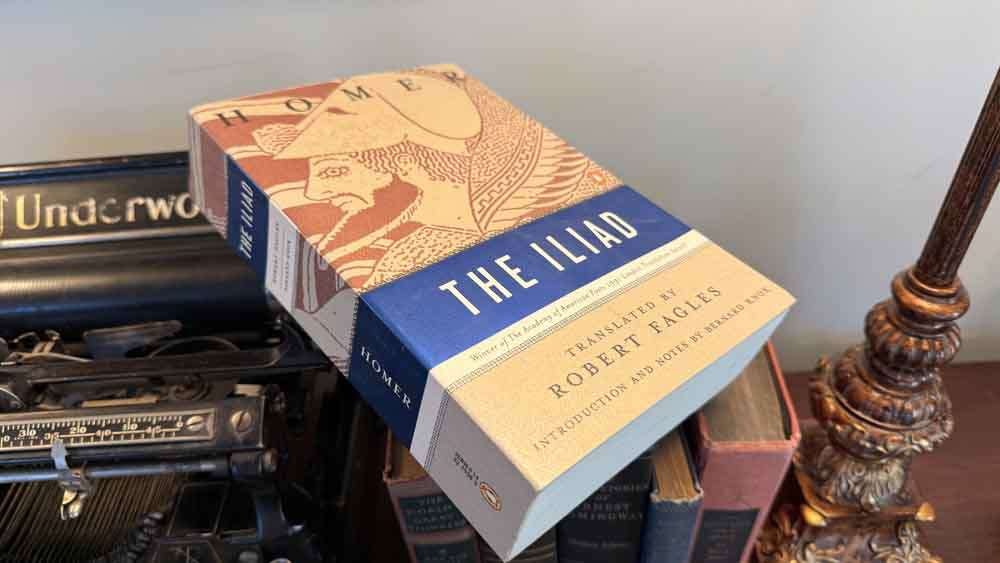
The Iliad, translated by Robert Fagles — Penguin Classics, 1990. Introduction by Bernard Knox. Available wherever books are sold.
You Might Also Like:
- Thus Spoke Zarathustra by Friedrich Nietzsche — The Book That Rewired My Understanding of Everything
- The God Delusion by Richard Dawkins: A Review
Sources
- Homer. The Iliad. Translated by Robert Fagles, with introduction by Bernard Knox. Viking/Penguin Classics, 1990. penguinrandomhouse.com
- Knox, Bernard. Essays Ancient and Modern. Johns Hopkins University Press, 1989.
- Wilson, Emily. “On Translating Homer.” The New Yorker, 2017. newyorker.com
- Graziosi, Barbara, and Johannes Haubold. Homer: The Resonance of Epic. Duckworth, 2005.
- Silk, M.S. Homer: The Iliad. Cambridge University Press, 1987.