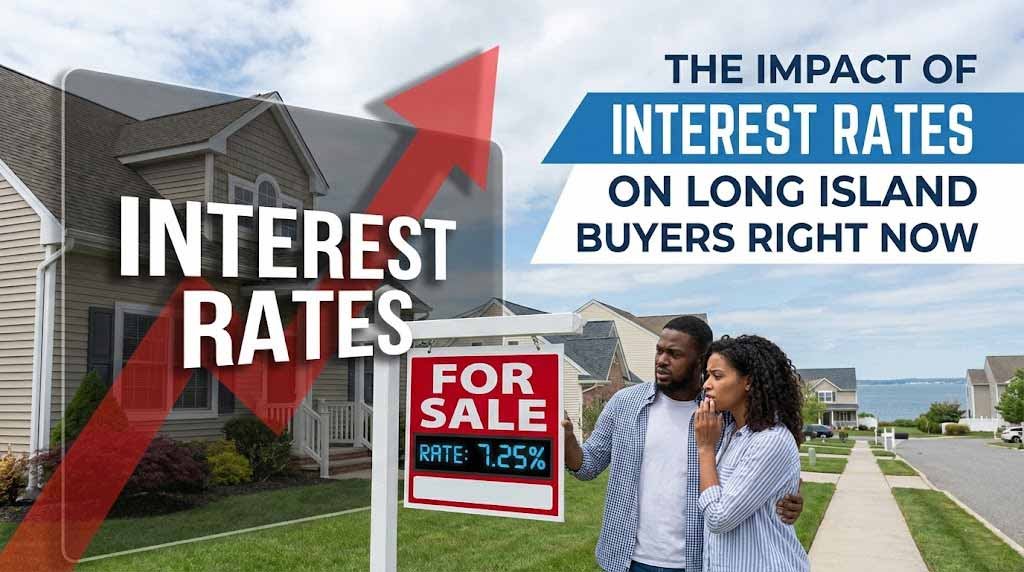
If you’ve been sitting on the sidelines waiting for rates to drop back to pandemic lows, you’re not alone — but the data suggests that waiting could be costing you more than you think. Interest rates are the invisible hand shaping every single decision in today’s Long Island real estate market: who buys, who sells, what sells fast, and what sits. Right now, as the 30-year fixed mortgage rate hovers around 6.00%–6.22% (Bankrate, February 2026), we are living through one of the most consequential rate environments in modern real estate history. Understanding how those numbers translate to your monthly payment, your purchasing power, and your competition on the North Shore and throughout Nassau and Suffolk counties is not optional — it is the whole game.
This post cuts through the noise. Drawing on data from Freddie Mac, the Mortgage Bankers Association, NAR, OneKey MLS, and local market reports, we map exactly what is happening with rates, why it happened, and most importantly — what it means for buyers in communities from Smithtown and Mt. Sinai to Valley Stream and Huntington right now in early 2026.
1. How We Got Here: A Brief History of the Rate Surge
To understand where we are today, you must understand the extraordinary journey mortgage rates have taken since the COVID-19 pandemic. In 2021, the 30-year fixed mortgage averaged a record-low 2.96% — a number that now reads like financial mythology. Those near-zero rates were the product of emergency Federal Reserve policy designed to shield the economy from pandemic collapse. What followed was a feeding frenzy in real estate nationally and across Long Island, with bidding wars, cash offers above asking, and homes moving in hours.
The hangover came in 2022. Inflation surged to a 40-year high, peaking at 9.1% annually in June 2022. The Federal Reserve, which had been slow to react, launched what would become the most aggressive rate-hiking campaign since the early 1980s. The Fed hiked rates a total of 11 times between March 2022 and July 2023, pushing the federal funds rate from near-zero to a peak of 5.25%–5.50%. Mortgage rates did not merely follow — they sprinted. The 30-year fixed rate climbed from 3.22% in January 2022 to a peak of 7.08% by October of that same year, according to Freddie Mac. By October 2023, the 30-year rate briefly breached 8% — a level not seen since 2000.
“Beginning in March 2022, the Fed hiked interest rates at the fastest pace in over 40 years, as inflation surged to the highest levels since the 1980s.” — Bankrate
The pivot began in late 2024. With inflation cooling to 2.7% by December 2024 (still above the Fed’s 2% target but dramatically lower than the peak), the Fed cut rates three times — in September, November, and December 2024 — totaling 100 basis points. In 2025, three additional 25-basis-point cuts followed in September, October, and December, bringing the federal funds rate to its current range of 3.50%–3.75%, the lowest since 2022, according to The Street. Yet mortgage rates, which track the 10-year Treasury yield rather than the federal funds rate directly, have been slower to follow. As of February 17, 2026, the 30-year fixed mortgage rate in New York stands at 6.00% and the national average APR sits at 6.22% (Bankrate).
30-Year Fixed Rate — Jan 2022: 3.22% (Freddie Mac)
30-Year Fixed Rate Peak — Oct 2023: ~8.00% (Freddie Mac)
30-Year Fixed Rate — Feb 17, 2026: 6.00% (NY) / 6.22% (National) (Bankrate)
Federal Funds Rate — Jan 2026: 3.50%–3.75% (Federal Reserve)
2. The Math That Matters: What Rates Actually Cost Long Island Buyers
Abstract rate numbers mean nothing without translation into dollars. Long Island is one of the most expensive real estate markets in the United States, and even modest rate movements create dramatic swings in monthly obligations. As of Q2 2025, the Long Island median home price hit $725,000 — up 8.2% year-over-year, according to the Long Island Business News. In Nassau County, the median single-family listing price reached $849,000, while Suffolk County sat at $839,000 (Norada Real Estate, November 2024 data).
Let’s do the math that lenders do. Assume a 20% down payment on a $725,000 Long Island home — that’s $145,000 down, leaving a $580,000 mortgage.
- At 3.00% (2021 average): Monthly payment ≈ $2,446 | Total interest over 30 years ≈ $300,600
- At 6.00% (Feb 2026 NY rate): Monthly payment ≈ $3,477 | Total interest over 30 years ≈ $671,572
- At 7.00% (2023 peak zone): Monthly payment ≈ $3,860 | Total interest over 30 years ≈ $809,600
That is a difference of more than $1,000 per month between the 2021 environment and today — on the same home, same down payment, same loan amount. For a family budgeting $3,500 per month for housing, today’s 6.00% rate is just barely workable, while last year’s 7%+ environment pushed that same purchase entirely out of reach.
The qualifying income tells an equally stark story. With Nassau median prices at $840,000 and rates at 6.2%, according to EXIT Realty Premier’s November 2025 market report, the qualifying income for a standard loan skyrocketed — putting first-time homeownership further out of reach for many Long Island families. The Housing Affordability Index for Long Island dropped to 73 in Nassau and 79 in Suffolk in Q1 2025, according to OneKey MLS data cited in the EXIT Realty Premier April 2025 report. An index below 100 means a median-income household cannot afford a median-priced home.
A Long Island homeowner with a $500,000 mortgage at 3% who moves to a similarly priced home at 6.5% faces a monthly payment increase of roughly 73% for the same principal. — EXIT Realty Premier, Nov. 2025
3. The Lock-In Effect: Why Inventory Is Frozen and What It Means for Buyers
Here is the paradox strangling the Long Island market: rates are high enough to suppress buyer demand, yet they’re also the exact reason there’s almost nothing to buy. This is the infamous ‘lock-in effect’ — and its grip on Long Island has been iron-tight.
Nationally, approximately 80.3% of mortgage holders carry an interest rate below 6%, and nearly one-third have a rate between 3% and 4%, according to EXIT Realty Premier’s comprehensive 2025 market analysis. For a Long Island homeowner with a $600,000 mortgage locked at 2.65% from 2021, selling to buy a new home at today’s rates essentially means doubling their monthly payment. That’s not a decision most homeowners make voluntarily. They stay put. Boomers age in place. The ‘move-up market’ — families selling a starter home to buy a larger one — essentially froze.
The numbers in Long Island bear this out with precision. Inventory stood at a historically tight 3.1 months’ supply as of mid-2025, according to the Mid-Island Times. Long Island home sales in Q2 2025 fell approximately 10.6% from a year earlier, even as median prices hit new highs. Nassau County had just 2,106 active listings in March 2025; Suffolk County had 2,971. To put that in context, a balanced market typically carries 5–6 months of supply.
Long Island Inventory (Mid-2025): ~3.1 months’ supply (Mid-Island Times)
Q2 2025 Long Island Sales Change: -10.6% year-over-year (Mid-Island Times / LIBN)
Nassau Active Listings (March 2025): 2,106 homes (EXIT Realty Premier / OneKey MLS)
Suffolk Active Listings (March 2025): 2,971 homes (EXIT Realty Premier / OneKey MLS)
The result for buyers: the homes that do come to market are ferociously competitive. In Suffolk County in March 2025, 51% of homes sold above asking price, with an average sold-to-list ratio of 100.6%. In Nassau, 40% sold above asking. This is not the relief buyers were hoping rate stabilization would bring.
Lawrence Yun, Chief Economist for the National Association of Realtors, has noted that if mortgage rates fall toward 6%, many more buyers will jump in — he projects home sales rising 6–11% over 2025–26 if rates ease. With New York’s rate now at precisely that threshold, the spring 2026 market is shaping up to be a decisive moment.
4. Who Is Buying — and Who Is Being Left Behind
Not all buyers experience the rate environment equally. The 2025 and early 2026 Long Island market has drawn a stark dividing line between buyer cohorts, and understanding which side of that line you’re on shapes the entire strategy.
Cash buyers and equity rollers — typically repeat buyers who have accumulated substantial home equity over the past five years of price appreciation — are largely insulated from rate shock. They use their embedded equity from a sale to make large down payments or all-cash offers, either sidestepping the rate environment entirely or dramatically reducing the financed amount. In luxury coastal markets like Fire Island and the East End, nearly half of buyers were still paying cash or financing with large down payments even through the 7%+ rate environment of 2023–24, according to Behind the Hedges.
First-time buyers have borne the brunt of this era. With no equity to roll, no windfall from a prior sale, and student debt often competing for the same income, they are financing at full market rates on Long Island’s eye-watering prices. This group has increasingly pivoted toward co-ops and condos as the only affordable access point to homeownership. The data confirms it: co-op pending sales surged 11.6% in late 2025, according to EXIT Realty Premier’s November report, driven almost entirely by first-time buyers seeking the most affordable entry point possible.
There is also a growing pool of what market analysts are calling ‘necessity buyers’ — people moving not because of financial optimization, but because life demands it: job changes, family formation, divorce, downsizing after the kids leave, eldercare needs. These buyers are in the market regardless of rates. They represent a floor of sustained demand that keeps Long Island from ever fully stalling, no matter what the Fed does.
The ‘wait-and-see approach that defined the transaction lulls of 2023 and 2024 has given way to necessity-driven activity.’ — EXIT Realty Premier, December 2025
For first-time buyers in communities like Mt. Sinai and Smithtown — areas with strong school districts and slightly more accessible price points than Nassau’s premium towns — the current rate environment demands sharp pre-planning. Programs through SONYMA (State of New York Mortgage Agency) offer below-market rates, down payment assistance, and reduced mortgage insurance for qualifying first-time buyers, and are often overlooked. A conversation with a knowledgeable local broker before setting foot in an open house is not optional — it’s the difference between a successful offer and a wasted search.
5. Nassau vs. Suffolk: How Rates Are Playing Out Differently Across Long Island
Long Island is not one market — it is many, stitched together by the Long Island Rail Road and divided by the Nassau-Suffolk line. The rate environment impacts each county differently, and the divergence in 2025 data is striking.
Nassau County remains the premium, higher-stakes battlefield. The median single-family sale price in Nassau was $790,000 in April 2025, with the upper tier (5+ bedrooms) hitting a median of $1.1 million — an 18.5% year-over-year increase. Year-over-year price growth was 12.3% as of March 2025. But rate sensitivity is highest here: Nassau’s affordability index of 73 means the median household cannot afford the median home, period. With rates above 6.5%, every 25-basis-point move either qualifies or disqualifies thousands of households. The average days on market in Nassau has stretched from approximately 45 days in 2024 to 66 days by mid-2025.
Suffolk County is where the rate-sensitive buyer has fled, and where the market is responding with more activity. Suffolk’s median sold price of $649,000–$655,000 represents a 25%+ discount to Nassau. New listings in Suffolk surged 11.7% in March 2025. Closed sales increased 6.3% year-over-year — while Nassau’s fell 1.9%. In towns along the North Shore like Mt. Sinai, Miller Place, and Rocky Point, buyers are finding slightly more room to breathe on price, even if rates remain challenging. Suffolk properties are also selling faster: 58 days on market on average versus Nassau’s 63, and 56.9% of Suffolk homes sold above asking price in March 2025 — the highest proportion of the two counties.
Nassau Median Home Price (April 2025): $790,000 (OneKey MLS / EXIT Realty Premier)
Suffolk Median Sold Price: $649,000 (Norada Real Estate)
Nassau Affordability Index (Q1 2025): 73 (OneKey MLS)
Suffolk % Homes Sold Above Ask (March 2025): 56.9% (Redfin / EXIT Realty Premier)
Suffolk New Listings Change (March 2025): +11.7% (EXIT Realty Premier)
The divergence isn’t merely academic for buyers. A family who can genuinely afford up to $700,000 will get far more home — and far more negotiating room — in eastern Suffolk than in western Nassau. With the 30-year rate now at 6.00% in New York, even a 20% down payment on a $650,000 Suffolk home results in a $520,000 mortgage carrying a payment of roughly $3,118/month — meaningfully more manageable than the same exercise in Nassau.
6. What Buyers Should Be Doing Right Now: A Strategic Playbook
Given everything the data shows, what is the right move for a Long Island buyer in February 2026? The answer depends entirely on your situation — but the framework below applies broadly.
- Get pre-approved immediately, not pre-qualified. Pre-approval is a full underwriting review. In a market where 51–57% of homes sell above asking price and competition is fierce, sellers and their agents prioritize pre-approved buyers. Your pre-approval letter also locks in a rate for 30–60 days in many cases.
- Lock your rate strategically. With rates at their lowest level since 2022, the conventional wisdom of ‘wait for rates to drop more’ carries real risk. The MBA and Fannie Mae project rates staying in the 5.9%–6.4% range through 2026. A lock-in today captures a rate near the bottom of recent ranges. Ask your lender about float-down options, which allow a one-time rate drop if market rates fall before closing.
- Consider adjustable-rate mortgages (ARMs) carefully. A 7/1 ARM may offer rates 50–75 basis points lower than a 30-year fixed. For buyers who plan to sell or refinance within 7 years — which describes many young families on Long Island — this can be a compelling tool. But understand the reset risk before signing.
- Explore SONYMA programs for first-time buyers. New York State offers below-market rate mortgages, closing cost assistance, and reduced PMI through the State of New York Mortgage Agency. These programs are underutilized and can be the difference-maker for first-time buyers on Long Island.
- Think about the ‘marry the house, date the rate’ principle. This phrase has become a cliché in real estate circles, but the math backs it. If rates fall meaningfully — say, toward 5.5% — you refinance and save hundreds per month. If they don’t, you still own a tangible asset in one of the most supply-constrained markets in the Northeast.
- Look hard at North Shore Suffolk communities. Towns like Mt. Sinai, Miller Place, and Shoreham-Wading River offer a combination of top-rated schools, Long Island Sound access, and price points that are 20–30% below comparable Nassau communities. These are among the most undervalued pockets on the Island for buyers operating in today’s rate environment.
📍 Thinking about buying on Long Island’s North Shore? Browse current listings at heritagediner.com/properties/ or connect with Paola Meyer, Associate Broker at Realty Connect USA — a trusted advisor for buyers and sellers across Nassau and Suffolk counties.
▶ ▶ Search North Shore Long Island Homes — Heritage Diner Real Estate
7. The Outlook: What Rates May Do in 2026 — and What That Means for You
Forecasting interest rates is famously humbling — the past four years have made fools of experts at every turn. That said, the consensus among major institutions entering 2026 is cautiously constructive. Here is where the smartest money is looking.
The Mortgage Bankers Association and other major forecasters project 30-year rates remaining in the low-6% range (6.1%–6.4%) through most of 2026. Fannie Mae offers a slightly more optimistic outlook, projecting a gradual decline that could see rates ending 2026 near 5.9%. The Federal Reserve signaled just one additional 25-basis-point cut for 2026 at its December 2025 meeting, with markets currently pricing that cut for June 2026 (Trading Economics, February 2026). Chair Jerome Powell has been explicit: the Fed is in no hurry, and any rate easing will be data-dependent.
Critically, the spread between the 10-year Treasury yield and mortgage rates remains wider than historical norms. In typical market conditions, mortgage rates run 1.5–2.0 percentage points above the 10-year yield. From 2023 through much of 2024, that spread stretched to nearly 3 percentage points, making mortgages artificially expensive even relative to the underlying benchmark. As that spread normalizes — a process already underway — mortgage rates can fall even without significant Fed action. Morningstar analysts have flagged this as one of the key underappreciated tailwinds for housing affordability in 2026.
The bottom line for Long Island buyers: the window of relative rate relief that opened in late 2025 and early 2026 is real, and it is being noticed. Mortgage applications nationally were up more than 11% in early spring 2025 as rates dipped (MBA data cited in BHHS Laffey’s March 2025 market report). If rates approach 5.75%–6.00% consistently, NAR’s Lawrence Yun projects that 6.2 million additional households would regain affordability for median-priced homes. On Long Island, that kind of unlock could substantially increase competition — meaning today’s buyer faces less competition than the buyer of late 2026 might.
“The next big changes will come from shifting mortgage rates or an influx of new listings. Selling now while inventory is still low and demand is decent might be your last chance to get top dollar.” — Local analyst quoted in Mid-Island Times, 2025
Further Reading & Video Resources
The following resources informed this analysis and are recommended for buyers and sellers seeking to deepen their understanding of today’s rate environment.
▶ Bankrate: Current New York Mortgage Rates (Updated Daily)
▶ Federal Reserve: Open Market Operations & Rate History
▶ Freddie Mac: Primary Mortgage Market Survey
▶ EXIT Realty Premier: Long Island Housing Market Report Nov. 2025
▶ Morningstar: How Much Will the Fed Cut Rates?
▶ SONYMA First-Time Homebuyer Programs (NY State)
▶ NAR: Economic and Housing Market Outlook
▶ 📺 VIDEO: How Mortgage Rates Are Determined — Khan Academy (YouTube)
▶ 📺 VIDEO: Long Island Real Estate Market Update 2025 — Market Watch LIBN
▶ 📺 VIDEO: Jerome Powell Explains the Fed’s Rate Decision — C-SPAN
The Bottom Line for Long Island Buyers
Interest rates are not simply an abstract economic variable — they are the central organizing fact of the 2026 Long Island real estate market. They have frozen inventory by trapping owners in their low-rate mortgages. They have squeezed purchasing power, pushing first-time buyers toward co-ops and condos and toward Suffolk’s relatively more affordable towns. They have divided the buyer pool into cash-rich equity rollers and rate-squeezed first-timers navigating two entirely different markets.
And yet, here is the truth buried beneath the headlines: the rate environment has improved materially from 2023’s peak, and it is showing signs of continued — if gradual — improvement through 2026. The buyers who are winning in this market are not waiting for perfect conditions. They are getting pre-approved now, understanding the math of their specific scenario, leveraging SONYMA programs where applicable, and working with experienced local professionals who know both the macro picture and the micro detail of specific neighborhoods.
In communities up and down the North Shore — including the village of Mt. Sinai, where The Heritage Diner has been a fixture of community life for decades — the families who ultimately find their homes are the ones who do their homework and move decisively when the right property appears. That’s not luck. That’s strategy.
Ready to navigate today’s rate environment with an expert by your side? Reach out to Paola Meyer, Associate Broker at Realty Connect USA — and start your property search at heritagediner.com/properties/
Search current listings: heritagediner.com/properties/
Sources & Citations
1. Bankrate. “Current New York Mortgage and Refinance Rates.” Updated February 17, 2026. bankrate.com
2. EXIT Realty Premier. “Long Island Housing Market Report: November 2025, Year’s Recap & The Road Ahead.” December 22, 2025. exitpremiersells.com
3. EXIT Realty Premier. “Long Island Real Estate Market Report: April 2025.” May 2025. exitpremiersells.com
4. EXIT Realty Premier. “Long Island Housing Market Overview: March 2025.” April 2025. exitpremiersells.com
5. Mid-Island Times. “The Great Holding Pattern: Why Long Island Homeowners Aren’t Selling.” October 2025. midislandtimes.com
6. Norada Real Estate. “Long Island Housing Market: Prices, Trends, Forecast 2025–2026.” noradarealestate.com
7. The Mortgage Reports. “Mortgage Rate History: Chart & Trends Over Time 2026.” themortgagereports.com
8. Bankrate. “Federal Funds Rate History: 1980 Through the Present.” bankrate.com
9. Bankrate. “How Does the Federal Reserve Affect Mortgages?” bankrate.com
10. The Street. “A Timeline of the Fed’s 2022–2023 Rate Hikes.” thestreet.com
11. Morningstar. “How Much Will the Fed Cut Interest Rates?” morningstar.com
12. Mortgage Bankers Association (MBA). Weekly Application Survey, Spring 2025. mba.org
13. BHHS Laffey / Pesce & Lanzillotta Team. “Mortgage Rates on a Downward Trend.” March 2025. blog.thepescelanzillottateam.com
14. Behind the Hedges. “Interest Rates Take a Dive and What It Means on Long Island.” September 2024. behindthehedges.com
15. OneKey MLS. Housing Affordability Index, Q1 2025.
16. NYS Department of Labor. Nassau-Suffolk Unemployment Rate, March–April 2025.
17. National Association of Realtors (NAR). Lawrence Yun, Economic Commentary, 2025. nar.realtor
18. Trading Economics. “United States Federal Funds Interest Rate.” tradingeconomics.com, February 2026.
19. Freddie Mac. Primary Mortgage Market Survey, historical data. freddiemac.com
20. Matt Klages Realty. “Long Island Housing Market Update: Should Motivated Sellers Act Now?” August 2025. mattklages.com
All Market Data for Informational Purposes Only Paola Meyer, Associate Broker | Realty Connect USA | heritagediner.com/properties/