
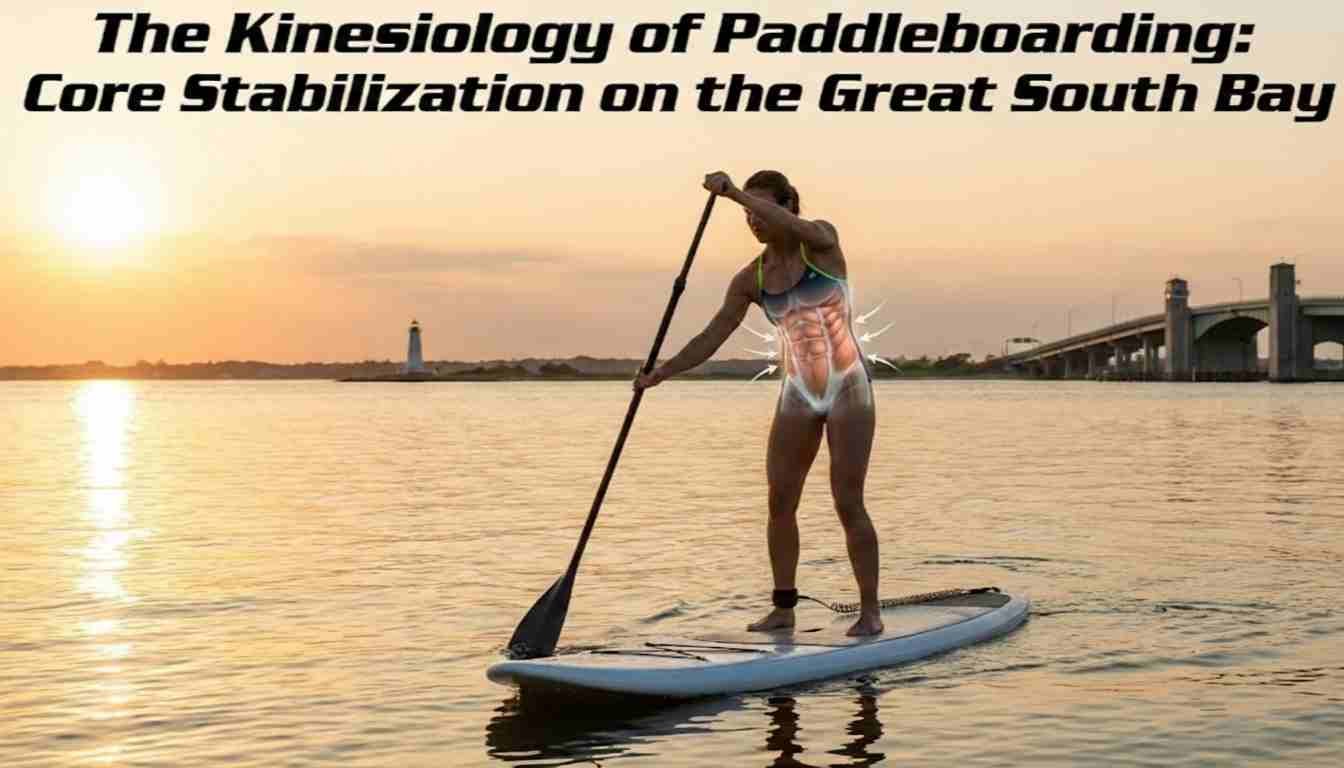
Stand atop a paddleboard on the Great South Bay on a clear July morning — the salt air carrying that particular low-tide weight, Fire Island’s barrier dunes visible across four miles of pewter-blue water — and your body initiates a negotiation more sophisticated than any gym machine can replicate. Before the first stroke even breaks the surface, the deep stabilizers of your trunk are already firing, recalibrating continuously against the bay’s gentle chop, the ghost of a passing powerboat wake still moving through the water from a hundred yards off. What begins as recreation is, in kinesiological terms, a masterclass in the body’s oldest architectural achievement: the standing, breathing, moving human form maintaining itself in three-dimensional space against a dynamic, unforgiving surface.
The Great South Bay has become one of Long Island’s premier paddleboarding corridors, and for good reason. With water on every side — Long Island Sound, the ocean, and the bay itself — the South Shore offers paddle environments that range from flat river calm to open-bay challenge, all within reach of a single afternoon. Men’s Journal South Shore Paddleboards, Long Island’s original SUP shop, has cultivated a community around the water that now hosts the region’s largest paddleboard race, drawing over a hundred competitors annually in support of the environmental nonprofit Save the Great South Bay. That signature race — a paddle toward the Great South Bay Bridge and back, offered in three- and six-mile distances — has become a community ritual, raising funds for autism advocacy and environmental protection alike. Southshorepaddleboards But beyond the community and the scenery, there is a deeper story embedded in every stroke taken across that water: one written not in miles, but in muscle fiber, neural signal, and gravitational negotiation.
The Architecture of Standing Still
Kinesiology — from the Greek kinesis, “to move” — is the scientific study of human movement and the physiological adaptations generated by physical activity. It concerns itself with the why beneath the how, the musculoskeletal logic underneath every gesture the body makes. On a paddleboard, kinesiology becomes immediately legible in a way it rarely is on dry land: there is no railing to grab, no floor to push against, no stable reference point beyond the horizon. The body must solve the problem of balance in real time, every second, across an unstable medium.
What most people understand as the “core” — the rectus abdominis, the washboard muscle of fitness marketing — represents only a fraction of the actual stabilizing architecture. The core makes up nearly half the body, encompassing all the muscles that attach to the pelvis and spine, sometimes defined as “everything excluding the extremities.” Baltimoresup This includes the transversus abdominis (the body’s deepest corset muscle, the one that braces before any limb movement occurs), the multifidus along the spine, the internal and external obliques that govern rotation, the gluteal complex that anchors the pelvis from below, and the erector spinae that hold the vertical column against gravity’s relentless arithmetic.
On a paddleboard, all of these structures activate simultaneously. The moment the board begins to rock — and on the Great South Bay, it always begins to rock, that broad, shallow body of water amplifying every wake and wind shift — isometric contractions of the entire trunk, gluteals, and lower leg musculature are required to counter the rotational forces generated by each paddling stroke. PubMed Central The body is not merely balancing. It is calculating torque and counter-torque in continuous feedback with the proprioceptive system, the nerves embedded in joints, fascia, and muscle that report the body’s position in space with a speed and resolution no digital sensor has matched.
The Paddling Stroke: A Chain of Muscular Events
Each stroke across the bay is not a single muscle action. It is a kinetic chain — a sequenced cascade of muscular events that begins at the feet gripping the board’s deck pad, travels through the ankle stabilizers, up through the gluteals and core, through the latissimus dorsi (the broadest muscle of the back, the primary engine of any downward pulling motion), across the shoulder, and down into the forearm and hand that grips the paddle. Upper-body strength, lower-body stabilization, and core muscle activity work in synergy to create forward movement during SUP, with each stroke activating the upper trapezius, biceps brachii, triceps brachii, tibialis anterior, and gastrocnemius medialis in coordinated sequence. PubMed Central
The paddling mechanics follow a three-phase structure borrowed from dragon boat racing: the entry, the drive, and the exit. During the entry phase, the paddle blade is planted as far forward as reach permits, requiring trunk rotation — a movement governed largely by the obliques and the thoracic spine’s capacity for axial twist. The drive phase pulls the blade through the water, and here the latissimus dorsi dominates, but the core must remain braced or the power transfer becomes inefficient, energy dissipating into trunk flex rather than forward propulsion. The triceps brachii activates from the late recovery phase through the intermediate pull phase, its activation driven by arm extension and trunk rotation, with the triceps on the opposite side of the stroke exhibiting higher activation to stabilize and drive the paddle motion. PubMed Central
Alternate all of this from left to right, maintain upright posture against the paddle’s lateral pull, and do it continuously across a bay that does not hold still — and you begin to understand why six weeks of consistent SUP training produces measurable results that gym protocols struggle to replicate.
What the Research Actually Shows
The scientific literature on stand-up paddleboarding, while still developing, is striking in its consistency. Significant improvements in aerobic fitness (+23.57%) and anaerobic fitness (+41.98%) were observed in previously untrained individuals following a six-week SUP intervention of three one-hour sessions per week. BMC Sports Science, Medicine and Rehabilitation More relevant to the kinesiology of balance and core function, multidirectional core strength tests showed substantial gains post-intervention: a 19.78% increase in the prone bridge test and over 22% improvement in lateral bridge tests on both sides, with the Biering-Sørensen back endurance test improving 21.33%. PubMed Central
These are not trivial numbers. They represent adaptations that take significantly longer to achieve through conventional resistance training, largely because SUP forces the core to work in all three planes of motion simultaneously — sagittal, frontal, and transverse — rather than the single-plane isolation that dominates most gym programming. The body, when confronted with genuine instability, recruits deep stabilizers that remain dormant on a stable floor. The bay, in other words, trains muscles that a Pilates studio can only approximate.
Beyond the musculoskeletal gains, significant improvements in self-rated quality of life were also documented, including an 18.99% increase in physical health domain scores and a 17.49% improvement in psychological health. PubMed Central This should surprise no one who has paddled the Great South Bay at golden hour, with the ospreys working the shallows near the barrier beach and the Manhattan skyline just barely visible through the summer haze on a clear day. The bay is not merely a training medium. It is an environment, and the nervous system responds to beautiful environments differently than it responds to fluorescent-lit weight rooms.
The Feet, the Ankles, and the Water’s Demand
An underappreciated element of SUP kinesiology is the demand placed on the lower kinetic chain — specifically, the ankle and its surrounding musculature. The tibialis anterior and gastrocnemius (the shin and calf muscles) are in constant, low-grade activation on a moving board, making micro-adjustments that keep the center of gravity over the board’s deck. This is proprioceptive training in its purest form, and its benefits extend well beyond paddleboarding. Physical therapists working in rehabilitation — particularly post-ankle sprain protocols and fall prevention in older populations — frequently use balance-board training precisely because it mirrors this demand. The Great South Bay, then, is something of a natural physical therapy clinic at scale.
The stance itself matters enormously. Feet positioned parallel, roughly hip-width apart, placed perpendicular to the board’s long axis, knees softly bent to lower the center of gravity and act as shock absorbers for incoming chop. The spine neutral — not rigidly upright, not flexed forward — which is a position that demands both postural awareness and genuine back-extensor endurance. Experienced paddlers describe finding this position not through conscious thought but through accumulated proprioceptive memory, the body learning to inhabit the stance automatically, the way a seasoned craftsman learns to hold a tool without thinking about the grip.
The Oblique Engine: Rotation as Power
Among the muscles engaged by paddleboarding, the obliques deserve particular attention. These diagonal bands of tissue — internal and external, wrapping around the torso — are simultaneously the body’s primary rotators and a critical element of spinal bracing. On the paddleboard, they serve both functions at once: producing the trunk rotation that extends paddle reach, and bracing against the lateral torque that each stroke creates.
The core is where the paddler gains that extra stroke, gets the extra hip hinge, and finds more rotation in each paddle stroke — it is what connects the paddler to the rest of their body and stabilizes each movement across the water. Baltimoresup This is not metaphor. The obliques function as the physical link between upper-body pulling power and lower-body ground (or board) reaction force. A paddler with weak obliques is essentially trying to transfer force between two structures with nothing solid in between — the mechanical equivalent of trying to push a heavy door with a rope instead of a rigid pole.
Developing the obliques on the water is inherently functional because the training load — the bay’s resistance — changes continuously. A static side plank trains endurance in a fixed position. A paddleboarding session trains the obliques to generate and resist force across a moving, variable environment. The distinction is the difference between memorizing a word and learning a language.
The Bay as Teacher
There is a philosophical dimension to what happens on the water that kinesiology, for all its precision, cannot fully quantify. Heidegger wrote about Dasein — being-in-the-world — as a form of engaged, embodied presence that precedes all abstract thought. On the Great South Bay, that concept becomes literal. The paddler is not thinking about balance; they are balance, the entire nervous system recruited into a single continuous act of being upright on moving water. The body knows things the mind has not yet articulated, and the bay forces a kind of attention — to wind shift, to incoming wake, to the subtle tilt of the board underfoot — that modern life has largely engineered away.
I think about this when I consider what we’ve built at The Heritage Diner over twenty-five years, or what I build at the bench with a piece of English bridle leather destined for a Marcellino briefcase. The quality that endures — in a piece of vegetable-tanned leather, in a slow-fermented sourdough, in a body trained honestly over years — comes from systems subjected to genuine, variable demand, not controlled simulation. The Great South Bay gives the body that. It gives it wind and wake and tide and uncertainty, and the body responds by becoming stronger in ways that are not easily measured on a machine but are immediately felt the next time the board rocks beneath you and you don’t fall.
On the Water: Practical Notes for the North Shore Paddler
For those approaching SUP as a fitness protocol rather than a recreational pastime, a few kinesiological principles translate directly into better sessions. Begin every water session with hip and thoracic spine mobility work on shore — the hip flexors and thoracic extensors are the most common limiting factors in paddling efficiency, and cold, stiff tissue is less effective and more prone to strain. During the stroke, initiate rotation from the hips rather than the shoulders: the hips are the body’s largest rotational engine, and routing force through them before the upper body reduces shoulder impingement risk considerably.
Postural endurance, not maximal strength, governs paddleboard performance. The core muscles are working at low-to-moderate intensity for sustained periods — the demands more closely resemble long-distance running than weightlifting. Training accordingly, with endurance-focused core work (long-hold planks, sustained single-leg balance drills, rotational cable movements at moderate resistance) will carry over more directly to the water than conventional strength training. And finally: asymmetry matters. Paddling creates lateral imbalances over time, as one side habitually generates more power or receives more load. Deliberate cross-training to address these imbalances — dedicated work on the weaker side, anti-rotation exercises, single-arm variations — keeps the system honest.
The Great South Bay does not grade on a curve. It gives back exactly what the body brings to it: efficiency, attention, and calibrated strength, met with the particular beauty of open water on a clear Long Island morning, which has always been, and will always be, its own sufficient reward.