Beneath double-height ceilings that once watched German immigrants bend white oak staves into sugar barrels, two chefs from a tiny Greenpoint bistro quietly built one of the most celebrated French restaurants in New York City. Le Crocodile occupies the ground floor of the Wythe Hotel, a converted 1901 cooperage on the Williamsburg waterfront, and it has become — in barely five years — the kind of place where the roast chicken alone justifies the L train ride from Manhattan. That is not hyperbole. The New York Times gave the restaurant three stars upon opening in December 2019, with critic Pete Wells declaring he wanted to return for nearly every dish he had sampled (The New York Times, 2020). The Times later placed Le Crocodile on its prestigious list of the 100 Best Restaurants in New York City, where it ranked number 67 in 2024 — twelve spots higher than the previous year (Greenpointers, 2024). For a hotel restaurant in a borough that treats culinary mediocrity as a mortal sin, that kind of ascent tells you everything.
The Architects of the Kitchen: Jake Leiber, Aidan O’Neal, and Jon Neidich
Le Crocodile was born from a partnership between chef-partners Jake Leiber and Aidan O’Neal and restaurateur Jon Neidich, whose company Golden Age Hospitality has shaped some of New York’s most storied nightlife and dining destinations since its founding in 2012 (Crain’s New York Business, 2020). Leiber and O’Neal had already earned serious critical attention at Chez Ma Tante, their bare-bones French-Canadian bistro on a quiet block of Greenpoint. That restaurant collected a 92 from New York Magazine, two stars and a Critic’s Pick from Pete Wells, and four stars from Robert Sietsema at Eater (Heritage Radio Network, 2024). When Neidich first ate there, he was so taken with the food that he waited years for the right opportunity to collaborate — looking at spaces in Manhattan that the chefs flatly rejected because they refused to leave Brooklyn (WWD, 2019).
Leiber’s formative years were spent at Barbuto under the legendary Jonathan Waxman, a lineage that shows in the roast chicken at Le Crocodile — a dish that has drawn direct comparisons to Waxman’s iconic preparation. O’Neal came up through Hugue Dufour’s M. Wells empire in Long Island City, where he cooked in the original M. Wells Diner and later ran the kitchen at M. Wells Dinette inside MoMA PS1 (The New York Times, 2020). Together, they share the executive chef title and an almost philosophical alignment on what a restaurant should feel like: unpretentious, deeply satisfying, and rooted in classical technique without being enslaved by it.
Neidich, a Brown University English graduate who started his hospitality career as a host and busboy under André Balazs, brought the narrative instinct. His portfolio — ACME in NoHo, The Happiest Hour in the Village, Le Dive in Dimes Square, Deux Chats in South Williamsburg — reveals a man obsessed with the story a room tells before a single plate is set down (WWD, 2018). For Le Crocodile, he traveled with the chefs through multiple cities in France and Italy over nine days, eating and drinking their way to the menu that would eventually anchor the Wythe Hotel’s culinary identity (WWD, 2019).
The Room: A Cooperage Reborn as a Brasserie
Understanding Le Crocodile requires understanding the building it inhabits. The Wythe Hotel sits at the corner of North 11th Street and Wythe Avenue in a structure designed by Brooklyn architect Theobald Engelhardt and built in 1901 as a cooperage — a barrel factory — for German immigrant Paul Weidmann. In the 1880s and 1890s, North Brooklyn was the largest sugar-refining district in the world, and Weidmann’s operation produced between six and seven thousand barrels a day for the refineries lining the East River (Greenpointers, 2018). The building later served as a textile warehouse producing specialty fabrics for NASA before falling into disuse (Wythe Hotel, 2024).
When architect Morris Adjmi converted the cooperage into a 69-room boutique hotel in 2012, he preserved every industrial artifact he could salvage — the heavy yellow pine beams, the cast-iron columns, the fortress-thick brick walls, the original masonry. Custom furniture was built by local craftsmen using wood reclaimed from the cooperage itself (Morris Adjmi Architects). Le Crocodile occupies the space formerly held by Reynard, the Andrew Tarlow restaurant that was the hotel’s original ground-floor tenant. When Reynard closed in 2018, Neidich and the Chez Ma Tante team reimagined the cavernous room with designer Loren Daye of Love Is Enough Studio, drawing inspiration from the traditional coffee houses of Vienna — all-day establishments with an element of femininity, brightness, and ease (WWD, 2019).
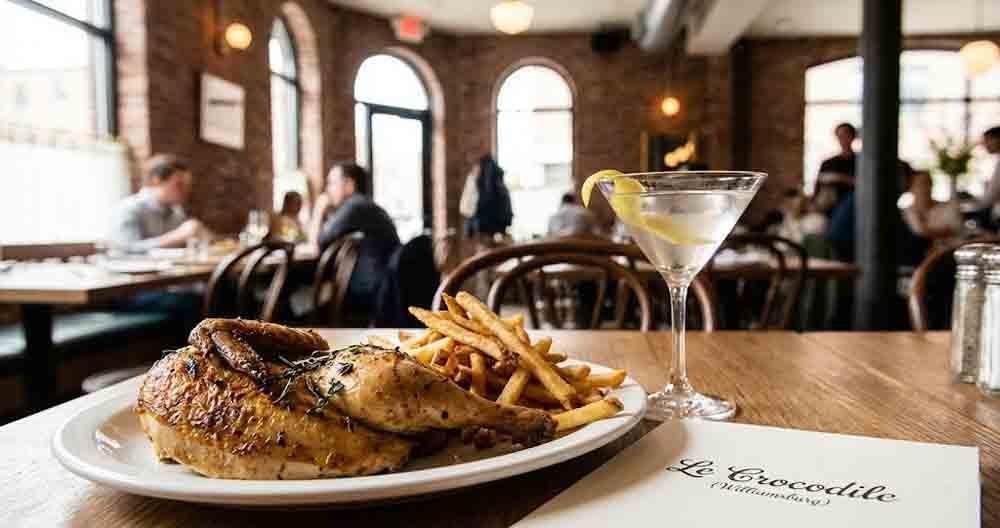
The result is a dining room defined by exposed red brick, towering arched windows that flood the space with natural light, burgundy leather booths, dark walnut tables, a long marble bar with globe fixtures, and mirrors that critics have described as the size of jumbotrons. It is simultaneously grand and intimate — the kind of room where you can eat profiteroles alone at the bar without feeling exposed, or settle into a round booth for the most important dinner of your year.
The Menu: French Brasserie by Way of Brooklyn
Le Crocodile describes itself as an all-day neighborhood brasserie serving earnest French fare, and that description is both accurate and insufficient. The menu cascades down a single long page — appetizers blending into entrées (used in the French sense, meaning starters), plats principaux, and a dozen desserts. At dinner, the kitchen sends out plates like escargots braised with parsley, Pernod, and fennel; Jonah crab stirred with yuzukosho mayonnaise on a cushion of avocado purée; leeks vinaigrette doused in tarragon and buried under toasted hazelnuts; and nearly half a dozen terrines and pâtés on any given night — including a mushroom pâté so smooth and butter-rich that the Times compared it to foie gras (The New York Times, 2020).
The roast chicken with herb jus and frites is the signature, and for good reason. Crispy-skinned, impossibly juicy, served alongside a heap of thin, golden fries, it has become one of the most talked-about chicken dishes in the five boroughs. The Infatuation rated the restaurant an 8 out of 10 — their “Truly Excellent” designation — and called the chicken both incredibly delicious and extremely filling (The Infatuation, 2025). Other standout plats principaux include the bistro steak frites with maître d’hôtel butter at $48, filet mignon au poivre et frites at $61, and a 24-ounce ribeye for two from Black Rock Farms in Maryland at $149.
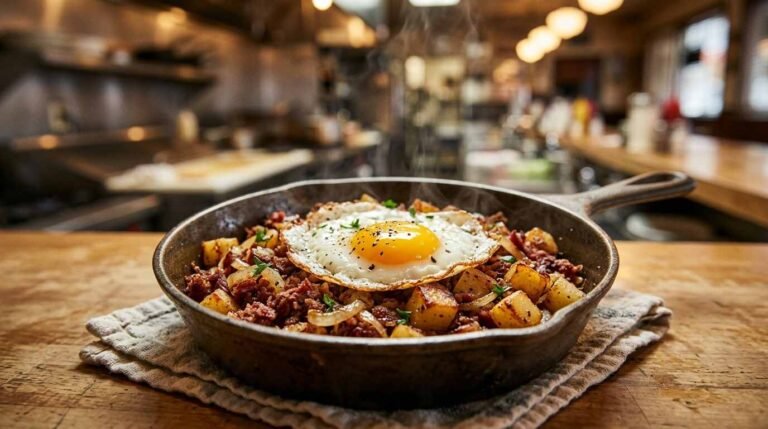
At lunch, the kitchen pivots slightly — offering a chicken cordon bleu with spinach and mustard jus and a two-course prix fixe for $39. Weekend brunch carries its own gravitational pull, with a Le Crocodile Petit Déjeuner that bundles free-range eggs, smoked bacon or pork sausage, hash browns, petite salade, a choice of patisserie, fresh juice, and coffee or tea for $42. The cocktail program runs deep: a Spritz au Crocodile built on Aperol and Italian bitters, a Martini Amalfi Coast with gin and cucumber botanical vodka, and a Vieille Manhattan aged with prune brandy and both sweet and dry vermouth.
Desserts deserve their own paragraph. The profiteroles have achieved near-mythic status — pâte à choux puffs filled with ice cream, drowned in dark chocolate sauce, consumed completely and without mercy. The banana date pudding runs warm and slightly salty with a moat of caramel. The maple crème brûlée, the lemon bergamot tart, and a hazelnut and chocolate malt cake round out a pastry program that routinely draws superlatives from critics and diners alike.
The Wine and Cocktail Philosophy
Le Crocodile’s sommelier, Rafa García Febles, curates a wine program that leans heavily into natural and biodynamic producers from France and beyond — pét-nats, chillable reds, orange wines, and old-world Burgundies sitting comfortably beside each other on the list. Bottles range from approachable to investment-grade: a Domaine les Conques “Casa” 2007 Rivesaltes at $15 by the glass, a Famille Hugel Sélection de Grains Nobles 2011 Alsace Riesling at $45, or a Château d’Yquem Sauternes 2014 at $85. The beer selection stays local and international — Kronenbourg 1664 from Alsace on draft, Talea’s Fresh Coast IPA brewed in Williamsburg, Guinness from Dublin, and Brooklyn Lager from literally across the street.
The sixth-floor rooftop sibling, Bar Blondeau, extends the culinary vision upward with natural wines, smaller plates inspired by France, Spain, and Portugal, and sweeping views of the Manhattan skyline and East River. It operates as a separate destination within the Wythe ecosystem — sultry, cocktail-forward, and one of the most coveted sunset spots in North Brooklyn.
Accolades, Recognition, and the Weight of Consistency
What separates Le Crocodile from the dozens of French-leaning restaurants that bloom and wither across Brooklyn every year is the relentless consistency of the operation. The three-star New York Times review upon opening in 2019 was remarkable enough — Pete Wells praised the chefs for making food that seemed perfectly normal and ordinary right up until you tasted it (The New York Times, 2020). But remaining on the Times’ Top 100 list years later, climbing rather than sliding, speaks to a kitchen that refuses to coast.
The Infatuation rates Le Crocodile an 8 out of 10, placing it in the “Truly Excellent” tier — restaurants worth making an effort or crossing town for (The Infatuation, 2025). Resy has highlighted the restaurant’s private dining room, the Cellar, as one of the best in New York City. France Today critic Alexander Lobrano, a Paris-based food writer who has covered European dining for decades, declared Le Crocodile his favorite brasserie — not in Paris, not in Strasbourg, but in Williamsburg (France Today, 2025). Luxury Lifestyle Magazine praised it as having a string of rave reviews and food quality rivaling the finest bistros in France (Luxury Lifestyle Magazine, 2024). On Yelp, the restaurant holds a Health Score of A and has accumulated over 900 photos and nearly 400 reviews.
Practical Information: Getting to Your Table
Le Crocodile operates as an all-day restaurant, open Sunday through Wednesday from 7:00 AM to 10:00 PM and Thursday through Saturday from 7:00 AM to 11:00 PM. Breakfast, lunch, weekend brunch, afternoon snacks, and dinner each carry their own menus. Room service is available for Wythe Hotel guests.
Reservations are available through Resy, opening 28 days in advance for parties of up to 12 guests. Larger groups and private events can be accommodated in the Cellar, the intimate private dining room beneath the main restaurant. The average à la carte dinner runs approximately $80 per person before drinks.
The restaurant is wheelchair accessible and offers vegan options. It sits one block from the Williamsburg waterfront and an eight-minute walk from the Bedford Avenue L train station — one stop into Manhattan. The East River Ferry terminal at North 6th Street is also nearby for those arriving by water.
Address: 80 Wythe Avenue, Brooklyn, NY 11249 (inside the Wythe Hotel)
Phone: (718) 460-8004
Website: lecrocodile.com
Reservations: resy.com/cities/ny/le-crocodile
Instagram: @lecrocodilebk — 44K+ followers
Hours: Sun–Wed 7:00 AM – 10:00 PM | Thu–Sat 7:00 AM – 11:00 PM
Price Range: $$$ (Dinner entrées $29–$149; Lunch prix fixe $39)
Cuisine: French Brasserie
Nearest Transit: Bedford Avenue (L train), North 6th Street Ferry
Peter — The Heritage Diner, Mount Sinai, NY | Marcellino NY — Bespoke Leather Goods
Peter holds graduate degrees in Philosophy from Long Island University and The New School University in New York City.