Space has always rewarded the patient. Since the dawn of the Space Age, orbital launches were planned in years, celebrated like cathedral dedications, and mourned like national funerals when they failed. The Falcon 9 — already the most prolific launch vehicle in human history — currently completes its fastest booster turnaround in 27 days. The Space Shuttle’s record for orbiter reflight was 54 days. Against that backdrop, Elon Musk’s February 19, 2026 post on X reads not merely as ambition but as something closer to a civilizational declaration: “It will get really nutty when Starship is launching every hour in 3 years.”
This is not a stray comment. It extends a consistent pattern of increasingly granular public statements that began in August 2025, when Musk predicted there would be days where Starship launches more than 24 times in 24 hours within six to seven years — with a sustained daily average of around ten. He has also shared with SpaceX employees, according to reporting by Ars Technica, that “with launches every hour carrying 200 tons per flight, Starship will deliver millions of tons to orbit and beyond per year.” What sits beneath these numbers is not speculation but a precise engineering theory — one whose feasibility can be examined rigorously, challenge by challenge.
The Architecture That Makes It Possible: Mechazilla and the Logic of the Catch
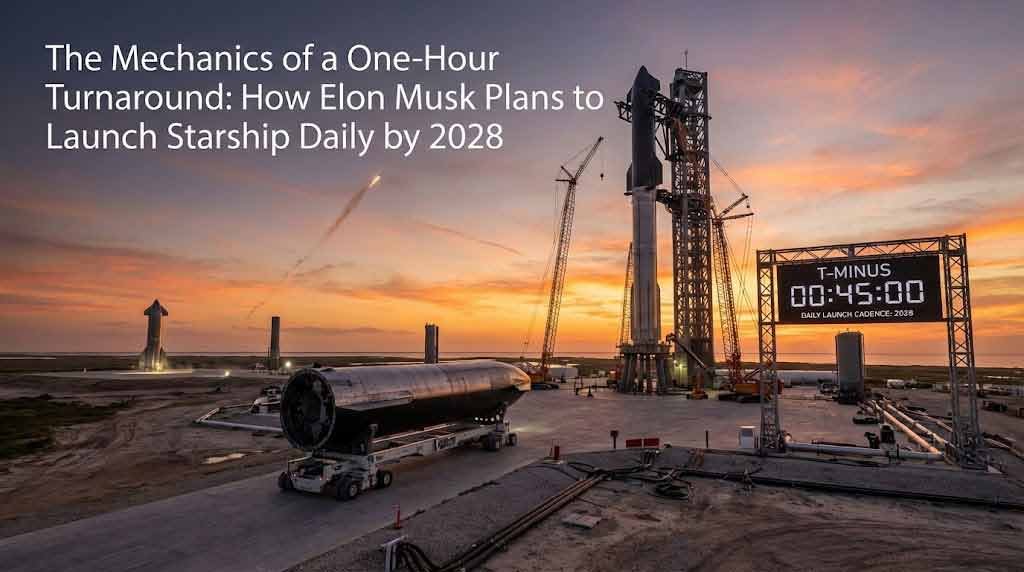
The entire rapid-reuse strategy rests on a single engineering bet made publicly in January 2021: eliminate landing legs entirely and replace them with a tower-based catch system. Musk’s logic was direct. Landing legs add mass, require post-flight inspection, and impose a physical lower bound on turnaround time. A tower-mounted robotic catch system — since nicknamed Mechazilla by the SpaceX community — allows the Super Heavy booster to be seized in mid-air by massive actuated arms, repositioned directly onto the launch mount, and declared ready to refly in under an hour.
The catch is not theoretical anymore. On October 13, 2024, Starship’s fifth flight test produced one of the most striking feats in the history of rocketry: Mechazilla successfully caught the Super Heavy booster on its first attempt. Launch commentator Dan Huot, watching from the control room, said afterward, “Even in this day and age, what we just saw, that looks like magic.” Since that milestone, SpaceX has successfully completed the booster catch three times (SpaceX, 2025).
The engineering rationale sharpens once you understand what catching eliminates. By returning the booster directly to the launch pad via the chopstick arms rather than a droneship or landing zone, SpaceX gains three simultaneous advantages: it removes the weight and structural complexity of landing legs, it positions the booster for immediate stacking with a new upper stage, and it compresses the inspection-to-relaunch cycle from weeks to, theoretically, minutes. Musk has publicly stated his goal is to have the booster ready for reflight within one hour of landing (Interesting Engineering, 2024).
The Starship upper stage follows a parallel logic. Future ships are designed without deployable legs as well — caught by Mechazilla too — with landing legs reserved only for missions on the Moon or Mars where no tower infrastructure yet exists. The Block 3 iteration of Starship, whose development was active as of late 2025, features redesigned forward flaps, larger propellant tanks, and upgraded heat shield tiles and secondary thermal protection layers, all aimed at reducing post-flight refurbishment requirements (SpaceX, 2025).
From 27 Days to 60 Minutes: The Engineering Problem Nobody Has Solved at Scale Yet
Stating the goal and achieving it are separated by a gulf that deserves honest scrutiny. The fastest Falcon 9 booster has ever turned around from one flight to the next is 27 days. The Space Shuttle’s all-time record orbiter turnaround was 54 days — and that was a smaller, simpler vehicle operating in a fully mature support infrastructure. Starship is the largest and most complex flying object ever conceived. Getting it to refly in one hour requires solving simultaneously: propellant replenishment, heat shield inspection and any necessary tile replacement, avionics checkout, quick-disconnect arm reattachment, upper stage mating, and full range safety clearance.
The heat shield alone represents a credible bottleneck. The Block 2 Starship is protected by approximately eighteen thousand hexagonal silica tiles designed to withstand temperatures of up to 1,400 degrees Celsius during atmospheric reentry (Wikipedia, SpaceX Starship). Even with the secondary ablative layer SpaceX added after Flight 4, tile inspection and spot replacement after each reentry is not trivially automated. SpaceX’s iterative development cadence — each flight test generating terabytes of sensor data that feeds into the next vehicle — suggests the company is treating this as a solvable engineering problem rather than a physical constant. But the honest position is that sub-hour refurbishment at the scale of a 123-meter vehicle has never been demonstrated and remains one of the program’s most significant unresolved challenges.
The regulatory dimension adds a separate constraint. Range availability and Federal Aviation Administration licensing have historically throttled SpaceX’s cadence more than hardware. SpaceX has already sought waivers from the FAA on multiple fronts, and the FCC has recently been engaged regarding SpaceX’s plans for over one million satellites in connection with its proposed orbital data center constellation (SpaceX FCC filing, January 31, 2026). How regulatory agencies respond to a launch cadence that treats rockets less like events and more like airline operations will shape the practical ceiling for frequency regardless of what the hardware can achieve.
Why the Cadence Matters: The Economics of Tonnage to Orbit
The hourly launch vision is not an aesthetic preference for velocity. It is the load-bearing pillar beneath a specific economic theory about what cheap, high-frequency access to orbit enables.
Today’s Falcon 9 delivers payload to low Earth orbit at roughly $3,600 per kilogram (TechCrunch, February 2026). SpaceX’s aspirational target for Starship, under fully reusable and high-frequency conditions, is under $500 per kilogram — with some internal projections pointing toward $200 per kilogram or less (Project Suncatcher white paper, 2025). Musk has theorized that a single Starship orbital launch might eventually cost SpaceX only $1 million, compared to development program expenditures that have run approximately $4 million per day (SpaceX lawsuit response, 2024).
Estimates suggest that at full operational maturity, Starship could reduce payload prices to under $10 per kilogram — a figure that, if realized, would represent roughly a 5,000-fold reduction from Space Shuttle costs of approximately $54,500 per kilogram (Born to Engineer, 2024). The compounding effect of that cost curve applied to hourly launch frequency transforms orbital access from a premium service into something approaching industrial infrastructure.
Musk has outlined a production ambition that calibrates to this frequency: 10,000 Starship units produced annually. While that figure reads as extreme under current assumptions, it becomes coherent when viewed against the demand profile he is constructing. SpaceX aims to launch 60 high-capacity Starlink V3 satellites per Starship flight beginning in 2026, with each launch adding 60 terabits per second of network capacity — more than twenty times the capacity added by current launches (Introl, 2026). The satellite manifest alone, before accounting for third-party commercial customers or NASA’s Artemis requirements, begins to justify an industrial production and launch philosophy.
The Downstream Vision: Orbital AI, Mars, and Point-to-Point Earth Travel
The hourly cadence is not a goal in itself. It is the prerequisite for several of Musk’s parallel ambitions, each of which demands a fundamentally different relationship with launch frequency than the industry currently supports.
The most immediately commercially significant is the orbital AI data center project. Following SpaceX’s acquisition of xAI and a January 31, 2026 FCC filing for a proposed constellation of up to one million satellites, Musk has publicly estimated that within two to three years the lowest-cost way to generate AI compute will be in space (Ars Technica, via Light Reading). He has described the vision in first-principles terms: solar panels facing the sun for unlimited power generation, radiators pointed away from the sun for passive cooling, all connected via high-speed laser links. SpaceX projects that launching one million tonnes per year of satellites generating 100 kilowatts of compute power per tonne would add 100 gigawatts of AI compute capacity annually (Introl, 2026). For context, global data center capacity currently stands at approximately 59 gigawatts (TechRepublic, December 2025).
The economics of that proposition, however, are contested. A 2025 Project Suncatcher white paper from Google concludes that space-based computing becomes cost-competitive only when launch costs drop to approximately $200 per kilogram — a threshold the paper places in the mid-2030s. At current Falcon 9 rates of $3,600 per kilogram, the math is decisively unfavorable. The transformation is contingent on Starship delivering its cost promises at high cadence, which creates a circular dependency: the orbital data center vision justifies the investment in hourly Starship launch infrastructure, but that infrastructure must first exist before the data center economics close. Critics including short seller James Chanos have called space-based AI compute “AI snake oil” on cost grounds (Yahoo Finance, February 2026). Amazon Web Services CEO Matt Gorman stated bluntly at a recent industry event: “If you think about the cost of getting a payload in space today, it’s massive. It is just not economical” (TechCrunch, February 2026).
Beyond the near-term commercial play, the Mars colonization mission remains Musk’s long-stated civilizational purpose for Starship. He estimated in 2019 that a self-sufficient Martian city would require approximately one million tonnes of cargo. At 100 tonnes per Starship flight, that demands 10,000 missions — a number only achievable if launch frequency is measured in hours, not months. A crewed Mars mission remains targeted for approximately 2030 following a planned uncrewed mission, though timelines have consistently proven aspirational (Sify, October 2025).
Point-to-point Earth travel represents the third application. Musk has repeatedly described a future in which Starship carries passengers between major cities in under an hour. That service model requires precisely the kind of rapid turnaround, tower-catch infrastructure, and industrialized production philosophy that the hourly cadence project is being built to support.
Musk’s Credibility Problem — and Why It Doesn’t Fully Apply Here
Any serious treatment of Musk’s timelines must acknowledge the record. He predicted Starship would carry twelve people around the Moon in 2023. He said humans would land on Mars by 2024. The Cybertruck, which he claimed could function as a boat and cross small bodies of water, launched with a manual warning against taking it through automated car washes. His critics, who are numerous and include serious aerospace engineers, argue that Musk’s timelines function primarily as management motivation tools and investor narrative devices, not engineering forecasts (Slashdot, passim).
The counterargument — and it is a substantial one — is that Musk has a documented record of eventually reaching destinations others dismissed as impossible. SpaceX landed and reused an orbital booster when the industry consensus held it was not worth attempting. It built Starlink into a profitable, operationally significant satellite internet service serving millions of users globally. It recovered a Super Heavy booster with robotic arms on the first attempt. The company has been on pace for over 100 U.S. rocket launches in a single year, with Falcon 9 reuse nearing 100% across its fleet (TradingKey, December 2025). These are not projections. They are facts on record.
What distinguishes the hourly Starship claim from some of Musk’s more speculative pronouncements is the degree to which the engineering architecture already exists and has been partially validated. The Mechazilla catch system works. The Super Heavy booster returns to the launch site. The heat shield, while still in development, has survived multiple reentries with iterative improvement. The trajectory from demonstrated capability to hourly cadence is long and technically demanding — but it is a trajectory grounded in hardware that already flies, not a blank-sheet concept.
The Competitive Landscape and What Hourly Launches Mean for Everyone Else
SpaceX’s current market position makes the trajectory more credible, not less. In February 2026, seven of nine upcoming worldwide orbital rocket launches were Falcon 9 missions — a level of market dominance with no precedent in the commercial launch industry. Blue Origin’s New Glenn has entered operational service, but it retails at approximately $70 million per launch, a price point that SpaceX could undercut substantially with a mature Starship. If Starship achieves even a fraction of the frequency Musk describes, it will not merely capture market share — it will redefine what market share means in an industry where the unit of measurement shifts from launches per year to launches per day.
The implications for legacy launch providers are stark. Arianespace, United Launch Alliance, and Rocket Lab all operate on a model where a single launch represents months of preparation and tens to hundreds of millions in revenue. An hourly launch paradigm, even applied selectively to high-demand payload types, compresses the economic rationale for that model in ways that may be irreversible. The question for the broader industry is not whether to compete with SpaceX’s cadence target but how to remain relevant in an orbital economy where access is increasingly measured in cost per kilogram rather than launch slots per calendar.
What Comes After the Hour: The Long View on Industrial Space Access
Heidegger wrote that the nature of a tool is revealed only in its breakdown — that the hammer becomes visible as an object only when it fails to drive the nail. For most of the Space Age, the rocket was that kind of visible tool: rare, expensive, and present only because something demanded its use. What Musk is proposing — what the hourly cadence represents at its deepest level — is the transformation of the rocket into something invisible through ubiquity, the way a cargo container became invisible to the global economy not through sophistication but through sheer repetition and standardization.
The analogy is not arbitrary. The modern container shipping industry did not emerge because ships got faster. It emerged because Malcolm McLean standardized the container in 1956 and made interoperability possible at scale. Once the unit of measurement became the container rather than the cargo, the economics of global trade transformed in ways nobody fully anticipated. Musk is attempting something structurally similar with orbital access: to make the unit of measurement the tonne to orbit rather than the launch event, and to make the logistics of that transfer routine enough that the downstream applications — AI compute, Mars colonization, point-to-point travel — become the visible layer while the rockets themselves become infrastructure.
Whether Starship achieves hourly cadence by 2029 or 2035 or some later date, the direction is established and the engineering theory is sound enough to take seriously. The heat shield will be refined. The regulatory framework will adapt or be pressed to adapt. The production cadence will scale. The strategic takeaway is consistent: if reusability delivers high-frequency operations, launch services could begin to resemble a scalable transportation network, with corresponding shifts in economics, competition, and investment across the space sector.
Twenty-five years of watching the restaurant industry has taught a certain patience with visionaries who describe destinations that seem impossible from where you are standing. The diner that commits to sourcing locally, that refuses to compromise on the quality of its bread, that builds a 25-year relationship with its community — that diner survives not because the vision was modest but because the discipline behind it was absolute. What SpaceX is attempting with Starship is the same species of long commitment, expressed at civilizational scale.
The hour is not a metaphor. It is an engineering specification. And the people building toward it have caught a rocket with robot arms in the middle of the Texas sky.