Dawkins handed us the word. Blackmore handed us the theory.
That distinction matters more than it might first appear. When I finished The Selfish Gene — a book I’ve returned to more than once over the years and written about here — I carried something away that went beyond genes and natural selection. The chapter on memes lodged in me the way a good idea always does: quietly, then completely. Dawkins had proposed that culture, like biology, might be driven by replicators — units of information competing to copy themselves through human minds. He named them memes, gave the concept a persuasive few pages, and then, almost with a shrug, moved on. It felt like a philosopher laying a cornerstone and walking off the job site. Susan Blackmore picked up the tools.
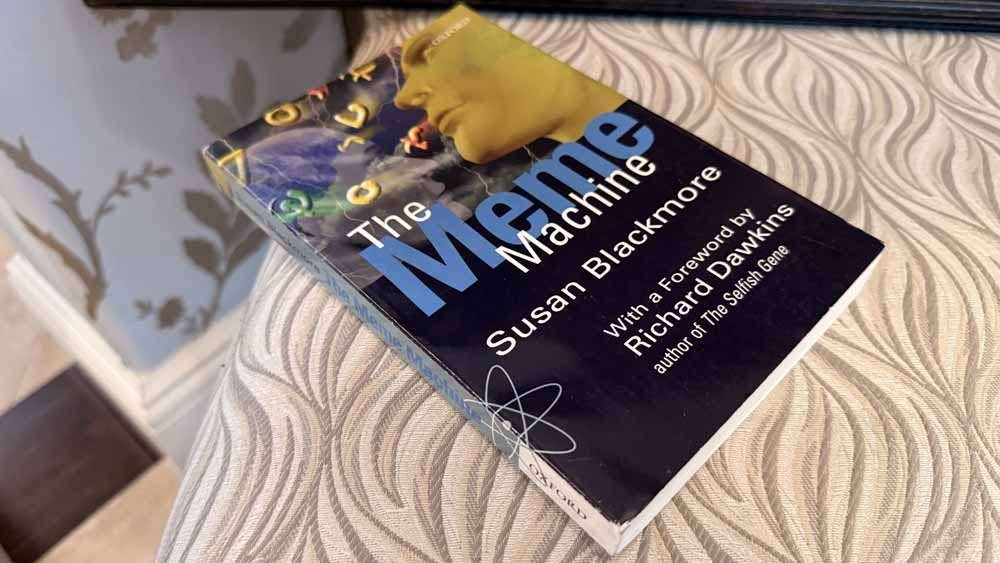
The Meme Machine, published in 1999, is the book that turns meme theory from a provocative footnote into a full-blown framework for understanding human culture, language, the arts, technology, and — most unsettlingly — the very self. It is rigorous without being inaccessible, and ambitious without being reckless. If The Selfish Gene cracked a door, Blackmore walks through it and turns on all the lights.
What Memes Actually Are — and Why the Word Has Been Abused
Before diving into what Blackmore argues, it’s worth rescuing the word from what the internet did to it. The cat photos and viral slogans we now casually call memes share almost nothing with the concept Dawkins coined and Blackmore develops. A meme, in the original sense, is any unit of cultural information that can be copied from one mind to another — a tune, a phrase, a technique, a belief, an architectural style, a hand gesture. The criterion isn’t humor or virality. It’s copyability.
What makes memes powerful as a theoretical tool is that they satisfy the three conditions required for evolution by natural selection: variation, heredity, and differential fitness. Memes vary — no two people hold exactly the same version of a tune or a belief. They are inherited — transmitted from person to person through imitation. And they compete — not all memes spread equally. The ones that are easiest to remember, most pleasurable to repeat, most socially useful, or most psychologically compelling tend to out-replicate the others. That is not a metaphor. Blackmore argues it is a literal evolutionary process, as real and as consequential as the genetic one.
This is where she parts company with those who treat memes as a cute analogy. For Blackmore, memetics isn’t a colorful way of describing cultural change. It is a second replicator theory — a genuine extension of Darwinian thinking into a new domain.
The Leap Dawkins Wouldn’t Take
One of the quiet pleasures of reading Blackmore is watching her go places Dawkins himself pulled back from. The Extended Phenotype, which I found equally important in my own reading of evolutionary biology, pushed the gene’s-eye view outward to include beaver dams and cuckoo behavior — the gene expressing itself beyond the body. Blackmore takes a parallel step in the cultural direction.
Her boldest claim is about the origin of language. She proposes that human language didn’t evolve primarily because it benefited our genes. It evolved because it benefited memes. Language is, above all else, a copying machine. A species capable of complex, precise symbolic communication can transmit memes with extraordinary fidelity across time and distance. If memes are selfish replicators competing for brain space, they would strongly favor any mutation that improved their host’s capacity for transmission. Blackmore argues that our large brains, our language faculties, our deep social structures — all of it may have been shaped, at least in part, by memetic selection pressure rather than purely genetic. The memes built us to carry them better.
This is a genuinely startling idea, and she argues it carefully enough that you can’t dismiss it outright.
The Self as a Memeplex
The hardest section of the book — and the most rewarding — is her treatment of the self. Blackmore doesn’t believe in a unified, stable self that sits behind your eyes making decisions. She follows Buddhist philosophy and contemporary cognitive science in viewing the sense of a continuous “I” as a construction, not a discovery. And then she gives this old idea a new mechanism: the self, she argues, is a memeplex.
A memeplex is a cluster of memes that replicate together because they reinforce one another — like a religion, or a political ideology, or a professional identity. The self is a memeplex that has organized itself around a particular body and brain, recruiting other memes into its orbit, creating the illusion of a coherent, continuous agent in charge. The “I” that feels like the driver is actually just another passenger — a highly organized group of memes that benefits from portraying itself as the one in control.
I’ve sat with this idea for a long time. It doesn’t reduce the experience of being a person; it makes that experience more interesting, in the same way that understanding how flavor compounds work doesn’t ruin a good meal. If anything, it adds a layer of vertigo that philosophy — particularly the existentialists I’ve wrestled with over the years — approaches from the other direction. Sartre’s radical freedom and Blackmore’s memetic self are not, I think, incompatible. They are two different angles on the same uncanny fact: the thing you call yourself is not as solid as it feels.
Where the Book Earns Its Criticism — and Why That’s Fine
Blackmore’s critics, including Dawkins himself in his foreword, raise legitimate objections. The biggest is the question of meme boundaries. A gene has a reasonably clear physical definition. A meme does not. Where does one meme end and another begin? Is a symphony one meme or ten thousand? Is a religion a single memeplex or an ecosystem of competing sub-memes? Blackmore acknowledges the problem and pushes through it, arguing that the fuzziness is a feature of early theoretical work, not a fatal flaw — the same imprecision plagued early genetics. She may be right. Or the analogy may eventually buckle under the weight. Either outcome would be scientifically interesting.
There is also the question of testability. Memetics has struggled to produce the kind of quantitative, predictive models that would satisfy a strict empiricist. This doesn’t make the framework useless — evolutionary psychology and linguistics have similar challenges — but it does mean that memetics remains more of a lens than a law, more conceptual scaffold than finished architecture.
Read in that spirit, the book holds up extremely well.
Why It Belongs on the Shelf
On the Origin of Species changed how we understand life. The Selfish Gene changed how we understand genes. The Meme Machine proposes a change in how we understand minds, culture, and the sense of self — and proposes it with clarity, honesty about its own speculative edges, and a kind of intellectual courage that I find increasingly rare. Blackmore doesn’t dress the theory up as more settled than it is. She lays it out, defends it, and invites you to push back.
There is something quietly thrilling about following an idea across books — watching Dawkins plant a seed in one decade and Blackmore tend it into something structural in the next. It’s how intellectual traditions actually grow, through succession and argument rather than solitary genius. If The Selfish Gene introduced me to memes as a curiosity, The Meme Machine made me take them seriously as a framework. That is about the highest thing I can say about any book: it changed the way I look at something I thought I already understood.
You Might Also Like
- The Selfish Gene by Richard Dawkins — The Book That Unlocked Darwin for Me
- The Extended Phenotype: How Your Genes Build Structures Beyond Your Body
- On the Origin of Species by Charles Darwin: The Book That Changed Everything We Thought We Knew About Life
Sources
- Blackmore, Susan. The Meme Machine. Oxford University Press, 1999. https://global.oup.com/academic/product/the-meme-machine-9780192862129
- Dawkins, Richard. The Selfish Gene. Oxford University Press, 1976. https://www.amazon.com/Selfish-Gene-Anniversary-Landmark-Science/dp/0198788606
- Dawkins, Richard. The Extended Phenotype. Oxford University Press, 1982. https://www.amazon.com/Extended-Phenotype-Long-Reach-Gene/dp/0192880519
- Dennett, Daniel C. Darwin’s Dangerous Idea. Simon & Schuster, 1995. https://www.amazon.com/Darwins-Dangerous-Idea-Evolution-Meanings/dp/068482471X
- Distin, Kate. The Selfish Meme: A Critical Reassessment. Cambridge University Press, 2005. https://www.cambridge.org/core/books/selfish-meme/